Qatar Gamification Market Size, Share & Growth Rate
The Qatar Gamification Market was estimated at USD 717 Million in 2025 and is projected to reach USD 1020 Million by 2032, growing at a CAGR of 5.2% from 2026 to 2032. This growth trajectory is primarily driven by a burgeoning recognition among organizations of gamifications ability to enhance engagement and learning. The shift towards digital solutions across multiple sectors—education, marketing, and corporate training—is further accelerating the adoption of innovative gamified strategies aimed at optimizing user interactions and outcomes.
Qatar Gamification Market Year-wise Growth Rate and Key Drivers
This graph highlights how the Qatar Gamification Market has steadily grown over the years, supported by major growth factors.
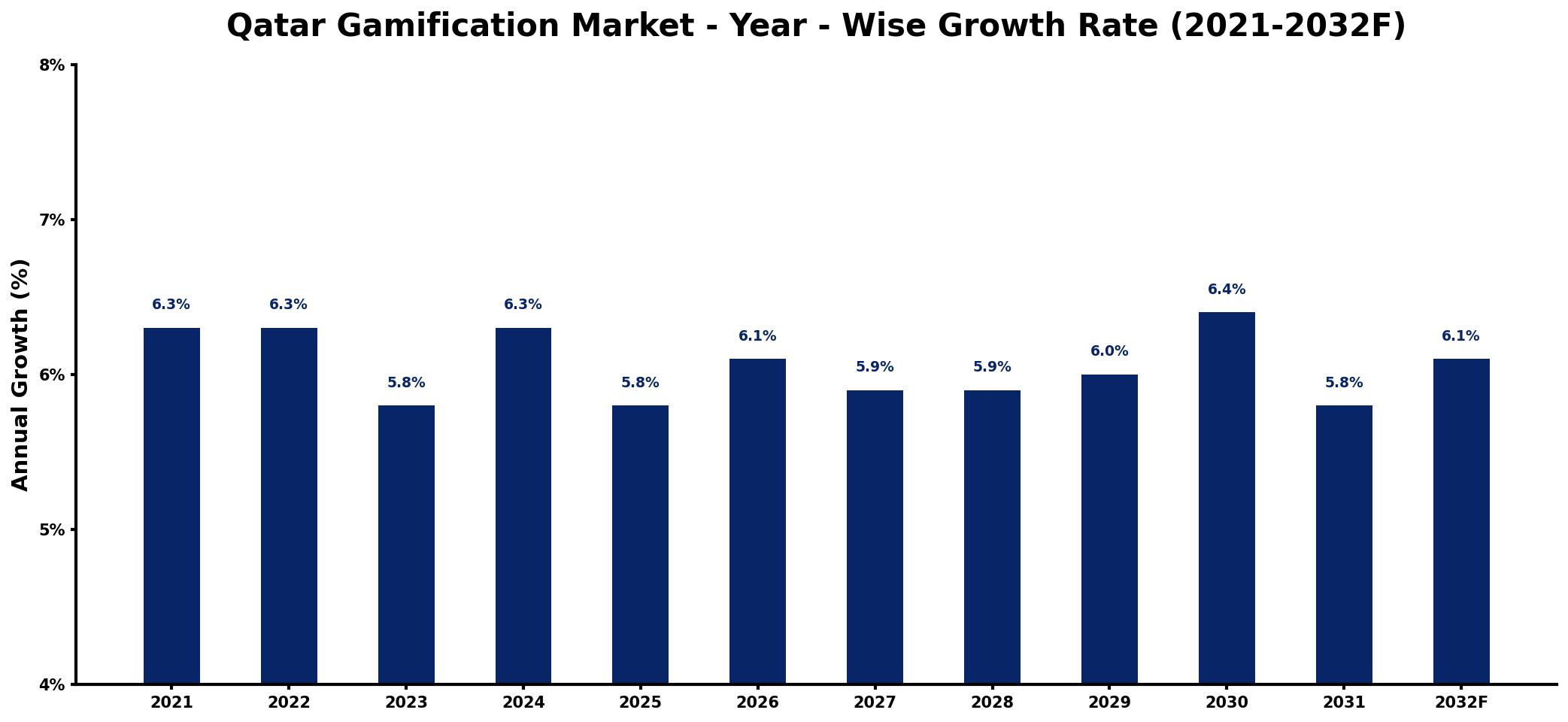
The table below presents the year‑wise growth rates along with the key drivers influencing the market
| Year | Growth Rate | Major Drivers |
| 2021 | 6.3% | rising interest in digital engagement |
| 2022 | 6.3% | growth in educational technology investments |
| 2023 | 5.8% | increased focus on employee training |
| 2024 | 6.3% | expansion of mobile app development |
| 2025 | 5.8% | surge in corporate wellness initiatives |
| 2026 | 6.1% | growing popularity of interactive learning |
| 2027 | 5.9% | enhanced customer experience strategies |
| 2028 | 5.9% | adoption of loyalty programs worldwide |
| 2029 | 6.0% | emphasis on remote collaboration tools |
| 2030 | 6.4% | investments in entertainment sector innovations |
| 2031 | 5.8% | demand for personalized marketing solutions |
| 2032 | 6.1% | improved processing technologies adoption |
Note: Market size estimations and growth projections presented in this report are based on 6Wresearch's proprietary forecasting methodology, utilizing the latest available industry data, government publications, and primary research inputs.
Qatar Gamification Market Synopsis
The Qatar Gamification Market is witnessing an invigorating surge as businesses actively seek out creative ways to engage their employees and customers. Organizations are leveraging game-like elements to foster loyalty and drive motivation in ways that traditional strategies cannot achieve.
With the integration of gamification technologies, companies are not only enhancing training programs but are also transforming customer interactions into interactive experiences. This pivot to gamified solutions reflects a broader trend where the line between traditional business practices and interactive engagement blurs.
Qatar Gamification Market Key Takeaways
- The market is witnessing robust growth driven by increasing digital engagement strategies.
- Organizations across sectors are prioritizing gamification to improve learning outcomes and user experiences.
- Ongoing innovations in gamification technologies are essential for sustaining long-term user interest.
- Understanding audience motivations is crucial for the effective design of gamified experiences.
- The importance of addressing data privacy and security remains paramount in gamified platforms.
Evaluation of Restraints in Qatar Gamification Market
Despite its potential, the Qatar Gamification Market faces significant restraints, primarily related to the complexity of designing engaging experiences. Organizations must align gamification strategies with specific business objectives, which requires in-depth knowledge of user motivations. Additionally, maintaining the appeal of gamified solutions over time poses a challenge, as continuous innovation is necessary to prevent user fatigue. Lastly, addressing data privacy concerns is critical to ensuring the integrity and sustainability of gamified platforms.
Qatar Gamification Market Trends
Emerging trends in the Qatar Gamification Market indicate a growing emphasis on personalization and adaptive learning experiences. Companies are increasingly utilizing analytics to tailor gamified content to individual user preferences, enhancing engagement. Another trend is the convergence of gamification with emerging technologies such as augmented reality (AR) and artificial intelligence (AI), which are set to revolutionize user interactions. As organizations strive for higher engagement rates, these innovations will play a pivotal role in shaping the future of gamified strategies.
Qatar Gamification Market Opportunities
The Qatar Gamification Market presents substantial opportunities for growth, particularly within the educational sector. As educational institutions embrace digital learning platforms, gamification can enhance student engagement and retention. Similarly, the corporate training landscape is ripe for innovation, as companies seek effective ways to foster employee development and commitment. Furthermore, industries focusing on customer loyalty programs can harness gamification to create more interactive and rewarding experiences, thus driving customer retention and satisfaction.
Government Initiatives in the Qatar Gamification Market
The Qatari government has recognized the importance of digital transformation and innovation across sectors, including education and business. Initiatives aimed at enhancing technological adoption have paved the way for gamification to gain traction. Through public spending and support for digital infrastructure, the government is fostering an environment conducive to the growth of innovative solutions, including gamified applications. This strategic direction aligns with Qatar's vision to diversify its economy and enhance workforce skills.
Future Insights of the Qatar Gamification Market
Looking ahead to 2026-2032, the Qatar Gamification Market is poised for continued growth driven by technological advancements and evolving consumer preferences. Businesses that prioritize personalized and interactive solutions will likely see a significant competitive advantage. Additionally, as gamification techniques become more ingrained in corporate culture and educational practices, organizations will invest more in sophisticated gamified systems that not only enhance engagement but also improve overall effectiveness across various functions.
Qatar Gamification Market Latest Developments (2025 - 2026)
Recent developments in the Qatar Gamification Market indicate a heightened focus on creating immersive experiences through advanced technologies such as virtual reality (VR) and AR. Companies are exploring partnerships with tech providers to integrate these tools into their gamified solutions. Furthermore, there is a growing trend of organizations conducting pilot programs to measure the effectiveness of gamification strategies, thus refining their approaches to enhance user engagement and retention.
Qatar Gamification Market - Key Attractiveness of the Report
- 10 Years of Market Numbers
- Historical Data Starting from 2022 to 2025
- Base Year: 2025
- Forecast Data until 2032
- Key Performance Indicators Impacting the Market
- Major Upcoming Developments and Projects
Key Highlights of the Report:
- Qatar Gamification Market Outlook
- Market Size of Qatar Gamification Market, 2025
- Forecast of Qatar Gamification Market, 2032
- Historical Data and Forecast of Qatar Gamification Revenues & Volume for the Period 2022-2032F
- Qatar Gamification Market Trend Evolution
- Qatar Gamification Market Drivers and Challenges
- Qatar Gamification Price Trends
- Qatar Gamification Porter's Five Forces
- Qatar Gamification Industry Life Cycle
- Historical Data and Forecast of Qatar Gamification Market Revenues & Volume By Component for the Period 2022-2032F
- Historical Data and Forecast of Qatar Gamification Market Revenues & Volume By Solution for the Period 2022-2032F
- Historical Data and Forecast of Qatar Gamification Market Revenues & Volume By Services for the Period 2022-2032F
- Historical Data and Forecast of Qatar Gamification Market Revenues & Volume By Deployment for the Period 2022-2032F
- Historical Data and Forecast of Qatar Gamification Market Revenues & Volume By Cloud for the Period 2022-2032F
- Historical Data and Forecast of Qatar Gamification Market Revenues & Volume By On-premises for the Period 2022-2032F
- Historical Data and Forecast of Qatar Gamification Market Revenues & Volume By Organization Size for the Period 2022-2032F
- Historical Data and Forecast of Qatar Gamification Market Revenues & Volume By SMEs for the Period 2022-2032F
- Historical Data and Forecast of Qatar Gamification Market Revenues & Volume By Large Enterprises for the Period 2022-2032F
- Historical Data and Forecast of Qatar Gamification Market Revenues & Volume By End-User for the Period 2022-2032F
- Historical Data and Forecast of Qatar Gamification Market Revenues & Volume By Enterprise-Driven for the Period 2022-2032F
- Historical Data and Forecast of Qatar Gamification Market Revenues & Volume By Consumer-Driven for the Period 2022-2032F
- Qatar Gamification Import Export Trade Statistics
- Market Opportunity Assessment By Component
- Market Opportunity Assessment By Deployment
- Market Opportunity Assessment By Organization Size
- Market Opportunity Assessment By End-User
- Qatar Gamification Top Companies Market Share
- Qatar Gamification Competitive Benchmarking By Technical and Operational Parameters
- Qatar Gamification Company Profiles
- Qatar Gamification Key Strategic Recommendations






































