United Kingdom (UK) Ghee Market Size, Share & Growth Rate
The United Kingdom (UK) Ghee Market was estimated at USD 235 Million in 2025 and is projected to reach USD 292 Million by 2032, growing at a CAGR of 3.2% from 2026 to 2032. This growth trajectory is fueled by rising consumer awareness of the health benefits associated with ghee, along with the growing demand for natural and minimally processed food products. Furthermore, the increasing incorporation of ghee in ethnic cuisines and the expanding foodservice sector in the UK further bolster market dynamics.
United Kingdom (UK) Ghee Market Year-wise Growth Rate and Key Drivers
This graph highlights how the United Kingdom (UK) Ghee Market has steadily grown over the years, supported by major growth factors.
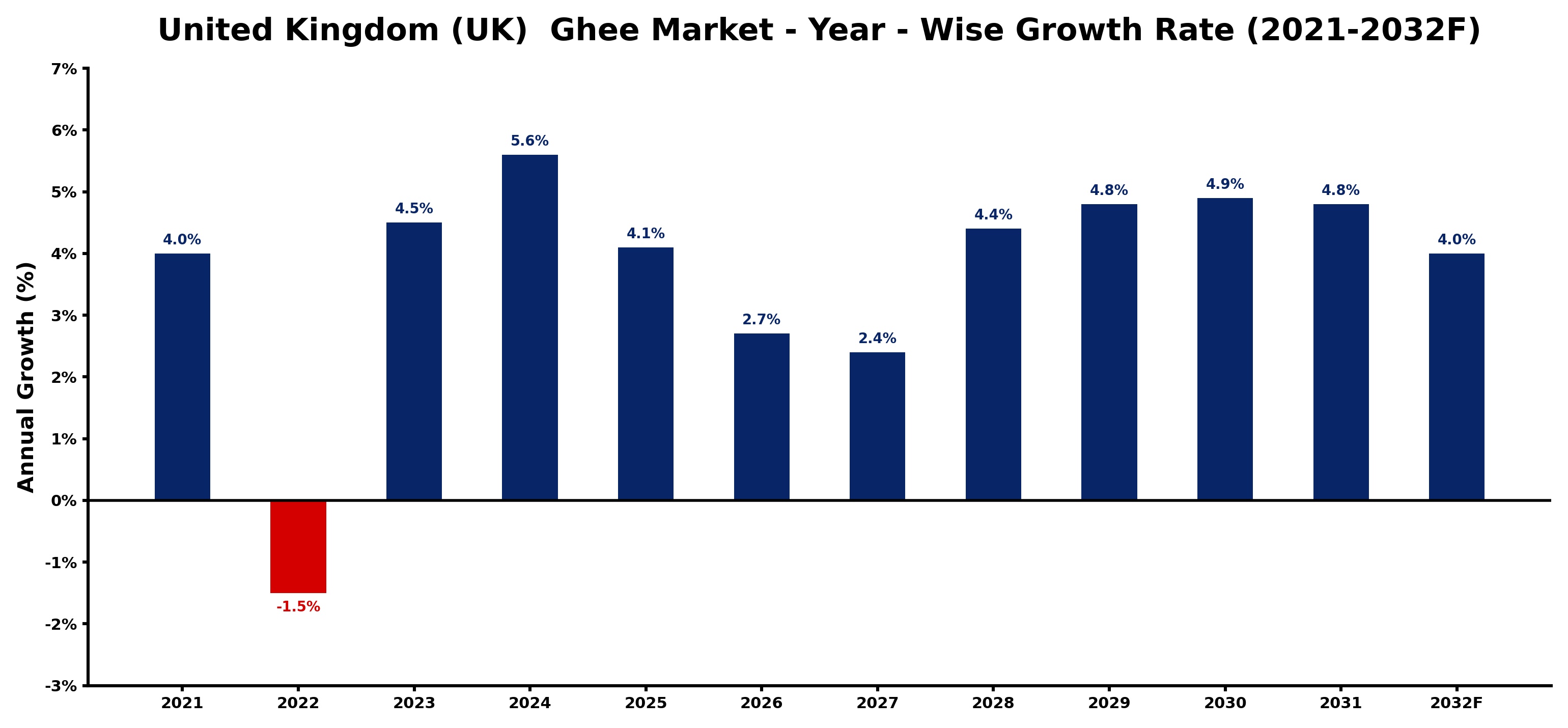
The table below presents the year‑wise growth rates along with the key drivers influencing the market
| Year | Growth Rate | Major Drivers |
| 2021 | 4.0% | Health trends favored ghee consumption |
| 2022 | -1.5% | Consumer interest in alternatives declined |
| 2023 | 4.5% | Culinary diversity increased ghee usage |
| 2024 | 5.6% | Organic product demand rose sharply |
| 2025 | 4.1% | Cultural cuisine popularity expanded market |
| 2026 | 2.7% | Sustainable sourcing practices gained traction |
| 2027 | 2.4% | Nutritional awareness drove sales growth |
| 2028 | 4.4% | Innovative packaging attracted new buyers |
| 2029 | 4.8% | E-commerce platforms enhanced accessibility |
| 2030 | 4.9% | Local sourcing initiatives boosted sales |
| 2031 | 4.8% | Ghee-based products gained popularity |
| 2032 | 4.0% | Culinary education promoted ghee usage |
Note - Market size estimations and growth projections presented in this report are based on 6Wresearch's advanced forecasting approach, validated with industry datasets as of June 2026.
United Kingdom (UK) Ghee Market Synopsis
The UK ghee market has witnessed a notable shift in consumer preferences, with a marked rise in demand for traditional dairy products. This trend is particularly strong among health-conscious consumers who value the nutritional advantages that ghee offers compared to other cooking fats. Additionally, the multicultural demographic landscape in the UK continues to enhance the market, as ghee is embraced in a variety of culinary practices.
Production of ghee is being positively influenced by innovations in packaging and marketing strategies. These advancements not only enhance the product's accessibility but also appeal to a broader consumer base, including those seeking organic and high-quality options. As ghee continues to carve its niche within the culinary market, understanding its evolving landscape will be essential for stakeholders.
United Kingdom (UK) Ghee Market Key Takeaways
- The UK ghee market is driven by rising health awareness and demand for ethnic cuisine.
- Growing consumer preference for natural and organic products supports market expansion.
- Innovative packaging solutions are enhancing consumer access to ghee products.
- Health-conscious trends are shifting consumer behavior towards traditional dairy options.
- The expansion of the foodservice industry is creating new demand for ghee in various culinary applications.
Evaluation of Restraints in United Kingdom (UK) Ghee Market
Despite its growth potential, the UK ghee market is not without its challenges. High production costs and the need to comply with stringent food safety regulations create hurdles for manufacturers. Additionally, consumer perceptions surrounding ghee's health implications can influence purchasing decisions, leading to hesitancy among potential buyers. Moreover, the presence of competing cooking oils and fats, alongside fluctuating prices of raw materials, continues to present significant barriers to market progress.
United Kingdom (UK) Ghee Market Trends
Current trends in the UK ghee market indicate an increasing interest in clean label products, as consumers become more discerning about ingredient transparency. The rising popularity of plant-based and organic products is also influencing the ghee segment, leading to innovations in product formulation and sourcing. Furthermore, the integration of ghee into wellness programs and dietary trends underscores its versatility and appeal, solidifying its role in both traditional and contemporary cuisine.
United Kingdom (UK) Ghee Market Opportunities
The UK ghee market presents significant growth and investment opportunities, particularly within the organic and specialty segments. Brands that focus on sustainable sourcing and transparent production practices are likely to resonate with the increasingly eco-conscious consumer base. Moreover, as the foodservice sector continues to expand, there is an opportunity for ghee to be utilized in a broader array of culinary applications, including health-oriented menus and gourmet dishes.
Government Initiatives in the United Kingdom (UK) Ghee Market
The UK government plays a pivotal role in regulating the ghee market through comprehensive food safety and quality standards. The Food Standards Agency (FSA) establishes guidelines ensuring that ghee production meets necessary hygiene and safety requirements. Furthermore, policies aimed at promoting sustainable dairy farming practices are influencing the quality and availability of ghee products within the market, reflecting the government's commitment to food safety and quality.
Future Insights of the United Kingdom (UK) Ghee Market
Looking ahead to the period from 2026 to 2032, the UK ghee market is poised for continued expansion. As consumer preferences shift further towards health-focused diets and authentic culinary experiences, ghee's role in the kitchen is likely to become more prominent. Innovations in product development, along with ongoing efforts to educate consumers on ghee's benefits, will drive demand, ensuring a vibrant market for years to come.
United Kingdom (UK) Ghee Market Latest Developments (May 2025 - June 2026)
Recent developments in the UK ghee market indicate a trend toward premiumization, as brands enhance product offerings with added health benefits and unique flavor profiles. Collaborations within the foodservice sector are also on the rise, integrating ghee into new culinary concepts. As awareness of ghee's versatility grows, marketing efforts are increasingly focused on educating consumers about its use in everyday cooking and baking, further driving interest in this traditional product.
United Kingdom (UK) Ghee Market - Key Attractiveness of the Report
- 10 Years of Market Numbers
- Historical Data Starting from 2022 to 2025
- Base Year: 2025
- Forecast Data until 2032
- Key Performance Indicators Impacting the Market
- Major Upcoming Developments and Projects
Key Highlights of the Report:
- United Kingdom (UK) Ghee Market Outlook
- Market Size of United Kingdom (UK) Ghee Market, 2025
- Forecast of United Kingdom (UK) Ghee Market, 2032
- Historical Data and Forecast of United Kingdom (UK) Ghee Revenues & Volume for the Period 2022-2032F
- United Kingdom (UK) Ghee Market Trend Evolution
- United Kingdom (UK) Ghee Market Drivers and Challenges
- United Kingdom (UK) Ghee Price Trends
- United Kingdom (UK) Ghee Porter's Five Forces
- United Kingdom (UK) Ghee Industry Life Cycle
- Historical Data and Forecast of United Kingdom (UK) Ghee Market Revenues & Volume By Source for the Period 2022-2032F
- Historical Data and Forecast of United Kingdom (UK) Ghee Market Revenues & Volume By Cow for the Period 2022-2032F
- Historical Data and Forecast of United Kingdom (UK) Ghee Market Revenues & Volume By Buffalo for the Period 2022-2032F
- Historical Data and Forecast of United Kingdom (UK) Ghee Market Revenues & Volume By Mixed for the Period 2022-2032F
- Historical Data and Forecast of United Kingdom (UK) Ghee Market Revenues & Volume By End-use for the Period 2022-2032F
- Historical Data and Forecast of United Kingdom (UK) Ghee Market Revenues & Volume By Retail for the Period 2022-2032F
- Historical Data and Forecast of United Kingdom (UK) Ghee Market Revenues & Volume By Institutional for the Period 2022-2032F
- Historical Data and Forecast of United Kingdom (UK) Ghee Market Revenues & Volume By Distribution Channel for the Period 2022-2032F
- Historical Data and Forecast of United Kingdom (UK) Ghee Market Revenues & Volume By Supermarkets/Hypermarkets for the Period 2022-2032F
- Historical Data and Forecast of United Kingdom (UK) Ghee Market Revenues & Volume By Convenience Stores for the Period 2022-2032F
- Historical Data and Forecast of United Kingdom (UK) Ghee Market Revenues & Volume By Specialty Stores for the Period 2022-2032F
- Historical Data and Forecast of United Kingdom (UK) Ghee Market Revenues & Volume By Online for the Period 2022-2032F
- Historical Data and Forecast of United Kingdom (UK) Ghee Market Revenues & Volume By Others for the Period 2022-2032F
- United Kingdom (UK) Ghee Import Export Trade Statistics
- Market Opportunity Assessment By Source
- Market Opportunity Assessment By End-use
- Market Opportunity Assessment By Distribution Channel
- United Kingdom (UK) Ghee Top Companies Market Share
- United Kingdom (UK) Ghee Competitive Benchmarking By Technical and Operational Parameters
- United Kingdom (UK) Ghee Company Profiles
- United Kingdom (UK) Ghee Key Strategic Recommendations






































