United Kingdom (UK) Glass Tiles Market Size, Share & Growth Rate
The United Kingdom (UK) Glass Tiles Market was estimated at USD 166 Million in 2025 and is projected to reach USD 204 Million by 2032, growing at a CAGR of 3.0% from 2026 to 2032. This anticipated growth is driven by a surge in residential and commercial construction projects, where glass tiles are increasingly favored for their aesthetic appeal and durability. Additionally, rising consumer preference for sustainable building materials is further bolstering the market, making glass tiles a prominent choice for modern interiors.
United Kingdom (UK) Glass Tiles Market Year-wise Growth Rate and Key Drivers
This graph highlights how the United Kingdom (UK) Glass Tiles Market has steadily grown over the years, supported by major growth factors.
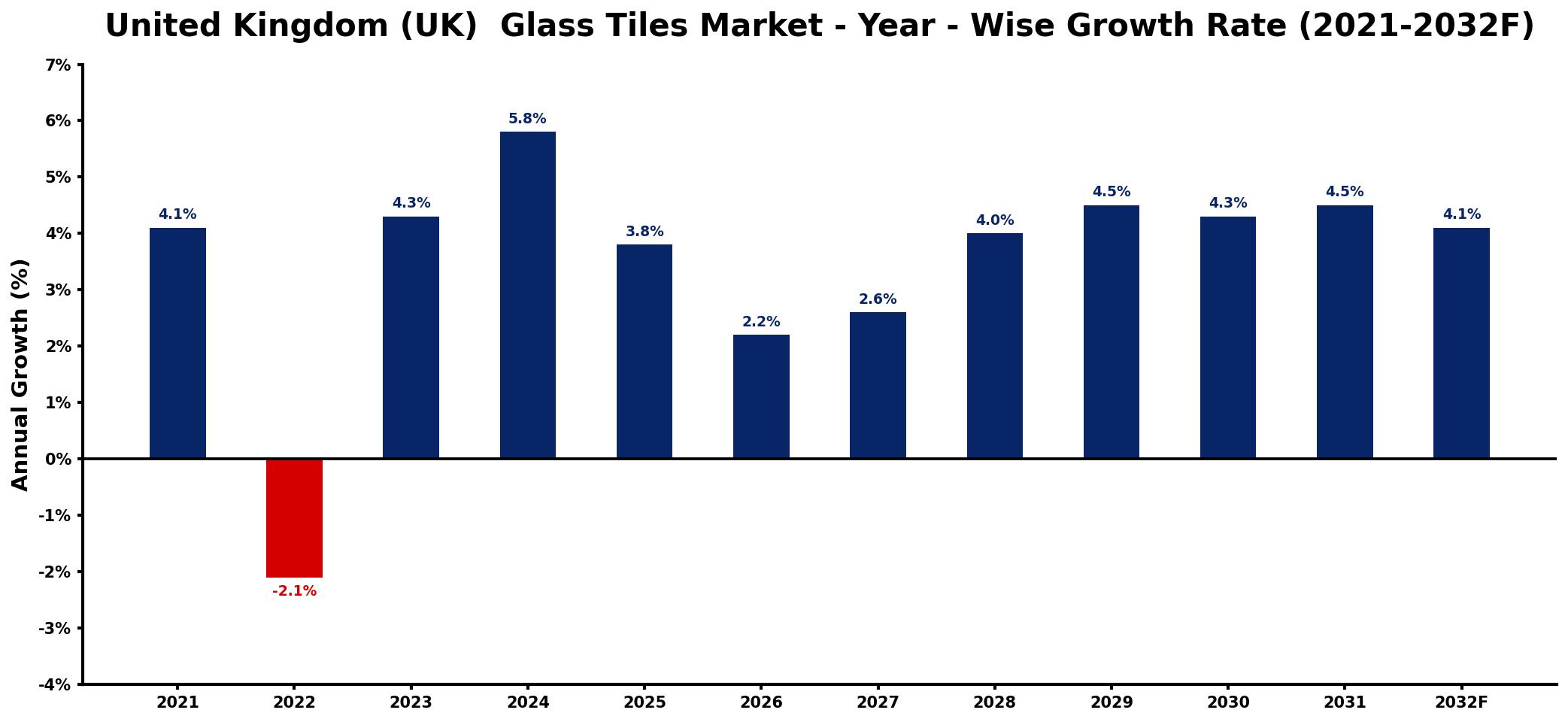
The table below presents the year‑wise growth rates along with the key drivers influencing the market
| Year | Growth Rate | Major Drivers |
| 2021 | 4.1% | Rising demand for sustainable materials |
| 2022 | -2.1% | Decreased consumer spending on renovations |
| 2023 | 4.3% | Increased investment in construction projects |
| 2024 | 5.8% | Growing popularity of interior design |
| 2025 | 3.8% | Surge in home improvement activities |
| 2026 | 2.2% | Expansion of eco-friendly building regulations |
| 2027 | 2.6% | Increased urbanization and housing demand |
| 2028 | 4.0% | Technological advancements in manufacturing |
| 2029 | 4.5% | Higher disposable income for renovations |
| 2030 | 4.3% | Growth in luxury home market |
| 2031 | 4.5% | Increased focus on aesthetic appeal |
| 2032 | 4.1% | Rising trend of DIY projects |
Note: Market size estimations and growth projections presented in this report are based on 6Wresearch's proprietary forecasting methodology, utilizing the latest available industry data, government publications, and primary research inputs.
United Kingdom (UK) Glass Tiles Market Synopsis
The UK glass tiles market has experienced notable momentum in recent years, largely due to the rising demand for stylish and sustainable construction materials. However, as the industry evolves, it faces the challenge of maintaining growth amid competition from more cost-effective alternatives. Despite these pressures, the market is poised for expansion as consumers increasingly recognize the long-term benefits of glass tiles.
In the coming years, the UK glass tiles market is expected to embrace innovation in design and sustainability, appealing to both architects and homeowners. This transformation aligns with broader industry trends emphasizing eco-friendliness and quality, providing a solid foundation for continued growth and market penetration.
United Kingdom (UK) Glass Tiles Market Key Takeaways
- The market is projected to reach USD 204 Million by 2032, with a steady growth trajectory driven by aesthetic and sustainable construction trends.
- Glass tiles are increasingly favored for their durability and ease of maintenance, particularly in high-moisture areas like kitchens and bathrooms.
- Challenges related to high costs and specialized installation continue to impact market penetration compared to traditional alternatives.
- Government policies promoting sustainability are expected to further support the adoption of glass tiles in construction projects.
- Emerging trends indicate a strong focus on innovative design and eco-friendly materials, driving consumer interest and demand.
Evaluation of Restraints in United Kingdom (UK) Glass Tiles Market
Despite the positive growth outlook, several factors constrain the UK glass tiles market. The high manufacturing costs inherent in specialized production techniques can hinder profitability, making it difficult for manufacturers to compete against ceramic and porcelain tiles that offer similar aesthetic benefits at lower prices. Additionally, the need for professional installation may deter some consumers, limiting market reach. Economic fluctuations and changing consumer spending habits further complicate the landscape, necessitating targeted marketing strategies to effectively engage potential buyers.
United Kingdom (UK) Glass Tiles Market Trends
Several key trends are shaping the UK glass tiles market. The growing emphasis on eco-friendly materials aligns with a broader consumer shift towards sustainable living, prompting manufacturers to innovate in recycling and production processes. Moreover, advancements in manufacturing technology are enhancing the design possibilities for glass tiles, allowing for more vibrant colors and intricate patterns. As a result, interior designers are increasingly incorporating glass tiles into their projects, reinforcing their status as a premium option in residential and commercial spaces.
United Kingdom (UK) Glass Tiles Market Opportunities
Opportunities abound for businesses within the UK glass tiles market, particularly in areas of innovation and sustainability. As consumers become more environmentally conscious, there is a significant opportunity for companies to develop recycled glass tiles and promote their use in construction. Additionally, tapping into niche markets such as bespoke designs for luxury residential properties can drive higher margins. Collaborations with architects and interior designers to create unique, stylish installations will further enhance market presence and consumer engagement.
Government Initiatives in the United Kingdom (UK) Glass Tiles Market
UK government policies increasingly emphasize environmental sustainability, safety regulations, and quality standards in building materials. These initiatives support recycling programs and encourage manufacturers to adopt eco-friendly practices, enhancing the appeal of glass tiles in modern construction. Public spending on sustainable infrastructure also promotes the demand for high-quality materials, positioning glass tiles favorably within the context of national environmental goals.
Future Insights of the United Kingdom (UK) Glass Tiles Market
Looking ahead to 2026-2032, the UK glass tiles market is expected to witness a transformative phase characterized by increased adoption in both residential and commercial projects. As consumers prioritize sustainability and durability, glass tiles will likely gain traction, supported by innovative designs and manufacturing processes. The market's growth will be fueled by a combination of economic stability, rising disposable incomes, and an enduring trend towards high-quality, aesthetically appealing building materials.
United Kingdom (UK) Glass Tiles Market Latest Developments (2025 - 2026)
Recent developments in the UK glass tiles market indicate a marked shift towards sustainability and innovation. Manufacturers are increasingly investing in research and development to create eco-friendly products that meet consumer demand for sustainability. Additionally, collaborations between architects and tile designers are becoming more common, resulting in unique design applications that highlight the versatility of glass tiles. Trade shows and exhibitions have also seen an uptick in participation, showcasing the latest offerings and fostering industry connections.
United Kingdom (UK) Glass Tiles Market - Key Attractiveness of the Report
- 10 Years of Market Numbers
- Historical Data Starting from 2022 to 2025
- Base Year: 2025
- Forecast Data until 2032
- Key Performance Indicators Impacting the Market
- Major Upcoming Developments and Projects
Key Highlights of the Report:
- United Kingdom (UK) Glass Tiles Market Outlook
- Market Size of United Kingdom (UK) Glass Tiles Market, 2025
- Forecast of United Kingdom (UK) Glass Tiles Market, 2032
- Historical Data and Forecast of United Kingdom (UK) Glass Tiles Revenues & Volume for the Period 2022-2032F
- United Kingdom (UK) Glass Tiles Market Trend Evolution
- United Kingdom (UK) Glass Tiles Market Drivers and Challenges
- United Kingdom (UK) Glass Tiles Price Trends
- United Kingdom (UK) Glass Tiles Porter's Five Forces
- United Kingdom (UK) Glass Tiles Industry Life Cycle
- Historical Data and Forecast of United Kingdom (UK) Glass Tiles Market Revenues & Volume By Manufacturing Process for the Period 2022-2032F
- Historical Data and Forecast of United Kingdom (UK) Glass Tiles Market Revenues & Volume By Smalti Tiles for the Period 2022-2032F
- Historical Data and Forecast of United Kingdom (UK) Glass Tiles Market Revenues & Volume By Fused Tiles for the Period 2022-2032F
- Historical Data and Forecast of United Kingdom (UK) Glass Tiles Market Revenues & Volume By Sintered Tiles for the Period 2022-2032F
- Historical Data and Forecast of United Kingdom (UK) Glass Tiles Market Revenues & Volume By Cast Tiles for the Period 2022-2032F
- Historical Data and Forecast of United Kingdom (UK) Glass Tiles Market Revenues & Volume By Other for the Period 2022-2032F
- Historical Data and Forecast of United Kingdom (UK) Glass Tiles Market Revenues & Volume By Product Type for the Period 2022-2032F
- Historical Data and Forecast of United Kingdom (UK) Glass Tiles Market Revenues & Volume By Matte-finished Glass Tile for the Period 2022-2032F
- Historical Data and Forecast of United Kingdom (UK) Glass Tiles Market Revenues & Volume By Smooth Glass Tile for the Period 2022-2032F
- Historical Data and Forecast of United Kingdom (UK) Glass Tiles Market Revenues & Volume By End-User Industry for the Period 2022-2032F
- Historical Data and Forecast of United Kingdom (UK) Glass Tiles Market Revenues & Volume By Residential for the Period 2022-2032F
- Historical Data and Forecast of United Kingdom (UK) Glass Tiles Market Revenues & Volume By Commercial for the Period 2022-2032F
- Historical Data and Forecast of United Kingdom (UK) Glass Tiles Market Revenues & Volume By Infrastructure for the Period 2022-2032F
- United Kingdom (UK) Glass Tiles Import Export Trade Statistics
- Market Opportunity Assessment By Manufacturing Process
- Market Opportunity Assessment By Product Type
- Market Opportunity Assessment By End-User Industry
- United Kingdom (UK) Glass Tiles Top Companies Market Share
- United Kingdom (UK) Glass Tiles Competitive Benchmarking By Technical and Operational Parameters
- United Kingdom (UK) Glass Tiles Company Profiles
- United Kingdom (UK) Glass Tiles Key Strategic Recommendations






































