United Kingdom (UK) IT Services Market Growth Rate
According to 6Wresearch internal database and industry insights, the United Kingdom (UK) IT Services Market is projected to grow at a compound annual growth rate (CAGR) of 6.5% during the forecast period (2026-2032).
United Kingdom (UK) IT Services Market Year-wise Growth Rate and Key Drivers
This graph highlights how the United Kingdom (UK) IT Services Market has steadily grown over the past five years, supported by major growth factors.
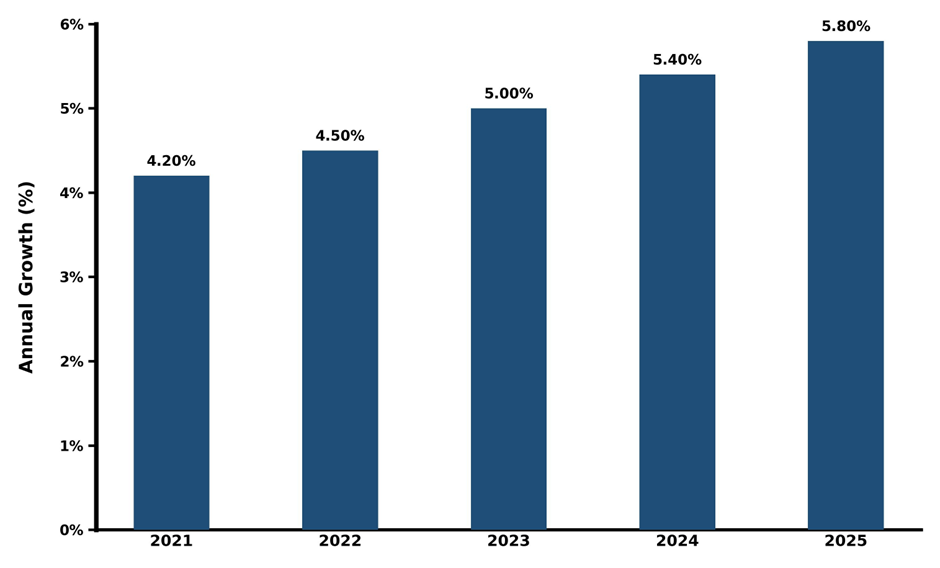
The table below presents the year‑wise growth rates along with the key drivers influencing the market
| Year | Est. Annual Growth (%) | Growth Drivers |
| 2021 | 4.2% | Increased demand for cloud services and digital transformation initiatives |
| 2022 | 4.5% | Rising adoption of automation and AI solutions in various industries |
| 2023 | 5% | Increased focus on cybersecurity due to growing data protection concerns |
| 2024 | 5.4% | Government-driven initiatives to promote digital infrastructure |
| 2025 | 5.8% | Widespread adoption of 5G networks and IoT integration in business operations |
Topics Covered in the United Kingdom (UK) IT Services Market Report
The United Kingdom (UK) IT Services Market report thoroughly covers the market by Vertical, Business Function, Deployment Mode, Organization Size and Service Type. The market report provides an unbiased and detailed analysis of ongoing market trends, opportunities/high growth areas, and market drivers, which help stakeholders devise and align their market strategies according to the current and future market dynamics.
United Kingdom (UK) IT Services Market Highlights
| Report Name |
United Kingdom (UK) IT Services Market |
| Forecast period | 2026-2032 |
| CAGR | 6.5% |
| Market Size |
IT and Telecom |
United Kingdom (UK) IT Services Market Synopsis
It is expected that the United Kingdom (UK) IT Services Market will enjoy stable growth owing to rising digital transformation strategies by organizations, growing demand for effective cybersecurity solutions, and growing popularity of cloud services.
Also, governmental initiatives to develop the country’s digital infrastructure are giving it the much-needed push for market growth. With companies looking for ways to increase efficiency using automation and artificial intelligence, the requirement for IT services will see an upward trend, contributing positively to the United Kingdom (UK) IT Services Market Growth.
Evaluation of Growth Drivers in the United Kingdom (UK) IT Services Market (2026-2032)
Below mentioned are some prominent drivers and their influence on the market dynamics:
| Drivers | Primary Segments Affected | Why it Matters (Evidence) |
| Digital Transformation Initiatives | Cloud, IT Infrastructure, Operations | Businesses increasingly invest in IT services to enhance operational efficiency through automation and digital technologies. |
| Government Investment in Digital Infrastructure | Cloud, Managed Services, Telecom | Government funding boosts infrastructure development, increasing the availability and adoption of IT services. |
| Increasing Cybersecurity Threats | Cybersecurity, Cloud, IT Infrastructure | Rising concerns over data breaches and cyber threats drive demand for robust cybersecurity solutions. |
| Adoption of AI and Automation | Professional Services, Managed Services | AI adoption helps streamline business operations, increasing the demand for AI and automation solutions. |
| Rising Demand for Cloud Solutions | Cloud, IT Infrastructure | The shift to cloud-based solutions supports scalability, security, and cost savings for businesses. |
The United Kingdom (UK) IT Services Market is expected to grow at the CAGR of 6.5% during the forecast period of 2026-2032. Factors that drive growth include a shift towards digital transformation, the wide application of artificial intelligence and cloud-based services, and the increase in demand for cybersecurity services. Additionally, growth will be fueled by government policies aimed at the development of digital infrastructure and increasing adoption of 5G services.
Evaluation of Restraints in the United Kingdom (UK) IT Services Market
Below mentioned are some major restraints and their influence on the market dynamics:
| Restraints | Primary Segments Affected | What This Means (Evidence) |
| Talent Shortage in IT Services | All Segments | The shortage of skilled professionals limits the ability to scale services and deliver high-quality solutions. |
| High Operational Costs | Managed Services, Cloud, Telecom | High costs of infrastructure and skilled labor make it challenging for smaller firms to compete. |
| Data Privacy Concerns | Cloud, Cybersecurity, IT Infrastructure | Rising concerns over data protection impact the trust and adoption of IT services in some sectors. |
| Integration Challenges | Cloud, IT Infrastructure | Businesses face difficulties integrating new technologies with legacy systems, leading to slower adoption. |
| Budget Constraints | All Segments | Limited budgets, particularly in SMEs, restrict investments in advanced IT services. |
United Kingdom (UK) IT Services Market Challenges
Despite the anticipated strong growth in the market, the United Kingdom (UK) IT Services Market is confronted with various obstacles such as the lack of skilled IT personnel, high operational expenses, and issues related to data security. Moreover, integration problems, especially with the existing infrastructure, act as barriers to the fast adoption of advanced technology, and financial limitations prevent small organizations from leveraging IT services.
United Kingdom (UK) IT Services Market Trends
Key trends evaluating the landscape of the United Kingdom IT Services Market are:
- Cloud Adoption and Migration – More organizations are transitioning to cloud services, enabling greater flexibility and scalability. Cloud computing helps organizations to lower costs and simplify their operations in addition to improving their data security.
- AI Automation – With the advancement of AI-driven technologies, there has been an increase in automation in the field of IT tasks, leading to efficiency and productivity improvements.
- Cybersecurity Services – In view of the rise in the number of cyber attacks, the requirement for cybersecurity services to deal with these attacks has become mandatory.
- IT Services in 5G & IoT – There is increasing potential for offering IT services with the advent of 5G networks and Internet of Things (IoT), particularly in sectors like healthcare and logistics.
Investment Opportunities in the United Kingdom (UK) IT Services Market
Key investment opportunities in the United Kingdom IT Services Market include:
- Developing Cyber Security Solutions – Investment in cybersecurity solutions, especially solutions geared towards data security, presents huge growth potential because of the rising number of cyber attacks.
- Developing Cloud Service Platforms – The construction of scalable cloud platforms to help organizations deliver and manage their digital services creates great investment potential.
- Development of AI and Automated Business Processes – Utilization of AI technologies to automate various business processes will give investors an advantage over other players in the market.
- Building out 5G Networks – The deployment of 5G network solutions opens up enormous potential for IT services providers across industries such as manufacturing, healthcare, and logistics.
Top 5 Leading Players in the United Kingdom (UK) IT Services Market
Some leading players operating in the United Kingdom IT Services Market include:
1. Accenture
| Company Name | Accenture |
|---|---|
| Established Year | 1989 |
| Headquarters | Dublin, Ireland |
| Official Website | Click Here |
Accenture provides comprehensive IT services, including cloud, cybersecurity, and AI-driven solutions, to organizations globally.
2. IBM Corporation
| Company Name | IBM Corporation |
|---|---|
| Established Year | 1911 |
| Headquarters | Armonk, New York, United States |
| Official Website | Click Here |
IBM offers a range of IT services, including managed services, cloud solutions, and advanced data analytics for business transformation.
3. Capgemini
| Company Name | Capgemini |
|---|---|
| Established Year | 1967 |
| Headquarters | Paris, France |
| Official Website | Click Here |
Capgemini delivers IT services in cloud migration, digital transformation, and technology-driven innovation to enterprises.
4. Cognizant Technology Solutions
| Company Name | Cognizant Technology Solutions |
|---|---|
| Established Year | 1994 |
| Headquarters | Teaneck, New Jersey, United States |
| Official Website | Click Here |
Cognizant provides IT services across various sectors, focusing on AI, automation, and cloud computing.
5. Tata Consultancy Services
| Company Name | Tata Consultancy Services (TCS) |
|---|---|
| Established Year | 1968 |
| Headquarters | Mumbai, India |
| Official Website | Click Here |
Tata Consultancy Services (TCS) offers IT solutions, including consulting, digital transformation, cloud services, and managed services to businesses globally.
Government Regulations Introduced in the United Kingdom (UK) IT Services Market
According to UK Government Data, Several projects exist that help with the provision of IT services, such as the Digital Transformation Strategy 2021. This initiative promotes the adoption of advanced IT technology in the transformation of public services. The government is also funding the expansion of broadband and 5G networks throughout the country to increase internet access. In addition, the National Cyber Security Centre (NCSC) has established regulations that enhance the level of cybersecurity in all industries, thus promoting IT services.
Future Insights of the United Kingdom (UK) IT Services Market
The prospects of the United Kingdom (UK) IT Services Industry look promising owing to the continued governmental initiatives that seek to improve digital infrastructure, a substantial rise in the use of cloud services, and the increasing need for business solutions based on AI. The use of IoT, 5G, and AI in different industries will keep driving the demand for IT services.
Market Segmentation Analysis
The report offers a comprehensive study of the subsequent market segments and their leading categories:
BFSI to dominate the Market- By Vertical
According to Shubh, Senior Research Analyst, 6Wresearch, the BFSI sector is expected to dominate the United Kingdom IT Services Market Share due to the growing demand for digital banking services, enhanced cybersecurity measures, and the increasing adoption of financial technologies (FinTech). This vertical is leading the market due to the ongoing digital transformation in financial institutions, the need for secure transactions, and the growing reliance on data analytics.
Finance and Accounting to dominate the Market- By Business Function
It is believed that the Finance & Accounting department will take the lead due to the widespread implementation of AI-driven automation and cloud computing technology. Financial services have been working towards enhancing efficiency, lowering costs, and complying with regulations, thus generating an increased demand for IT services that would facilitate the process of conducting business.
Cloud to dominate the Market- By Deployment Mode
The Cloud deployment mode is set to dominate as more organizations shift toward cloud computing to benefit from scalability, cost-effectiveness, and security. Cloud solutions are transforming businesses by enabling them to manage their IT resources remotely and enhance collaboration while reducing infrastructure costs, which makes cloud-based services a major player in the United Kingdom IT Services Market.
Key Attractiveness of the Report
- 10 Years of Market Numbers
- Historical Data Starting from 2022 to 2025
- Base Year: 2025
- Forecast Data until 2032
- Key Performance Indicators Impacting the Market
- Major Upcoming Developments and Projects
Key Highlights of the Report:
- United Kingdom (UK) IT Services Market Outlook
- Market Size of United Kingdom (UK) IT Services Market, 2025
- Forecast of United Kingdom (UK) IT Services Market, 2032
- Historical Data and Forecast of United Kingdom (UK) IT Services Revenues & Volume for the Period 2022-2032
- United Kingdom (UK) IT Services Market Trend Evolution
- United Kingdom (UK) IT Services Market Drivers and Challenges
- United Kingdom (UK) IT Services Price Trends
- United Kingdom (UK) IT Services Porter's Five Forces
- United Kingdom (UK) IT Services Industry Life Cycle
- Historical Data and Forecast of United Kingdom (UK) IT Services Market Revenues & Volume By Vertical for the Period 2022-2032
- Historical Data and Forecast of United Kingdom (UK) IT Services Market Revenues & Volume By Government and defense for the Period 2022-2032
- Historical Data and Forecast of United Kingdom (UK) IT Services Market Revenues & Volume By Banking, Financial Services, and Insurance (BFSI) for the Period 2022-2032
- Historical Data and Forecast of United Kingdom (UK) IT Services Market Revenues & Volume By Healthcare for the Period 2022-2032
- Historical Data and Forecast of United Kingdom (UK) IT Services Market Revenues & Volume By Media and entertainment for the Period 2022-2032
- Historical Data and Forecast of United Kingdom (UK) IT Services Market Revenues & Volume By Consumer goods and retail for the Period 2022-2032
- Historical Data and Forecast of United Kingdom (UK) IT Services Market Revenues & Volume By IT and telecom for the Period 2022-2032
- Historical Data and Forecast of United Kingdom (UK) IT Services Market Revenues & Volume By Business Function for the Period 2022-2032
- Historical Data and Forecast of United Kingdom (UK) IT Services Market Revenues & Volume By Human Resources for the Period 2022-2032
- Historical Data and Forecast of United Kingdom (UK) IT Services Market Revenues & Volume By Finance and Accounting for the Period 2022-2032
- Historical Data and Forecast of United Kingdom (UK) IT Services Market Revenues & Volume By Sales and Marketing for the Period 2022-2032
- Historical Data and Forecast of United Kingdom (UK) IT Services Market Revenues & Volume By Supply Chain Management for the Period 2022-2032
- Historical Data and Forecast of United Kingdom (UK) IT Services Market Revenues & Volume By Operations and Support for the Period 2022-2032
- Historical Data and Forecast of United Kingdom (UK) IT Services Market Revenues & Volume By Manufacturing for the Period 2022-2032
- Historical Data and Forecast of United Kingdom (UK) IT Services Market Revenues & Volume By Deployment Mode for the Period 2022-2032
- Historical Data and Forecast of United Kingdom (UK) IT Services Market Revenues & Volume By On-premises for the Period 2022-2032
- Historical Data and Forecast of United Kingdom (UK) IT Services Market Revenues & Volume By Cloud for the Period 2022-2032
- Historical Data and Forecast of United Kingdom (UK) IT Services Market Revenues & Volume By Organization Size for the Period 2022-2032
- Historical Data and Forecast of United Kingdom (UK) IT Services Market Revenues & Volume By Large enterprises for the Period 2022-2032
- Historical Data and Forecast of United Kingdom (UK) IT Services Market Revenues & Volume By Small and Medium Enterprises (SMEs) for the Period 2022-2032
- Historical Data and Forecast of United Kingdom (UK) IT Services Market Revenues & Volume By Service Type for the Period 2022-2032
- Historical Data and Forecast of United Kingdom (UK) IT Services Market Revenues & Volume By Professional services for the Period 2022-2032
- Historical Data and Forecast of United Kingdom (UK) IT Services Market Revenues & Volume By Managed services for the Period 2022-2032
- Historical Data and Forecast of United Kingdom (UK) IT Services Market Revenues & Volume By Telecom services for the Period 2022-2032
- United Kingdom (UK) IT Services Import Export Trade Statistics
- Market Opportunity Assessment By Vertical
- Market Opportunity Assessment By Business Function
- Market Opportunity Assessment By Deployment Mode
- Market Opportunity Assessment By Organization Size
- Market Opportunity Assessment By Service Type
- United Kingdom (UK) IT Services Top Companies Market Share
- United Kingdom (UK) IT Services Competitive Benchmarking By Technical and Operational Parameters
- United Kingdom (UK) IT Services Company Profiles
- United Kingdom (UK) IT Services Key Strategic Recommendations
Market Covered
The report offers a comprehensive study of the subsequent market segments:
By Vertical:
- Government and Defense
- Banking, Financial Services, and Insurance (BFSI)
- Healthcare
- Media and Entertainment
- Consumer Goods and Retail
- IT and Telecom
By Business Function:
- Human Resources
- Finance and Accounting
- Sales and Marketing
- Supply Chain Management
- Operations and Support
- Manufacturing
By Deployment Mode:
- On-premises
- Cloud
By Organization Size:
- Large Enterprises
- Small and Medium Enterprises (SMEs)
By Service Type:
- Professional Services
- Managed Services
- Telecom Services






































