Global IT Services Market Highlights
| Market Size (2025) | USD 800 Billion |
| Forecast Size (2032) | USD 1159.6 Billion |
| CAGR | 5.60% |
| Base Year | 2025 |
| Forecast Period | 2026-2032 |
| Largest Region | North America |
| Fastest Growing Region | Asia-Pacific |
| Largest Segment | Managed IT Services |
| Fastest Growing Segment | Cybersecurity Services |
| Leading Companies | IBM, Accenture, Deloitte, TCS, Infosys |
Global IT Services Market Size & Growth Rate (2026-2032)
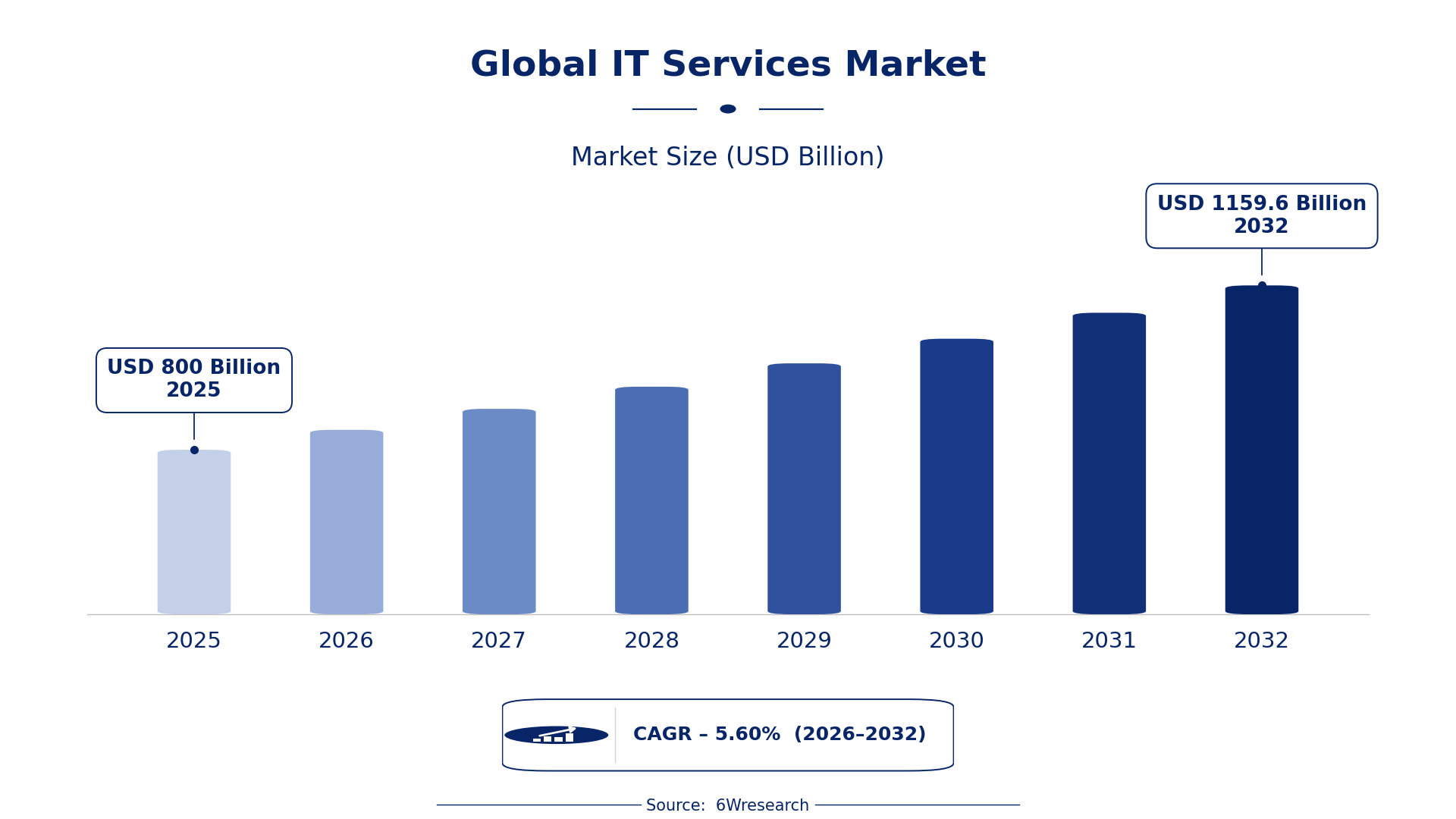
The Global IT Services Market was estimated at USD 800 Billion in 2025 and is projected to reach USD 1159.6 Billion by 2032, growing at a CAGR of 5.60% from 2026 to 2032.
Global IT Services Market Synopsis
The Global IT Services Market is witnessing a pivotal transformation driven by an array of factors including the heightened emphasis on cybersecurity, cloud adoption, and digital transformation initiatives. Firms across sectors are investing heavily to enhance operational efficiency and resilience, spurring demand for specialized IT service providers. This market, distinct from traditional tech sectors, thrives on the urgent need for integrated solutions tailored to diverse client requirements.
As industries adapt to new technologies like AI and the Internet of Things, the demand for agile IT services is intensifying. This shift harmonizes with the rise of remote working trends, locking in a substantial market potential for providers that can offer customized, scalable solutions. Unlike adjacent sectors, the Global IT Services Market is characterized by a robust competitive landscape, compelling companies to consistently innovate in service delivery.
Global IT Services Market Year-wise Growth Rate and Key Drivers
This graph illustrates the annual growth rates of the Global IT Services Market from 2022 to 2032, highlighting a steady upward trajectory and projected expansion over the forecast period.
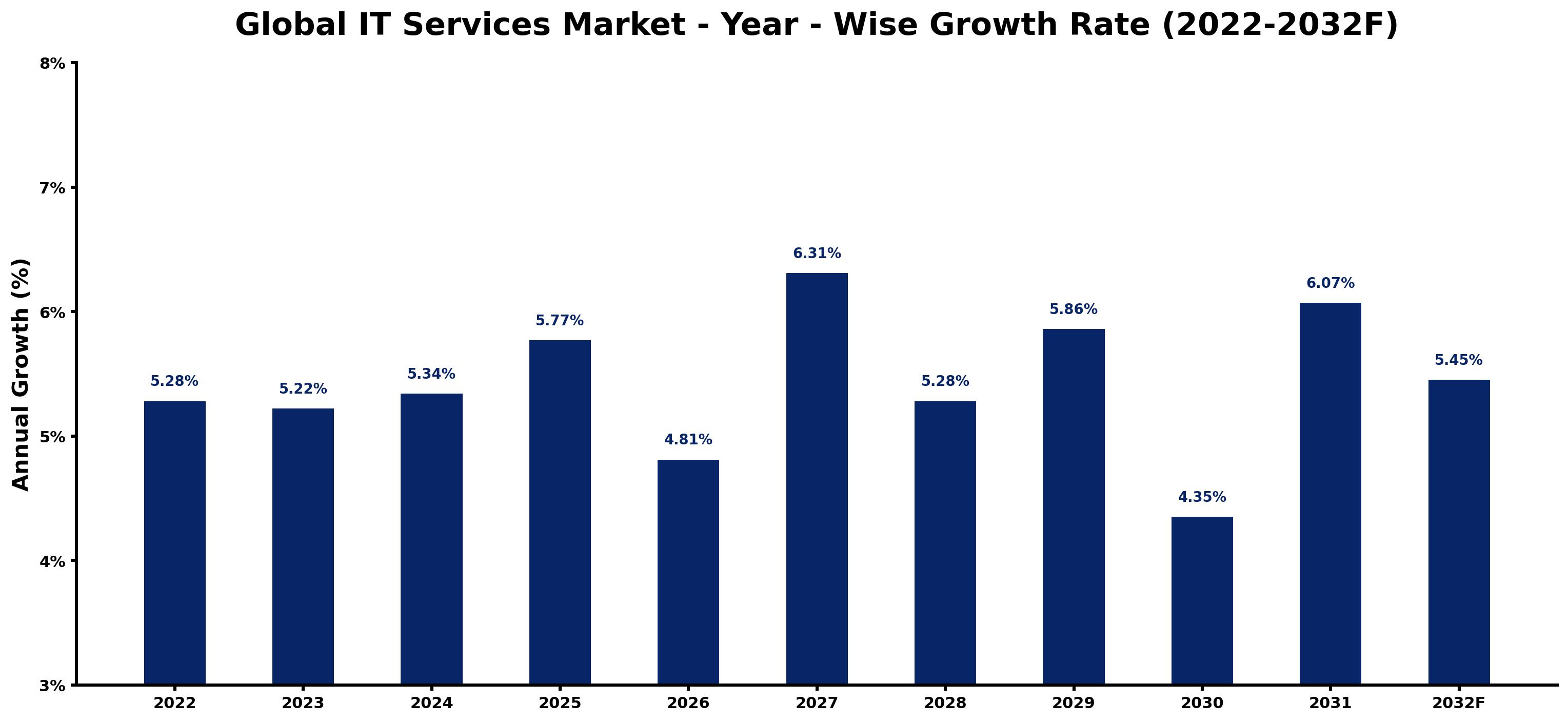
The table below presents the year‑wise growth rates along with the key drivers influencing the market
| Year | Growth Rate (%) | Major Drivers |
| 2022 | 5.28 | Telecom infrastructure expansion facilitates regional growth in IT services across multiple markets. |
| 2023 | 5.22 | A skilled workforce emerging in data center operations improves IT services delivery efficiency. |
| 2024 | 5.34 | Cloud migration initiatives lead to heightened investment in scalable IT services solutions. |
| 2025 | 5.77 | In North America, sustainable practices in IT services promote eco-friendly business models. |
| 2026 | 4.81 | While network infrastructure upgrades accelerate, IT services must adapt to evolving technologies. |
| 2027 | 6.31 | A shift toward stricter cybersecurity regulations enhances compliance requirements for IT services. |
| 2028 | 5.28 | Expanding edge computing capabilities drives IT services towards more responsive user solutions. |
| 2029 | 5.86 | API ecosystems facilitate interoperability, reshaping competitive dynamics within IT services ecosystems. |
| 2030 | 4.35 | Enterprise customers increasingly prioritize IT services that enhance supply chain resilience and efficiency. |
| 2031 | 6.07 | Regulators impose new standards on IT providers, impacting cost structures and service offerings. |
| 2032 | 5.45 | The growing demand for personalized IT services reflects shifting consumer expectations and behavior. |
Note - Market size estimations and growth projections presented in this report are based on 6Wresearch's proprietary research methodology, combining internal industry data, secondary research, and primary validation, updated periodically to reflect current market conditions. As markets evolve rapidly, figures for certain industries may vary slightly and are intended as informed estimates rather than absolute figures. For the most current market sizing, we recommend validating figures with a 6Wresearch analyst.
Global IT Services Market Key Takeaways
Below are some of the specific key takeaways from the market, including:
- North America commands a major share, with approximately 44% of the market in 2025.
- In the Asia-Pacific region, growth is anticipated at a CAGR of 7.8% from 2026 to 2032, driven by increased IT spending.
- Cybersecurity Services are projected to achieve a CAGR of 6.5% during 2026-2032, reflecting rising concerns over data breaches.
- IBM and Accenture have substantially increased their investments in cybersecurity offerings, with both companies reporting over 20% revenue from this segment in 2025.
- The Managed IT Services segment remains the largest, accounting for an estimated 36% of market share as of 2025, highlighting ongoing outsourcing trends.
Evaluation of Restraints in Global IT Services Market
Amidst robust growth, the Global IT Services Market faces significant challenges, including regulatory compliance and escalating operational costs. For instance, adherence to data protection standards, particularly GDPR compliance, can impose substantial financial burdens on service providers, often exceeding $1 million annually for mid-sized firms. Additionally, the rapid pace of technological advancement necessitates continuous workforce upskilling, adding further financial strain. This environment fosters competitive pressure, with companies needing to balance the costs of innovation against market expectations.
Global IT Services Market Trends
Currently, the Global IT Services Market is shaped by three prominent trends. First, the escalating adoption of cloud services highlights a shift toward hybrid cloud environments, exemplified by companies like Microsoft, which reported a 30% increase in Azure subscriptions in 2023. Second, the cybersecurity landscape is transforming with the integration of AI technologies, as demonstrated by Cisco's deployment of AI-driven security analytics in its offerings, enhancing threat detection capabilities since 2022. Lastly, automation tools are increasingly streamlining operations, with organizations like Accenture implementing robotic process automation (RPA) solutions, reported to decrease operational costs by as much as 25% in select sectors.
Global IT Services Market Opportunities
Several lucrative revenue opportunities exist within the Global IT Services Market, particularly in specialized sectors like healthcare IT and the Internet of Things (IoT). Companies are increasingly pursuing digital health solutions, with an estimated $250 billion investment projected by 2026 directed toward telemedicine and electronic health records. Additionally, the rise of IoT applications presents a unique revenue stream, as organizations like Siemens expect to generate at least $40 billion from IoT services by 2025. Furthermore, the renewable energy sector is leveraged by IT service providers to enhance operational efficiencies, with companies like IBM partnering with energy firms to optimize their digital frameworks.
Global IT Services Market by Service Type
Managed IT Services represent the largest segment of the Global IT Services Market, holding an estimated 36% share in 2025. This dominance is attributed to organizations' preference for outsourcing IT operations to enhance efficiency and reduce costs. In contrast, Cybersecurity Services are the fastest-growing segment, expected to grow at a CAGR of 6.5% from 2026 to 2032. The surge in cyber threats necessitates businesses to prioritize cybersecurity measures, prompting service providers to innovate and offer advanced security solutions.
Global IT Services Market by End-Use
The BFSI (Banking, Financial Services, and Insurance) sector is the largest end-use category in the Global IT Services Market, commanding a share of approximately 30% in 2025. This is due to the sector's critical need for robust IT infrastructure and compliance with stringent regulations. Conversely, the Government sector is the fastest-growing category, projected to achieve a CAGR of 7% from 2026 to 2032. Heightened investment in digital services and government projects enhances the demand for specialized IT solutions within this sector.
Global IT Services Market by Deployment Mode
Cloud-Based solutions lead the deployment mode in the Global IT Services Market, holding a substantial share of 58% in 2025. The shift toward cloud infrastructure is primarily due to its scalability and cost-effectiveness for businesses across different sectors. On-Premises solutions, while still significant, are currently the fastest-growing segment, forecasted to achieve a CAGR of 6.2% from 2026 to 2032. This growth is driven by organizations' need for customized solutions that are secure and compliant with internal standards.
Global IT Services Market by Region
North America is the largest region in the Global IT Services Market, accounting for approximately 44% of the total market in 2025. This dominance is bolstered by the presence of major IT service firms and substantial investments in technology infrastructure by both private and public sectors. Conversely, the Asia-Pacific region is positioned as the fastest-growing area, expected to grow at a CAGR of 7.8% from 2026 to 2032, fueled by increasing digital transformation initiatives and high demand for IT services from emerging economies like India and China.
Government Initiatives in the Global IT Services Market
The regulatory and policy environment surrounding the Global IT Services Market is intensifying, characterized by a range of government initiatives aimed at enhancing digital infrastructure and promoting innovative technologies. These initiatives not only support the growth of service providers but also foster improved cybersecurity measures and encourage collaboration across sectors.
- U.S. Department of Commerce, National Cybersecurity Strategy, March 2023: This initiative strengthens cybersecurity frameworks, incentivizing IT service firms to enhance protective measures.
- European Commission, Digital Services Act, February 2022: Aims to create a safer digital space, impacting IT service providers by enforcing compliance with user protection regulations.
- Indian Ministry of Electronics & Information Technology, Digital India Initiative, July 2021: Supports the development of IT services in rural areas, enhancing accessibility and IT infrastructure.
- UK Government, National AI Strategy, November 2021: Encourages investment in AI technologies, presenting opportunities for IT service providers to develop innovative solutions leveraging AI.
Future Insights of the Global IT Services Market
The trajectory of the Global IT Services Market is set to undergo substantial shifts as enterprises increasingly prioritize digital transformation. By 2026, companies like Accenture are expected to leverage AI and automation to refine service offerings, focusing on predictive analytics and personalized solutions. Such an approach not only positions firms at the forefront of technology adoption but also enhances operational efficiencies across industries. With a projected market value of USD 1159.6 Billion by 2032, specialized and flexible IT services that cater to evolving consumer needs will likely drive competitive advantage.
Global IT Services Market Latest Developments
Recent advancements in the Global IT Services Market highlight the commitment of major companies to adapt and innovate in response to industry demands. Notable developments include:
- IBM recently announced the completion of its acquisition of a cybersecurity firm, aiming to enhance its service portfolio and expand its market share in the cybersecurity domain by late 2023.
- Accenture is transforming operations through the integration of cutting-edge AI tools, which began deployment in mid-2023 to optimize client service delivery.
- Deloitte’s new managed services model, launched in early 2023, focuses on cloud-based solutions, capitalizing on the growing preference for digital transformation across sectors.
- Infosys is investing heavily in upskilling initiatives for its workforce, with a major program rolled out in late 2023 to ensure staff are equipped to handle advanced cybersecurity challenges.
Global IT Services Market Key Players and Industry Positioning
The Global IT Services Market presents a fragmented competitive structure, with several key players vying for market dominance. This fragmentation fosters diverse service offerings and encourages continual advancements to meet discrete client needs.
| Leading Company | Core Strength | Strategic Focus |
|---|---|---|
| IBM | Deep expertise in cybersecurity solutions. | Targeting advanced security services and solutions. |
| Accenture | Strong innovation capabilities in IT strategy. | Focusing on AI and data analytics for improved client results. |
| Deloitte | Robust consulting framework across various sectors. | Enhancing managed services with a cloud-centric model. |
| TCS | Comprehensive IT service delivery. | Expanding operations through strategic partnerships. |
| Infosys | Focus on digital transformation and sustainability. | Investing in workforce development and skill enhancement. |
This competitive dynamic challenges companies to differentiate based on service quality and investment in technology, ensuring they remain relevant as the market evolves.
Key Attractiveness of the Report
- 10 Years of Market Numbers
- Historical Data Starting from 2022 to 2025
- Base Year: 2025
- Forecast Data until 2032
- Key Performance Indicators Impacting the Market
- Major Upcoming Developments and Projects
Key Highlights of the Report:
- Global IT Services Market Outlook
- Market Size of Global IT Services Market, 2025
- Forecast of Global IT Services Market, 2032
- Historical Data and Forecast of Global IT Services Revenues & Volume for the Period 2022-2032
- Global IT Services Market Trend Evolution
- Global IT Services Market Drivers and Challenges
- Global IT Services Price Trends
- Global IT Services Porter's Five Forces
- Global IT Services Industry Life Cycle
- Historical Data and Forecast of Global IT Services Market Revenues & Volume
- Historical Data and Forecast of Global IT Services Market Revenues & Volume By Service Type for the Period 2022-2032
- Historical Data and Forecast of Global IT Services Market Revenues & Volume By Managed IT Services for the Period 2022-2032
- Historical Data and Forecast of Global IT Services Market Revenues & Volume By Cloud Services for the Period 2022-2032
- Historical Data and Forecast of Global IT Services Market Revenues & Volume By Consulting Services for the Period 2022-2032
- Historical Data and Forecast of Global IT Services Market Revenues & Volume By Cybersecurity Services for the Period 2022-2032
- Historical Data and Forecast of Global IT Services Market Revenues & Volume By End-Use for the Period 2022-2032
- Historical Data and Forecast of Global IT Services Market Revenues & Volume By BFSI for the Period 2022-2032
- Historical Data and Forecast of Global IT Services Market Revenues & Volume By Healthcare for the Period 2022-2032
- Historical Data and Forecast of Global IT Services Market Revenues & Volume By Retail for the Period 2022-2032
- Historical Data and Forecast of Global IT Services Market Revenues & Volume By Government for the Period 2022-2032
- Historical Data and Forecast of Global IT Services Market Revenues & Volume By Deployment Mode for the Period 2022-2032
- Historical Data and Forecast of Global IT Services Market Revenues & Volume By On-Premises for the Period 2022-2032
- Historical Data and Forecast of Global IT Services Market Revenues & Volume By Cloud-Based for the Period 2022-2032
- Historical Data and Forecast of North America IT Services Market Revenues & Volume By Service Type for the Period 2022-2032
- Historical Data and Forecast of North America IT Services Market Revenues & Volume By Managed IT Services for the Period 2022-2032
- Historical Data and Forecast of North America IT Services Market Revenues & Volume By Cloud Services for the Period 2022-2032
- Historical Data and Forecast of North America IT Services Market Revenues & Volume By Consulting Services for the Period 2022-2032
- Historical Data and Forecast of North America IT Services Market Revenues & Volume By Cybersecurity Services for the Period 2022-2032
- Historical Data and Forecast of North America IT Services Market Revenues & Volume By End-Use for the Period 2022-2032
- Historical Data and Forecast of North America IT Services Market Revenues & Volume By BFSI for the Period 2022-2032
- Historical Data and Forecast of North America IT Services Market Revenues & Volume By Healthcare for the Period 2022-2032
- Historical Data and Forecast of North America IT Services Market Revenues & Volume By Retail for the Period 2022-2032
- Historical Data and Forecast of North America IT Services Market Revenues & Volume By Government for the Period 2022-2032
- Historical Data and Forecast of North America IT Services Market Revenues & Volume By Deployment Mode for the Period 2022-2032
- Historical Data and Forecast of North America IT Services Market Revenues & Volume By On-Premises for the Period 2022-2032
- Historical Data and Forecast of North America IT Services Market Revenues & Volume By Cloud-Based for the Period 2022-2032
- Historical Data and Forecast of United States of America IT Services Market Revenues & Volume for the Period 2022-2032
- Historical Data and Forecast of Canada IT Services Market Revenues & Volume for the Period 2022-2032
- Historical Data and Forecast of Rest of North America IT Services Market Revenues & Volume for the Period 2022-2032
- Historical Data and Forecast of Latin America (LATAM) IT Services Market Revenues & Volume By Service Type for the Period 2022-2032
- Historical Data and Forecast of Latin America (LATAM) IT Services Market Revenues & Volume By Managed IT Services for the Period 2022-2032
- Historical Data and Forecast of Latin America (LATAM) IT Services Market Revenues & Volume By Cloud Services for the Period 2022-2032
- Historical Data and Forecast of Latin America (LATAM) IT Services Market Revenues & Volume By Consulting Services for the Period 2022-2032
- Historical Data and Forecast of Latin America (LATAM) IT Services Market Revenues & Volume By Cybersecurity Services for the Period 2022-2032
- Historical Data and Forecast of Latin America (LATAM) IT Services Market Revenues & Volume By End-Use for the Period 2022-2032
- Historical Data and Forecast of Latin America (LATAM) IT Services Market Revenues & Volume By BFSI for the Period 2022-2032
- Historical Data and Forecast of Latin America (LATAM) IT Services Market Revenues & Volume By Healthcare for the Period 2022-2032
- Historical Data and Forecast of Latin America (LATAM) IT Services Market Revenues & Volume By Retail for the Period 2022-2032
- Historical Data and Forecast of Latin America (LATAM) IT Services Market Revenues & Volume By Government for the Period 2022-2032
- Historical Data and Forecast of Latin America (LATAM) IT Services Market Revenues & Volume By Deployment Mode for the Period 2022-2032
- Historical Data and Forecast of Latin America (LATAM) IT Services Market Revenues & Volume By On-Premises for the Period 2022-2032
- Historical Data and Forecast of Latin America (LATAM) IT Services Market Revenues & Volume By Cloud-Based for the Period 2022-2032
- Historical Data and Forecast of Brazil IT Services Market Revenues & Volume for the Period 2022-2032
- Historical Data and Forecast of Mexico IT Services Market Revenues & Volume for the Period 2022-2032
- Historical Data and Forecast of Argentina IT Services Market Revenues & Volume for the Period 2022-2032
- Historical Data and Forecast of Rest of LATAM IT Services Market Revenues & Volume for the Period 2022-2032
- Historical Data and Forecast of Asia IT Services Market Revenues & Volume By Service Type for the Period 2022-2032
- Historical Data and Forecast of Asia IT Services Market Revenues & Volume By Managed IT Services for the Period 2022-2032
- Historical Data and Forecast of Asia IT Services Market Revenues & Volume By Cloud Services for the Period 2022-2032
- Historical Data and Forecast of Asia IT Services Market Revenues & Volume By Consulting Services for the Period 2022-2032
- Historical Data and Forecast of Asia IT Services Market Revenues & Volume By Cybersecurity Services for the Period 2022-2032
- Historical Data and Forecast of Asia IT Services Market Revenues & Volume By End-Use for the Period 2022-2032
- Historical Data and Forecast of Asia IT Services Market Revenues & Volume By BFSI for the Period 2022-2032
- Historical Data and Forecast of Asia IT Services Market Revenues & Volume By Healthcare for the Period 2022-2032
- Historical Data and Forecast of Asia IT Services Market Revenues & Volume By Retail for the Period 2022-2032
- Historical Data and Forecast of Asia IT Services Market Revenues & Volume By Government for the Period 2022-2032
- Historical Data and Forecast of Asia IT Services Market Revenues & Volume By Deployment Mode for the Period 2022-2032
- Historical Data and Forecast of Asia IT Services Market Revenues & Volume By On-Premises for the Period 2022-2032
- Historical Data and Forecast of Asia IT Services Market Revenues & Volume By Cloud-Based for the Period 2022-2032
- Historical Data and Forecast of China IT Services Market Revenues & Volume for the Period 2022-2032
- Historical Data and Forecast of India IT Services Market Revenues & Volume for the Period 2022-2032
- Historical Data and Forecast of Japan IT Services Market Revenues & Volume for the Period 2022-2032
- Historical Data and Forecast of Rest of Asia IT Services Market Revenues & Volume for the Period 2022-2032
- Historical Data and Forecast of Africa IT Services Market Revenues & Volume By Service Type for the Period 2022-2032
- Historical Data and Forecast of Africa IT Services Market Revenues & Volume By Managed IT Services for the Period 2022-2032
- Historical Data and Forecast of Africa IT Services Market Revenues & Volume By Cloud Services for the Period 2022-2032
- Historical Data and Forecast of Africa IT Services Market Revenues & Volume By Consulting Services for the Period 2022-2032
- Historical Data and Forecast of Africa IT Services Market Revenues & Volume By Cybersecurity Services for the Period 2022-2032
- Historical Data and Forecast of Africa IT Services Market Revenues & Volume By End-Use for the Period 2022-2032
- Historical Data and Forecast of Africa IT Services Market Revenues & Volume By BFSI for the Period 2022-2032
- Historical Data and Forecast of Africa IT Services Market Revenues & Volume By Healthcare for the Period 2022-2032
- Historical Data and Forecast of Africa IT Services Market Revenues & Volume By Retail for the Period 2022-2032
- Historical Data and Forecast of Africa IT Services Market Revenues & Volume By Government for the Period 2022-2032
- Historical Data and Forecast of Africa IT Services Market Revenues & Volume By Deployment Mode for the Period 2022-2032
- Historical Data and Forecast of Africa IT Services Market Revenues & Volume By On-Premises for the Period 2022-2032
- Historical Data and Forecast of Africa IT Services Market Revenues & Volume By Cloud-Based for the Period 2022-2032
- Historical Data and Forecast of South Africa IT Services Market Revenues & Volume for the Period 2022-2032
- Historical Data and Forecast of Nigeria IT Services Market Revenues & Volume for the Period 2022-2032
- Historical Data and Forecast of Egypt IT Services Market Revenues & Volume for the Period 2022-2032
- Historical Data and Forecast of Rest of Africa IT Services Market Revenues & Volume for the Period 2022-2032
- Historical Data and Forecast of Europe IT Services Market Revenues & Volume By Service Type for the Period 2022-2032
- Historical Data and Forecast of Europe IT Services Market Revenues & Volume By Managed IT Services for the Period 2022-2032
- Historical Data and Forecast of Europe IT Services Market Revenues & Volume By Cloud Services for the Period 2022-2032
- Historical Data and Forecast of Europe IT Services Market Revenues & Volume By Consulting Services for the Period 2022-2032
- Historical Data and Forecast of Europe IT Services Market Revenues & Volume By Cybersecurity Services for the Period 2022-2032
- Historical Data and Forecast of Europe IT Services Market Revenues & Volume By End-Use for the Period 2022-2032
- Historical Data and Forecast of Europe IT Services Market Revenues & Volume By BFSI for the Period 2022-2032
- Historical Data and Forecast of Europe IT Services Market Revenues & Volume By Healthcare for the Period 2022-2032
- Historical Data and Forecast of Europe IT Services Market Revenues & Volume By Retail for the Period 2022-2032
- Historical Data and Forecast of Europe IT Services Market Revenues & Volume By Government for the Period 2022-2032
- Historical Data and Forecast of Europe IT Services Market Revenues & Volume By Deployment Mode for the Period 2022-2032
- Historical Data and Forecast of Europe IT Services Market Revenues & Volume By On-Premises for the Period 2022-2032
- Historical Data and Forecast of Europe IT Services Market Revenues & Volume By Cloud-Based for the Period 2022-2032
- Historical Data and Forecast of United Kingdom IT Services Market Revenues & Volume for the Period 2022-2032
- Historical Data and Forecast of France IT Services Market Revenues & Volume for the Period 2022-2032
- Historical Data and Forecast of Germany IT Services Market Revenues & Volume for the Period 2022-2032
- Historical Data and Forecast of Rest of Europe IT Services Market Revenues & Volume for the Period 2022-2032
- Historical Data and Forecast of Middle East IT Services Market Revenues & Volume By Service Type for the Period 2022-2032
- Historical Data and Forecast of Middle East IT Services Market Revenues & Volume By Managed IT Services for the Period 2022-2032
- Historical Data and Forecast of Middle East IT Services Market Revenues & Volume By Cloud Services for the Period 2022-2032
- Historical Data and Forecast of Middle East IT Services Market Revenues & Volume By Consulting Services for the Period 2022-2032
- Historical Data and Forecast of Middle East IT Services Market Revenues & Volume By Cybersecurity Services for the Period 2022-2032
- Historical Data and Forecast of Middle East IT Services Market Revenues & Volume By End-Use for the Period 2022-2032
- Historical Data and Forecast of Middle East IT Services Market Revenues & Volume By BFSI for the Period 2022-2032
- Historical Data and Forecast of Middle East IT Services Market Revenues & Volume By Healthcare for the Period 2022-2032
- Historical Data and Forecast of Middle East IT Services Market Revenues & Volume By Retail for the Period 2022-2032
- Historical Data and Forecast of Middle East IT Services Market Revenues & Volume By Government for the Period 2022-2032
- Historical Data and Forecast of Middle East IT Services Market Revenues & Volume By Deployment Mode for the Period 2022-2032
- Historical Data and Forecast of Middle East IT Services Market Revenues & Volume By On-Premises for the Period 2022-2032
- Historical Data and Forecast of Middle East IT Services Market Revenues & Volume By Cloud-Based for the Period 2022-2032
- Historical Data and Forecast of Saudi Arabia IT Services Market Revenues & Volume for the Period 2022-2032
- Historical Data and Forecast of UAE IT Services Market Revenues & Volume for the Period 2022-2032
- Historical Data and Forecast of Turkey IT Services Market Revenues & Volume for the Period 2022-2032
- Historical Data and Forecast of Rest of Middle East IT Services Market Revenues & Volume for the Period 2022-2032
- Global IT Services Market - Key Performance Indicators
- Global IT Services Market - Import Export Trade Statistics
- Global IT Services Market - Opportunity Assessment By Countries
- Global IT Services Market - Opportunity Assessment By Service Type
- Global IT Services Market - Opportunity Assessment By End-Use
- Global IT Services Market - Opportunity Assessment By Deployment Mode
- Global IT Services Market - Top Companies Market Share
- Global IT Services Market - Top Companies Profiles
- Global IT Services Market - Comparison of Players in Technical and Operating Parameters
- Global IT Services Market - Strategic Recommendations
Markets Covered
The Global IT Services Market report provides a detailed analysis of the following market segments:
By Regions and Countries:
- North America
- Europe
- LATAM
- Middle East
- Asia
- Africa
By Service Type:
- Managed IT Services
- Cloud Services
- Consulting Services
- Cybersecurity Services
By End-Use:
- BFSI
- Healthcare
- Retail
- Government
By Deployment Mode:
- On-Premises
- Cloud-Based






































