Saudi Arabia IT Services Market Size & Growth Rate (2026-2032)
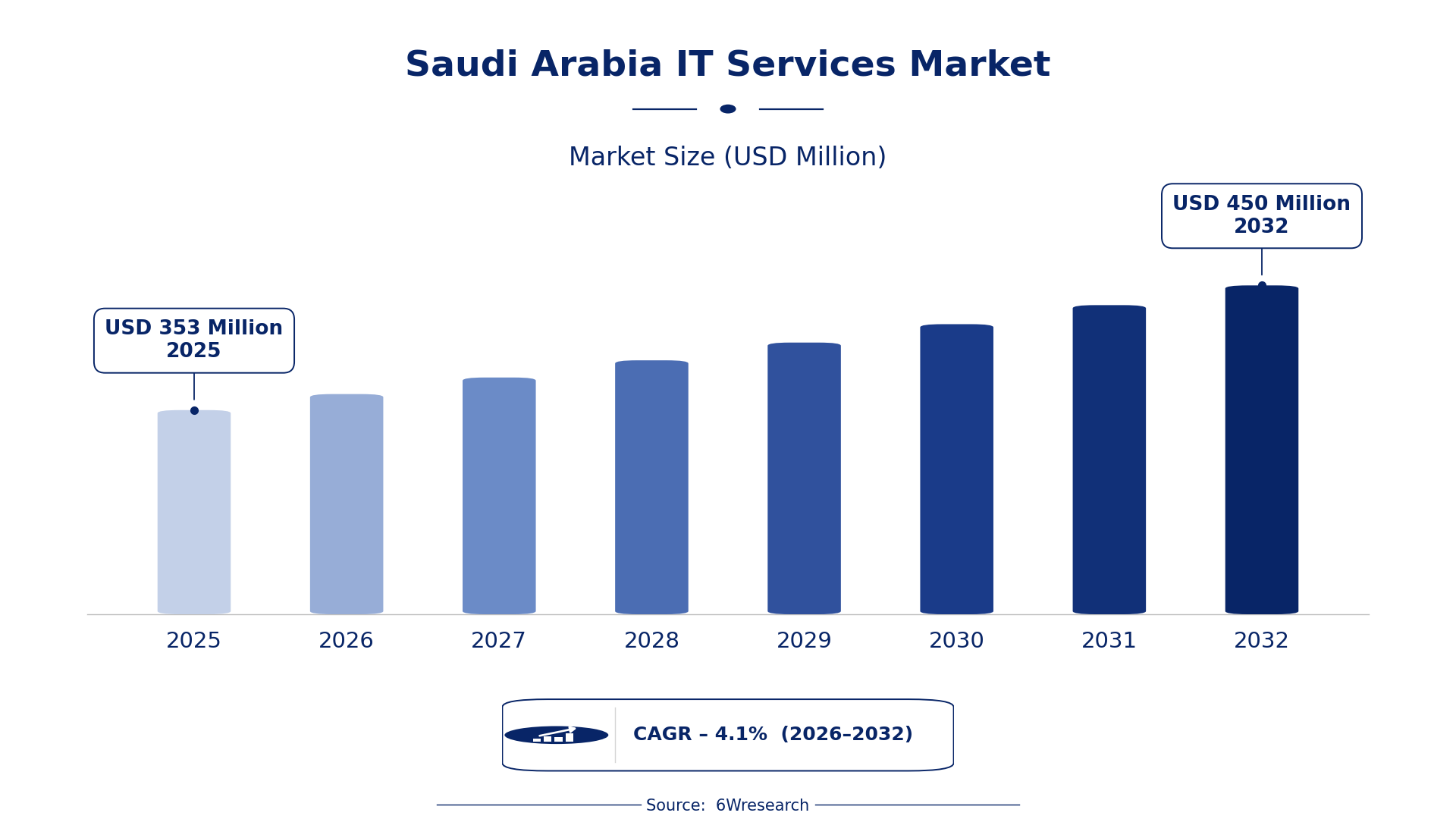
The Saudi Arabia IT Services Market was estimated at USD 353 Million in 2025 and is projected to reach USD 450 Million by 2032, growing at a CAGR of 4.1% from 2026 to 2032.
Saudi Arabia IT Services Market Synopsis
The Saudi Arabia IT Services market has seen a surge in activity as businesses aggressively pursue digital transformation and modernization. The current environment is characterized by heightened demand for innovative solutions, fueled by the government's Vision 2031 initiative, which aims to diversify the economy and enhance digital capabilities.
Looking ahead, the market is expected to continue its upward trajectory, driven by a growing reliance on IT consulting, software development, and cybersecurity services. As organizations adapt to a fast-paced technological landscape, the role of IT services in enabling efficiency and competitive advantage cannot be overstated.
Saudi Arabia IT Services Market Year-wise Growth Rate and Key Drivers
This graph illustrates the annual growth rates of the Saudi Arabia IT Services Market from 2021 to 2032, highlighting a steady upward trajectory and projected expansion over the forecast period.
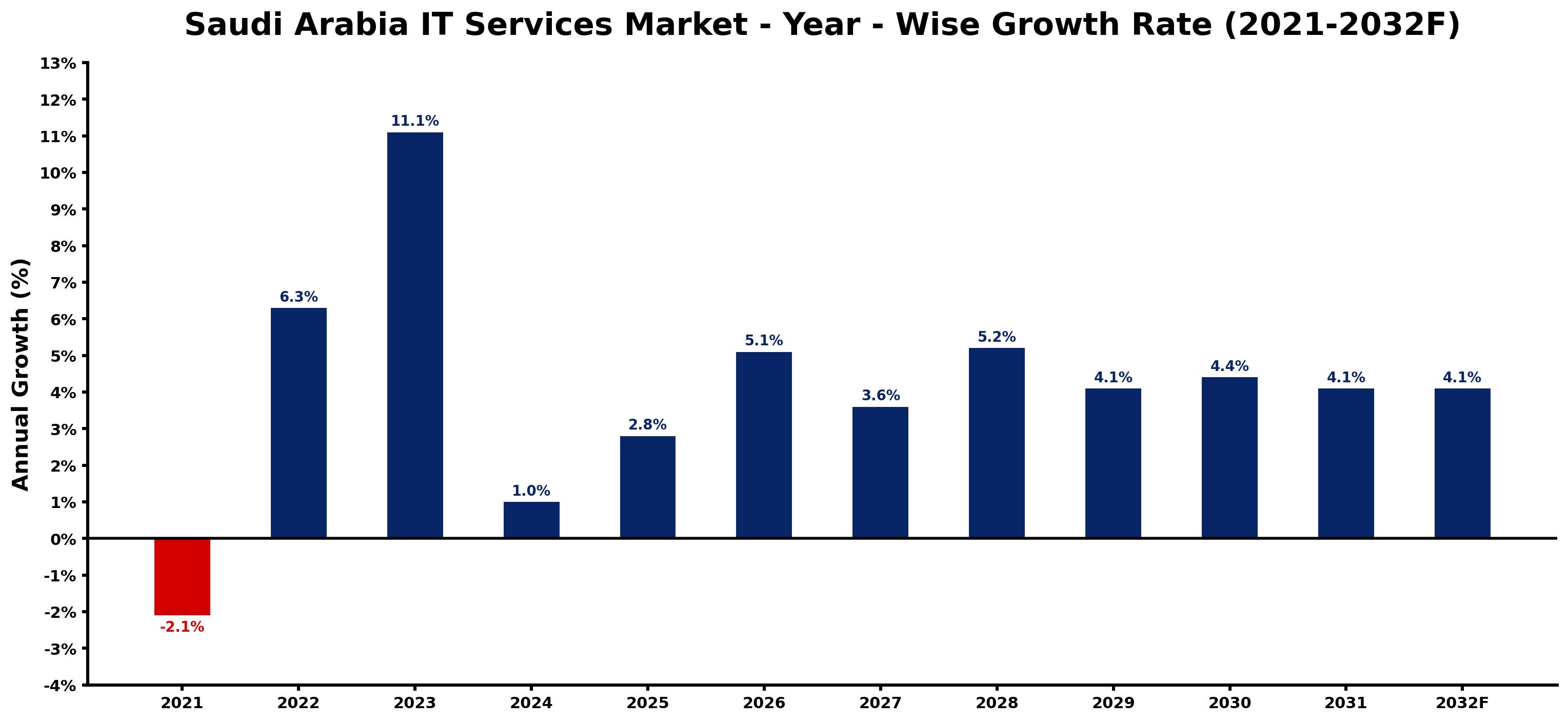
The table below presents the year‑wise growth rates along with the key drivers influencing the market
| Year | Growth Rate | Major Drivers |
| 2021 | -2.1% | Delays in government IT project approvals hindered growth. |
| 2022 | 6.3% | Saudi Vision 2030 boosting digital transformation initiatives. |
| 2023 | 11.1% | Increased investment in fintech startups driving IT solutions. |
| 2024 | 1.0% | Public sector digitalization enhancing government tech services. |
| 2025 | 2.8% | Growing internet penetration facilitating cloud service demand. |
| 2026 | 5.1% | Rising emphasis on AI integration in local enterprises. |
| 2027 | 3.6% | E-commerce growth necessitating robust IT infrastructure. |
| 2028 | 5.2% | Telecommunications expansion supporting digital service accessibility. |
| 2029 | 4.1% | Business innovation incentives encouraging IT consultancy growth. |
| 2030 | 4.4% | Regulatory support for data protection legislation enhancing IT services. |
| 2031 | 4.1% | Increased collaboration between Saudi firms and global tech players. |
| 2032 | 4.1% | Emergence of tech hubs fostering IT talent development. |
Note: Market size estimations and growth projections presented in this report are based on 6Wresearch's proprietary forecasting methodology, utilizing the latest available industry data, government publications, and primary research inputs.
Saudi Arabia IT Services Market Key Takeaways
Below are some of the specific key takeaways from the market, including:
- The market is witnessing robust growth due to increased investment in IT infrastructure.
- Cloud services and cybersecurity are among the most demanded segments.
- Government initiatives are aligning with private sector needs to foster innovation.
- Businesses are prioritizing IT services for improved operational efficiency and data security.
- COVID-19 has accelerated the shift toward digital solutions across industries.
Evaluation of Restraints in Saudi Arabia IT Services Market
Despite the positive growth trajectory, the Saudi Arabia IT Services market faces several restraints that can hinder its progress. One prominent issue is the challenge of keeping up with rapid technological advancements. Companies must continuously innovate to meet evolving business needs, which can strain resources. Additionally, concerns surrounding cybersecurity and data privacy are paramount, as organizations grapple with increasing threats. The shortage of skilled IT professionals further complicates efforts to enhance service delivery and innovation, making it a critical area for investment and attention.
Saudi Arabia IT Services Market Trends
Several trends are emerging within the Saudi Arabia IT Services market that shape its future. A significant shift is the increased adoption of cloud computing solutions, as businesses seek scalable options for managing their IT resources. Additionally, the rise of artificial intelligence and machine learning is driving new service offerings, with companies looking to harness these technologies for data analytics and process automation. on top of that, there is a growing emphasis on cybersecurity measures, reflecting the heightened awareness of data protection in an increasingly digital world.
Saudi Arabia IT Services Market Opportunities
Opportunities abound in the Saudi Arabia IT Services market, particularly for organizations willing to innovate. The increasing demand for managed IT services presents a lucrative avenue, as companies seek to outsource their IT needs to focus on core business functions. The government's push for digital transformation creates fertile ground for startups and established firms alike to introduce cutting-edge solutions. Additionally, sectors like healthcare, education, and finance are ripe for IT service expansion, as they increasingly leverage technology for operational improvements.
Government Initiatives in the Saudi Arabia IT Services Market
The Saudi government is actively shaping the IT Services market through various initiatives aimed at fostering digital innovation and economic diversification. Regulatory policies are being introduced to streamline IT operations and enhance cybersecurity measures across industries. This proactive approach is vital for supporting a robust IT ecosystem, ensuring that businesses can effectively utilize technology in their operations.
- A national digital infrastructure upgrade programme recently launched to enhance connectivity across urban and rural areas.
- Current initiatives include a cybersecurity framework to safeguard sensitive data, which is being rolled out throughout 2025.
- Plans for a public-private partnership expected to improve IT service delivery and innovation by 2027.
- A technology incubator programme initiated to support startups focusing on IT solutions, which commenced in early 2025.
- Ongoing assessments of regulatory measures to ensure compliance with international data protection standards.
Future Insights of the Saudi Arabia IT Services Market
From 2026 to 2032, the Saudi Arabia IT Services market is set for continued evolution, underpinned by a growing recognition of the value that technology brings to businesses. As organizations increasingly turn to IT services for critical functions, there will be a marked shift toward personalized and adaptive solutions. The emphasis on cybersecurity will also intensify, ensuring that data integrity and protection are at the forefront of service offerings. Ultimately, the market's trajectory will be shaped by both technological advancements and the strategic objectives of the Saudi government.
Saudi Arabia IT Services Market Latest Developments
In the past year, the Saudi Arabia IT Services market has witnessed a flurry of activity as organizations adapt to the digital age. With a strong focus on enhancing IT capabilities, companies have begun to roll out innovative solutions that align with national initiatives. The urgency for modernization has never been more pronounced, reflecting the sector's readiness for growth and adaptation.
- A major technology vendor announced the launch of a cloud-based platform aimed at small to medium-sized enterprises, which started in Q1 2025 and has gained significant traction.
- An ongoing partnership between regional operators to enhance cybersecurity infrastructure is expected to bolster protection against emerging threats, currently underway and set to conclude in late 2025.
- A rollout of a new data analytics service targeting the retail sector is planned for mid-2026, designed to optimize inventory management and customer engagement.
- Recently completed workshops aimed at upskilling IT professionals in cybersecurity best practices were held throughout 2025.
- Investments in AI-driven customer service solutions are anticipated to begin in early 2026, focusing on enhancing user experience across platforms.
Saudi Arabia IT Services Market - Key Attractiveness of the Report
- 10 Years of Market Numbers
- Historical Data Starting from 2022 to 2025
- Base Year: 2025
- Forecast Data until 2032
- Key Performance Indicators Impacting the Market
- Major Upcoming Developments and Projects
Key Highlights of the Report:
- Saudi Arabia IT Services Market Outlook
- Market Size of Saudi Arabia IT Services Market, 2025
- Forecast of Saudi Arabia IT Services Market, 2032
- Historical Data and Forecast of Saudi Arabia IT Services Revenues & Volume for the Period 2022-2032F
- Saudi Arabia IT Services Market Trend Evolution
- Saudi Arabia IT Services Market Drivers and Challenges
- Saudi Arabia IT Services Price Trends
- Saudi Arabia IT Services Porter's Five Forces
- Saudi Arabia IT Services Industry Life Cycle
- Historical Data and Forecast of Saudi Arabia IT Services Market Revenues & Volume By Vertical for the Period 2022-2032F
- Historical Data and Forecast of Saudi Arabia IT Services Market Revenues & Volume By Government and defense for the Period 2022-2032F
- Historical Data and Forecast of Saudi Arabia IT Services Market Revenues & Volume By Banking, Financial Services, and Insurance (BFSI) for the Period 2022-2032F
- Historical Data and Forecast of Saudi Arabia IT Services Market Revenues & Volume By Healthcare for the Period 2022-2032F
- Historical Data and Forecast of Saudi Arabia IT Services Market Revenues & Volume By Media and entertainment for the Period 2022-2032F
- Historical Data and Forecast of Saudi Arabia IT Services Market Revenues & Volume By Consumer goods and retail for the Period 2022-2032F
- Historical Data and Forecast of Saudi Arabia IT Services Market Revenues & Volume By IT and telecom for the Period 2022-2032F
- Historical Data and Forecast of Saudi Arabia IT Services Market Revenues & Volume By Business Function for the Period 2022-2032F
- Historical Data and Forecast of Saudi Arabia IT Services Market Revenues & Volume By Human Resources for the Period 2022-2032F
- Historical Data and Forecast of Saudi Arabia IT Services Market Revenues & Volume By Finance and Accounting for the Period 2022-2032F
- Historical Data and Forecast of Saudi Arabia IT Services Market Revenues & Volume By Sales and Marketing for the Period 2022-2032F
- Historical Data and Forecast of Saudi Arabia IT Services Market Revenues & Volume By Supply Chain Management for the Period 2022-2032F
- Historical Data and Forecast of Saudi Arabia IT Services Market Revenues & Volume By Operations and Support for the Period 2022-2032F
- Historical Data and Forecast of Saudi Arabia IT Services Market Revenues & Volume By Manufacturing for the Period 2022-2032F
- Historical Data and Forecast of Saudi Arabia IT Services Market Revenues & Volume By Deployment Mode for the Period 2022-2032F
- Historical Data and Forecast of Saudi Arabia IT Services Market Revenues & Volume By On-premises for the Period 2022-2032F
- Historical Data and Forecast of Saudi Arabia IT Services Market Revenues & Volume By Cloud for the Period 2022-2032F
- Historical Data and Forecast of Saudi Arabia IT Services Market Revenues & Volume By Organization Size for the Period 2022-2032F
- Historical Data and Forecast of Saudi Arabia IT Services Market Revenues & Volume By Large enterprises for the Period 2022-2032F
- Historical Data and Forecast of Saudi Arabia IT Services Market Revenues & Volume By Small and Medium Enterprises (SMEs) for the Period 2022-2032F
- Historical Data and Forecast of Saudi Arabia IT Services Market Revenues & Volume By Service Type for the Period 2022-2032F
- Historical Data and Forecast of Saudi Arabia IT Services Market Revenues & Volume By Professional services for the Period 2022-2032F
- Historical Data and Forecast of Saudi Arabia IT Services Market Revenues & Volume By Managed services for the Period 2022-2032F
- Historical Data and Forecast of Saudi Arabia IT Services Market Revenues & Volume By Telecom services for the Period 2022-2032F
- Saudi Arabia IT Services Import Export Trade Statistics
- Market Opportunity Assessment By Vertical
- Market Opportunity Assessment By Business Function
- Market Opportunity Assessment By Deployment Mode
- Market Opportunity Assessment By Organization Size
- Market Opportunity Assessment By Service Type
- Saudi Arabia IT Services Top Companies Market Share
- Saudi Arabia IT Services Competitive Benchmarking By Technical and Operational Parameters
- Saudi Arabia IT Services Company Profiles
- Saudi Arabia IT Services Key Strategic Recommendations






































