India LED Lighting Market Size & Growth Rate
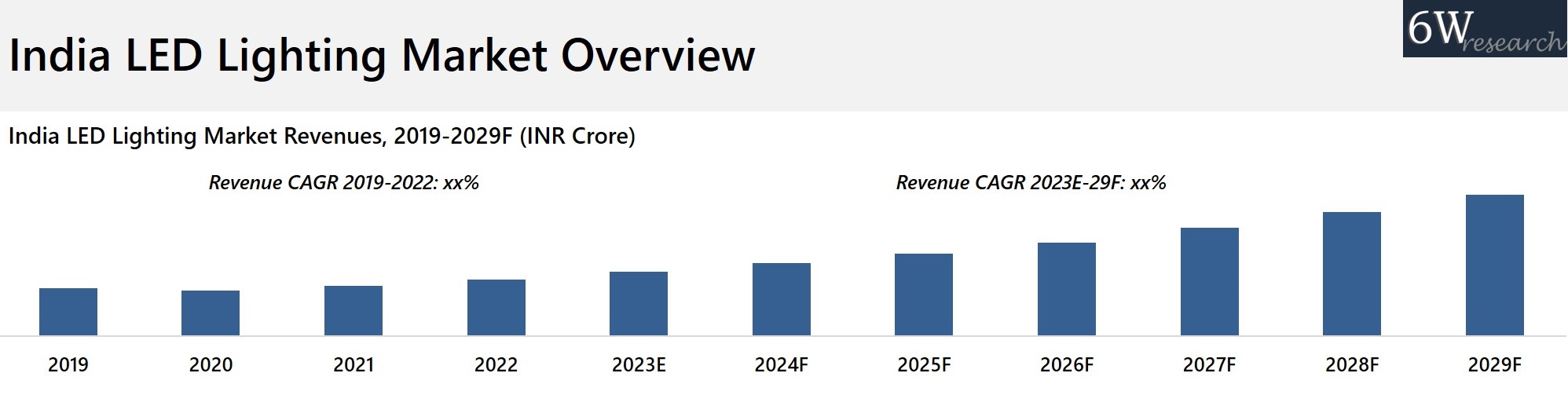
According to 6Wresearch, the India LED Lighting Market is projected to grow at a CAGR of 9.2% during 2024–2030, fueled by government initiatives like Smart Cities Mission, UJALA, and SLNP, rising real estate and smart home developments, and growing demand for energy-efficient and IoT-integrated lighting solutions across residential, commercial, and infrastructure sectors.
Topics Covered in India LED Lighting Market Report
India LED Lighting Market Report thoroughly covers the market by types, applications, sales channels and regions. India LED Lighting Market Outlook report provides an unbiased and detailed analysis of the ongoing India LED Lighting Market trends, opportunities/high growth areas, and market drivers. This would help stakeholders devise and align their market strategies according to the current and future market dynamics.
India LED Lighting Market Synopsis
India LED lighting market experienced significant growth in recent years, driven by rising government investments in schemes such as UJALA, PLI and SLNP along with an increased focus on smart cities and rural electrification. However, the market faced a temporary setback in 2019 due to the COVID-19 pandemic owing to which the demand for LED lighting products declined moderately as there was a nationwide lockdown imposed by the government and disruptions happened in the supply chain, resulting in the suspension of manufacturing operations. However, the market recovered post pandemic after ease of lockdown restrictions. Further, the growth of the LED lighting market was driven by significant increase in the residential, office and hospitality sectors. For instance, the real estate sector grew with rising housing unit completions from 2.5 lakh units in 2018 to 4.35 lakh units in 2023. Moreover, India's energy demand is expected to rise by 8.6%, reaching 11,02,887 MU in 2023-24, compared to 10,15,908 MU in 2022. This growth in demand of energy-efficient solutions, combined with the shift to smart, IoT-integrated lighting systems and energy-saving LED lights, has been driving the growth for LED lighting in the Indian market.
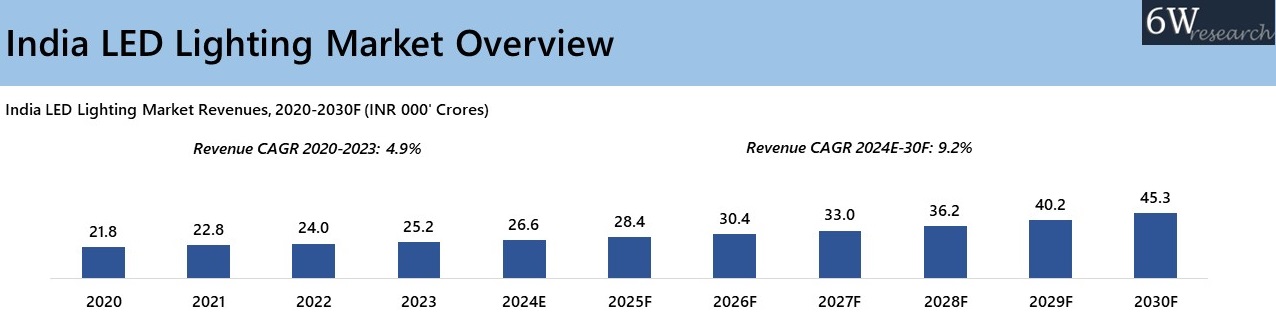
According to 6Wresearch, India LED Lighting Market is projected to grow at a CAGR of 9.2% during 2024-2030. The Indian government’s Smart Cities Mission which aims to transform 100 existing cities in India into smart cities has been positively influencing the LED lighting market since 2015 and the initiative has been extended till 2025. This would assist in increasing the market size. Along with this, the housing demand in India is projected to surge, reaching an estimated 93 million units by 2036. Additionally, in 2023, the country had 13 million smart houses, and it is anticipated that the installation of smart home solutions would increase by 12.8% by 2025. Further, hospitality sector is expected to witness growth with the upcoming 177 hospitality projects to be completed by 2025. This upward trajectory would increase the demand for LED lighting products during the forecast period.
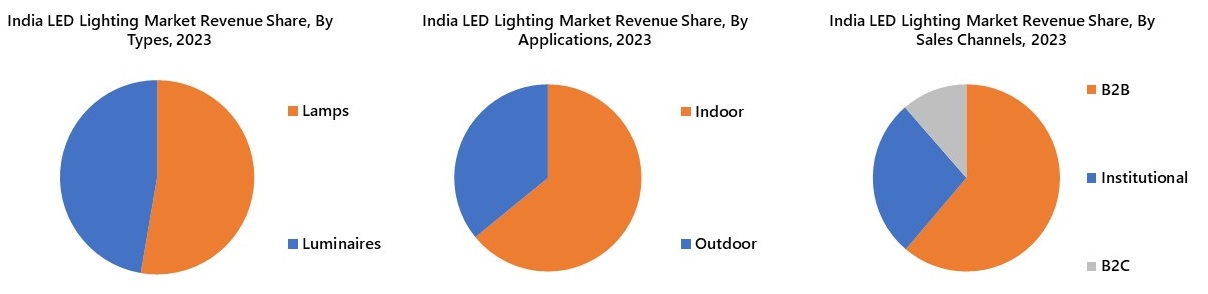
Market Segmentation By Types
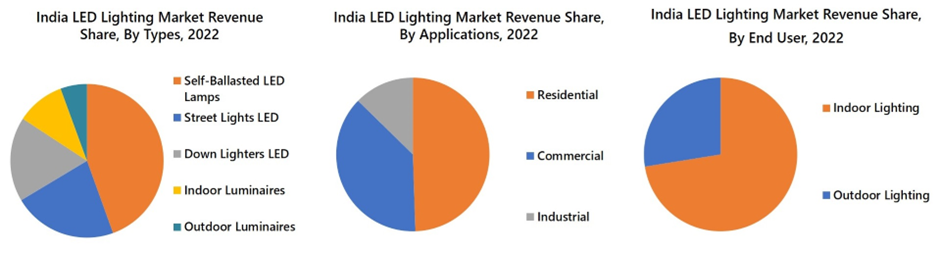
Luminaires are expected to experience a higher growth rate in the coming years due to the rising trend of incorporating landscape lighting in infrastructure design, along with increasing demand for floodlights in stadiums. For instance, in Sep 2024, the Uttar Pradesh government announced plans to build 1,000 playgrounds and 18 stadiums, along with mini-stadiums in nearly 825 development blocks. Additionally, India's bid for the 2036 Olympics is likely to drive the construction of more stadiums in the coming years, with the Gujarat government already planning to build five international-standard stadiums in Ahmedabad. These initiatives would increase the deployment of Luminaires in the years to come.
Market Segmentation By Applications
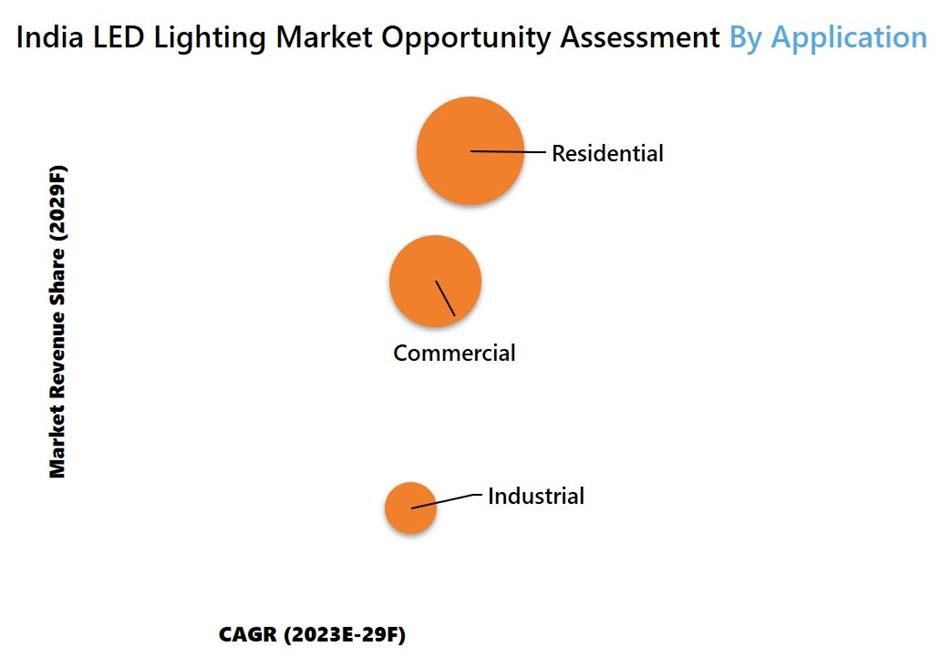
Indoor application is expected to see higher growth in India’s LED lighting market due to the rising trend of using energy efficient LED lighting products in commercial retail malls, office spaces, hotels and high-end residential units. For instance, smart homes market is projected to grow by 9.14% to reach a market value of INR 0.7 Lakh Crores by 2028. Moreover, 120 million square feet of office spaces is schedule for completion by 2025 across the nation which would further contribute to drive the demand for LED lights in indoor segment.
Market Segmentation By Sales Channels
The institutional sales channel is anticipated to experience a higher growth rate than B2B and B2C channels during the forecast period owing to government initiatives, such as UJALA and SLNP which have been assisting in driving mass procurement, leveraging institutional partnerships, and facilitating large-scale distribution. Additionally, large-scale infrastructure projects in roadways, airports, and railways are expected to increase demand, supporting the extensive deployment of energy-efficient LED lighting.
Market Segmentation By Regions
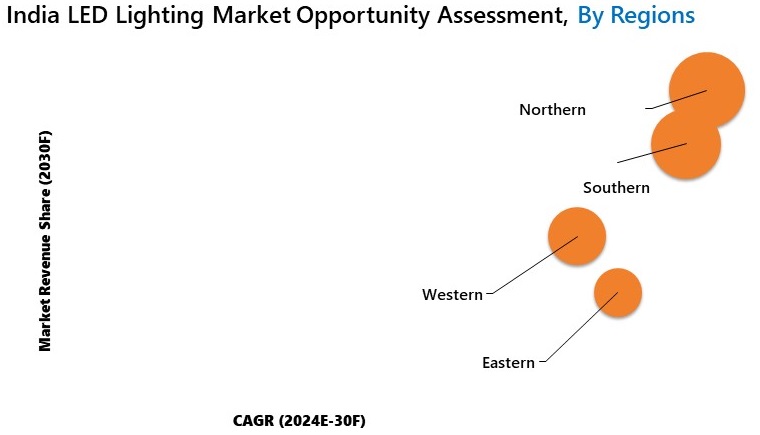
The Northern region is projected to experience rapid growth in the coming years, driven by rising peak electricity demand which is expected to increase from 73 GW in 2021-22 to 127 GW by 2031F-32F, the highest among all regions. This surge in demand, coupled with a steady influx of real estate projects, especially in Delhi-NCR, is anticipated to further boost the need for LED lighting products across the region in the coming years.
India LED Lighting Market Trends
The India LED Lighting Market has experienced significant expansion over time driven by multiple changing trends. Advancements and growing awareness about energy efficiency propel innovation and push market growth. Below are the key trends shaping LED lighting market in India:
Energy Efficiency Awareness: Due to lower power costs and environmental effects, two groups of energy users, residential and commercial, have started to pay attention to energy efficiency issues and are moving towards LED lighting.
Government Initiatives: The use of LEDs is being accelerated nationwide by initiatives like UJALA (Unnat Jyoti by Affordable LEDs for All) and infrastructure modernisation.
Demand for Smart Lighting: The overall growth in demand for smart lighting systems is being followed by the modernisation of smart cities and IoT-enabled infrastructure.
Cost-Effectiveness: As a result of production improvements and economies of scale, LED light prices are now more reasonably priced. This additional ease of adoption has spread rapidly in larger cities as well as in rural regions, tier-2 and tier-3 cities, and other places.
Expanding Uses: LED lighting is becoming widely used in industries including retail, healthcare, and automobiles, not just in homes and businesses. LEDs are used in automobile manufacture to improve visibility and aesthetics, while in the medical field, they are crucial for surgical procedures and patient care—mostly through improved illumination.
Investment Opportunities in the India LED Lighting Market
Smart Lighting Solutions: IoT and AI-driven technology is evolving the India LED Lighting Market From motion-sensing street lights to voice-controlled home lighting, investors can benefit from the growing demand for automated and energy-efficient solutions in residential and commercial spaces.
Rural Electrification Projects: Government initiatives to improve rural infrastructure have created a huge demand for cost-effective and durable LED lighting solutions. With millions of under-served households and businesses looking for affordable energy, companies investing in rural-friendly LED products will have large-scale deployment opportunities.
Energy Efficiency Programs: As sustainability and carbon footprint reduction become a concern, businesses and consumers are looking at energy-efficient lighting. Innovations like solar-powered LEDs and low-wattage solutions are gaining traction, this is a good investment avenue for eco-friendly and regulatory-compliant products.
Growth in Emerging Segments: Industries like agriculture and education are increasingly using LED lighting for specific applications. The rise of indoor farming has created a demand for grow lights and schools as well as universities are investing in flicker-free, high-efficiency LEDs to improve learning environments. These niche markets are untapped space for sector-specific LED solutions.
Export Potential: India’s competitive manufacturing ecosystem and growing global demand for cost-effective LED products make the country a key player in the global market. With increasing exports to the Middle East, Africa and Southeast Asia, investors can look at scaling up production and distribution for global reach.
Premium Lighting Segments: Urbanization and growing disposable income are driving demand for high-end, decorative and customisable LED lighting. From luxury home interiors to designer commercial spaces, the market for stylish, smart-enabled lighting solutions is growing, this is a good space for premium brands.
Leading Players in the India LED Lighting Market
India LED Lighting Market is controlled by several major players that create wealth through innovation, product diversification, and strategic market expansion. These companies fuel competition and growth by utilizing advanced technology and catering to changing consumer needs. Here are some key players that help shape the market:
Philips Lighting: This company is a leader in connecting smart lighting solutions worldwide, from devices to energy-efficient smart lighting solutions. It continues to remain on the leading edge of the market through sustainability and IoT-enabled lighting.
Havells India Ltd.: This is a well-established brand known for its comprehensive LED lighting portfolio, emphasising affordability, long-lasting performance, and eco-friendly solutions. Its strong distribution network enhances accessibility across urban and rural markets.
Crompton Greaves Consumer Electricals Ltd.: This is a trusted name in the industry, providing high-quality LED lighting with a focus on durability and energy efficiency. The brand is known for its customer-centric approach and reliable after-sales service.
SYSKA LED Lights: Staying up-to-date with both premium and mass-market LED solutions that deliver the best value for money, SYSKA LED lights set a new standard in LED solutions. Its widespread presence in metropolitan as well as semi-urban regions further strengthens its hold in the industry.
Wipro Consumer Lighting: This company is known as a frontrunner in smart lighting systems designed for modern workplaces and connected homes. Its expertise in intelligent automation and sustainable solutions aligns with the growing demand for high-tech LED products.
Government Regulations of The Report
Government rules have played a key role in shaping the India LED lighting industry. The Unnat Jyoti by Affordable LEDs for All (UJALA) plan, which started in 2015, has been crucial to push energy-saving lights across the country. UJALA gives out LED bulbs at lower prices, which has led to many more homes using them. This has helped save a lot of energy and cut down on carbon emissions.
Along with UJALA, the Street Lighting National Programme (SLNP) has been important in switching old streetlights to LED ones. This plan has made public lighting better and helped towns save a lot of energy. To boost the industry even more, the government has put into action the Production Linked Incentive (PLI) Scheme for White Goods, which includes LED lighting products. This scheme encourages domestic manufacturing by giving financial perks to companies that make components and sub-assemblies of LED lights. This helps cut down on imports and strengthens the local ecosystem. Also, the Energy Conservation Act of 2001, which was set up by the Bureau of Energy Efficiency (BEE) creates performance standards and labelling rules for appliances, including lighting products. When manufacturers follow these standards, they make sure they produce LED offerings that are safe and reliable for consumers to use.
Future Insights of the India LED Lighting Market
The LED lighting market in India is set to grow in the next few years. This growth is driven by expansion of cities, advance technology and rising awareness about saving energy. Smart lighting is getting more popular, and the use of the Internet of Things and better controls will likely propel change in the industry. Current trends show that people need custom designs and current styles of lights for homes and businesses. Additionally, more solar-powered LED lights are coming out, which fits with India's plan to use more clean energy. Investment in research will lead to new tech for different uses, from street lights to factory lights.
Key Attractiveness of the Report
- 10 Years Market Numbers.
- Historical Data Starting from 2020 to 2023.
- Base Year: 2023
- Forecast Data until 2030.
- Key Performance Indicators Impacting the Market.
- Major Upcoming Developments and Projects.
Key Highlights of the Report:
- India LED Lighting Market Overview
- India LED Lighting Market Outlook
- India LED Lighting Market Forecast
- Historical Data and Forecast of India LED Lighting Market Revenues for the Period 2020-2030F
- Historical Data and Forecast of Market Revenues, By Types, for the Period 2020-2030F
- Historical Data and Forecast of Market Revenues, By Applications, for the Period 2020-2030F
- Historical Data and Forecast of Market Revenues, By Sales Channels, for the Period 2020-2030F
- Historical Data and Forecast of Market Revenues, By Regions, for the Period 2020-2030F
- India LED Lighting Market Drivers and Restraints
- Industry Life Cycle
- Porter’s Five Force Analysis
- SWOT Analysis
- India LED Lighting Market Evolution & Trends
- Market Opportunity Assessment
- India LED Lighting Market Revenue Share, By Top B2B & B2C Companies
- Competitive Benchmarking
- Company Profiles
- Key Strategic Recommendations
Market Scope and Segmentation
Thereportprovides a detailed analysis of the following market segments:
By Types
- Lamps
- Luminaires
By Applications
- Indoor
- Outdoor
By Sales Channels
- B2C (includes Brick & Mortar and Ecommerce)
- B2B (includes Traditional Channels i.e. Distribution & Trade)
- Institutional (includes Private & Government Projects)
By Regions
- Northern (includes Ladakh, Jammu & Kashmir, Himachal Pradesh, Punjab, Haryana, Delhi, Rajasthan, Uttar Pradesh, Uttarakhand)
- Southern (includes Telangana, Andhra Pradesh, Karnataka, Kerala, Tamil Nadu)
- Eastern (includes Bihar, Odisha, Jharkhand, West Bengal, Sikkim, Meghalaya, Tripura, Mizoram, Manipur, Nagaland, Arunachal Pradesh, Assam)
- Western (includes Gujarat, Maharashtra, Goa, Madhya Pradesh, Chhattisgarh)