Argentina IT Services Market Size & Growth Rate (2026-2032)
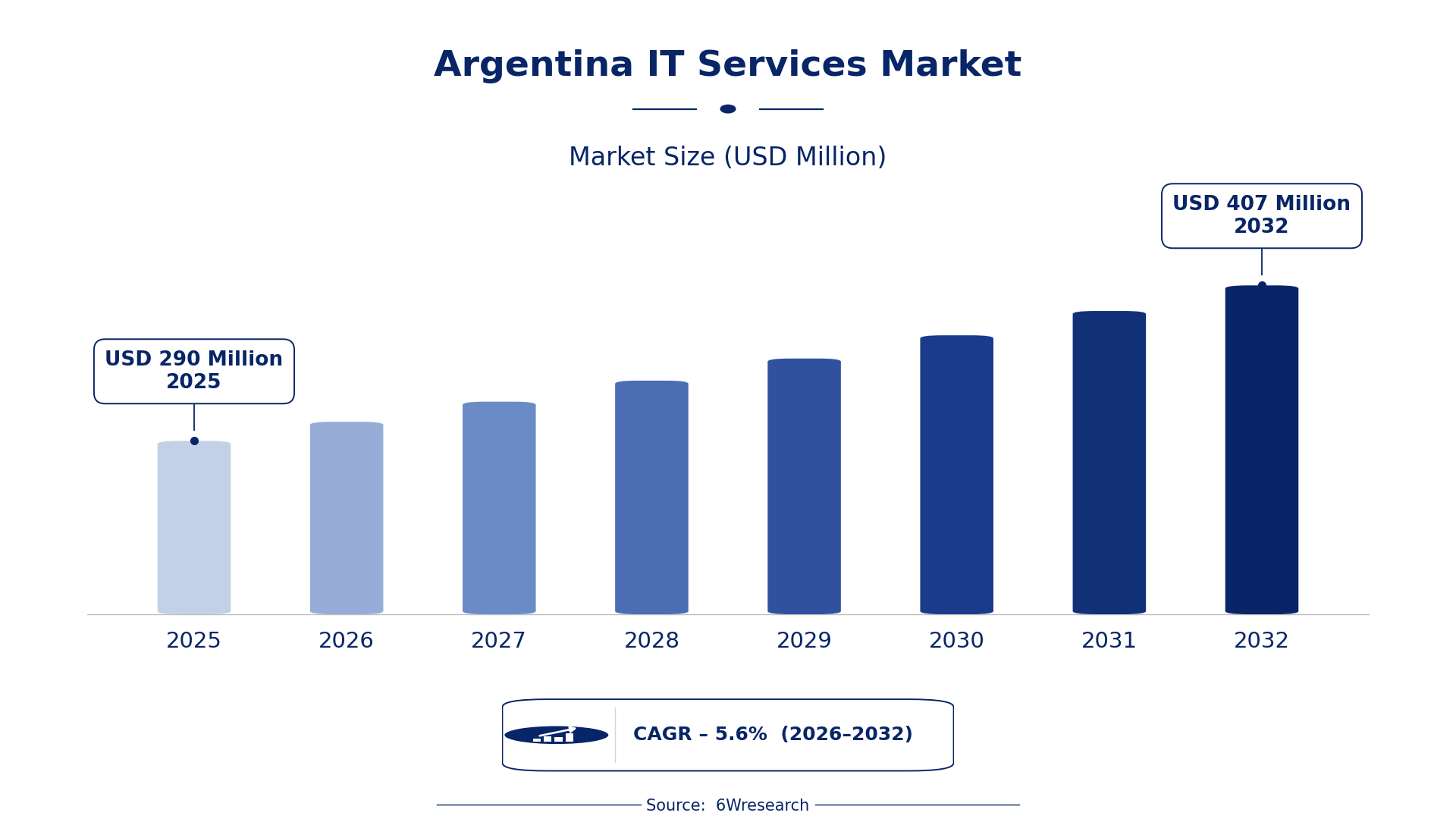
The Argentina IT Services Market was estimated at USD 290 Million in 2025 and is projected to reach USD 407 Million by 2032, growing at a CAGR of 5.6% from 2026 to 2032.
Argentina IT Services Market Synopsis
The Argentina IT Services Market is witnessing a surge in demand fueled by a strong push towards digital transformation. Businesses across multiple sectors are increasingly prioritizing technology investments to improve operational efficiency and customer engagement, leading to a broader adoption of IT service offerings.
Amidst this evolution, service providers are diversifying their portfolios to include consulting, system integration, and managed services. This shift aligns with the growing need for cloud computing and cybersecurity solutions, which are no longer optional but essential for businesses aiming to remain competitive in the current market.
Argentina IT Services Market Year-wise Growth Rate and Key Drivers
This graph illustrates the annual growth rates of the Argentina IT Services Market from 2021 to 2032, highlighting a steady upward trajectory and projected expansion over the forecast period.
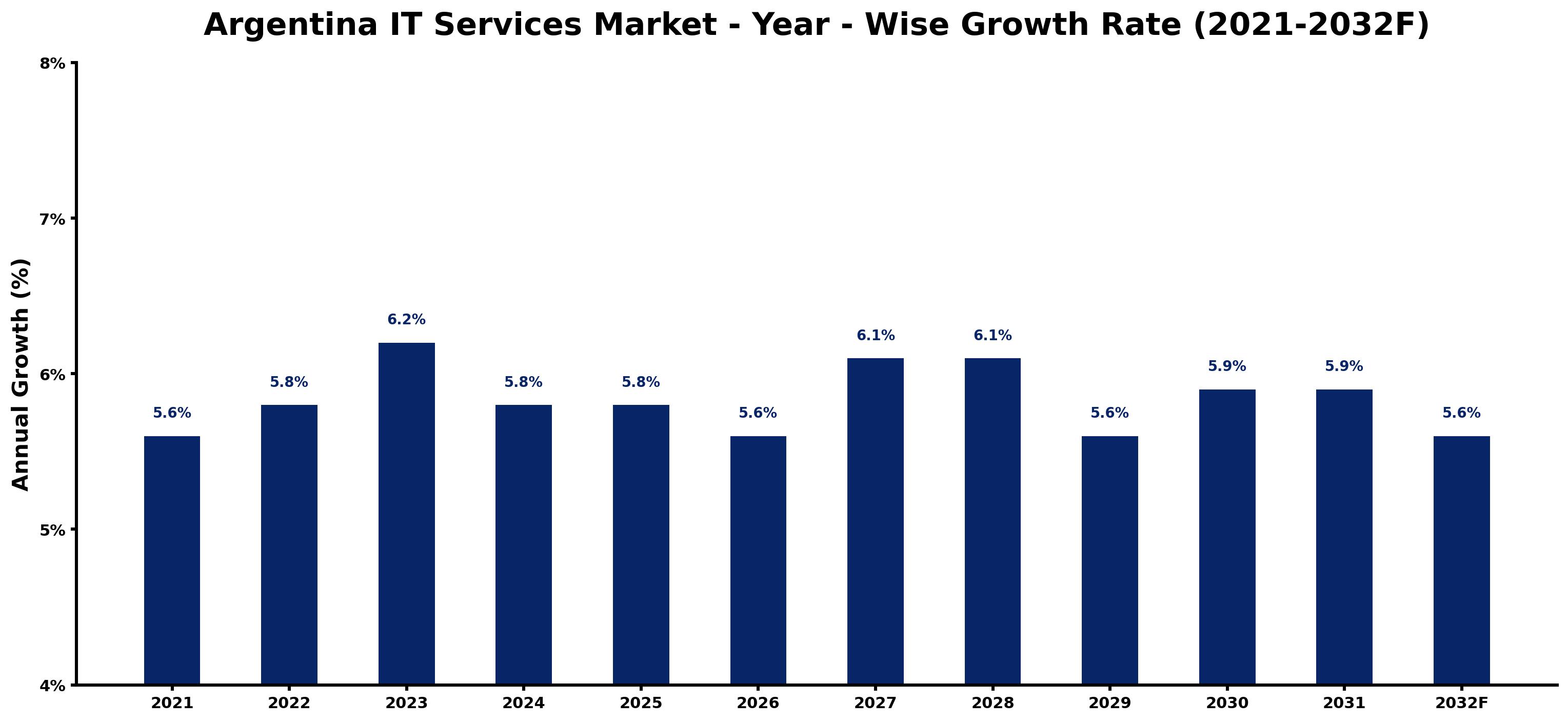
The table below presents the year‑wise growth rates along with the key drivers influencing the market
| Year | Growth Rate | Major Drivers |
| 2021 | 5.6% | Growth in fintech driving software development investments. |
| 2022 | 5.8% | Surge in e-commerce generating need for IT support. |
| 2023 | 6.2% | Increased adoption of digital payment solutions nationwide. |
| 2024 | 5.8% | Investment in cybersecurity solutions due to data breaches. |
| 2025 | 5.8% | Government programs promoting technology in education sectors. |
| 2026 | 5.6% | Demand for healthcare IT solutions amid digital health expansion. |
| 2027 | 6.1% | Rising interest in blockchain technology for local startups. |
| 2028 | 6.1% | Increased focus on telemedicine boosting IT service needs. |
| 2029 | 5.6% | Growth of local tech hubs fostering innovation ecosystems. |
| 2030 | 5.9% | Government grants supporting software development for SMEs. |
| 2031 | 5.9% | Rising digital literacy driving IT service demand. |
| 2032 | 5.6% | Boom in gaming development attracting local IT talent. |
Note: Market size estimations and growth projections presented in this report are based on 6Wresearch's proprietary forecasting methodology, utilizing the latest available industry data, government publications, and primary research inputs.
Argentina IT Services Market Key Takeaways
Below are some of the specific key takeaways from the market, including:
- Significant growth in demand for cloud computing and cybersecurity solutions across various industries.
- Outsourcing of IT services is increasingly common as businesses seek specialized expertise and cost savings.
- Emerging technologies such as IoT and big data analytics are creating new service opportunities.
- Challenges related to skills shortages and pricing pressures continue to impact service providers.
- Government initiatives are actively promoting the digital economy and enhancing infrastructure investments.
Evaluation of Restraints in Argentina IT Services Market
The Argentina IT Services Market faces notable constraints that hinder its full potential. A critical shortage of skilled professionals in areas like software development and cybersecurity presents a formidable barrier to growth. As companies ramp up their digital initiatives, the competition for top talent intensifies, leaving many businesses struggling to find adequate resources.
on top of that, aggressive pricing pressures driven by market competition mean that IT service providers must continually innovate while managing costs. This often leads to compromises in service quality or profit margins, creating a challenging environment for sustainable growth.
Argentina IT Services Market Trends
A noticeable trend in the Argentina IT Services Market is the rapid shift towards cloud-based solutions. Companies are increasingly adopting Software-as-a-Service (SaaS) and Infrastructure-as-a-Service (IaaS) models, which allows them to enhance operational agility and reduce costs. As cloud adoption accelerates, the need for associated consulting and integration services will only grow.
Additionally, the focus on cybersecurity has intensified, with businesses investing in more advanced security measures to protect sensitive data. This has created a robust demand for cybersecurity services, from risk assessment to incident response, and is expected to remain a key driver of market growth.
Argentina IT Services Market Opportunities
The landscape of opportunities within the Argentina IT Services Market is promising, particularly in the realms of digital transformation and cybersecurity. Organizations seeking to modernize their operations are on the lookout for service providers capable of delivering innovative solutions.
on top of that, the rise of artificial intelligence and machine learning is paving the way for new service offerings, from predictive analytics to automated IT management. As these technologies become more accessible, IT service providers that can harness their capabilities will find themselves at a distinct advantage.
Government Initiatives in the Argentina IT Services Market
Government initiatives play a crucial role in shaping the Argentina IT Services Market. The current regulatory focus aims to promote the digital economy and encourage innovation across various sectors. By investing in skills development and infrastructure, the government is working to create a conducive environment for both local and foreign IT service providers.
- A recently completed initiative focused on enhancing digital skills training across universities and technical institutes to address the skills gap.
- A current national digital infrastructure upgrade programme is in its rollout phase, aimed at improving broadband access across urban and rural areas.
- Planned public-private partnerships are expected to expand cloud computing adoption by incentivizing local businesses to adopt emerging technologies.
- A regulatory framework introduced in early 2025 mandates cybersecurity measures for critical industries to safeguard against increasing threats.
- Ongoing support for technology incubators and accelerators to promote start-ups in the IT services space and foster innovation.
Future Insights of the Argentina IT Services Market
Looking ahead, the Argentina IT Services Market is set to continue its upward trajectory through 2032. The increasing urgency for digital transformation across industries will drive demand for various IT services. Companies will prioritize strategic partnerships with service providers who can deliver cutting-edge solutions, especially in areas like cloud computing and cybersecurity.
As the market matures, the focus will shift towards integrating artificial intelligence and machine learning into existing services, enhancing operational efficiencies and creating new revenue streams. The government's commitment to fostering a digital economy will further bolster growth, positioning Argentina as a competitive player in the global IT services arena.
Argentina IT Services Market Latest Developments
Recent months have seen a flurry of activity within the Argentina IT Services Market, reflecting a dynamic sector responding to changing demands. Companies are increasingly aligning their service offerings with emerging technologies, particularly in cloud services and cybersecurity.
- A major technology vendor launched a new cybersecurity service in Q3 2025, focusing on small to medium-sized enterprises.
- An ongoing partnership between local universities and IT firms aims to develop a talent pipeline for the growing IT services sector, initiated in early 2025.
- A leading regional operator is currently rolling out a cloud service that integrates AI capabilities, with plans to expand access by late 2026.
- A new service platform focused on big data analytics was announced in mid-2025 and is expected to enhance businesses' decision-making processes.
- Upcoming initiatives include a nationwide cybersecurity awareness campaign scheduled for early 2026, aimed at educating businesses on best practices.
Argentina IT Services Market - Key Attractiveness of the Report
- 10 Years of Market Numbers
- Historical Data Starting from 2022 to 2025
- Base Year: 2025
- Forecast Data until 2032
- Key Performance Indicators Impacting the Market
- Major Upcoming Developments and Projects
Key Highlights of the Report:
- Argentina IT Services Market Outlook
- Market Size of Argentina IT Services Market, 2025
- Forecast of Argentina IT Services Market, 2032
- Historical Data and Forecast of Argentina IT Services Revenues & Volume for the Period 2022-2032F
- Argentina IT Services Market Trend Evolution
- Argentina IT Services Market Drivers and Challenges
- Argentina IT Services Price Trends
- Argentina IT Services Porter's Five Forces
- Argentina IT Services Industry Life Cycle
- Historical Data and Forecast of Argentina IT Services Market Revenues & Volume By Vertical for the Period 2022-2032F
- Historical Data and Forecast of Argentina IT Services Market Revenues & Volume By Government and defense for the Period 2022-2032F
- Historical Data and Forecast of Argentina IT Services Market Revenues & Volume By Banking, Financial Services, and Insurance (BFSI) for the Period 2022-2032F
- Historical Data and Forecast of Argentina IT Services Market Revenues & Volume By Healthcare for the Period 2022-2032F
- Historical Data and Forecast of Argentina IT Services Market Revenues & Volume By Media and entertainment for the Period 2022-2032F
- Historical Data and Forecast of Argentina IT Services Market Revenues & Volume By Consumer goods and retail for the Period 2022-2032F
- Historical Data and Forecast of Argentina IT Services Market Revenues & Volume By IT and telecom for the Period 2022-2032F
- Historical Data and Forecast of Argentina IT Services Market Revenues & Volume By Business Function for the Period 2022-2032F
- Historical Data and Forecast of Argentina IT Services Market Revenues & Volume By Human Resources for the Period 2022-2032F
- Historical Data and Forecast of Argentina IT Services Market Revenues & Volume By Finance and Accounting for the Period 2022-2032F
- Historical Data and Forecast of Argentina IT Services Market Revenues & Volume By Sales and Marketing for the Period 2022-2032F
- Historical Data and Forecast of Argentina IT Services Market Revenues & Volume By Supply Chain Management for the Period 2022-2032F
- Historical Data and Forecast of Argentina IT Services Market Revenues & Volume By Operations and Support for the Period 2022-2032F
- Historical Data and Forecast of Argentina IT Services Market Revenues & Volume By Manufacturing for the Period 2022-2032F
- Historical Data and Forecast of Argentina IT Services Market Revenues & Volume By Deployment Mode for the Period 2022-2032F
- Historical Data and Forecast of Argentina IT Services Market Revenues & Volume By On-premises for the Period 2022-2032F
- Historical Data and Forecast of Argentina IT Services Market Revenues & Volume By Cloud for the Period 2022-2032F
- Historical Data and Forecast of Argentina IT Services Market Revenues & Volume By Organization Size for the Period 2022-2032F
- Historical Data and Forecast of Argentina IT Services Market Revenues & Volume By Large enterprises for the Period 2022-2032F
- Historical Data and Forecast of Argentina IT Services Market Revenues & Volume By Small and Medium Enterprises (SMEs) for the Period 2022-2032F
- Historical Data and Forecast of Argentina IT Services Market Revenues & Volume By Service Type for the Period 2022-2032F
- Historical Data and Forecast of Argentina IT Services Market Revenues & Volume By Professional services for the Period 2022-2032F
- Historical Data and Forecast of Argentina IT Services Market Revenues & Volume By Managed services for the Period 2022-2032F
- Historical Data and Forecast of Argentina IT Services Market Revenues & Volume By Telecom services for the Period 2022-2032F
- Argentina IT Services Import Export Trade Statistics
- Market Opportunity Assessment By Vertical
- Market Opportunity Assessment By Business Function
- Market Opportunity Assessment By Deployment Mode
- Market Opportunity Assessment By Organization Size
- Market Opportunity Assessment By Service Type
- Argentina IT Services Top Companies Market Share
- Argentina IT Services Competitive Benchmarking By Technical and Operational Parameters
- Argentina IT Services Company Profiles
- Argentina IT Services Key Strategic Recommendations






































