Mexico IT Services Market Size & Growth Rate (2026-2032)
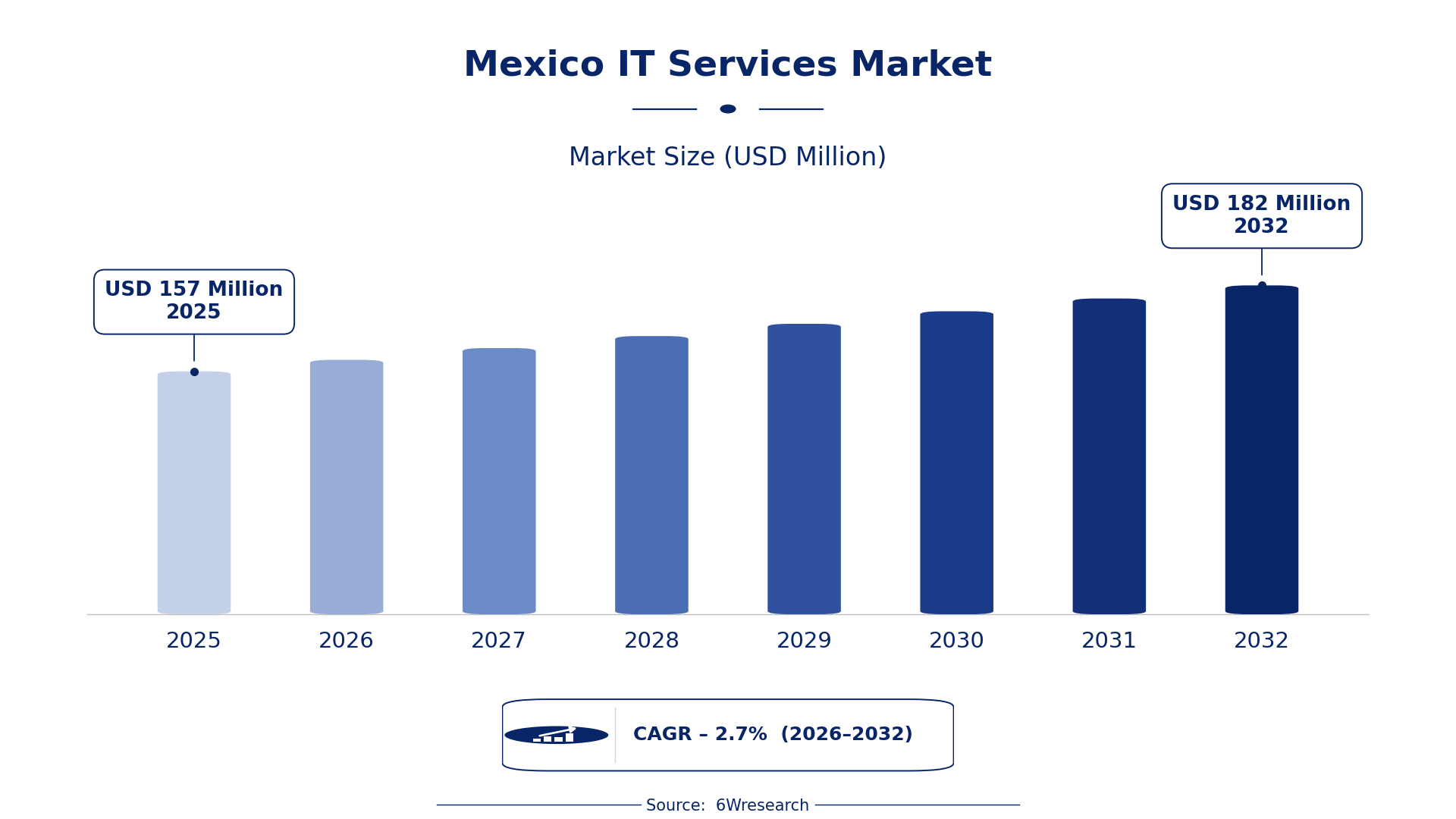
The Mexico IT Services Market was estimated at USD 157 Million in 2025 and is projected to reach USD 182 Million by 2032, growing at a CAGR of 2.7% from 2026 to 2032.
Mexico IT Services Market Synopsis
The Mexico IT services market is currently experiencing notable expansion, driven by rising demands for software development, IT consulting, and managed services. Organizations are increasingly recognizing the need for IT solutions to enhance their digital transformation efforts, streamline operations, and gain a competitive edge.
This growth is underpinned by Mexico's well-educated IT workforce and a business environment that is becoming increasingly conducive to technology adoption. Government initiatives are bolstering investment in IT services, signaling a positive outlook for the sector as it aligns with global trends toward digital transformation.
Mexico IT Services Market Year-wise Growth Rate and Key Drivers
This graph illustrates the annual growth rates of the Mexico IT Services Market from 2021 to 2032, highlighting a steady upward trajectory and projected expansion over the forecast period.
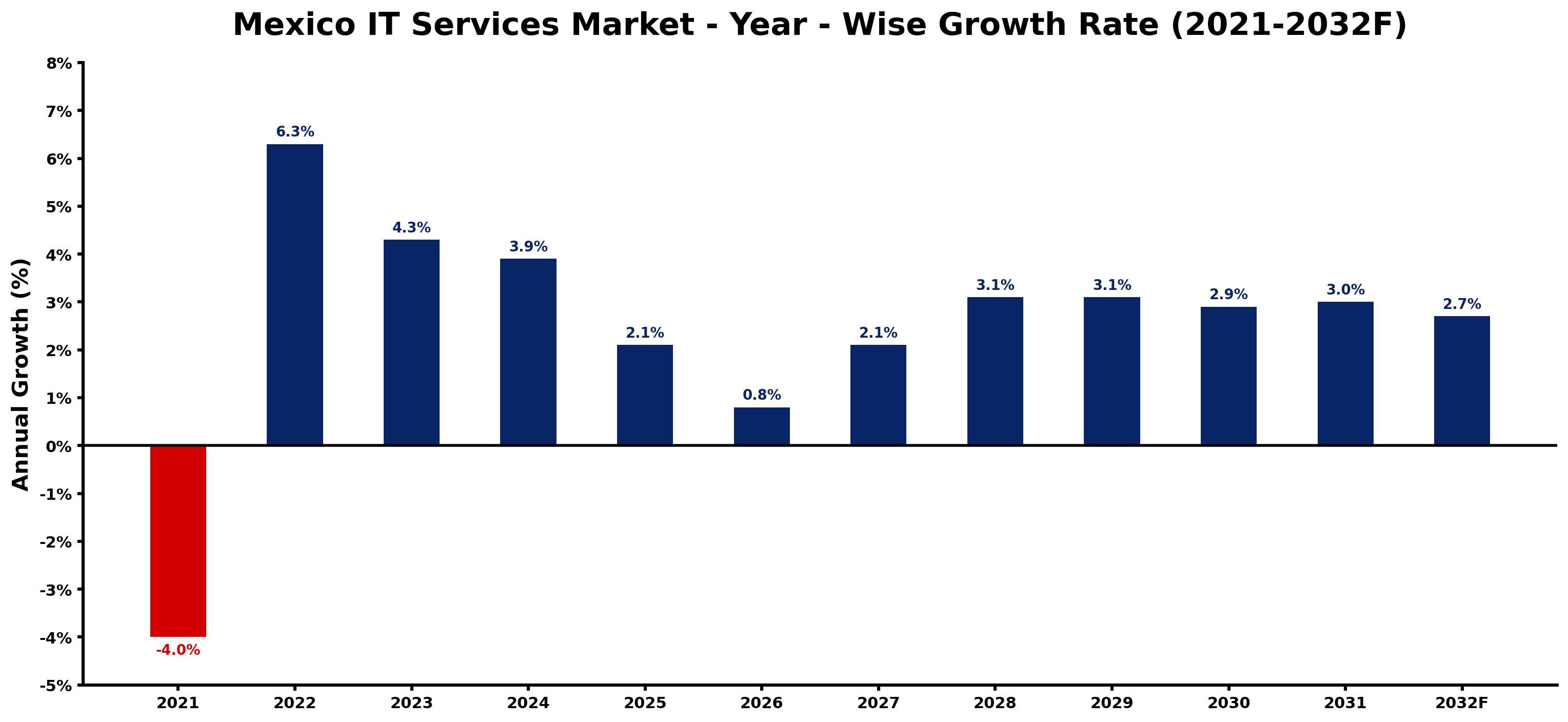
The table below presents the year‑wise growth rates along with the key drivers influencing the market
| Year | Growth Rate | Major Drivers |
| 2021 | -4.0% | Pandemic restrictions hindered IT service adoption rates. |
| 2022 | 6.3% | Government digitalization plans accelerate IT service sector growth. |
| 2023 | 4.3% | Rising fintech startups driving demand for IT innovations. |
| 2024 | 3.9% | Telecom reforms enhancing connectivity spur IT service adoption. |
| 2025 | 2.1% | Increased investment in smart manufacturing boosts IT services. |
| 2026 | 0.8% | Push for e-governance increases IT infrastructure requirements. |
| 2027 | 2.1% | Local tech talent development initiatives enhance service capabilities. |
| 2028 | 3.1% | Surge in remote work fostering IT services necessity. |
| 2029 | 3.1% | Healthcare digitization efforts stimulate IT service provision. |
| 2030 | 2.9% | Manufacturing sector automation drives new IT service needs. |
| 2031 | 3.0% | Emerging blockchain applications create niche IT service opportunities. |
| 2032 | 2.7% | Educational institutions adopting technology fuels IT service requirements. |
Note: Market size estimations and growth projections presented in this report are based on 6Wresearch's proprietary forecasting methodology, utilizing the latest available industry data, government publications, and primary research inputs.
Mexico IT Services Market Key Takeaways
Below are some of the specific key takeaways from the market, including:
- The demand for cloud computing and managed services is driving significant market growth.
- Companies are outsourcing IT services to enhance efficiency and reduce operational costs.
- Regulatory compliance remains a critical focus for businesses engaging in IT services.
- Investment in local talent development is essential to address the ongoing talent shortage.
- Emerging technologies are reshaping service offerings and client expectations.
Evaluation of Restraints in Mexico IT Services Market
While the Mexico IT services market is on an upward trajectory, several constraints are hindering its full potential. Intense competition from established global IT service providers makes it challenging for local firms to capture market share. Economic fluctuations can create uncertainty, impacting demand for IT services.
Additionally, the talent shortage in critical areas like cybersecurity and data analytics poses a significant hurdle. Companies must invest in ongoing workforce training and development to keep pace with technological advancements, which can strain resources.
Mexico IT Services Market Trends
The shift towards cloud-based solutions continues to gain momentum, with businesses prioritizing flexibility and scalability. IT service providers are increasingly adopting agile methodologies to improve service delivery and responsiveness to client needs. on top of that, there is a marked trend toward automation and artificial intelligence in IT services, enhancing efficiency and reducing operational costs.
Additionally, businesses are focusing on cybersecurity, recognizing the growing threats in the digital space. As a result, IT service providers are enhancing their offerings to include comprehensive security solutions to protect client data and maintain compliance with regulatory requirements.
Mexico IT Services Market Opportunities
Opportunities abound in the Mexico IT services market, particularly in sectors such as finance, healthcare, and manufacturing. The digital transformation initiatives in these industries are creating a demand for specialized IT solutions that improve operational efficiency and customer engagement. on top of that, the increasing adoption of IoT devices presents opportunities for companies to develop innovative service offerings.
Investments in smart city projects and infrastructure upgrades are also expected to generate demand for IT services. As the government prioritizes digital infrastructure, IT service providers can capitalize on public-sector contracts that align with these initiatives.
Government Initiatives in the Mexico IT Services Market
Government policy plays a crucial role in shaping the Mexico IT services market, focusing on fostering a competitive environment and enhancing digital infrastructure. Recent initiatives are aimed at supporting local talent development and attracting foreign investment, which is essential for the market's growth. These policies help create a favorable regulatory framework that encourages innovation and technology adoption across sectors.
- A national digital infrastructure upgrade programme launched in early 2025 aims to improve internet access across urban and rural areas.
- Currently ongoing initiatives include a public-private partnership focused on enhancing cybersecurity measures for businesses.
- A regulatory framework introduced in 2025 mandating billing transparency to promote trust between IT service providers and clients.
- A planned public initiative expected to bolster local tech talent development by establishing new training programs in collaboration with educational institutions, set to begin in mid-2026.
- Investment incentives for foreign IT service firms are currently being promoted to attract new players to the market.
Future Insights of the Mexico IT Services Market
Looking ahead to 2026-2032, the Mexico IT services market is set for steady growth driven by ongoing digital transformation across industries. Companies will increasingly seek to enhance their IT capabilities through cloud solutions and cybersecurity measures. Additionally, the emphasis on local talent development will continue to shape the workforce, addressing the skills gap and fostering innovation.
As the government rolls out infrastructure projects and enhances regulatory frameworks, the market will likely attract more foreign investment. This influx of capital will further catalyze service development and technology adoption, positioning Mexico as a competitive player in the global IT services arena.
Mexico IT Services Market Latest Developments
In the past year, the Mexico IT services market has witnessed a flurry of activity, reflecting its vibrant growth trajectory. Companies have been expanding their service portfolios, focusing on advanced technologies such as AI and machine learning. Partnerships between educational institutions and IT firms are also gaining traction, aimed at bolstering the local talent pool.
- A major technology vendor announced the rollout of a new cloud-based service aimed at small and medium enterprises, launched in Q3 2025.
- An initiative focusing on upskilling IT professionals in cybersecurity began in early 2025 and remains underway, addressing the critical talent shortage.
- A regional operator has commenced an expansion project expected to enhance service delivery in underserved areas, set to be completed by late 2026.
- In late 2025, a leading consulting firm introduced a comprehensive digital transformation package tailored for the manufacturing sector, gaining positive market feedback.
- A planned partnership between the government and private sector to develop a cybersecurity training center is expected to kick off in early 2027.
Mexico IT Services Market - Key Attractiveness of the Report
- 10 Years of Market Numbers
- Historical Data Starting from 2022 to 2025
- Base Year: 2025
- Forecast Data until 2032
- Key Performance Indicators Impacting the Market
- Major Upcoming Developments and Projects
Key Highlights of the Report:
- Mexico IT Services Market Outlook
- Market Size of Mexico IT Services Market, 2025
- Forecast of Mexico IT Services Market, 2032
- Historical Data and Forecast of Mexico IT Services Revenues & Volume for the Period 2022-2032F
- Mexico IT Services Market Trend Evolution
- Mexico IT Services Market Drivers and Challenges
- Mexico IT Services Price Trends
- Mexico IT Services Porter's Five Forces
- Mexico IT Services Industry Life Cycle
- Historical Data and Forecast of Mexico IT Services Market Revenues & Volume By Vertical for the Period 2022-2032F
- Historical Data and Forecast of Mexico IT Services Market Revenues & Volume By Government and defense for the Period 2022-2032F
- Historical Data and Forecast of Mexico IT Services Market Revenues & Volume By Banking, Financial Services, and Insurance (BFSI) for the Period 2022-2032F
- Historical Data and Forecast of Mexico IT Services Market Revenues & Volume By Healthcare for the Period 2022-2032F
- Historical Data and Forecast of Mexico IT Services Market Revenues & Volume By Media and entertainment for the Period 2022-2032F
- Historical Data and Forecast of Mexico IT Services Market Revenues & Volume By Consumer goods and retail for the Period 2022-2032F
- Historical Data and Forecast of Mexico IT Services Market Revenues & Volume By IT and telecom for the Period 2022-2032F
- Historical Data and Forecast of Mexico IT Services Market Revenues & Volume By Business Function for the Period 2022-2032F
- Historical Data and Forecast of Mexico IT Services Market Revenues & Volume By Human Resources for the Period 2022-2032F
- Historical Data and Forecast of Mexico IT Services Market Revenues & Volume By Finance and Accounting for the Period 2022-2032F
- Historical Data and Forecast of Mexico IT Services Market Revenues & Volume By Sales and Marketing for the Period 2022-2032F
- Historical Data and Forecast of Mexico IT Services Market Revenues & Volume By Supply Chain Management for the Period 2022-2032F
- Historical Data and Forecast of Mexico IT Services Market Revenues & Volume By Operations and Support for the Period 2022-2032F
- Historical Data and Forecast of Mexico IT Services Market Revenues & Volume By Manufacturing for the Period 2022-2032F
- Historical Data and Forecast of Mexico IT Services Market Revenues & Volume By Deployment Mode for the Period 2022-2032F
- Historical Data and Forecast of Mexico IT Services Market Revenues & Volume By On-premises for the Period 2022-2032F
- Historical Data and Forecast of Mexico IT Services Market Revenues & Volume By Cloud for the Period 2022-2032F
- Historical Data and Forecast of Mexico IT Services Market Revenues & Volume By Organization Size for the Period 2022-2032F
- Historical Data and Forecast of Mexico IT Services Market Revenues & Volume By Large enterprises for the Period 2022-2032F
- Historical Data and Forecast of Mexico IT Services Market Revenues & Volume By Small and Medium Enterprises (SMEs) for the Period 2022-2032F
- Historical Data and Forecast of Mexico IT Services Market Revenues & Volume By Service Type for the Period 2022-2032F
- Historical Data and Forecast of Mexico IT Services Market Revenues & Volume By Professional services for the Period 2022-2032F
- Historical Data and Forecast of Mexico IT Services Market Revenues & Volume By Managed services for the Period 2022-2032F
- Historical Data and Forecast of Mexico IT Services Market Revenues & Volume By Telecom services for the Period 2022-2032F
- Mexico IT Services Import Export Trade Statistics
- Market Opportunity Assessment By Vertical
- Market Opportunity Assessment By Business Function
- Market Opportunity Assessment By Deployment Mode
- Market Opportunity Assessment By Organization Size
- Market Opportunity Assessment By Service Type
- Mexico IT Services Top Companies Market Share
- Mexico IT Services Competitive Benchmarking By Technical and Operational Parameters
- Mexico IT Services Company Profiles
- Mexico IT Services Key Strategic Recommendations






































