United Kingdom (UK) Manufacturing Analytics Market Size & Growth Rate (2026-2032)
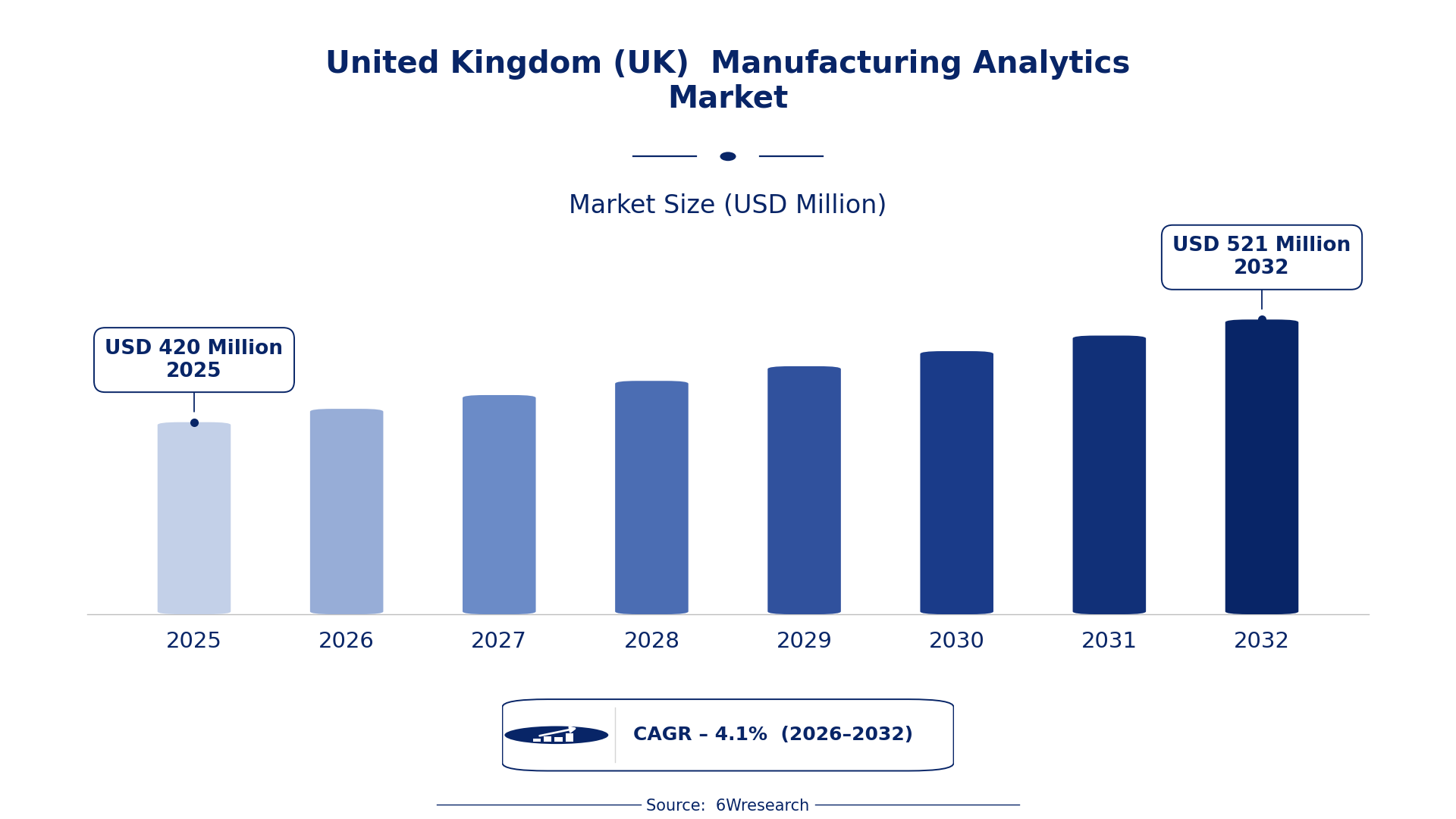
The United Kingdom (UK) Manufacturing Analytics Market was estimated at USD 420 Million in 2025 and is projected to reach USD 521 Million by 2032, growing at a CAGR of 4.1% from 2026 to 2032.
United Kingdom (UK) Manufacturing Analytics Market Synopsis
The UK manufacturing analytics market has witnessed a surge in interest driven by the increasing integration of Industry 4.0 technologies. Companies are realizing the potential of data analytics in streamlining operations, improving production efficiency, and enhancing product quality. However, this momentum is juxtaposed with challenges, including the integration of legacy systems and the skills gap in data analytics.
As manufacturers in the UK lean into advanced analytics tools, the focus has shifted toward real-time data insights and predictive maintenance. This approach not only optimizes operational efficiency but also aligns with governmental policies promoting data-driven decision-making, ensuring that the UK remains competitive in the global manufacturing arena.
United Kingdom (UK) Manufacturing Analytics Market Year-wise Growth Rate and Key Drivers
This graph illustrates the annual growth rates of the United Kingdom (UK) Manufacturing Analytics Market from 2021 to 2032, highlighting a steady upward trajectory and projected expansion over the forecast period.
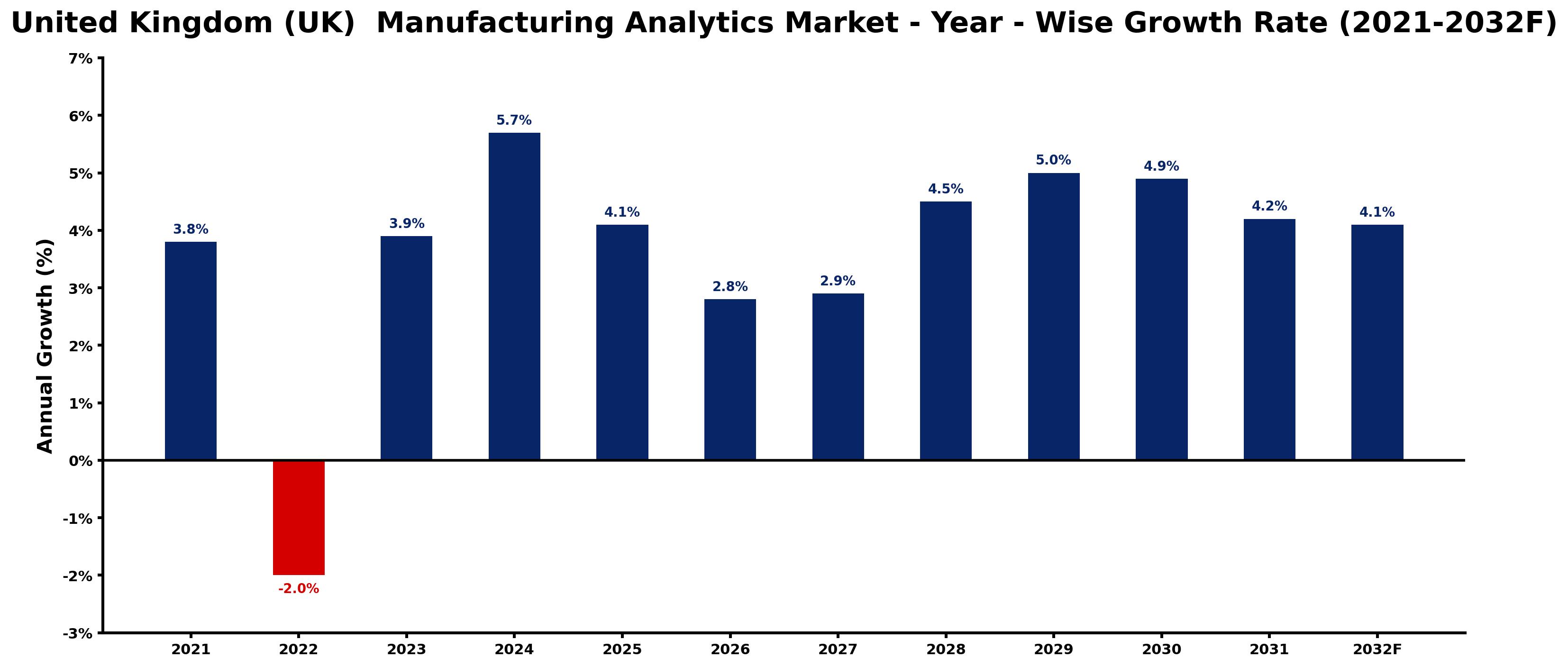
The table below presents the year‑wise growth rates along with the key drivers influencing the market
| Year | Growth Rate | Major Drivers |
| 2021 | 3.8% | UK government's 'Industry 4.0' strategy driving digital transformation |
| 2022 | -2.0% | Brexit-related restrictions hampered manufacturing data access. |
| 2023 | 3.9% | Increased focus on predictive maintenance in manufacturing sectors |
| 2024 | 5.7% | Rising adoption of AI-driven analytics in local factories |
| 2025 | 4.1% | Implementation of UK Manufacturing Technology Centre initiatives |
| 2026 | 2.8% | Surge in domestic manufacturing due to Brexit opportunities |
| 2027 | 2.9% | Investment in smart manufacturing technologies by government grants |
| 2028 | 4.5% | Growing emphasis on sustainability practices in British manufacturing |
| 2029 | 5.0% | Heightened need for supply chain visibility post-pandemic |
| 2030 | 4.9% | Integration of IoT solutions in UK manufacturing processes |
| 2031 | 4.2% | Support for small manufacturers through innovation vouchers |
| 2032 | 4.1% | Emergence of cloud-based data solutions for local producers |
Note: Market size estimations and growth projections presented in this report are based on 6Wresearch's proprietary forecasting methodology, utilizing the latest available industry data, government publications, and primary research inputs.
United Kingdom (UK) Manufacturing Analytics Market Key Takeaways
Below are some of the specific key takeaways from the market, including:
- The market is projected to grow from USD 420 Million in 2025 to USD 521 Million by 2032.
- Industry 4.0 technologies are central to the advancements in manufacturing analytics.
- Real-time data insights are becoming crucial for predictive maintenance and operational efficiency.
- Data privacy and compliance remain pressing concerns amid increasing data usage.
- Skills shortages in data analytics pose challenges to full market potential realization.
Evaluation of Restraints in United Kingdom (UK) Manufacturing Analytics Market
Despite the promising outlook, the UK manufacturing analytics market faces notable constraints. One major hurdle is the challenge of integrating disparate data sources, particularly when dealing with legacy systems that do not easily adapt to new technologies. This fragmentation can lead to inefficiencies and missed opportunities for optimization. on top of that, ensuring data security and compliance with privacy regulations adds another layer of complexity for manufacturers looking to leverage analytics. Coupled with a prevailing skills gap in data analytics, these factors can severely impact the operational efficiency and decision-making capabilities of manufacturers across various sectors.
United Kingdom (UK) Manufacturing Analytics Market Trends
Several trends are currently shaping the UK manufacturing analytics market. The adoption of artificial intelligence and machine learning technologies is accelerating, with manufacturers increasingly using these tools for predictive analytics. Additionally, there's a growing emphasis on sustainability, leading companies to utilize analytics for optimizing resource usage and reducing waste. The demand for real-time analytics is also on the rise, as businesses seek to enhance responsiveness to market changes and operational disruptions.
United Kingdom (UK) Manufacturing Analytics Market Opportunities
The future holds substantial growth and investment opportunities within the UK manufacturing analytics market. Companies that prioritize the upskilling of their workforce in data analytics will be better positioned to harness the full potential of these technologies. on top of that, partnerships between technology providers and manufacturers can foster innovation, particularly in developing tailored analytics solutions. The ongoing push for Industry 4.0 presents a ripe environment for integrating advanced analytics into traditional manufacturing processes, driving efficiency and productivity gains.
Government Initiatives in the United Kingdom (UK) Manufacturing Analytics Market
Government policy in the UK is increasingly supportive of advanced analytics and Industry 4.0 technologies, which significantly influences the manufacturing analytics market. Regulatory frameworks are designed to ensure data privacy while encouraging the adoption of data-driven decision-making. These policies are crucial as they create an environment that fosters innovation and enhances productivity across manufacturing sectors.
- A recently completed initiative launched the "Smart Manufacturing Programme," focusing on funding projects that integrate advanced analytics and IoT technologies.
- A currently ongoing initiative is the "UK Digital Strategy," which aims to enhance digital skills in the workforce, particularly in data analytics.
- Upcoming plans include a "Manufacturing Innovation Fund" set to be introduced in 2026, aimed at supporting research and development in analytics technologies.
- Current regulatory updates are emphasizing data transparency and cybersecurity, addressing critical concerns for manufacturers utilizing analytics.
- Another ongoing initiative involves collaboration with industry stakeholders to develop best practices for implementing analytics in manufacturing processes.
Future Insights of the United Kingdom (UK) Manufacturing Analytics Market
Looking ahead to 2026-2032, the UK manufacturing analytics market is likely to experience steady growth fueled by ongoing technological advancements. As manufacturers increasingly recognize the value of data-driven strategies, the demand for advanced analytics tools is set to rise. Additionally, the integration of AI and machine learning will likely redefine traditional manufacturing processes, leading to enhanced operational efficiencies and reduced costs. The focus on sustainability and resource optimization will further drive innovation in analytics applications, ensuring that the UK remains competitive on the global stage.
United Kingdom (UK) Manufacturing Analytics Market Latest Developments
Recent months have seen a flurry of activity within the UK manufacturing analytics market, characterized by significant developments that reflect a growing commitment to data-driven methodologies. Manufacturers are increasingly investing in advanced analytics tools and technologies to enhance operational efficiency and product quality. This trend underscores the market's momentum and the increasing recognition of analytics as a core component of manufacturing strategy.
- A new analytics platform was launched in early 2025, offering predictive maintenance features designed specifically for the manufacturing sector.
- An ongoing project started in mid-2025 focuses on integrating AI-driven analytics into supply chain management, with promising early results.
- A planned initiative aims to establish a network of manufacturing analytics centers across the UK, expected to kick off in late 2026.
- A partnership between technology providers and manufacturers was announced in early 2025, focusing on developing tailored analytics solutions for small and medium-sized enterprises.
- A service upgrade currently underway will enhance data visualization capabilities for existing analytics tools, aimed for completion by mid-2026.
United Kingdom (UK) Manufacturing Analytics Market - Key Attractiveness of the Report
- 10 Years of Market Numbers
- Historical Data Starting from 2022 to 2025
- Base Year: 2025
- Forecast Data until 2032
- Key Performance Indicators Impacting the Market
- Major Upcoming Developments and Projects
Key Highlights of the Report:
- United Kingdom (UK) Manufacturing Analytics Market Outlook
- Market Size of United Kingdom (UK) Manufacturing Analytics Market, 2025
- Forecast of United Kingdom (UK) Manufacturing Analytics Market, 2032
- Historical Data and Forecast of United Kingdom (UK) Manufacturing Analytics Revenues & Volume for the Period 2022-2032F
- United Kingdom (UK) Manufacturing Analytics Market Trend Evolution
- United Kingdom (UK) Manufacturing Analytics Market Drivers and Challenges
- United Kingdom (UK) Manufacturing Analytics Price Trends
- United Kingdom (UK) Manufacturing Analytics Porter's Five Forces
- United Kingdom (UK) Manufacturing Analytics Industry Life Cycle
- Historical Data and Forecast of United Kingdom (UK) Manufacturing Analytics Market Revenues & Volume By Type for the Period 2022-2032F
- Historical Data and Forecast of United Kingdom (UK) Manufacturing Analytics Market Revenues & Volume By Software for the Period 2022-2032F
- Historical Data and Forecast of United Kingdom (UK) Manufacturing Analytics Market Revenues & Volume By Service for the Period 2022-2032F
- Historical Data and Forecast of United Kingdom (UK) Manufacturing Analytics Market Revenues & Volume By Deployment Models for the Period 2022-2032F
- Historical Data and Forecast of United Kingdom (UK) Manufacturing Analytics Market Revenues & Volume By On-premises for the Period 2022-2032F
- Historical Data and Forecast of United Kingdom (UK) Manufacturing Analytics Market Revenues & Volume By On-demand for the Period 2022-2032F
- Historical Data and Forecast of United Kingdom (UK) Manufacturing Analytics Market Revenues & Volume By Applications for the Period 2022-2032F
- Historical Data and Forecast of United Kingdom (UK) Manufacturing Analytics Market Revenues & Volume By Predictive maintenance & asset management for the Period 2022-2032F
- Historical Data and Forecast of United Kingdom (UK) Manufacturing Analytics Market Revenues & Volume By Inventory management for the Period 2022-2032F
- Historical Data and Forecast of United Kingdom (UK) Manufacturing Analytics Market Revenues & Volume By Supply chain planning & procurement for the Period 2022-2032F
- Historical Data and Forecast of United Kingdom (UK) Manufacturing Analytics Market Revenues & Volume By Energy management for the Period 2022-2032F
- Historical Data and Forecast of United Kingdom (UK) Manufacturing Analytics Market Revenues & Volume By Emergency management for the Period 2022-2032F
- Historical Data and Forecast of United Kingdom (UK) Manufacturing Analytics Market Revenues & Volume By Sales & customer management for the Period 2022-2032F
- Historical Data and Forecast of United Kingdom (UK) Manufacturing Analytics Market Revenues & Volume By Other applications for the Period 2022-2032F
- Historical Data and Forecast of United Kingdom (UK) Manufacturing Analytics Market Revenues & Volume By Industry Vertical for the Period 2022-2032F
- Historical Data and Forecast of United Kingdom (UK) Manufacturing Analytics Market Revenues & Volume By Automotive & aerospace manufacturing for the Period 2022-2032F
- Historical Data and Forecast of United Kingdom (UK) Manufacturing Analytics Market Revenues & Volume By Electronics equipment manufacturing for the Period 2022-2032F
- Historical Data and Forecast of United Kingdom (UK) Manufacturing Analytics Market Revenues & Volume By Food & beverages manufacturing for the Period 2022-2032F
- Historical Data and Forecast of United Kingdom (UK) Manufacturing Analytics Market Revenues & Volume By Chemicals & materials manufacturing for the Period 2022-2032F
- Historical Data and Forecast of United Kingdom (UK) Manufacturing Analytics Market Revenues & Volume By Machinery & industrial equipment manufacturing for the Period 2022-2032F
- Historical Data and Forecast of United Kingdom (UK) Manufacturing Analytics Market Revenues & Volume By Pharma and life sciences for the Period 2022-2032F
- Historical Data and Forecast of United Kingdom (UK) Manufacturing Analytics Market Revenues & Volume By Paper, pulp, plastic and rubber manufacturing for the Period 2022-2032F
- Historical Data and Forecast of United Kingdom (UK) Manufacturing Analytics Market Revenues & Volume By Others for the Period 2022-2032F
- United Kingdom (UK) Manufacturing Analytics Import Export Trade Statistics
- Market Opportunity Assessment By Type
- Market Opportunity Assessment By Deployment Models
- Market Opportunity Assessment By Applications
- Market Opportunity Assessment By Industry Vertical
- United Kingdom (UK) Manufacturing Analytics Top Companies Market Share
- United Kingdom (UK) Manufacturing Analytics Competitive Benchmarking By Technical and Operational Parameters
- United Kingdom (UK) Manufacturing Analytics Company Profiles
- United Kingdom (UK) Manufacturing Analytics Key Strategic Recommendations






































