United Kingdom (UK) Milk Protein Market Size, Share & Growth Rate
The United Kingdom (UK) Milk Protein Market was estimated at USD 490 Million in 2025 and is projected to reach USD 609 Million by 2032, growing at a CAGR of 3.2% from 2026 to 2032. This upward trajectory is primarily driven by rising consumer awareness regarding the nutritional benefits of milk proteins, particularly in sports nutrition and functional foods. Additionally, innovations in protein extraction and processing technologies continue to enhance product offerings, catering to an increasingly health-conscious demographic.
United Kingdom (UK) Milk Protein Market Year-wise Growth Rate and Key Drivers
This graph highlights how the United Kingdom (UK) Milk Protein Market has steadily grown over the years, supported by major growth factors.
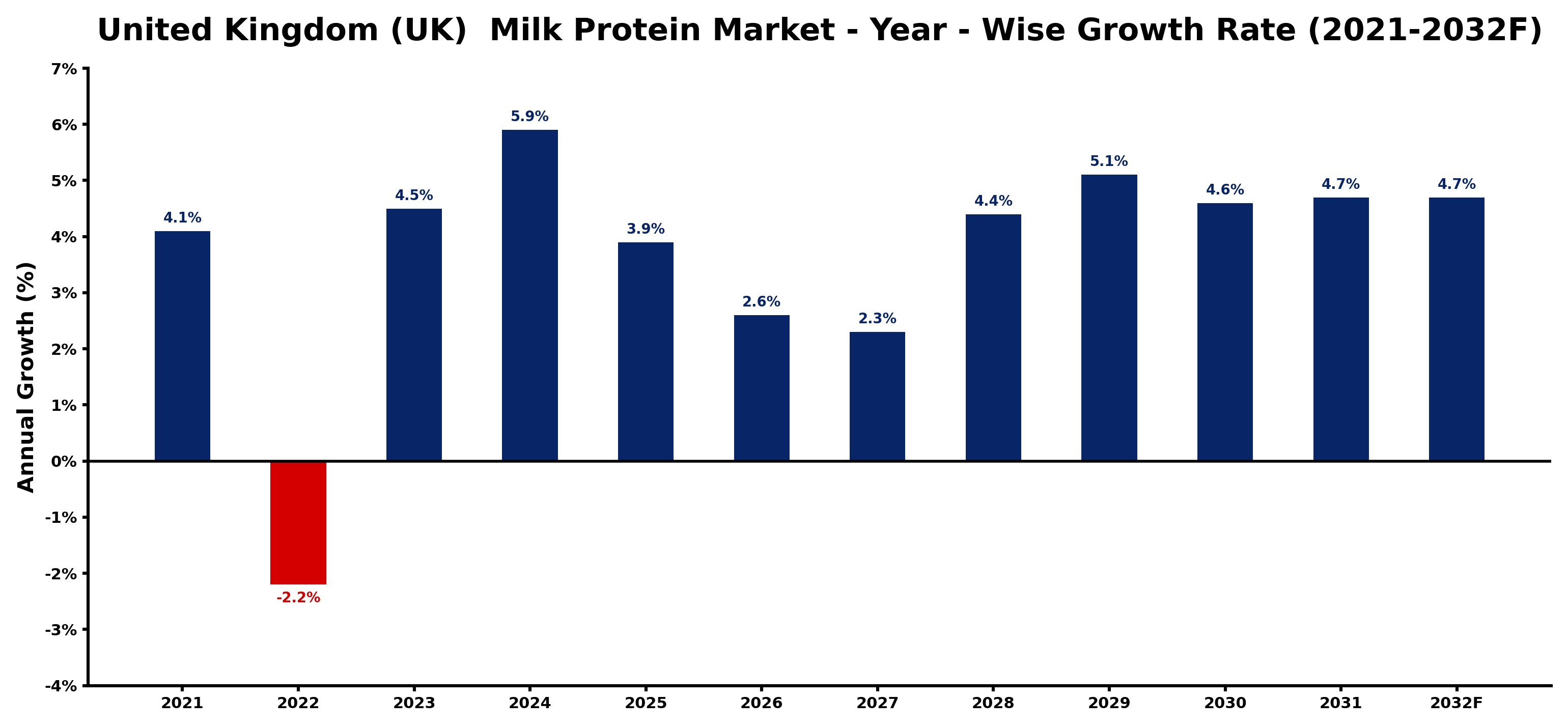
The table below presents the year‑wise growth rates along with the key drivers influencing the market
| Year | Growth Rate | Major Drivers |
| 2021 | 4.1% | Regional dairy processing plants expand capacity to meet export demand |
| 2022 | -2.2% | Reduced manufacturing investments weakened domestic milk protein production capacity |
| 2023 | 4.5% | Upgraded dairy processing facilities enhanced milk protein production efficiency |
| 2024 | 5.9% | Advanced filtration technology adoption boosts milk protein processing efficiency |
| 2025 | 3.9% | Export driven milk protein demand boosted UK dairy processing capacity |
| 2026 | 2.6% | Increased dairy export demand boosts milk protein production capacity |
| 2027 | 2.3% | Advanced filtration technologies boosted milk protein production efficiency |
| 2028 | 4.4% | Improved dairy processing technologies enhanced milk protein extraction efficiency |
| 2029 | 5.1% | New processing plants boost domestic milk protein production capacity |
| 2030 | 4.6% | Increased dairy processing capacity supports local milk protein production |
| 2031 | 4.7% | Investment in advanced processing technologies boosts milk protein output |
| 2032 | 4.7% | Milk protein processing plant upgrades drive local supply chain resilience |
Note - Market size estimations and growth projections presented in this report are based on 6Wresearch’s advanced forecasting approach, validated with industry datasets as of June 2026.
United Kingdom (UK) Milk Protein Market Synopsis
In the UK, the milk protein market is rapidly evolving, characterized by a marked increase in demand across various sectors, including dietary supplements and functional food ingredients. As consumers prioritize high-quality protein sources, dairy proteins such as casein and whey are becoming essential components in both daily diets and specialized nutrition products.
Recent trends indicate a growing inclination towards clean label products, where consumers seek transparency in sourcing and processing. This demand is propelling the market toward sustainable practices, as manufacturers aim to meet regulatory standards while also addressing allergen control and fortification needs.
United Kingdom (UK) Milk Protein Market Key Takeaways
- Increasing awareness of health and wellness is propelling demand for milk protein products.
- Innovations in protein extraction techniques are enhancing product diversity and efficacy.
- Regulatory frameworks are evolving to support sustainability and safety in dairy practices.
- Consumer preference is shifting towards functional foods and personalized nutrition solutions.
- The growth in sports nutrition is significantly influencing the milk protein segment.
Evaluation of Restraints in United Kingdom (UK) Milk Protein Market
Despite its promising growth, the UK milk protein market faces several challenges. One major constraint is optimizing extraction methods to maintain nutritional integrity while meeting the rising demand for both dairy and plant-based protein supplements. Additionally, the need for compliance with allergen control and clean label requirements is necessitating a shift towards sustainable sourcing practices. As manufacturers strive to innovate while adhering to regulatory standards, balancing cost and product efficacy remains a continuous challenge.
United Kingdom (UK) Milk Protein Market Trends
Key trends in the UK milk protein market include the integration of milk proteins into non-dairy products, reflecting the increasing consumer shift towards plant-based diets. Moreover, a surge in demand for ready-to-drink protein beverages and fortified food products underscores a broader movement towards convenience and functional nutrition. The rise of digital health and fitness platforms is also influencing purchasing decisions, particularly among younger demographics focused on sports nutrition.
United Kingdom (UK) Milk Protein Market Opportunities
Significant growth and investment opportunities lie in the development of specialized nutrition products targeting specific consumer segments, such as athletes, seniors, and individuals pursuing weight management. Expanding into untapped markets, including functional snacks and meal replacement solutions, presents avenues for innovation. Furthermore, leveraging advancements in technology for efficient protein fortification and sustainable sourcing could strengthen market positioning and meet evolving consumer expectations.
Government Initiatives in the United Kingdom (UK) Milk Protein Market
Government policies in the UK are increasingly focused on fostering sustainability within the dairy industry. Regulatory frameworks are designed to support innovation in nutritional products while ensuring high standards of food safety and labeling. Initiatives aimed at improving dairy farming practices and promoting responsible sourcing are being emphasized, aligning with the broader objectives of public health and consumer education.
Future Insights of the United Kingdom (UK) Milk Protein Market
Looking ahead to 2026-2032, the UK milk protein market is poised for substantial growth driven by evolving consumer preferences for health-oriented products and sustainable sourcing practices. The emphasis on personalized nutrition solutions and transparency in ingredient sourcing will likely dictate market dynamics. Furthermore, as technological advancements continue to emerge, they will facilitate the development of innovative products that meet the diverse needs of consumers while adhering to regulatory standards.
United Kingdom (UK) Milk Protein Market Latest Developments (May 2025 - June 2026)
In the recent months, the UK milk protein market has witnessed a notable shift towards integrating dairy proteins in plant-based products, responding to rising consumer demand for hybrid nutritional solutions. Additionally, several industry stakeholders are investing in R&D to enhance protein extraction processes, which are anticipated to yield cleaner and more effective protein profiles. The focus on regulatory compliance continues to influence production practices, with an increasing emphasis on allergen management and sustainable sourcing methodologies.
United Kingdom (UK) Milk Protein Market - Key Attractiveness of the Report
- 10 Years of Market Numbers
- Historical Data Starting from 2022 to 2025
- Base Year: 2025
- Forecast Data until 2032
- Key Performance Indicators Impacting the Market
- Major Upcoming Developments and Projects
Key Highlights of the Report:
- United Kingdom (UK) Milk Protein Market Outlook
- Market Size of United Kingdom (UK) Milk Protein Market, 2025
- Forecast of United Kingdom (UK) Milk Protein Market, 2032
- Historical Data and Forecast of United Kingdom (UK) Milk Protein Revenues & Volume for the Period 2022-2032F
- United Kingdom (UK) Milk Protein Market Trend Evolution
- United Kingdom (UK) Milk Protein Market Drivers and Challenges
- United Kingdom (UK) Milk Protein Price Trends
- United Kingdom (UK) Milk Protein Porter's Five Forces
- United Kingdom (UK) Milk Protein Industry Life Cycle
- Historical Data and Forecast of United Kingdom (UK) Milk Protein Market Revenues & Volume By Type for the Period 2022-2032F
- Historical Data and Forecast of United Kingdom (UK) Milk Protein Market Revenues & Volume By Whey Protein Isolates for the Period 2022-2032F
- Historical Data and Forecast of United Kingdom (UK) Milk Protein Market Revenues & Volume By Whey Protein Concentrates for the Period 2022-2032F
- Historical Data and Forecast of United Kingdom (UK) Milk Protein Market Revenues & Volume By Milk Protein Hydrolysates for the Period 2022-2032F
- Historical Data and Forecast of United Kingdom (UK) Milk Protein Market Revenues & Volume By Milk Protein Isolates for the Period 2022-2032F
- Historical Data and Forecast of United Kingdom (UK) Milk Protein Market Revenues & Volume By Milk Protein Concentrates for the Period 2022-2032F
- Historical Data and Forecast of United Kingdom (UK) Milk Protein Market Revenues & Volume By Others for the Period 2022-2032F
- Historical Data and Forecast of United Kingdom (UK) Milk Protein Market Revenues & Volume By Form for the Period 2022-2032F
- Historical Data and Forecast of United Kingdom (UK) Milk Protein Market Revenues & Volume By Liquid for the Period 2022-2032F
- Historical Data and Forecast of United Kingdom (UK) Milk Protein Market Revenues & Volume By Dry for the Period 2022-2032F
- Historical Data and Forecast of United Kingdom (UK) Milk Protein Market Revenues & Volume By Applications for the Period 2022-2032F
- Historical Data and Forecast of United Kingdom (UK) Milk Protein Market Revenues & Volume By Dairy Products for the Period 2022-2032F
- Historical Data and Forecast of United Kingdom (UK) Milk Protein Market Revenues & Volume By Sports Nutrition for the Period 2022-2032F
- Historical Data and Forecast of United Kingdom (UK) Milk Protein Market Revenues & Volume By Infant Formula for the Period 2022-2032F
- Historical Data and Forecast of United Kingdom (UK) Milk Protein Market Revenues & Volume By Others for the Period 2022-2032F
- United Kingdom (UK) Milk Protein Import Export Trade Statistics
- Market Opportunity Assessment By Type
- Market Opportunity Assessment By Form
- Market Opportunity Assessment By Applications
- United Kingdom (UK) Milk Protein Top Companies Market Share
- United Kingdom (UK) Milk Protein Competitive Benchmarking By Technical and Operational Parameters
- United Kingdom (UK) Milk Protein Company Profiles
- United Kingdom (UK) Milk Protein Key Strategic Recommendations






































