United Kingdom (UK) Multifunctional Composite Materials Market Summary
The united kingdom (uk) multifunctional composite materials market was estimated at USD 285 Million in 2025 and is projected to reach USD 354 Million by 2032, growing at a CAGR of 2.6% from 2026 to 2032.
United Kingdom (UK) Multifunctional Composite Materials Market Year-wise Growth Rate and Key Drivers
This graph highlights how the United Kingdom (UK) Multifunctional Composite Materials Market has steadily grown over the past five years, supported by major growth factors.
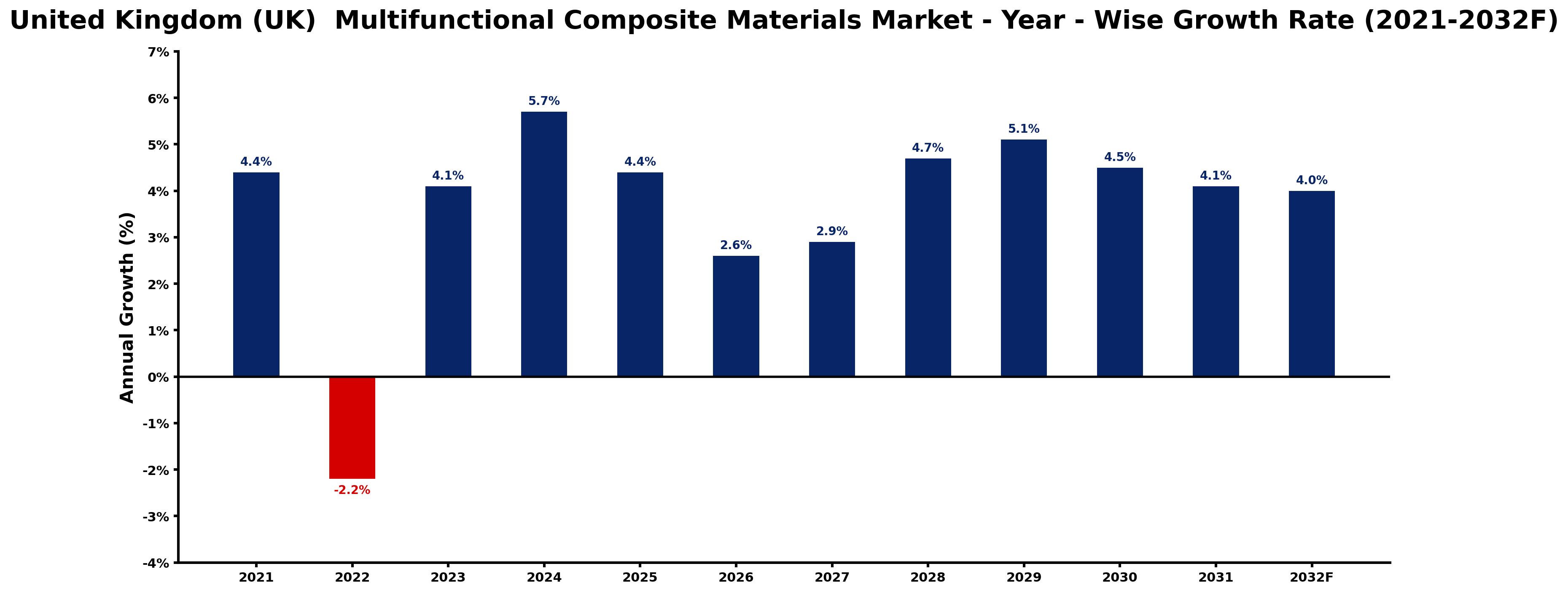
The table below presents the year wise growth rates along with the key drivers influencing the market
| Year | Growth Rate | Major Drivers |
| 2021 | 4.4% | Post-pandemic recovery sparked interest in innovative construction materials across various sectors. |
| 2022 | -2.2% | Supply chain disruptions and increased freight costs hindered product availability, leading to decreased market demand. |
| 2023 | 4.1% | Research into lightweight materials expanded, highlighting performance advantages for transportation applications. |
| 2024 | 5.7% | Emerging technologies in composites gained traction, attracting investment from diverse industries. |
| 2025 | 4.4% | Increased focus on energy efficiency prompted shifts towards multifunctional materials in design. |
| 2026 | 2.6% | The automotive sector integrated composite materials, enhancing performance and fuel efficiency standards. |
| 2027 | 2.9% | Investment in green technologies boosted demand for environmentally friendly composite solutions. |
| 2028 | 4.7% | Construction projects emphasizing longevity and durability began favoring advanced composite options. |
| 2029 | 5.1% | R&D initiatives in universities spurred innovation, leading to new multifunctional material applications. |
| 2030 | 4.5% | Collaborations between academia and industry catalyzed breakthroughs in composite material technologies. |
| 2031 | 4.1% | Evolving consumer preferences shaped demand for aesthetically pleasing yet functional building materials. |
| 2032 | 4.0% | Market maturity observed as multifunctional composites became standard in various manufacturing sectors. |
Note - Market size estimations and growth projections presented in this report are based on 6Wresearch's advanced forecasting approach, validated with industry datasets as of June 2026.
United Kingdom (UK) Multifunctional Composite Materials Market Synopsis
The United Kingdom (UK) Multifunctional Composite Materials Market is projected to reach 2.6% and witness significant growth during the forecast period (2026-2032). This market is poised for expansion as various industries, including aerospace, automotive, and construction, increasingly recognize the advantages of multifunctional composites. The advancements in material science play a pivotal role in enhancing the properties of these materials, which include lightweight characteristics, exceptional strength, and remarkable durability.
United Kingdom (UK) Multifunctional Composite Materials Market Growth Drivers
The growth of the United Kingdom (UK) Multifunctional Composite Materials Market can be attributed to several key drivers:
- The rise of aerospace and defense applications necessitates materials that can withstand extreme conditions while maintaining performance efficiency.
- Automotive lightweighting initiatives are catalyzed by the need for fuel efficiency and lower emissions, pushing manufacturers to adopt multifunctional composites.
- Increasing demand for high-performance materials with multiple functionalities fuels research and development investments.
- Technological innovations are consistently transforming the landscape of materials, leading to enhanced performance and broader applications in various sectors.
- A commitment to sustainability and carbon footprint reduction has driven the adoption of multifunctional composites, aligning with industry standards and regulatory frameworks.
United Kingdom (UK) Multifunctional Composite Materials Market Challenges and Restraints
Despite its growth potential, the United Kingdom (UK) Multifunctional Composite Materials Market faces several challenges:
- The optimization of material design and processing is essential for applications across aerospace, automotive, and renewable energy sectors, requiring significant investment and expertise.
- Meeting the demands for lightweighting while ensuring structural integrity necessitates advanced composite formulations that are still under development.
- There is an ongoing need for manufacturing technologies that can effectively scale up production without compromising quality or performance.
- Market dynamics are heavily influenced by the need for sustainability, necessitating continuous innovation and adjustment by manufacturers.
- Compliance with evolving regulations regarding material safety and environmental impact can require substantial adjustments in production processes.
United Kingdom (UK) Multifunctional Composite Materials Market Government Investment and Initiatives
The UK government has initiated several policies and incentives aimed at fostering the development of the Multifunctional Composite Materials Market. These initiatives are instrumental in promoting research and innovation in the sector:
- Regulatory frameworks oversee material safety and environmental impact assessments, ensuring that advancements in composite technologies align with national safety standards.
- Aerospace engineering standards are regularly updated, promoting the use of high-performance, eco-friendly composites in aviation applications.
- The government encourages public-private partnerships to spur technological development and research investment in next-generation composite materials.
- Sector-specific funding programs are established to support R&D activities focused on multifunctional composites and their applications.
- Investment in infrastructure development enhances manufacturing capabilities, enabling the swift adoption of innovative material solutions across various industries.
United Kingdom (UK) Multifunctional Composite Materials Market Latest Developments (May 2025 - June 2026)
Recent developments in the United Kingdom (UK) Multifunctional Composite Materials Market indicate a progressive shift towards innovation and adoption of advanced materials. The period from May 2025 to June 2026 has witnessed increasing collaborations between research institutions and industry players to enhance material performance and sustainability. Additionally, new manufacturing technologies are emerging, focusing on reducing costs and improving the scalability of composite production. Furthermore, awareness and demand for environmentally friendly composites continue to rise, aligning with broader sustainability objectives within the industry.
United Kingdom (UK) Multifunctional Composite Materials Market - Key Attractiveness of the Report
- 10 Years of Market Numbers
- Historical Data Starting from 2022 to 2025
- Base Year: 2025
- Forecast Data until 2032
- Key Performance Indicators Impacting the Market
- Major Upcoming Developments and Projects
Key Highlights of the Report:
- United Kingdom (UK) Multifunctional Composite Materials Market Outlook
- Market Size of United Kingdom (UK) Multifunctional Composite Materials Market, 2025
- Forecast of United Kingdom (UK) Multifunctional Composite Materials Market, 2032
- Historical Data and Forecast of United Kingdom (UK) Multifunctional Composite Materials Revenues & Volume for the Period 2022-2032F
- United Kingdom (UK) Multifunctional Composite Materials Market Trend Evolution
- United Kingdom (UK) Multifunctional Composite Materials Market Drivers and Challenges
- United Kingdom (UK) Multifunctional Composite Materials Price Trends
- United Kingdom (UK) Multifunctional Composite Materials Porter's Five Forces
- United Kingdom (UK) Multifunctional Composite Materials Industry Life Cycle
- Historical Data and Forecast of United Kingdom (UK) Multifunctional Composite Materials Market Revenues & Volume By Product Type for the Period 2022-2032F
- Historical Data and Forecast of United Kingdom (UK) Multifunctional Composite Materials Market Revenues & Volume By Carbon Fiber for the Period 2022-2032F
- Historical Data and Forecast of United Kingdom (UK) Multifunctional Composite Materials Market Revenues & Volume By Fabrics/Reinforcements for the Period 2022-2032F
- Historical Data and Forecast of United Kingdom (UK) Multifunctional Composite Materials Market Revenues & Volume By Prepregs/Resins for the Period 2022-2032F
- Historical Data and Forecast of United Kingdom (UK) Multifunctional Composite Materials Market Revenues & Volume By Adhesives for the Period 2022-2032F
- Historical Data and Forecast of United Kingdom (UK) Multifunctional Composite Materials Market Revenues & Volume By Honeycomb for the Period 2022-2032F
- Historical Data and Forecast of United Kingdom (UK) Multifunctional Composite Materials Market Revenues & Volume By Other for the Period 2022-2032F
- Historical Data and Forecast of United Kingdom (UK) Multifunctional Composite Materials Market Revenues & Volume By Applications for the Period 2022-2032F
- Historical Data and Forecast of United Kingdom (UK) Multifunctional Composite Materials Market Revenues & Volume By Aerospace Industry for the Period 2022-2032F
- Historical Data and Forecast of United Kingdom (UK) Multifunctional Composite Materials Market Revenues & Volume By Medical Industry for the Period 2022-2032F
- Historical Data and Forecast of United Kingdom (UK) Multifunctional Composite Materials Market Revenues & Volume By Machinery Industry for the Period 2022-2032F
- Historical Data and Forecast of United Kingdom (UK) Multifunctional Composite Materials Market Revenues & Volume By Achitechture Industry for the Period 2022-2032F
- Historical Data and Forecast of United Kingdom (UK) Multifunctional Composite Materials Market Revenues & Volume By Other for the Period 2022-2032F
- United Kingdom (UK) Multifunctional Composite Materials Import Export Trade Statistics
- Market Opportunity Assessment By Product Type
- Market Opportunity Assessment By Applications
- United Kingdom (UK) Multifunctional Composite Materials Top Companies Market Share
- United Kingdom (UK) Multifunctional Composite Materials Competitive Benchmarking By Technical and Operational Parameters
- United Kingdom (UK) Multifunctional Composite Materials Company Profiles
- United Kingdom (UK) Multifunctional Composite Materials Key Strategic Recommendations






































