United Kingdom (UK) Oil & Gas Pumps Market Size, Share & Growth Rate
The United Kingdom (UK) Oil & Gas Pumps Market was estimated at USD 350 Million in 2025 and is projected to reach USD 435 Million by 2032, growing at a CAGR of 3.2% from 2026 to 2032. This growth trajectory is driven by ongoing investments in the oil and gas sector, particularly in offshore exploration and production. Furthermore, the demand for advanced pumping solutions that enhance operational efficiency is propelling manufacturers to innovate and meet the evolving needs of the market.
United Kingdom (UK) Oil & Gas Pumps Market Year-wise Growth Rate and Key Drivers
This graph highlights how the United Kingdom (UK) Oil & Gas Pumps Market has steadily grown over the years, supported by major growth factors.
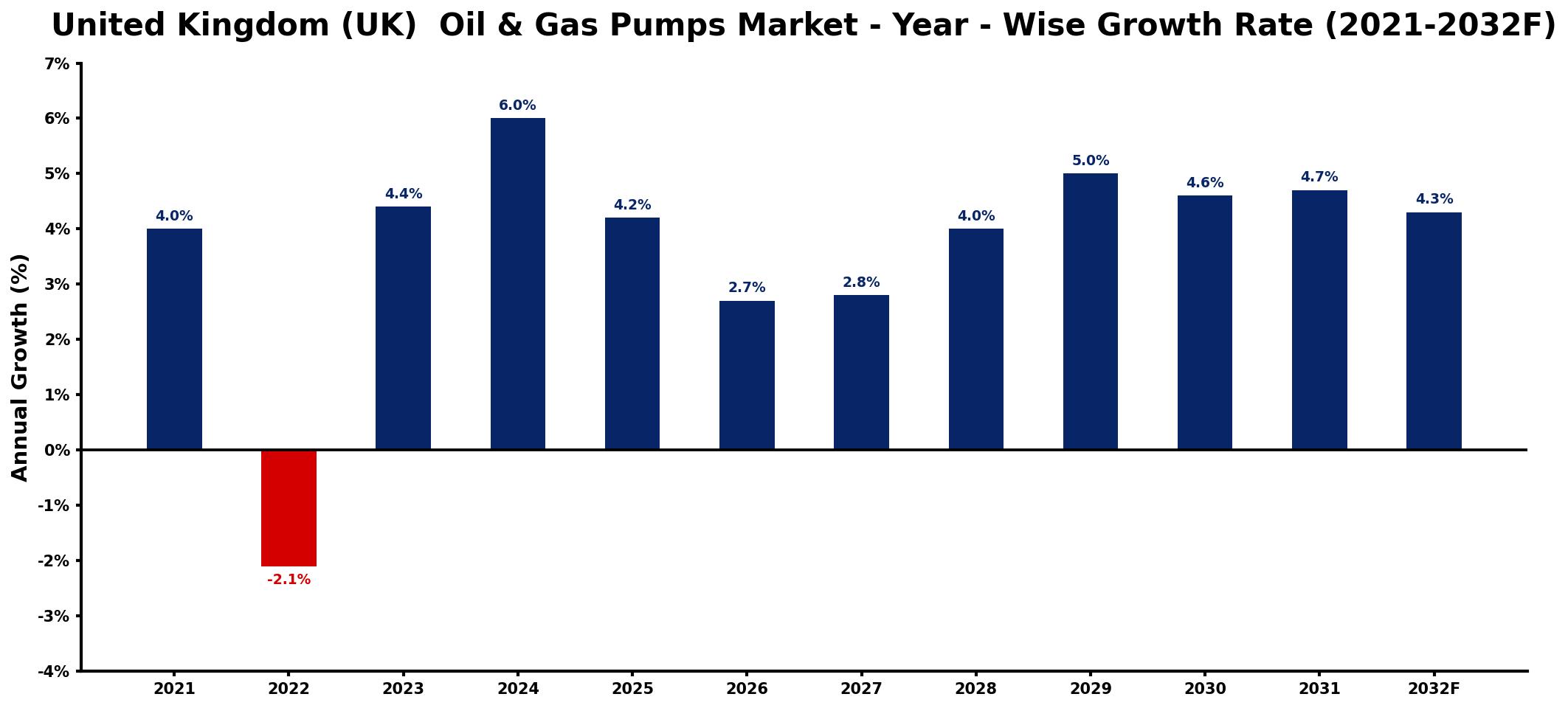
The table below presents the year‑wise growth rates along with the key drivers influencing the market
| Year | Growth Rate | Major Drivers |
| 2021 | 4.0% | Rising energy sector investments |
| 2022 | -2.1% | Decreased industrial project activities |
| 2023 | 4.4% | Increased infrastructure development projects |
| 2024 | 6.0% | Surge in renewable energy initiatives |
| 2025 | 4.2% | Expansion of transportation networks |
| 2026 | 2.7% | Growth in manufacturing sectors |
| 2027 | 2.8% | Rise in domestic energy demand |
| 2028 | 4.0% | Boost in export opportunities |
| 2029 | 5.0% | Investments in technological advancements |
| 2030 | 4.6% | Increased energy efficiency regulations |
| 2031 | 4.7% | increased capital investment inflows |
| 2032 | 4.3% | increased production capacity utilization |
Note: Market size estimations and growth projections presented in this report are based on 6Wresearch's proprietary forecasting methodology, utilizing the latest available industry data, government publications, and primary research inputs.
United Kingdom (UK) Oil & Gas Pumps Market Synopsis
The strongest force currently shaping the UK Oil & Gas Pumps Market is the rapid technological advancement in pump solutions. This trend is crucial as the sector seeks to enhance productivity and reduce downtime through smart technologies and automation. Manufacturers are increasingly focusing on providing efficient pumping solutions that comply with stringent environmental regulations.
As a mature segment within the UK energy landscape, the Oil & Gas Pumps Market remains a pivotal player amid fluctuating oil prices and shifting regulatory frameworks. The emphasis on sustainability has led to a growing demand for energy-efficient pumps, ensuring that the market continues to evolve and adapt in response to these challenges and opportunities.
- The market is estimated to grow from USD 350 Million in 2025 to USD 435 Million by 2032.
- Key drivers include advancements in pump technology and increased investment in offshore exploration.
- The focus on sustainability is leading to a demand for energy-efficient and environmentally friendly pumping solutions.
- Digitalization and automation are becoming critical components in optimizing pump performance.
- There is significant opportunity for companies to innovate in high-efficiency pump technologies.
Despite the positive growth outlook, the UK Oil & Gas Pumps Market faces several restraints. The volatility of global oil prices can significantly affect investment decisions and the overall viability of projects in the sector. Additionally, stringent environmental regulations and the increasing shift towards renewable energy sources create an uncertain demand landscape for traditional oil and gas pumping solutions. Companies must also navigate the complexities of a competitive marketplace, where numerous manufacturers vie for market share, placing pressure on pricing and innovation.
A noteworthy trend in the UK Oil & Gas Pumps Market is the integration of smart technology, which allows for improved operational efficiency through predictive maintenance and real-time monitoring. The adoption of automation systems is further enhancing productivity by reducing human error and downtime. Additionally, there is a burgeoning emphasis on developing pumps specifically designed for offshore drilling, as the North Sea continues to attract significant exploration investments. Finally, the demand for solutions that minimize carbon emissions is steering manufacturers toward sustainable pump designs.
Investment opportunities abound within the UK Oil & Gas Pumps Market, particularly for companies focusing on innovative pumping technologies. The growing global energy demand propels investments in exploration and infrastructure, presenting a ripe environment for advanced pump solutions. Companies that prioritize research and development to enhance efficiency, reliability, and sustainability will find a competitive edge. Moreover, the shift towards digitalization and smart pumps creates avenues for investments in automation and data analytics.
The UK government has enacted various policies aimed at promoting energy efficiency and reducing carbon emissions within the Oil & Gas Pumps Market. Key initiatives include the Climate Change Act, which imposes legally binding targets for emissions reductions. Additionally, the government encourages the adoption of cleaner technologies and fuels in the oil and gas sector through various guidelines and support mechanisms. These initiatives aim to foster innovation, sustainability, and responsible practices within the energy industry.
Looking ahead to 2026-2032, the UK Oil & Gas Pumps Market is positioned for steady growth, fueled by sustained investments in offshore exploration and production. The demand for energy on a global scale will likely result in increased extraction activities, further driving the market. The incorporation of advanced technologies and digital solutions is expected to enhance operational efficiency, while ongoing regulatory shifts may pose challenges. Nonetheless, the market is projected to thrive as companies remain focused on improving performance and output in a rapidly evolving landscape.
Recent developments in the UK Oil & Gas Pumps Market have highlighted a significant push towards integrating smart technologies into pump solutions. This shift aims to enhance operational efficiencies across the board, particularly in offshore projects. Additionally, there has been a notable increase in collaboration between manufacturers and technology providers to innovate pumping solutions that align with sustainability goals. Regulatory changes are also prompting companies to adapt their strategies, focusing more on eco-friendly pumping technologies.
- 10 Years of Market Numbers
- Historical Data Starting from 2022 to 2025
- Base Year: 2025
- Forecast Data until 2032
- Key Performance Indicators Impacting the Market
- Major Upcoming Developments and Projects
Key Highlights of the Report:
- United Kingdom (UK) Oil & Gas Pumps Market Outlook
- Market Size of United Kingdom (UK) Oil & Gas Pumps Market, 2025
- Forecast of United Kingdom (UK) Oil & Gas Pumps Market, 2032
- Historical Data and Forecast of United Kingdom (UK) Oil & Gas Pumps Revenues & Volume for the Period 2022-2032F
- United Kingdom (UK) Oil & Gas Pumps Market Trend Evolution
- United Kingdom (UK) Oil & Gas Pumps Market Drivers and Challenges
- United Kingdom (UK) Oil & Gas Pumps Price Trends
- United Kingdom (UK) Oil & Gas Pumps Porter's Five Forces
- United Kingdom (UK) Oil & Gas Pumps Industry Life Cycle
- Historical Data and Forecast of United Kingdom (UK) Oil & Gas Pumps Market Revenues & Volume By Type for the Period 2022-2032F
- Historical Data and Forecast of United Kingdom (UK) Oil & Gas Pumps Market Revenues & Volume By Submersible Pumps for the Period 2022-2032F
- Historical Data and Forecast of United Kingdom (UK) Oil & Gas Pumps Market Revenues & Volume By Non-submersible Pumps for the Period 2022-2032F
- Historical Data and Forecast of United Kingdom (UK) Oil & Gas Pumps Market Revenues & Volume By Pump Type for the Period 2022-2032F
- Historical Data and Forecast of United Kingdom (UK) Oil & Gas Pumps Market Revenues & Volume By Centrifugal Pump for the Period 2022-2032F
- Historical Data and Forecast of United Kingdom (UK) Oil & Gas Pumps Market Revenues & Volume By Positive Displacement Pump for the Period 2022-2032F
- Historical Data and Forecast of United Kingdom (UK) Oil & Gas Pumps Market Revenues & Volume By Cryogenic Pump for the Period 2022-2032F
- Historical Data and Forecast of United Kingdom (UK) Oil & Gas Pumps Market Revenues & Volume By Application for the Period 2022-2032F
- Historical Data and Forecast of United Kingdom (UK) Oil & Gas Pumps Market Revenues & Volume By Upstream for the Period 2022-2032F
- Historical Data and Forecast of United Kingdom (UK) Oil & Gas Pumps Market Revenues & Volume By Midstream for the Period 2022-2032F
- Historical Data and Forecast of United Kingdom (UK) Oil & Gas Pumps Market Revenues & Volume By Downstream for the Period 2022-2032F
- United Kingdom (UK) Oil & Gas Pumps Import Export Trade Statistics
- Market Opportunity Assessment By Type
- Market Opportunity Assessment By Pump Type
- Market Opportunity Assessment By Application
- United Kingdom (UK) Oil & Gas Pumps Top Companies Market Share
- United Kingdom (UK) Oil & Gas Pumps Competitive Benchmarking By Technical and Operational Parameters
- United Kingdom (UK) Oil & Gas Pumps Company Profiles
- United Kingdom (UK) Oil & Gas Pumps Key Strategic Recommendations






































