United Kingdom (UK) Optical Projector Market Size, Share & Growth Rate
The United Kingdom (UK) Optical Projector Market was estimated at USD 324 Million in 2025 and is projected to reach USD 399 Million by 2032, growing at a CAGR of 3.0% from 2026 to 2032. This growth trajectory reflects a burgeoning demand across various sectors, particularly in education and entertainment, where high-resolution, immersive experiences are paramount. The integration of cutting-edge technologies, such as laser projection and 4K resolution, is poised to enhance the viewing experience further, driving market expansion.
United Kingdom (UK) Optical Projector Market Year-wise Growth Rate and Key Drivers
This graph highlights how the United Kingdom (UK) Optical Projector Market has steadily grown over the years, supported by major growth factors.
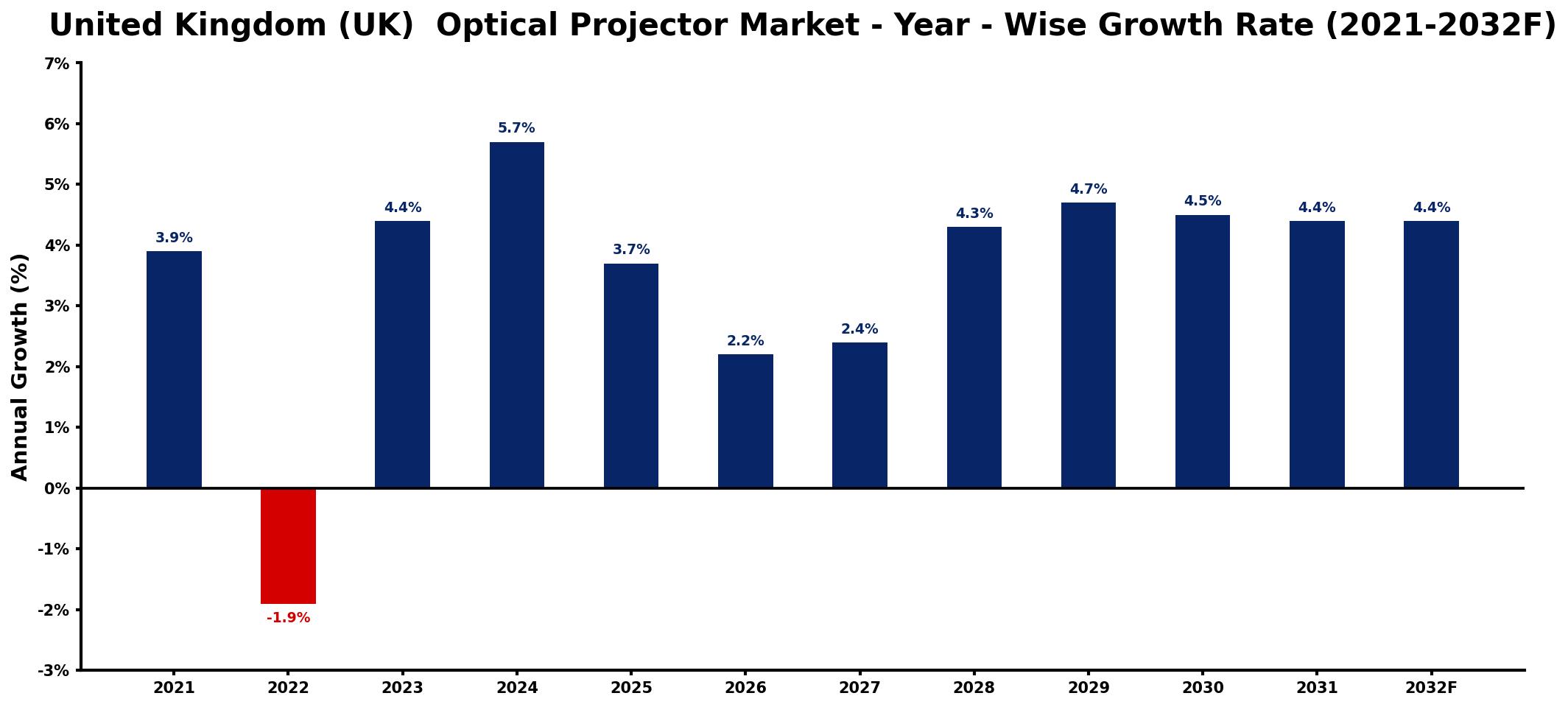
The table below presents the year‑wise growth rates along with the key drivers influencing the market
| Year | Growth Rate | Major Drivers |
| 2021 | 3.9% | Increased demand for home entertainment |
| 2022 | -1.9% | Decline in corporate spending initiatives |
| 2023 | 4.4% | Growth in educational technology investments |
| 2024 | 5.7% | Rising popularity of outdoor events |
| 2025 | 3.7% | Expansion of live event industries |
| 2026 | 2.2% | Increased adoption in gaming sector |
| 2027 | 2.4% | growing downstream application demand |
| 2028 | 4.3% | Surge in digital content creation |
| 2029 | 4.7% | Rising demand for hybrid solutions |
| 2030 | 4.5% | enhanced product quality standards |
| 2031 | 4.4% | Increase in streaming service partnerships |
| 2032 | 4.4% | expanding healthcare application demand |
Note: Market size estimations and growth projections presented in this report are based on 6Wresearch's proprietary forecasting methodology, utilizing the latest available industry data, government publications, and primary research inputs.
United Kingdom (UK) Optical Projector Market Synopsis
In recent years, the UK optical projector market has witnessed a significant transformation, largely propelled by advancements in technology and the increasing need for effective visual communication. Organizations are increasingly investing in high-definition projectors for use in classrooms, corporate environments, and entertainment spaces, ensuring a more engaging experience for audiences.
Furthermore, the emergence of IoT and AI has revolutionized traditional projectors into smart devices capable of wireless connectivity and enhanced interactivity. This has not only broadened their application across diverse sectors but also stimulated innovation within the market, addressing the evolving needs of consumers and businesses alike.
United Kingdom (UK) Optical Projector Market Key Takeaways
- Growing demand in education and entertainment sectors drives market growth.
- Technological advancements significantly enhance projector capabilities.
- Smart projectors equipped with IoT and AI are reshaping the industry landscape.
- Increased investments in digital signage solutions fuel market expansion.
- Government initiatives support the adoption of advanced optical projectors.
Evaluation of Restraints in United Kingdom (UK) Optical Projector Market
The optical projector market in the UK faces several restraints that could impede its growth. One of the primary concerns is the rapid pace of innovation in alternative display technologies, such as LED and OLED screens, which could sway consumer preference away from traditional projectors. Moreover, the competitive pricing among manufacturers creates a challenging landscape, forcing companies to innovate while managing costs. Lastly, the evolving consumer expectations for energy-efficient and low-maintenance devices add another layer of complexity for manufacturers striving to meet market demands.
United Kingdom (UK) Optical Projector Market Trends
Several trends are currently shaping the UK optical projector market. The shift towards immersive experiences is evident in the increasing adoption of 4K and 3D projection technologies, which cater to sectors demanding higher visual quality. Additionally, there is a notable rise in the preference for ultra-short throw projectors that provide flexibility in space utilization while delivering superior image quality. Furthermore, the integration of wireless technologies is making presentations and multimedia sharing more seamless, particularly in educational and corporate environments.
United Kingdom (UK) Optical Projector Market Opportunities
The UK optical projector market presents several lucrative opportunities for growth and investment. As educational institutions increasingly prioritize technological upgrades, there is a significant opportunity for manufacturers to develop innovative solutions tailored for classroom environments. Furthermore, the expanding corporate sector is investing in advanced audiovisual systems, creating a demand for high-quality projection solutions. Lastly, the burgeoning digital signage market opens doors for specialized projectors designed for commercial advertising and information dissemination.
Government Initiatives in the United Kingdom (UK) Optical Projector Market
Government policies in the UK play a crucial role in promoting the optical projector market. Initiatives aimed at enhancing educational resources, particularly in schools and universities, often include grants and subsidies designed to facilitate the adoption of advanced projection technologies. Additionally, regulatory frameworks ensure that optical projectors meet necessary safety and performance standards, thereby fostering an environment that encourages innovation and investment in this sector.
Future Insights of the United Kingdom (UK) Optical Projector Market
Looking ahead to 2026-2032, the UK optical projector market is expected to continue on a growth path fueled by technological advancements and changing consumer preferences. The increasing integration of smart technologies will further enhance projector functionality and user engagement. As educational and corporate sectors prioritize innovative solutions to capture audience attention, manufacturers will need to stay ahead of trends to meet evolving demands. This proactive approach will not only solidify their market position but also drive long-term growth in the optical projector landscape.
United Kingdom (UK) Optical Projector Market Latest Developments (2025 - 2026)
The UK optical projector market is witnessing dynamic developments, with several technological advancements being integrated into newer models. There is a significant focus on enhancing energy efficiency and reducing maintenance costs, as manufacturers respond to growing consumer demands for sustainable solutions. Additionally, collaborative projects between educational institutions and technology providers are emerging, aiming to develop tailored projection solutions that enhance learning experiences and facilitate interactivity in classrooms.
United Kingdom (UK) Optical Projector Market - Key Attractiveness of the Report
- 10 Years of Market Numbers
- Historical Data Starting from 2022 to 2025
- Base Year: 2025
- Forecast Data until 2032
- Key Performance Indicators Impacting the Market
- Major Upcoming Developments and Projects
Key Highlights of the Report:
- United Kingdom (UK) Optical Projector Market Outlook
- Market Size of United Kingdom (UK) Optical Projector Market, 2025
- Forecast of United Kingdom (UK) Optical Projector Market, 2032
- Historical Data and Forecast of United Kingdom (UK) Optical Projector Revenues & Volume for the Period 2022-2032F
- United Kingdom (UK) Optical Projector Market Trend Evolution
- United Kingdom (UK) Optical Projector Market Drivers and Challenges
- United Kingdom (UK) Optical Projector Price Trends
- United Kingdom (UK) Optical Projector Porter's Five Forces
- United Kingdom (UK) Optical Projector Industry Life Cycle
- Historical Data and Forecast of United Kingdom (UK) Optical Projector Market Revenues & Volume By Type for the Period 2022-2032F
- Historical Data and Forecast of United Kingdom (UK) Optical Projector Market Revenues & Volume By Digital Light Processing (DLP) for the Period 2022-2032F
- Historical Data and Forecast of United Kingdom (UK) Optical Projector Market Revenues & Volume By Liquid Crystal Display (LCD) for the Period 2022-2032F
- Historical Data and Forecast of United Kingdom (UK) Optical Projector Market Revenues & Volume By Liquid Crystal on Silicon (LCoS) for the Period 2022-2032F
- Historical Data and Forecast of United Kingdom (UK) Optical Projector Market Revenues & Volume By Application for the Period 2022-2032F
- Historical Data and Forecast of United Kingdom (UK) Optical Projector Market Revenues & Volume By Residential for the Period 2022-2032F
- Historical Data and Forecast of United Kingdom (UK) Optical Projector Market Revenues & Volume By Commercial for the Period 2022-2032F
- Historical Data and Forecast of United Kingdom (UK) Optical Projector Market Revenues & Volume By Industrial for the Period 2022-2032F
- United Kingdom (UK) Optical Projector Import Export Trade Statistics
- Market Opportunity Assessment By Type
- Market Opportunity Assessment By Application
- United Kingdom (UK) Optical Projector Top Companies Market Share
- United Kingdom (UK) Optical Projector Competitive Benchmarking By Technical and Operational Parameters
- United Kingdom (UK) Optical Projector Company Profiles
- United Kingdom (UK) Optical Projector Key Strategic Recommendations






































