United Kingdom (UK) Payment Security Market Size & Growth Rate (2026-2032)
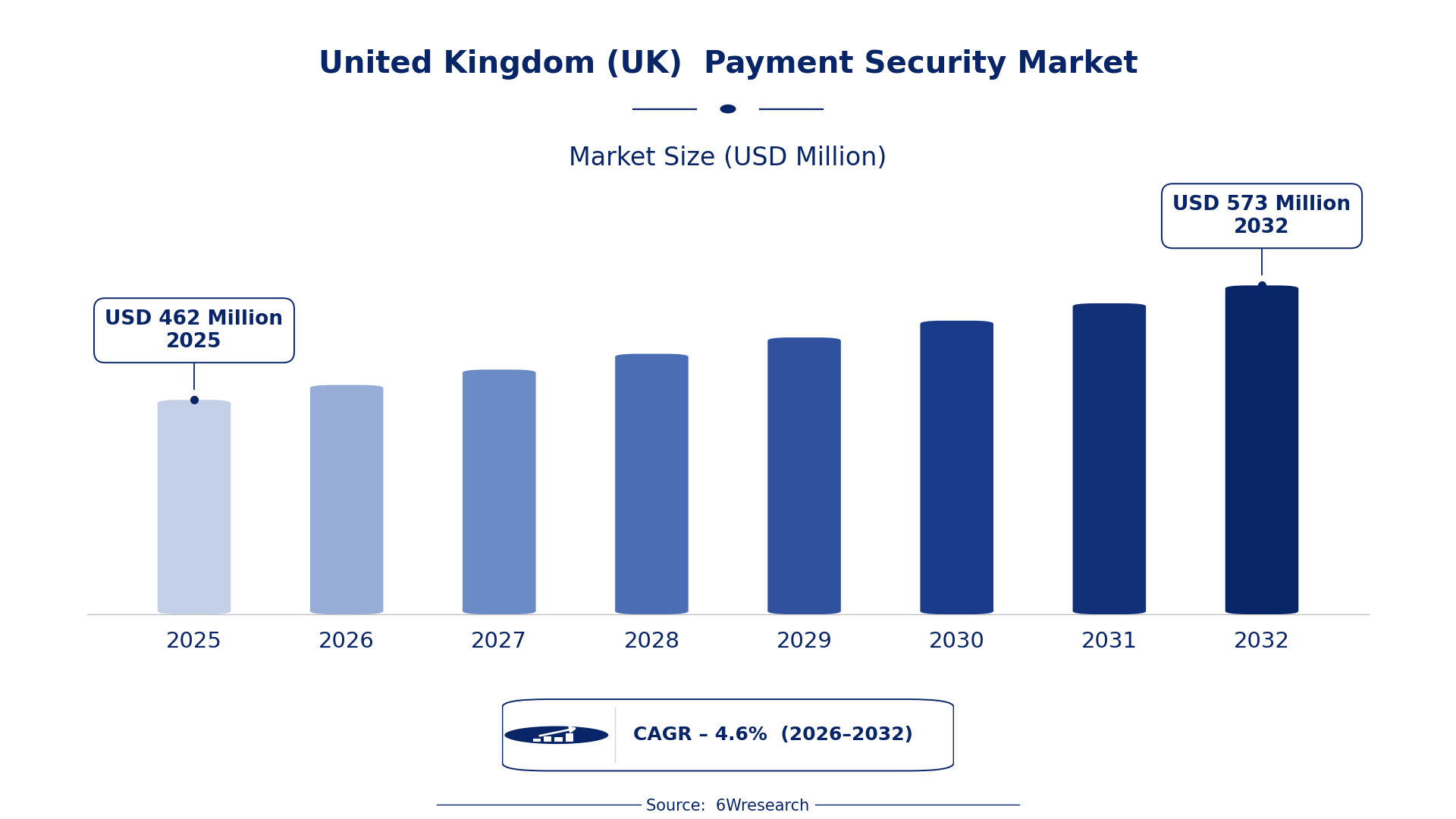
The United Kingdom (UK) Payment Security Market was estimated at USD 462 Million in 2025 and is projected to reach USD 573 Million by 2032, growing at a CAGR of 4.6% from 2026 to 2032.
United Kingdom (UK) Payment Security Market Synopsis
Recent momentum in the UK Payment Security Market has been underscored by the substantial growth in digital transactions. As e-commerce expands, so does the urgency for secure payment methods, a trend that’s only gaining traction.
Looking ahead, the market is set to witness a surge in the adoption of advanced security technologies. Enhanced regulatory compliance mandates are compelling organizations to invest significantly in payment security, thus driving innovation and shaping future growth.
United Kingdom (UK) Payment Security Market Year-wise Growth Rate and Key Drivers
This graph illustrates the annual growth rates of the United Kingdom (UK) Payment Security Market from 2021 to 2032, highlighting a steady upward trajectory and projected expansion over the forecast period.
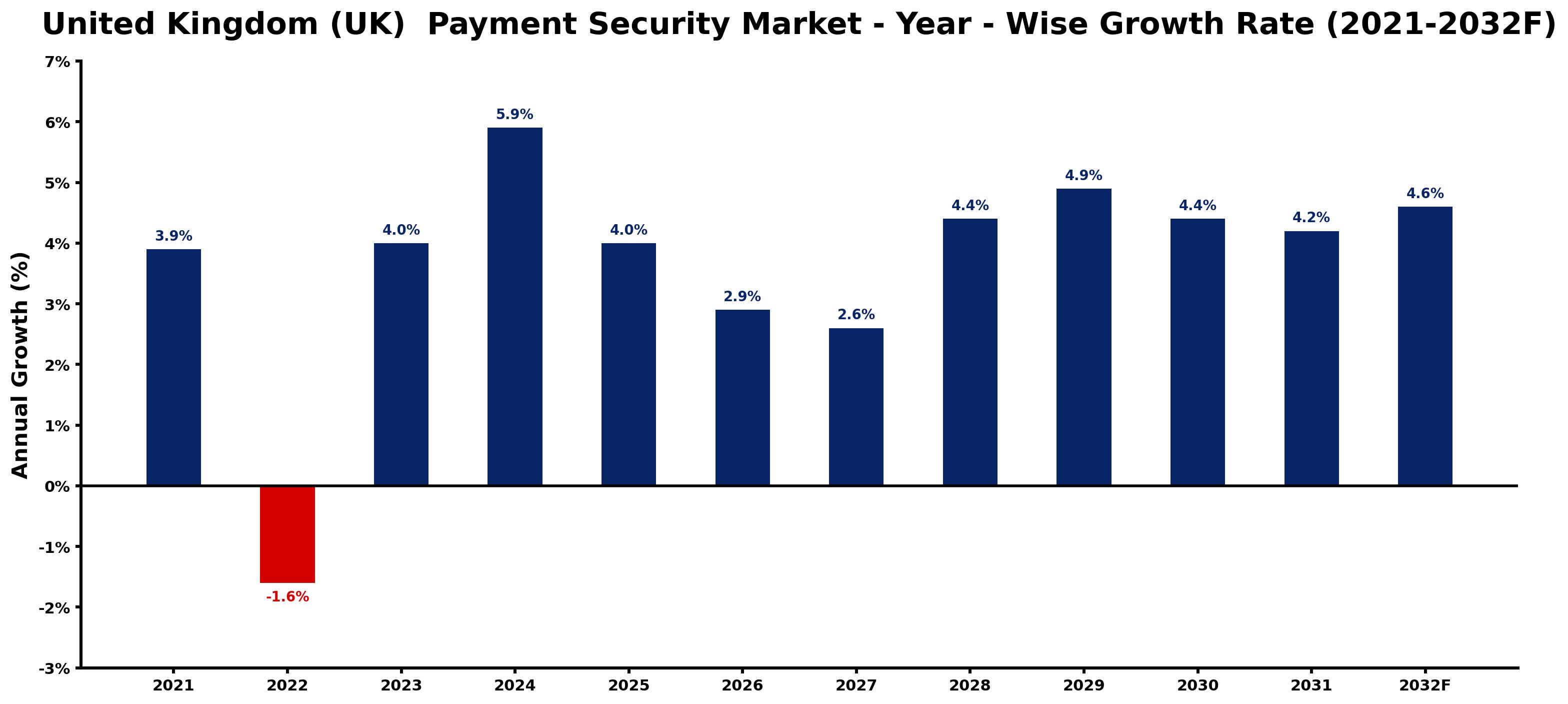
The table below presents the year‑wise growth rates along with the key drivers influencing the market
| Year | Growth Rate | Major Drivers |
| 2021 | 3.9% | Implementation of UK Payment Services Regulations enhancements. |
| 2022 | -1.6% | Implementation delays of PSD2 regulations hindered market adoption. |
| 2023 | 4.0% | Increased focus on GDPR compliance for data protection. |
| 2024 | 5.9% | Rising incidents of cyber fraud driving security needs. |
| 2025 | 4.0% | Adoption of PSD2 fostering secure third-party payment access. |
| 2026 | 2.9% | Growing consumer awareness of online transaction security. |
| 2027 | 2.6% | Government incentives for FinTech innovations in cybersecurity. |
| 2028 | 4.4% | Emergence of AI-powered fraud detection solutions in retail. |
| 2029 | 4.9% | Investment in secure payment architectures by banks. |
| 2030 | 4.4% | Strengthening regulations against payment data breaches. |
| 2031 | 4.2% | Collaboration with fintech startups to enhance security protocols. |
| 2032 | 4.6% | Increased integration of blockchain for secure transactions. |
Note: Market size estimations and growth projections presented in this report are based on 6Wresearch's proprietary forecasting methodology, utilizing the latest available industry data, government publications, and primary research inputs.
United Kingdom (UK) Payment Security Market Key Takeaways
Below are some of the specific key takeaways from the market, including:
- The increasing reliance on digital payment methods is driving demand for sophisticated security solutions.
- Regulatory frameworks like GDPR and PSD2 are enforcing stricter compliance requirements, compelling investment in secure payment systems.
- Technologies such as encryption and biometrics are becoming essential tools in combating cyber threats.
- Companies are focusing on multi-layered security strategies to protect customer information effectively.
- Investment opportunities are emerging in companies specializing in fraud detection and advanced authentication technologies.
Evaluation of Restraints in United Kingdom (UK) Payment Security Market
A few key restraints are holding the UK Payment Security Market back from achieving its full potential. The increasing sophistication of cyber threats demands continual adaptation and improvement of security measures, which can be resource-intensive. on top of that, compliance with evolving regulations poses challenges for organizations, particularly smaller firms that may lack the necessary infrastructure. The balance between security and user experience is also a pressing concern, as overly stringent measures can deter customers. Integrating various payment systems securely adds another layer of complexity, potentially hindering the seamlessness businesses seek in payment processing.
United Kingdom (UK) Payment Security Market Trends
The UK Payment Security Market is currently experiencing several key trends that are shaping its future. A noticeable increase in the adoption of encryption, tokenization, and biometric methods is evident as businesses strive to protect customer data. The surge in mobile payments and online transactions has led to a corresponding rise in demand for advanced security measures. on top of that, heightened consumer awareness of data privacy is prompting businesses to prioritize secure payment solutions, making it a critical focus for strategic investments.
United Kingdom (UK) Payment Security Market Opportunities
Amid these trends, genuine growth opportunities abound for investors and companies alike. The rising prevalence of digital transactions presents a robust market for solutions offering high-level encryption and fraud detection capabilities. Collaborations with financial institutions to enhance payment security infrastructure are likely to yield lucrative returns. Additionally, firms that innovate in biometric authentication technologies could capture significant market share as consumers demand more secure yet convenient payment options.
Government Initiatives in the United Kingdom (UK) Payment Security Market
The UK government is proactive in shaping the Payment Security Market through various initiatives aimed at enhancing electronic payment transaction safety. Regulatory frameworks, such as the Payment Services Regulations 2017 and GDPR, are compelling businesses to adopt stronger security measures. The regulatory posture reflects an increasing priority on consumer protection and data integrity in payment systems, making compliance not just beneficial but essential for market players.
- A regulatory framework was introduced in 2017 mandating enhanced customer authentication measures for payment service providers.
- A national initiative focused on the cybersecurity of financial transactions is currently underway, aiming to bolster defenses against emerging threats.
- A planned public-private partnership is expected to launch in 2026, aimed at improving digital payment security infrastructure across the UK.
- The Financial Conduct Authority is enhancing its oversight measures in response to the growing complexity of payment technologies.
- Current discussions are in progress regarding updates to regulations to better address the challenges posed by mobile payment platforms.
Future Insights of the United Kingdom (UK) Payment Security Market
From 2026 to 2032, the UK Payment Security Market is anticipated to steadily evolve in response to the ongoing digital transformation. As cyber threats become increasingly sophisticated, the demand for advanced security technologies will only intensify. Regulatory pressures will continue to encourage organizations to enhance their payment security measures, ensuring that they remain competitive. Forward-looking firms that embrace innovation and proactively adapt to these challenges are likely to thrive in the expanding market.
United Kingdom (UK) Payment Security Market Latest Developments
Over the past year, the UK Payment Security Market has seen a surge in activity as companies strive to adapt to changing consumer expectations and regulatory requirements. The emphasis has been on strengthening security protocols and leveraging new technologies to stay ahead of evolving threats.
- A major technology vendor launched a new biometric authentication platform in early 2025, aimed at enhancing user security for online transactions.
- An ongoing initiative focusing on the integration of advanced encryption methods into existing payment systems began in mid-2025 and remains underway.
- A collaborative effort between several banks to develop a shared fraud detection system is expected to be operational by late 2026.
- New training programs for financial institutions on complying with updated payment regulations were introduced in Q1 2025.
- Upcoming legislation aimed at further enhancing data protection standards for electronic payments is anticipated to be introduced in 2026.
United Kingdom (UK) Payment Security Market - Key Attractiveness of the Report
- 10 Years of Market Numbers
- Historical Data Starting from 2022 to 2025
- Base Year: 2025
- Forecast Data until 2032
- Key Performance Indicators Impacting the Market
- Major Upcoming Developments and Projects
Key Highlights of the Report:
- United Kingdom (UK) Payment Security Market Outlook
- Market Size of United Kingdom (UK) Payment Security Market, 2025
- Forecast of United Kingdom (UK) Payment Security Market, 2032
- Historical Data and Forecast of United Kingdom (UK) Payment Security Revenues & Volume for the Period 2022-2032F
- United Kingdom (UK) Payment Security Market Trend Evolution
- United Kingdom (UK) Payment Security Market Drivers and Challenges
- United Kingdom (UK) Payment Security Price Trends
- United Kingdom (UK) Payment Security Porter's Five Forces
- United Kingdom (UK) Payment Security Industry Life Cycle
- Historical Data and Forecast of United Kingdom (UK) Payment Security Market Revenues & Volume By Solution for the Period 2022-2032F
- Historical Data and Forecast of United Kingdom (UK) Payment Security Market Revenues & Volume By Encryption for the Period 2022-2032F
- Historical Data and Forecast of United Kingdom (UK) Payment Security Market Revenues & Volume By Tokenization for the Period 2022-2032F
- Historical Data and Forecast of United Kingdom (UK) Payment Security Market Revenues & Volume By Fraud Detection for the Period 2022-2032F
- Historical Data and Forecast of United Kingdom (UK) Payment Security Market Revenues & Volume By Prevention for the Period 2022-2032F
- Historical Data and Forecast of United Kingdom (UK) Payment Security Market Revenues & Volume By Service for the Period 2022-2032F
- Historical Data and Forecast of United Kingdom (UK) Payment Security Market Revenues & Volume By Integration for the Period 2022-2032F
- Historical Data and Forecast of United Kingdom (UK) Payment Security Market Revenues & Volume By Support for the Period 2022-2032F
- Historical Data and Forecast of United Kingdom (UK) Payment Security Market Revenues & Volume By Consulting for the Period 2022-2032F
- Historical Data and Forecast of United Kingdom (UK) Payment Security Market Revenues & Volume By Organization Size for the Period 2022-2032F
- Historical Data and Forecast of United Kingdom (UK) Payment Security Market Revenues & Volume By Large Enterprises for the Period 2022-2032F
- Historical Data and Forecast of United Kingdom (UK) Payment Security Market Revenues & Volume By SMEs for the Period 2022-2032F
- Historical Data and Forecast of United Kingdom (UK) Payment Security Market Revenues & Volume By Industry Vertical for the Period 2022-2032F
- United Kingdom (UK) Payment Security Import Export Trade Statistics
- Market Opportunity Assessment By Solution
- Market Opportunity Assessment By Service
- Market Opportunity Assessment By Organization Size
- Market Opportunity Assessment By Industry Vertical
- United Kingdom (UK) Payment Security Top Companies Market Share
- United Kingdom (UK) Payment Security Competitive Benchmarking By Technical and Operational Parameters
- United Kingdom (UK) Payment Security Company Profiles
- United Kingdom (UK) Payment Security Key Strategic Recommendations






































