United Kingdom (UK) Peas Market Size, Share & Growth Rate
The United Kingdom (UK) Peas Market was estimated at USD 375 Million in 2025 and is projected to reach USD 467 Million by 2032, growing at a CAGR of 3.2% from 2026 to 2032. This growth trajectory is primarily driven by the rising consumer inclination towards healthy, plant-based diets, coupled with an increased demand for convenient food options. The trend towards sustainability, including ethically sourced and organic products, further propels market expansion, as consumers become more health-conscious and environmentally aware.
United Kingdom (UK) Peas Market Year-wise Growth Rate and Key Drivers
This graph highlights how the United Kingdom (UK) Peas Market has steadily grown over the years, supported by major growth factors.
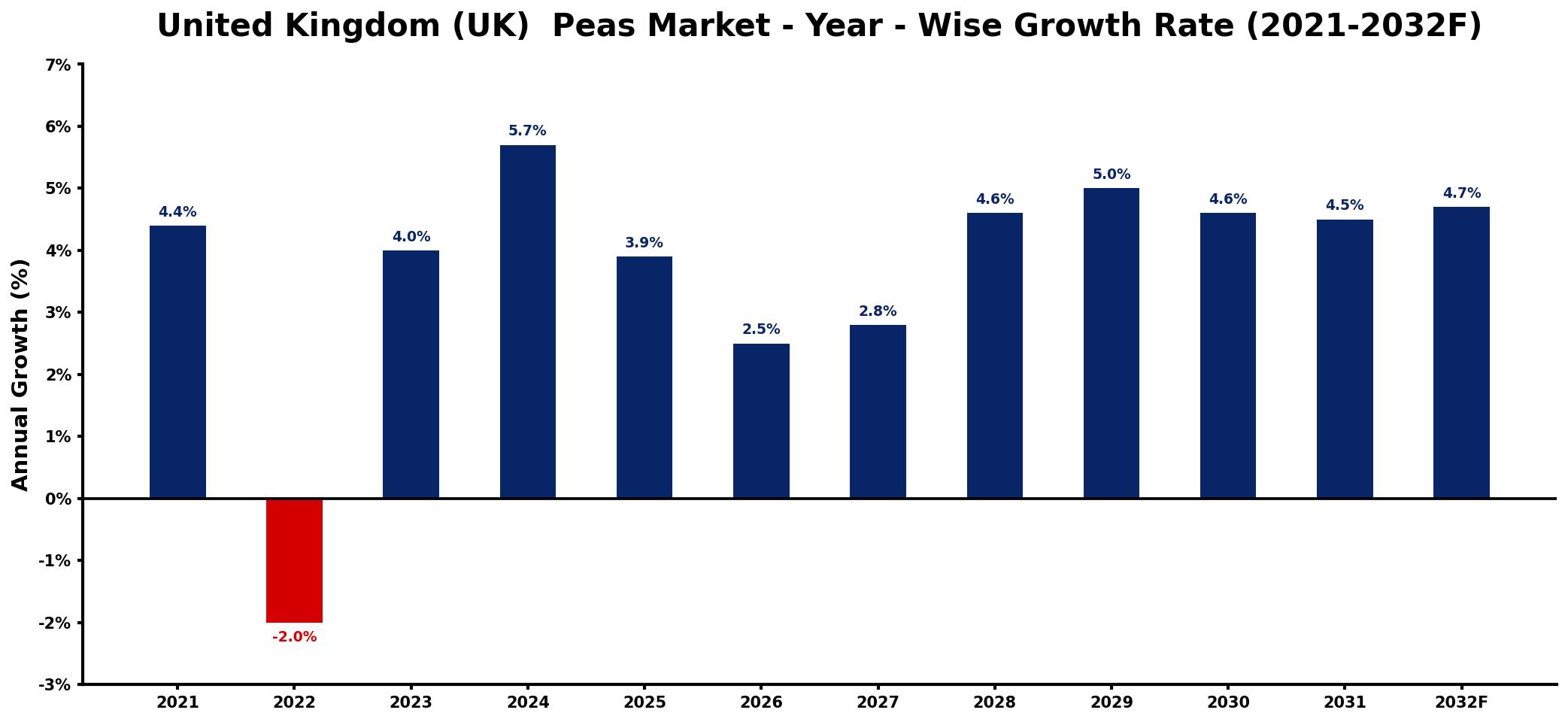
The table below presents the year‑wise growth rates along with the key drivers influencing the market
| Year | Growth Rate | Major Drivers |
| 2021 | 4.4% | Rising consumer health consciousness |
| 2022 | -2.0% | Supply chain disruptions impacting availability |
| 2023 | 4.0% | Increased plant-based diet adoption |
| 2024 | 5.7% | Growing sustainability initiatives in agriculture |
| 2025 | 3.9% | Expansion of organic farming practices |
| 2026 | 2.5% | Technological advancements in farming |
| 2027 | 2.8% | Increased investment in local agriculture |
| 2028 | 4.6% | Higher exports to international markets |
| 2029 | 5.0% | Consumer preference for local produce |
| 2030 | 4.6% | Enhanced distribution network efficiency |
| 2031 | 4.5% | Growing demand for alternative proteins |
| 2032 | 4.7% | Increased focus on food security |
Note: Market size estimations and growth projections presented in this report are based on 6Wresearch's proprietary forecasting methodology, utilizing the latest available industry data, government publications, and primary research inputs.
United Kingdom (UK) Peas Market Synopsis
The UK peas market is witnessing robust interest as peas emerge as a favored vegetable among consumers, thanks to their versatility and nutritional benefits. These legumes are not only consumed fresh but also in convenient forms like frozen, canned, and dried, aligning with busy lifestyles.
Additionally, the surge in the popularity of plant-based diets has catalyzed innovation in the sector, leading to the introduction of new flavors and ready-to-eat products. As sustainability continues to resonate with consumers, the market is evolving to meet these preferences with environmentally friendly practices.
United Kingdom (UK) Peas Market Key Takeaways
- The UK peas market is forecasted for steady growth driven by health and sustainability trends.
- Consumers increasingly demand organic and ethically sourced pea products, impacting production strategies.
- Convenience-oriented products like frozen peas and snacks are becoming prominent in retail spaces.
- Competitive pressures both domestically and internationally are shaping pricing and market dynamics.
- Investment opportunities exist across various segments, particularly in value-added products and organic offerings.
Evaluation of Restraints in United Kingdom (UK) Peas Market
One significant restraint affecting the UK peas market is the unpredictable nature of weather patterns, which can drastically influence crop yields and quality. Variations in rainfall and temperature can lead to inconsistent supply, ultimately affecting pricing and market availability. Moreover, the ongoing push towards sustainable farming practices is a double-edged sword; while it resonates with consumer preferences, the transition can impose higher operational costs and complexity on producers. This is compounded by intense market competition, which can limit profit margins and challenge smaller producers.
United Kingdom (UK) Peas Market Trends
The UK peas market is currently shaped by several notable trends. There is an increasing consumer preference for organic products free from pesticides and synthetic chemicals, driving a significant demand for sustainably sourced peas. Concurrently, the convenience trend is on the rise, with consumers opting for quick-to-prepare options such as frozen peas and pea-based snacks.
In addition to health considerations, innovative product development is becoming paramount, as companies explore new flavors, formats, and applications to cater to diverse consumer tastes. This includes the introduction of value-added products like pea protein snacks and fortified foods, aligning with the growing health-conscious demographic.
United Kingdom (UK) Peas Market Opportunities
The potential for investment in the UK peas market is significant, particularly as the demand for plant-based protein continues to rise. The fresh peas segment offers lucrative opportunities, especially with the increasing trend towards locally sourced and organic products. Similarly, the frozen peas market is primed for growth, driven by consumer preferences for convenience.
Moreover, expanding into value-added products, such as pea protein powders and innovative snacks, presents an appealing avenue for investors. With health and wellness remaining focal points for consumers, the market is poised for sustained expansion across these varied segments.
Government Initiatives in the United Kingdom (UK) Peas Market
The UK government plays a crucial role in shaping the peas market through various supportive policies. The Common Agricultural Policy (CAP) has historically provided financial support to farmers, promoting sustainable agricultural practices while ensuring a stable income stream. Additionally, regulations governing food safety and quality standards are in place to safeguard consumer interests, ensuring that UK-produced peas meet both domestic and export expectations.
In light of Brexit, the government is navigating new trade agreements that will affect the import and export landscape for peas, potentially opening up new markets while safeguarding local production. Future government policies are expected to focus on enhancing domestic pea production, sustainability practices, and compliance with evolving international standards.
Future Insights of the United Kingdom (UK) Peas Market
Looking ahead to 2026-2032, the UK peas market is poised for promising growth. The ongoing trend towards plant-based diets will likely amplify the popularity of peas as a nutritious food source. As consumers continue to prioritize health and environmental sustainability, products that highlight these attributes will gain traction.
Furthermore, innovation will remain key to success, as manufacturers develop new pea-based offerings in response to evolving consumer preferences. The market's future appears bright, characterized by expansion and diversification opportunities driven by changing dietary habits and a focus on wellness.
United Kingdom (UK) Peas Market Latest Developments (2025 - 2026)
Recent developments in the UK peas market indicate a strong movement towards innovative product offerings, particularly in the realm of ready-to-eat and snackable pea products. Companies are increasingly focusing on sustainability, investing in environmentally friendly packaging solutions and transparent supply chains. Additionally, collaborations between producers and retailers are being formed to enhance product visibility and meet consumer demand for locally sourced produce.
United Kingdom (UK) Peas Market - Key Attractiveness of the Report
- 10 Years of Market Numbers
- Historical Data Starting from 2022 to 2025
- Base Year: 2025
- Forecast Data until 2032
- Key Performance Indicators Impacting the Market
- Major Upcoming Developments and Projects
Key Highlights of the Report:
- United Kingdom (UK) Peas Market Outlook
- Market Size of United Kingdom (UK) Peas Market, 2025
- Forecast of United Kingdom (UK) Peas Market, 2032
- Historical Data and Forecast of United Kingdom (UK) Peas Revenues & Volume for the Period 2022-2032F
- United Kingdom (UK) Peas Market Trend Evolution
- United Kingdom (UK) Peas Market Drivers and Challenges
- United Kingdom (UK) Peas Price Trends
- United Kingdom (UK) Peas Porter's Five Forces
- United Kingdom (UK) Peas Industry Life Cycle
- Historical Data and Forecast of United Kingdom (UK) Peas Market Revenues & Volume By Type for the Period 2022-2032F
- Historical Data and Forecast of United Kingdom (UK) Peas Market Revenues & Volume By Field Peas for the Period 2022-2032F
- Historical Data and Forecast of United Kingdom (UK) Peas Market Revenues & Volume By Garden Peas for the Period 2022-2032F
- Historical Data and Forecast of United Kingdom (UK) Peas Market Revenues & Volume By Others for the Period 2022-2032F
- Historical Data and Forecast of United Kingdom (UK) Peas Market Revenues & Volume By Application for the Period 2022-2032F
- Historical Data and Forecast of United Kingdom (UK) Peas Market Revenues & Volume By Food for the Period 2022-2032F
- Historical Data and Forecast of United Kingdom (UK) Peas Market Revenues & Volume By Others for the Period 2022-2032F
- Historical Data and Forecast of United Kingdom (UK) Peas Market Revenues & Volume By Distribution Channel for the Period 2022-2032F
- Historical Data and Forecast of United Kingdom (UK) Peas Market Revenues & Volume By Online for the Period 2022-2032F
- Historical Data and Forecast of United Kingdom (UK) Peas Market Revenues & Volume By Offline for the Period 2022-2032F
- Historical Data and Forecast of United Kingdom (UK) Peas Market Revenues & Volume By Others for the Period 2022-2032F
- United Kingdom (UK) Peas Import Export Trade Statistics
- Market Opportunity Assessment By Type
- Market Opportunity Assessment By Application
- Market Opportunity Assessment By Distribution Channel
- United Kingdom (UK) Peas Top Companies Market Share
- United Kingdom (UK) Peas Competitive Benchmarking By Technical and Operational Parameters
- United Kingdom (UK) Peas Company Profiles
- United Kingdom (UK) Peas Key Strategic Recommendations






































