United Kingdom (UK) Photosensitive Semiconductor Device Market Size, Share & Growth Rate
The United Kingdom (UK) Photosensitive Semiconductor Device Market was estimated at USD 338 Million in 2025 and is projected to reach USD 476 Million by 2032, growing at a CAGR of 5.0% from 2026 to 2032. This growth is largely driven by increasing demand for imaging sensors across a multitude of sectors, including automotive, consumer electronics, and healthcare. As advancements in CMOS and CCD technologies improve image quality and overall performance, the market is well-positioned to capitalize on evolving consumer preferences and technological innovations.
United Kingdom (UK) Photosensitive Semiconductor Device Market Year-wise Growth Rate and Key Drivers
This graph highlights how the United Kingdom (UK) Photosensitive Semiconductor Device Market has steadily grown over the years, supported by major growth factors.
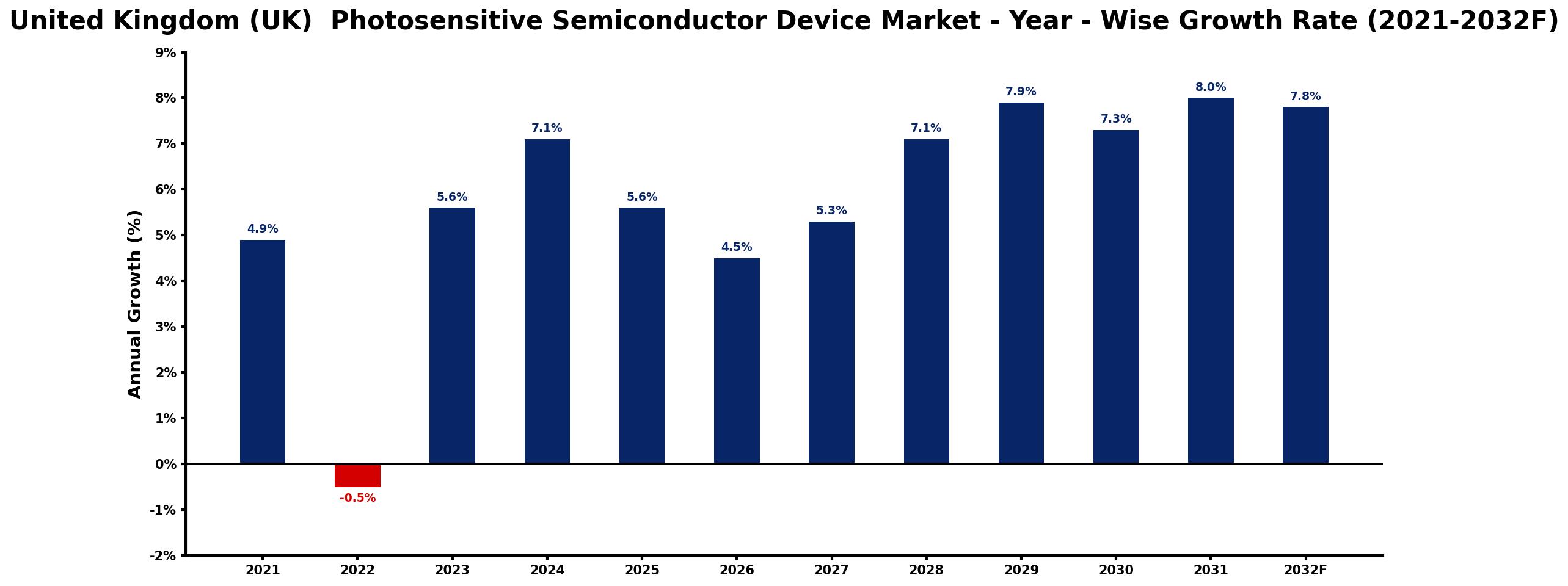
The table below presents the year‑wise growth rates along with the key drivers influencing the market
| Year | Growth Rate | Major Drivers |
| 2021 | 4.9% | Rising demand for renewable energy |
| 2022 | -0.5% | reduced capital spending allocations |
| 2023 | 5.6% | Increased investment in innovation |
| 2024 | 7.1% | Expansion of industrial automation |
| 2025 | 5.6% | Growing interest in smart cities |
| 2026 | 4.5% | Enhanced focus on energy efficiency |
| 2027 | 5.3% | Booming electric vehicle market |
| 2028 | 7.1% | Surge in home automation systems |
| 2029 | 7.9% | Investments in advanced manufacturing |
| 2030 | 7.3% | Growing demand for sustainable solutions |
| 2031 | 8.0% | expanding manufacturing base activity |
| 2032 | 7.8% | Increased adoption of IoT applications |
Note: Market size estimations and growth projections presented in this report are based on 6Wresearch's proprietary forecasting methodology, utilizing the latest available industry data, government publications, and primary research inputs.
United Kingdom (UK) Photosensitive Semiconductor Device Market Synopsis
A significant force shaping the UK photosensitive semiconductor device market is the rising demand for advanced imaging technologies. Enhanced capabilities such as low-light sensitivity and high resolution are essential for applications ranging from security surveillance to autonomous driving.
Additionally, the growing prevalence of smart devices is driving substantial innovation within the market. The development of niche applications, including facial recognition and gesture control, showcases a strategic shift toward customized solutions to meet diverse consumer needs.
United Kingdom (UK) Photosensitive Semiconductor Device Market Key Takeaways
- The UK photosensitive semiconductor device market is on a steady growth path, influenced by advancements in imaging technology.
- Key industries driving demand include automotive, healthcare, consumer electronics, and security sectors.
- Innovation is focused on high-resolution sensors with features like energy efficiency and enhanced low-light performance.
- The UK government is actively supporting the semiconductor industry through R&D initiatives and funding programs.
- Investment opportunities are abundant in developing specialized sensors for emerging applications, including IoT and AI integration.
Evaluation of Restraints in United Kingdom (UK) Photosensitive Semiconductor Device Market
Despite its growth trajectory, the UK photosensitive semiconductor device market encounters several restraints. One significant challenge is intense global competition from regions with lower manufacturing costs, which can pressure UK companies to remain cost-competitive. Furthermore, concerns regarding intellectual property rights are escalating, especially as technological advancements accelerate. The rapid pace of innovation necessitates consistent investment in R&D, placing additional strain on resources. Regulatory compliance, particularly related to environmental standards, adds another layer of complexity for manufacturers navigating the market landscape.
United Kingdom (UK) Photosensitive Semiconductor Device Market Trends
Current trends within the UK photosensitive semiconductor device market are marked by a push toward greater automation and the integration of artificial intelligence. These technologies are being incorporated into imaging systems, enhancing their capabilities and expanding their applications. Additionally, there's a noticeable shift toward eco-friendly and energy-efficient products, with manufacturers seeking innovative solutions to meet rising sustainability demands. The focus on customization and differentiation is also notable, as companies develop specialized sensors tailored for unique applications like 3D imaging and biometric recognition.
United Kingdom (UK) Photosensitive Semiconductor Device Market Opportunities
The opportunities for growth within the UK photosensitive semiconductor device market are robust. With the increasing penetration of smart technology across various industries, there is a heightened demand for innovative imaging solutions. Investors may find lucrative prospects in products that offer enhanced features, such as improved sensitivity and reduced power consumption. Collaborations with research institutions can also enhance product development initiatives. Additionally, as the government continues to support the semiconductor sector, private investments aligned with these initiatives can yield significant returns.
Government Initiatives in the United Kingdom (UK) Photosensitive Semiconductor Device Market
The UK government has taken proactive measures to foster growth in the photosensitive semiconductor device market. Various policies have been established to regulate product safety and ensure high quality standards, thereby safeguarding consumer interests. Initiatives focused on research and development are also in place, encouraging innovation within the sector. This supportive regulatory framework is designed to create a conducive business environment for manufacturers while promoting sustainable practices and protecting the environment.
Future Insights of the United Kingdom (UK) Photosensitive Semiconductor Device Market
Looking ahead to 2026-2032, the UK photosensitive semiconductor device market is poised for continued expansion. The increasing adoption of digital imaging technologies will likely drive demand for advanced sensors across various sectors, including automotive and healthcare. Moreover, as environmental concerns gain prominence, manufacturers will be under pressure to develop energy-efficient solutions that do not compromise performance. The incorporation of AI and machine learning in imaging technologies will further enhance capabilities, positioning the market for sustained growth as it adapts to evolving consumer demands and technological advancements.
United Kingdom (UK) Photosensitive Semiconductor Device Market Latest Developments (2025 - 2026)
Recent developments in the UK photosensitive semiconductor device market indicate a significant shift towards innovative imaging solutions driven by advancements in technology. Companies are increasingly focusing on the integration of AI into image sensors, enhancing functionalities and paving the way for new applications. Additionally, a rise in partnerships between manufacturers and research institutions is fostering collaborative approaches to product development, aiming to create next-generation imaging systems. Market players are also aligning their strategies with sustainability initiatives, focusing on energy-efficient technologies and environmentally friendly manufacturing processes.
United Kingdom (UK) Photosensitive Semiconductor Device Market - Key Attractiveness of the Report
- 10 Years of Market Numbers
- Historical Data Starting from 2022 to 2025
- Base Year: 2025
- Forecast Data until 2032
- Key Performance Indicators Impacting the Market
- Major Upcoming Developments and Projects
Key Highlights of the Report:
- United Kingdom (UK) Photosensitive Semiconductor Device Market Outlook
- Market Size of United Kingdom (UK) Photosensitive Semiconductor Device Market, 2025
- Forecast of United Kingdom (UK) Photosensitive Semiconductor Device Market, 2032
- Historical Data and Forecast of United Kingdom (UK) Photosensitive Semiconductor Device Revenues & Volume for the Period 2022-2032F
- United Kingdom (UK) Photosensitive Semiconductor Device Market Trend Evolution
- United Kingdom (UK) Photosensitive Semiconductor Device Market Drivers and Challenges
- United Kingdom (UK) Photosensitive Semiconductor Device Price Trends
- United Kingdom (UK) Photosensitive Semiconductor Device Porter's Five Forces
- United Kingdom (UK) Photosensitive Semiconductor Device Industry Life Cycle
- Historical Data and Forecast of United Kingdom (UK) Photosensitive Semiconductor Device Market Revenues & Volume By Device for the Period 2022-2032F
- Historical Data and Forecast of United Kingdom (UK) Photosensitive Semiconductor Device Market Revenues & Volume By Photocell for the Period 2022-2032F
- Historical Data and Forecast of United Kingdom (UK) Photosensitive Semiconductor Device Market Revenues & Volume By Photodiode for the Period 2022-2032F
- Historical Data and Forecast of United Kingdom (UK) Photosensitive Semiconductor Device Market Revenues & Volume By Phototransistor for the Period 2022-2032F
- Historical Data and Forecast of United Kingdom (UK) Photosensitive Semiconductor Device Market Revenues & Volume By Photoresistor for the Period 2022-2032F
- Historical Data and Forecast of United Kingdom (UK) Photosensitive Semiconductor Device Market Revenues & Volume By Photo IC for the Period 2022-2032F
- Historical Data and Forecast of United Kingdom (UK) Photosensitive Semiconductor Device Market Revenues & Volume By End User for the Period 2022-2032F
- Historical Data and Forecast of United Kingdom (UK) Photosensitive Semiconductor Device Market Revenues & Volume By Automotive and Transportation for the Period 2022-2032F
- Historical Data and Forecast of United Kingdom (UK) Photosensitive Semiconductor Device Market Revenues & Volume By Consumer Electronics for the Period 2022-2032F
- Historical Data and Forecast of United Kingdom (UK) Photosensitive Semiconductor Device Market Revenues & Volume By Aerospace and Defence for the Period 2022-2032F
- Historical Data and Forecast of United Kingdom (UK) Photosensitive Semiconductor Device Market Revenues & Volume By Healthcare for the Period 2022-2032F
- Historical Data and Forecast of United Kingdom (UK) Photosensitive Semiconductor Device Market Revenues & Volume By Industrial for the Period 2022-2032F
- Historical Data and Forecast of United Kingdom (UK) Photosensitive Semiconductor Device Market Revenues & Volume By Security and Survelliance for the Period 2022-2032F
- United Kingdom (UK) Photosensitive Semiconductor Device Import Export Trade Statistics
- Market Opportunity Assessment By Device
- Market Opportunity Assessment By End User
- United Kingdom (UK) Photosensitive Semiconductor Device Top Companies Market Share
- United Kingdom (UK) Photosensitive Semiconductor Device Competitive Benchmarking By Technical and Operational Parameters
- United Kingdom (UK) Photosensitive Semiconductor Device Company Profiles
- United Kingdom (UK) Photosensitive Semiconductor Device Key Strategic Recommendations






































