United Kingdom (UK) Predictive Maintenance Market Size & Growth Rate (2026-2032)
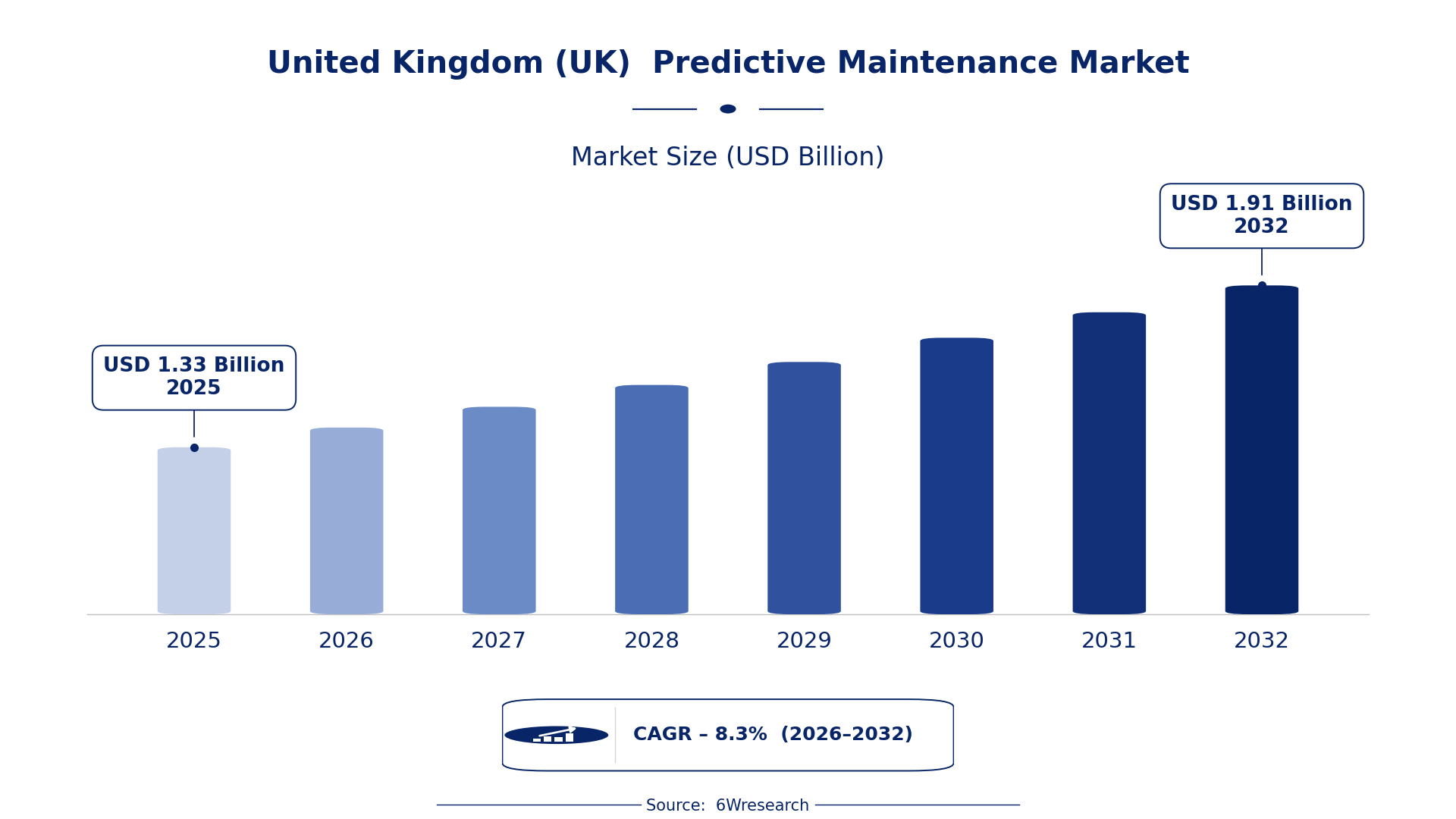
The United Kingdom (UK) Predictive Maintenance Market was estimated at USD 1328 Million in 2025 and is projected to reach USD 1907 Million by 2032, growing at a CAGR of 8.3% from 2026 to 2032.
United Kingdom (UK) Predictive Maintenance Market Synopsis
The drive towards Industry 4.0 is the most influential force currently shaping the UK Predictive Maintenance Market. As businesses increasingly adopt interconnected technologies, they are discovering the profound impact predictive maintenance can have on operational efficiency and asset management.
In sectors like manufacturing and automotive, predictive maintenance is transitioning from a novel concept to an essential strategy. Companies are now prioritizing proactive maintenance approaches, using data analytics to predict failures and optimize maintenance schedules, thus enhancing productivity and reducing costs.
United Kingdom (UK) Predictive Maintenance Market Year-wise Growth Rate and Key Drivers
This graph illustrates the annual growth rates of the United Kingdom (UK) Predictive Maintenance Market from 2021 to 2032, highlighting a steady upward trajectory and projected expansion over the forecast period.
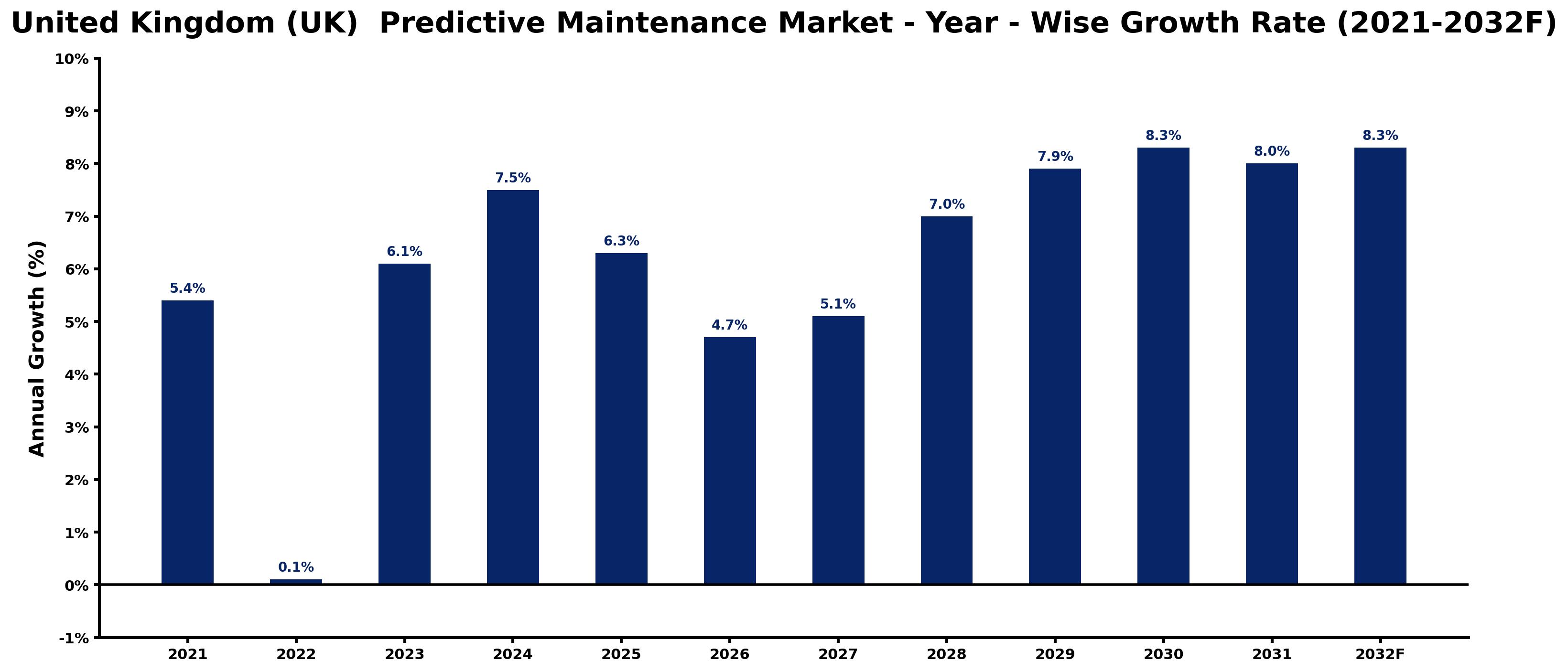
The table below presents the year‑wise growth rates along with the key drivers influencing the market
| Year | Growth Rate | Major Drivers |
| 2021 | 5.4% | High adoption of Industry 4.0 technologies across sectors. |
| 2022 | 0.1% | Manufacturers investing in efficiency-driven maintenance solutions. |
| 2023 | 6.1% | UK government promoting smart factory initiatives for manufacturing. |
| 2024 | 7.5% | Increased focus on reducing operational costs via analytics. |
| 2025 | 6.3% | Rising concern over equipment downtimes in key industries. |
| 2026 | 4.7% | Growing integration of IoT in manufacturing processes. |
| 2027 | 5.1% | Enhanced predictive analytics capabilities from local tech firms. |
| 2028 | 7.0% | Local demand for energy-efficient maintenance solutions rising. |
| 2029 | 7.9% | Regulatory pushes for improved asset management practices. |
| 2030 | 8.3% | Surge in A.I. applications for predictive maintenance methods. |
| 2031 | 8.0% | Increased funding for digital transformation in UK industries. |
| 2032 | 8.3% | Strong demand for remote monitoring in asset management. |
Note: Market size estimations and growth projections presented in this report are based on 6Wresearch's proprietary forecasting methodology, utilizing the latest available industry data, government publications, and primary research inputs.
United Kingdom (UK) Predictive Maintenance Market Key Takeaways
Below are some of the specific key takeaways from the market, including:
- The integration of IoT technologies is revolutionizing equipment monitoring.
- Data analytics and machine learning are being utilized to enhance predictive capabilities.
- Investment opportunities are abundant in software development and analytics platforms.
- Government initiatives are fostering innovation and technology adoption in the sector.
- Companies are shifting towards predictive maintenance as a service model.
Evaluation of Restraints in United Kingdom (UK) Predictive Maintenance Market
The UK Predictive Maintenance Market faces several restraints that could hinder its growth. A notable barrier is the high initial investment required for implementing these advanced technologies. Many businesses are hesitant to commit significant resources without clear, immediate returns. Additionally, the lack of skilled professionals adept in data analytics and machine learning complicates the effective deployment of predictive maintenance strategies. Integrating these modern solutions with traditional maintenance practices presents another challenge, as organizations must overhaul existing systems to fully realize the benefits of predictive maintenance.
United Kingdom (UK) Predictive Maintenance Market Trends
A clear trend in the UK market is the increased use of IoT devices to enhance equipment monitoring. Organizations are increasingly adopting advanced analytics to forecast equipment failures, which in turn reduces unplanned downtime. The integration of predictive maintenance solutions with cloud platforms is gaining traction, facilitating real-time monitoring and alerts for maintenance teams. on top of that, a shift towards a predictive maintenance as a service model allows businesses to adopt these technologies without large upfront costs, making it more accessible.
United Kingdom (UK) Predictive Maintenance Market Opportunities
The UK Predictive Maintenance Market presents numerous growth and investment opportunities. The surge in IoT, AI, and machine learning adoption across industries like manufacturing, energy, and transportation is driving demand for predictive maintenance solutions. Companies can explore avenues in developing innovative software, enhancing data analytics platforms, and creating advanced sensors. Collaborating with existing maintenance providers and research institutions will also provide a competitive advantage in this evolving market.
Government Initiatives in the United Kingdom (UK) Predictive Maintenance Market
The UK government is actively fostering the growth of predictive maintenance technologies through various initiatives. By promoting digital transformation, the government aims to improve operational efficiency and support the adoption of advanced maintenance practices across industries. These initiatives are crucial for enhancing the competitiveness of the industrial sector.
- A recently launched initiative under the Industrial Strategy Challenge Fund focuses on funding innovative projects in predictive maintenance technologies.
- A current program, Made Smarter, is assisting businesses in adopting digital technologies, including predictive maintenance solutions.
- A planned public-private partnership is expected to enhance data sharing frameworks for predictive maintenance by 2027.
- The government is developing a regulatory framework to encourage investment in digital maintenance solutions, scheduled for introduction in 2026.
Future Insights of the United Kingdom (UK) Predictive Maintenance Market
Looking ahead, the UK Predictive Maintenance Market is set for substantial growth from 2026 to 2032. The acceleration of IoT adoption and the utilization of AI-driven solutions will propel industries to refine their maintenance strategies. As organizations transition from reactive to predictive maintenance, the focus on equipment reliability and productivity will be paramount. This shift will not only enhance operational efficiency but also foster innovation within the sector, making predictive maintenance a cornerstone of modern business strategy.
United Kingdom (UK) Predictive Maintenance Market Latest Developments
Over the past year, the UK Predictive Maintenance Market has seen significant advancements driven by technological innovation and strategic partnerships. Companies are increasingly recognizing the value of predictive maintenance as a core component of their operational strategies.
- A major technology vendor launched an advanced predictive maintenance platform in early 2025, integrating machine learning capabilities for real-time data analysis.
- An ongoing initiative began in late 2025, focusing on collaboration between universities and industry leaders to develop new predictive maintenance algorithms.
- A leading regional operator is currently upgrading its predictive maintenance systems, expected to be completed by mid-2026.
- An upcoming rollout of a predictive maintenance service model is planned for late 2026, aimed at SMEs looking to minimize maintenance costs.
United Kingdom (UK) Predictive Maintenance Market - Key Attractiveness of the Report
- 10 Years of Market Numbers
- Historical Data Starting from 2022 to 2025
- Base Year: 2025
- Forecast Data until 2032
- Key Performance Indicators Impacting the Market
- Major Upcoming Developments and Projects
Key Highlights of the Report:
- United Kingdom (UK) Predictive Maintenance Market Outlook
- Market Size of United Kingdom (UK) Predictive Maintenance Market, 2025
- Forecast of United Kingdom (UK) Predictive Maintenance Market, 2032
- Historical Data and Forecast of United Kingdom (UK) Predictive Maintenance Revenues & Volume for the Period 2022-2032F
- United Kingdom (UK) Predictive Maintenance Market Trend Evolution
- United Kingdom (UK) Predictive Maintenance Market Drivers and Challenges
- United Kingdom (UK) Predictive Maintenance Price Trends
- United Kingdom (UK) Predictive Maintenance Porter's Five Forces
- United Kingdom (UK) Predictive Maintenance Industry Life Cycle
- Historical Data and Forecast of United Kingdom (UK) Predictive Maintenance Market Revenues & Volume By Component for the Period 2022-2032F
- Historical Data and Forecast of United Kingdom (UK) Predictive Maintenance Market Revenues & Volume By Solutions for the Period 2022-2032F
- Historical Data and Forecast of United Kingdom (UK) Predictive Maintenance Market Revenues & Volume By Services for the Period 2022-2032F
- Historical Data and Forecast of United Kingdom (UK) Predictive Maintenance Market Revenues & Volume By Organization Size for the Period 2022-2032F
- Historical Data and Forecast of United Kingdom (UK) Predictive Maintenance Market Revenues & Volume By Large Enterprises for the Period 2022-2032F
- Historical Data and Forecast of United Kingdom (UK) Predictive Maintenance Market Revenues & Volume By SME for the Period 2022-2032F
- Historical Data and Forecast of United Kingdom (UK) Predictive Maintenance Market Revenues & Volume By Deployment Mode for the Period 2022-2032F
- Historical Data and Forecast of United Kingdom (UK) Predictive Maintenance Market Revenues & Volume By On-premises for the Period 2022-2032F
- Historical Data and Forecast of United Kingdom (UK) Predictive Maintenance Market Revenues & Volume By Cloud for the Period 2022-2032F
- Historical Data and Forecast of United Kingdom (UK) Predictive Maintenance Market Revenues & Volume By Vertical for the Period 2022-2032F
- Historical Data and Forecast of United Kingdom (UK) Predictive Maintenance Market Revenues & Volume By Government and Defense for the Period 2022-2032F
- Historical Data and Forecast of United Kingdom (UK) Predictive Maintenance Market Revenues & Volume By Manufacturing for the Period 2022-2032F
- Historical Data and Forecast of United Kingdom (UK) Predictive Maintenance Market Revenues & Volume By Energy and Utilities for the Period 2022-2032F
- Historical Data and Forecast of United Kingdom (UK) Predictive Maintenance Market Revenues & Volume By Transportation and Logistics for the Period 2022-2032F
- Historical Data and Forecast of United Kingdom (UK) Predictive Maintenance Market Revenues & Volume By Healthcare and Life Sciences for the Period 2022-2032F
- United Kingdom (UK) Predictive Maintenance Import Export Trade Statistics
- Market Opportunity Assessment By Component
- Market Opportunity Assessment By Organization Size
- Market Opportunity Assessment By Deployment Mode
- Market Opportunity Assessment By Vertical
- United Kingdom (UK) Predictive Maintenance Top Companies Market Share
- United Kingdom (UK) Predictive Maintenance Competitive Benchmarking By Technical and Operational Parameters
- United Kingdom (UK) Predictive Maintenance Company Profiles
- United Kingdom (UK) Predictive Maintenance Key Strategic Recommendations






































