United Kingdom (UK) Prescriptive Analytics Market Size & Growth Rate (2026-2032)
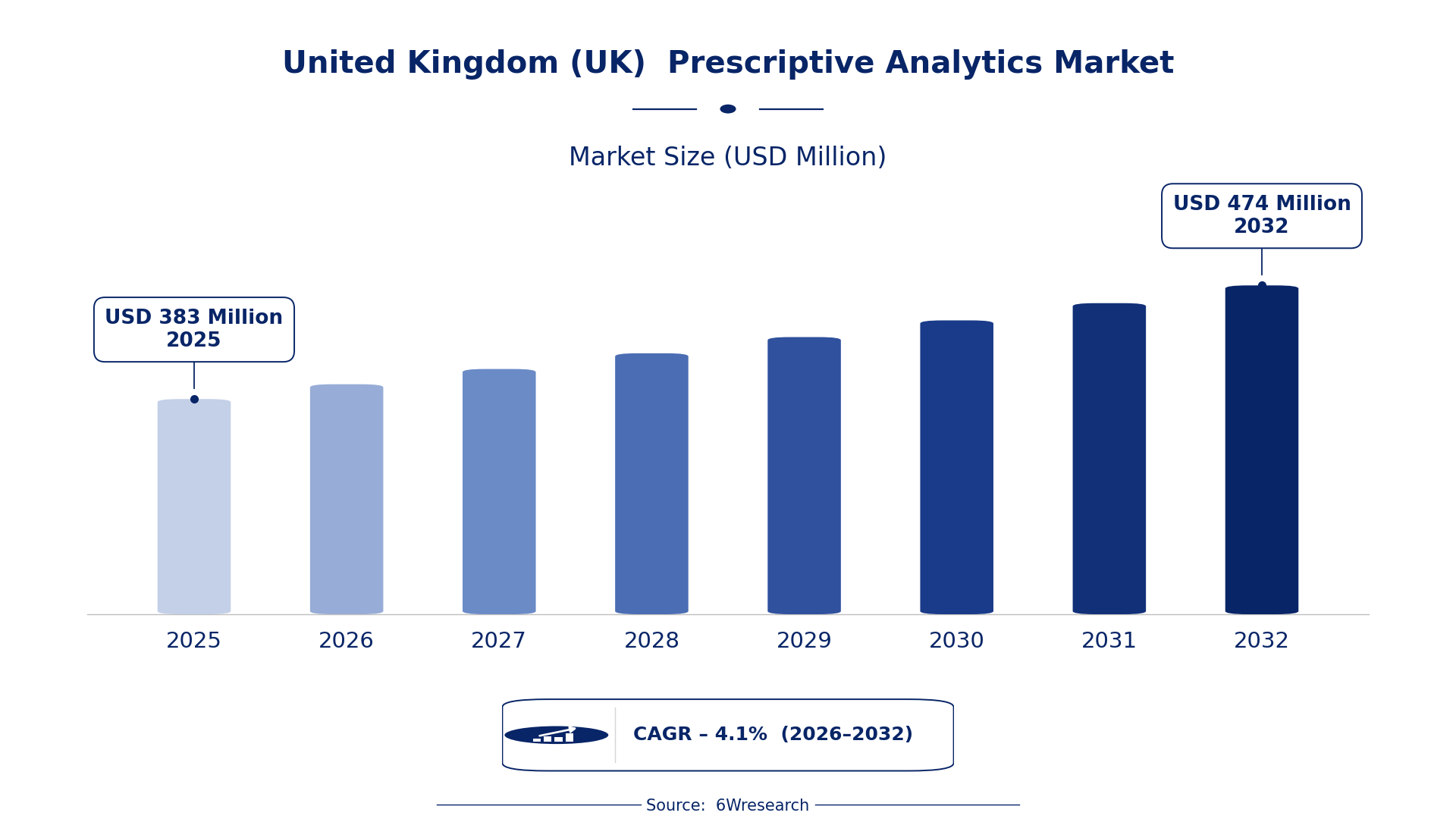
The United Kingdom (UK) Prescriptive Analytics Market was estimated at USD 383 Million in 2025 and is projected to reach USD 474 Million by 2032, growing at a CAGR of 4.1% from 2026 to 2032.
United Kingdom (UK) Prescriptive Analytics Market Synopsis
The prescriptive analytics market in the UK is witnessing a notable surge as organizations increasingly harness data to enhance decision-making and streamline operations. This market integrates advanced analytics, machine learning, and optimization techniques, offering actionable insights that businesses can implement promptly.
As the volume of data continues to grow, the demand for sophisticated analytics solutions becomes critical. Companies across various sectors recognize the competitive edge provided by prescriptive analytics, leading to greater investment in technologies that turn data into strategic advantages.
United Kingdom (UK) Prescriptive Analytics Market Year-wise Growth Rate and Key Drivers
This graph illustrates the annual growth rates of the United Kingdom (UK) Prescriptive Analytics Market from 2021 to 2032, highlighting a steady upward trajectory and projected expansion over the forecast period.
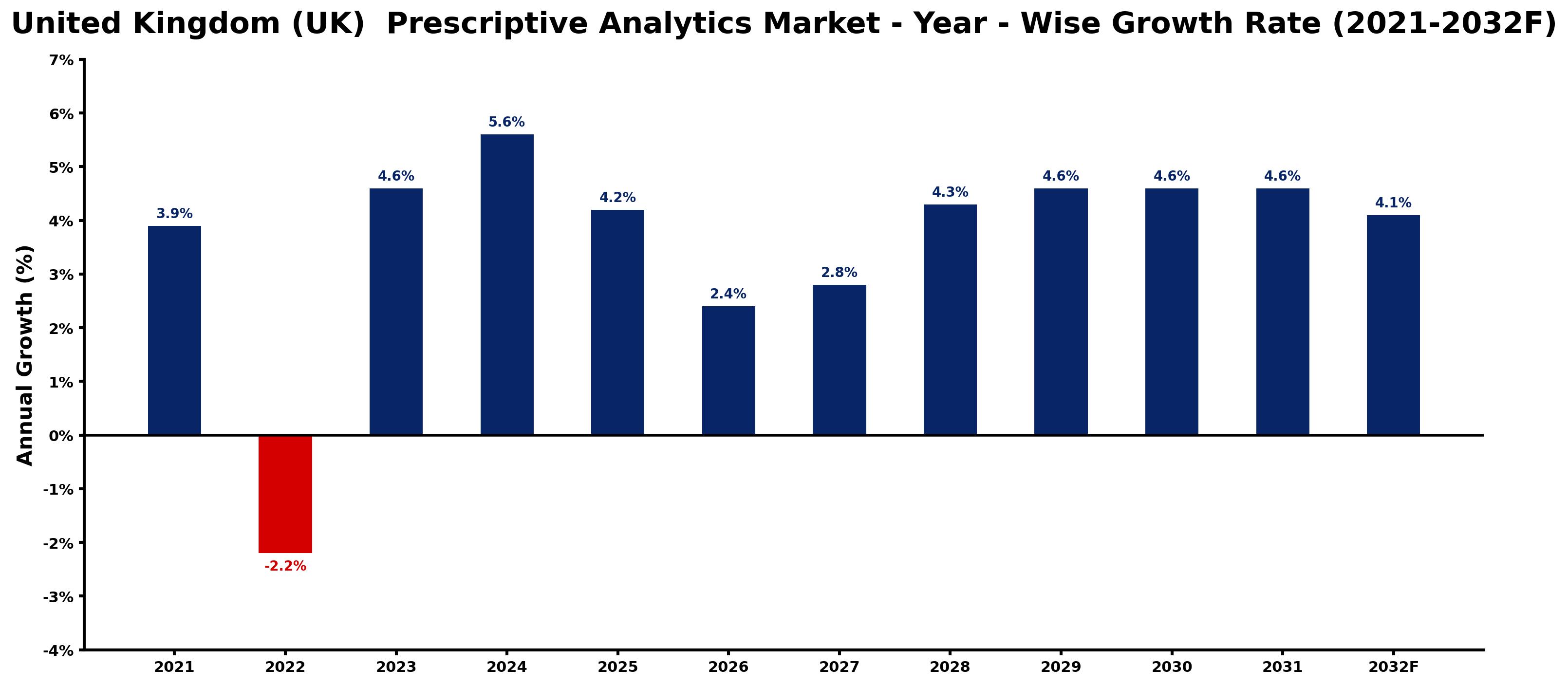
The table below presents the year‑wise growth rates along with the key drivers influencing the market
| Year | Growth Rate | Major Drivers |
| 2021 | 3.9% | UK's NHS adopting predictive models for patient care. |
| 2022 | -2.2% | UK public sector budget cuts reduced analytics investments. |
| 2023 | 4.6% | Government data strategy emphasizing enhanced analytics adoption. |
| 2024 | 5.6% | Rise of financial services leveraging prescriptive analytics. |
| 2025 | 4.2% | Increased regulation on business performance analytics compliance. |
| 2026 | 2.4% | Growing analytics investment by UK's insurance industry leaders. |
| 2027 | 2.8% | Local universities promoting prescriptive analytics through research grants. |
| 2028 | 4.3% | Retail sector leveraging analytics for supply chain efficiency. |
| 2029 | 4.6% | Energy sector initiatives driving predictive maintenance analytics. |
| 2030 | 4.6% | Healthcare technology firms collaborating on predictive analytics tools. |
| 2031 | 4.6% | Increased funding for AI-driven analytics startups in UK. |
| 2032 | 4.1% | Local councils using analytics for urban planning decisions. |
Note: Market size estimations and growth projections presented in this report are based on 6Wresearch's proprietary forecasting methodology, utilizing the latest available industry data, government publications, and primary research inputs.
United Kingdom (UK) Prescriptive Analytics Market Key Takeaways
Below are some of the specific key takeaways from the market, including:
- Rapid growth driven by the need for data-driven decision-making across industries.
- Increased adoption of predictive modeling and machine learning technologies.
- Technological innovations enhance the capabilities of prescriptive analytics platforms.
- Integration challenges remain a hurdle for many businesses adopting prescriptive analytics.
- Government initiatives are focusing on promoting ethical data usage and privacy regulations.
Evaluation of Restraints in United Kingdom (UK) Prescriptive Analytics Market
Despite the positive momentum, several constraints hinder the full potential of the prescriptive analytics market in the UK. One major issue is the integration of prescriptive models with existing analytics infrastructures, which can be complex and costly. on top of that, ensuring the accuracy and reliability of data for decision-making is crucial; any discrepancies can lead to misguided strategies.
Another challenge lies in adapting algorithms to the ever-changing dynamics of consumer behavior and market conditions. Companies that fail to keep pace with these changes may find their analytics solutions ineffective, undermining the value derived from their investments.
United Kingdom (UK) Prescriptive Analytics Market Trends
The trend towards real-time analytics is gaining traction as businesses strive for agility in their operations. Companies are increasingly focusing on AI-driven decision engines that not only analyze past data but also make forward-looking recommendations. This shift is particularly pronounced in sectors like healthcare and finance, where timely insights can lead to significant improvements in outcomes.
Another key trend is the rise of tailored prescriptive analytics platforms designed for specific industries. These customized solutions allow organizations to address their unique challenges and enhance operational efficiency. As industries evolve, the demand for specialized analytics tools will only intensify.
United Kingdom (UK) Prescriptive Analytics Market Opportunities
The landscape for prescriptive analytics in the UK is ripe with opportunities for growth and investment. Businesses looking to enhance their competitive edge can focus on integrating advanced analytics with their current operations. This includes investing in platforms that utilize machine learning for predictive modeling and optimization.
on top of that, as ethical data usage becomes a priority, companies can explore partnerships with technology vendors that specialize in compliance-oriented analytics solutions. This not only aligns with regulatory demands but also enhances consumer trust and engagement.
Government Initiatives in the United Kingdom (UK) Prescriptive Analytics Market
The UK government plays a crucial role in shaping the prescriptive analytics market through various initiatives aimed at fostering ethical data practices and encouraging the use of advanced analytics across industries. Current policies focus on promoting transparency, data privacy, and innovative data usage strategies that benefit both businesses and consumers.
- A national data privacy regulation introduced in 2024 that mandates compliance for businesses using prescriptive analytics.
- Currently ongoing government-sponsored workshops to educate businesses on best practices for implementing prescriptive analytics solutions.
- A planned public-private partnership expected to launch in 2026, aimed at enhancing data infrastructure across key sectors.
- Recent initiatives focusing on the ethical use of AI in analytics, promoting responsible data handling practices.
- A regulatory framework under development that will address the challenges of data integration in analytics platforms.
Future Insights of the United Kingdom (UK) Prescriptive Analytics Market
Looking ahead to 2026-2032, the prescriptive analytics market in the UK is set to evolve significantly. As more businesses recognize the importance of data-driven strategies, the demand for prescriptive analytics solutions is expected to surge. Companies will likely invest heavily in integrating AI and machine learning into their analytics frameworks, providing deeper insights and more accurate recommendations.
on top of that, regulatory frameworks will continue to shape how data is used, pushing organizations towards compliance-driven analytics solutions. This environment will create a landscape where ethical data practices are not just a requirement but a competitive advantage.
United Kingdom (UK) Prescriptive Analytics Market Latest Developments
In the past year, the prescriptive analytics market in the UK has seen a variety of developments, reflecting the dynamic nature of the industry. Companies are actively adopting new technologies to enhance their analytical capabilities, driven by the increasing need for real-time decision-making.
- A major technology vendor launched an AI-powered prescriptive analytics platform in late 2025, designed to optimize supply chain operations for retail businesses.
- In early 2025, a collaborative initiative was announced between several leading firms to develop standardized frameworks for data sharing in analytics.
- A service upgrade from a well-known analytics provider, introduced in Q3 2025, enhanced the user interface and functionality of their prescriptive analytics tools.
- A pilot program focused on ethical AI usage in prescriptive analytics began in mid-2025, aiming to establish best practices for businesses.
- Upcoming regulations expected to be finalized in early 2026 will mandate transparency in AI-driven analytics processes.
United Kingdom (UK) Prescriptive Analytics Market - Key Attractiveness of the Report
- 10 Years of Market Numbers
- Historical Data Starting from 2022 to 2025
- Base Year: 2025
- Forecast Data until 2032
- Key Performance Indicators Impacting the Market
- Major Upcoming Developments and Projects
Key Highlights of the Report:
- United Kingdom (UK) Prescriptive Analytics Market Outlook
- Market Size of United Kingdom (UK) Prescriptive Analytics Market, 2025
- Forecast of United Kingdom (UK) Prescriptive Analytics Market, 2032
- Historical Data and Forecast of United Kingdom (UK) Prescriptive Analytics Revenues & Volume for the Period 2022-2032F
- United Kingdom (UK) Prescriptive Analytics Market Trend Evolution
- United Kingdom (UK) Prescriptive Analytics Market Drivers and Challenges
- United Kingdom (UK) Prescriptive Analytics Price Trends
- United Kingdom (UK) Prescriptive Analytics Porter's Five Forces
- United Kingdom (UK) Prescriptive Analytics Industry Life Cycle
- Historical Data and Forecast of United Kingdom (UK) Prescriptive Analytics Market Revenues & Volume By Application for the Period 2022-2032F
- Historical Data and Forecast of United Kingdom (UK) Prescriptive Analytics Market Revenues & Volume By Risk Management for the Period 2022-2032F
- Historical Data and Forecast of United Kingdom (UK) Prescriptive Analytics Market Revenues & Volume By Operation Management for the Period 2022-2032F
- Historical Data and Forecast of United Kingdom (UK) Prescriptive Analytics Market Revenues & Volume By Revenue Management for the Period 2022-2032F
- Historical Data and Forecast of United Kingdom (UK) Prescriptive Analytics Market Revenues & Volume By Network Management for the Period 2022-2032F
- Historical Data and Forecast of United Kingdom (UK) Prescriptive Analytics Market Revenues & Volume By Workforce Management for the Period 2022-2032F
- Historical Data and Forecast of United Kingdom (UK) Prescriptive Analytics Market Revenues & Volume By Supply Chain Management for the Period 2022-2032F
- Historical Data and Forecast of United Kingdom (UK) Prescriptive Analytics Market Revenues & Volume By Others for the Period 2022-2032F
- Historical Data and Forecast of United Kingdom (UK) Prescriptive Analytics Market Revenues & Volume By Data Type for the Period 2022-2032F
- Historical Data and Forecast of United Kingdom (UK) Prescriptive Analytics Market Revenues & Volume By Unstructured for the Period 2022-2032F
- Historical Data and Forecast of United Kingdom (UK) Prescriptive Analytics Market Revenues & Volume By Semi-Structured for the Period 2022-2032F
- Historical Data and Forecast of United Kingdom (UK) Prescriptive Analytics Market Revenues & Volume By Structured for the Period 2022-2032F
- Historical Data and Forecast of United Kingdom (UK) Prescriptive Analytics Market Revenues & Volume By Component for the Period 2022-2032F
- Historical Data and Forecast of United Kingdom (UK) Prescriptive Analytics Market Revenues & Volume By Software for the Period 2022-2032F
- Historical Data and Forecast of United Kingdom (UK) Prescriptive Analytics Market Revenues & Volume By Services for the Period 2022-2032F
- Historical Data and Forecast of United Kingdom (UK) Prescriptive Analytics Market Revenues & Volume By Deployment Mode for the Period 2022-2032F
- Historical Data and Forecast of United Kingdom (UK) Prescriptive Analytics Market Revenues & Volume By Cloud for the Period 2022-2032F
- Historical Data and Forecast of United Kingdom (UK) Prescriptive Analytics Market Revenues & Volume By On-premises for the Period 2022-2032F
- Historical Data and Forecast of United Kingdom (UK) Prescriptive Analytics Market Revenues & Volume By Organization Size for the Period 2022-2032F
- Historical Data and Forecast of United Kingdom (UK) Prescriptive Analytics Market Revenues & Volume By Large enterprises for the Period 2022-2032F
- Historical Data and Forecast of United Kingdom (UK) Prescriptive Analytics Market Revenues & Volume By Small and medium-sized enterprises (SMEs) for the Period 2022-2032F
- Historical Data and Forecast of United Kingdom (UK) Prescriptive Analytics Market Revenues & Volume By Vertical for the Period 2022-2032F
- Historical Data and Forecast of United Kingdom (UK) Prescriptive Analytics Market Revenues & Volume By BFSI for the Period 2022-2032F
- Historical Data and Forecast of United Kingdom (UK) Prescriptive Analytics Market Revenues & Volume By Retail and eCommerce for the Period 2022-2032F
- Historical Data and Forecast of United Kingdom (UK) Prescriptive Analytics Market Revenues & Volume By Media and Entertainment for the Period 2022-2032F
- Historical Data and Forecast of United Kingdom (UK) Prescriptive Analytics Market Revenues & Volume By Manufacturing for the Period 2022-2032F
- Historical Data and Forecast of United Kingdom (UK) Prescriptive Analytics Market Revenues & Volume By Travel and Hospitality for the Period 2022-2032F
- Historical Data and Forecast of United Kingdom (UK) Prescriptive Analytics Market Revenues & Volume By Energy and Utilities for the Period 2022-2032F
- Historical Data and Forecast of United Kingdom (UK) Prescriptive Analytics Market Revenues & Volume By Telecom and IT for the Period 2022-2032F
- United Kingdom (UK) Prescriptive Analytics Import Export Trade Statistics
- Market Opportunity Assessment By Application
- Market Opportunity Assessment By Data Type
- Market Opportunity Assessment By Component
- Market Opportunity Assessment By Deployment Mode
- Market Opportunity Assessment By Organization Size
- Market Opportunity Assessment By Vertical
- United Kingdom (UK) Prescriptive Analytics Top Companies Market Share
- United Kingdom (UK) Prescriptive Analytics Competitive Benchmarking By Technical and Operational Parameters
- United Kingdom (UK) Prescriptive Analytics Company Profiles
- United Kingdom (UK) Prescriptive Analytics Key Strategic Recommendations






































