United Arab Emirates (UAE) Prescriptive Analytics Market Size & Growth Rate (2026-2032)
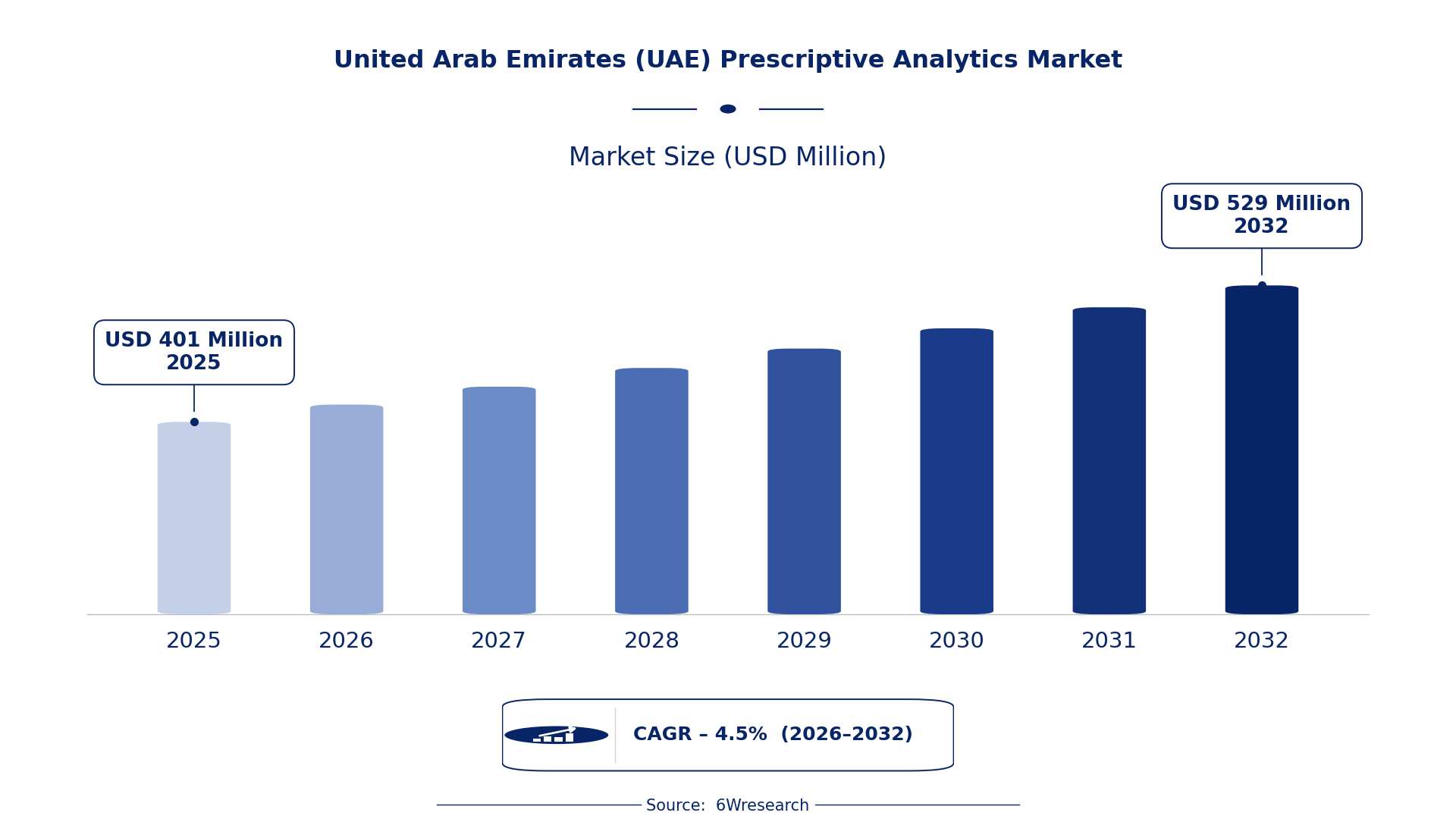
The United Arab Emirates (UAE) Prescriptive Analytics Market was estimated at USD 401 Million in 2025 and is projected to reach USD 529 Million by 2032, growing at a CAGR of 4.5% from 2026 to 2032.
United Arab Emirates (UAE) Prescriptive Analytics Market Synopsis
The Prescriptive Analytics market in the UAE has witnessed a surge in interest as organizations increasingly recognize the need for actionable insights. As businesses shift from merely understanding data to utilizing it for strategic decision-making, prescriptive analytics stands at the forefront of this transformation, shaping the future of operations across various sectors.
Looking ahead, the market is set to expand significantly. Companies are not just adopting prescriptive analytics for operational efficiency; they are also integrating these solutions into their core strategies to improve customer experiences and optimize supply chains. This trend is particularly evident in industries like healthcare and finance, where precise decision-making is critical.
United Arab Emirates (UAE) Prescriptive Analytics Market Year-wise Growth Rate and Key Drivers
This graph illustrates the annual growth rates of the United Arab Emirates (UAE) Prescriptive Analytics Market from 2021 to 2032, highlighting a steady upward trajectory and projected expansion over the forecast period.
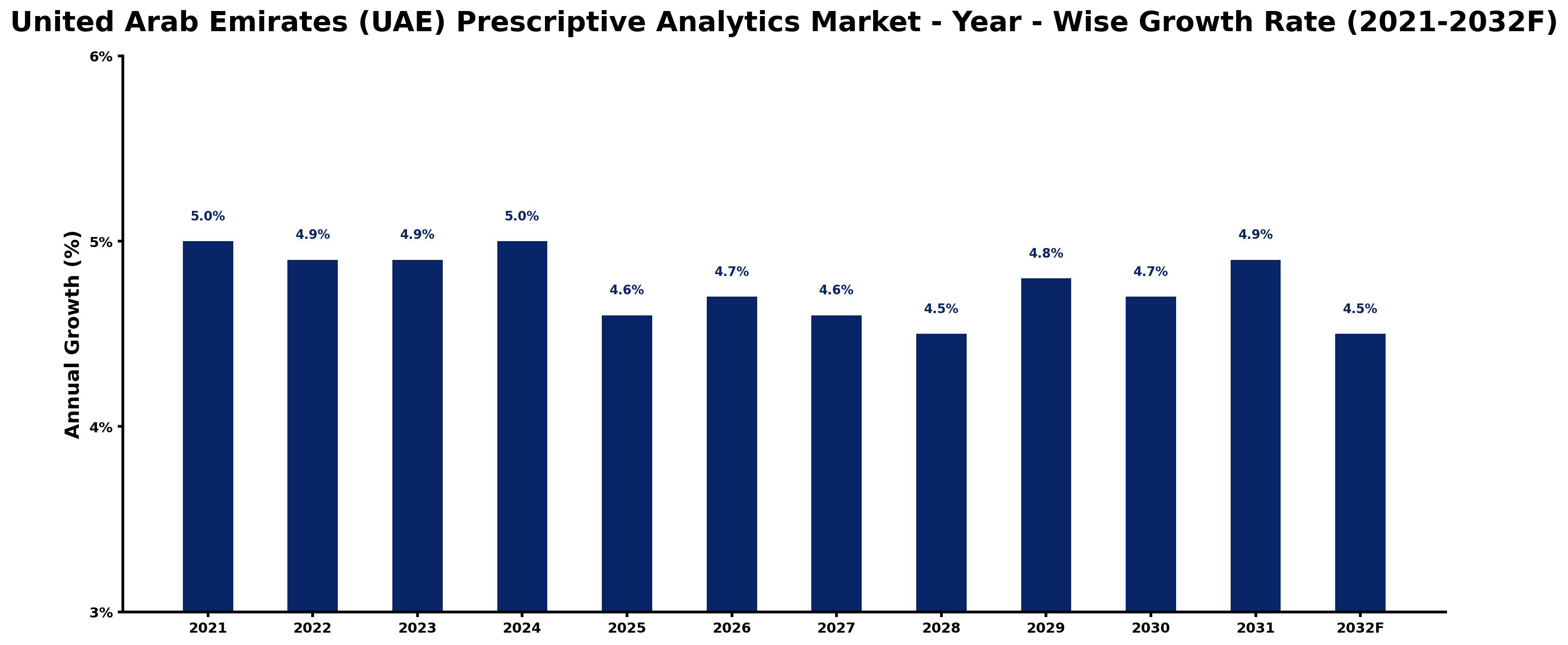
The table below presents the year‑wise growth rates along with the key drivers influencing the market
| Year | Growth Rate | Major Drivers |
| 2021 | 5.0% | UAE strategy emphasizing AI and data-driven decisions. |
| 2022 | 4.9% | Increased investment in smart city initiatives by Dubai. |
| 2023 | 4.9% | Implementation of GDPR-like data protection regulations boosting trust. |
| 2024 | 5.0% | Growing fintech sector leveraging predictive models for growth. |
| 2025 | 4.6% | Rise in e-commerce demands enhancing customer behavior analytics. |
| 2026 | 4.7% | Government financing supporting AI startups and innovation clusters. |
| 2027 | 4.6% | UAE national policies fostering data science education programs. |
| 2028 | 4.5% | Local businesses adopting personalization strategies for customer engagement. |
| 2029 | 4.8% | Emergence of healthcare analytics improving patient outcome predictions. |
| 2030 | 4.7% | Demand for real-time insights in logistics and transport. |
| 2031 | 4.9% | Smart tourism initiatives driving visitor data analysis requirements. |
| 2032 | 4.5% | Increased focus on sustainability analytics in urban planning. |
Note: Market size estimations and growth projections presented in this report are based on 6Wresearch's proprietary forecasting methodology, utilizing the latest available industry data, government publications, and primary research inputs.
United Arab Emirates (UAE) Prescriptive Analytics Market Key Takeaways
Below are some of the specific key takeaways from the market, including:
- Prescriptive analytics is crucial for optimizing decision-making processes across various industries in the UAE.
- The healthcare sector is increasingly relying on prescriptive analytics to enhance patient outcomes and streamline operations.
- Companies are adopting prescriptive analytics to automate decision-making, driving operational efficiency.
- Government initiatives are supporting the growth of data-driven strategies, further boosting market demand.
- Challenges related to organizational readiness may hinder some companies from fully implementing these solutions.
Evaluation of Restraints in United Arab Emirates (UAE) Prescriptive Analytics Market
Despite the promising growth trajectory, the prescriptive analytics market faces obstacles that could slow its momentum. A significant challenge is the readiness of organizations to embrace these advanced tools. Many companies struggle with the cultural shift required for data-driven decision-making. Resistance to change and the need for substantial organizational adjustments hinder the full realization of prescriptive analytics' benefits. As firms grapple with these issues, their ability to harness the power of data for strategic advantage may be compromised.
United Arab Emirates (UAE) Prescriptive Analytics Market Trends
Several key trends are shaping the demand for prescriptive analytics in the UAE. First, there is a growing emphasis on data privacy and security, leading organizations to seek analytics solutions that comply with stringent regulations. Second, the integration of artificial intelligence and machine learning into prescriptive analytics tools is enabling more sophisticated insights and automation capabilities. Lastly, the increasing focus on customer-centric strategies is driving businesses to leverage prescriptive analytics for personalized experiences.
United Arab Emirates (UAE) Prescriptive Analytics Market Opportunities
The future holds numerous opportunities for growth within the prescriptive analytics market in the UAE. Industries such as logistics and supply chain management are particularly ripe for investment, as companies look to enhance efficiency and reduce costs. Additionally, as the government continues to push for digital transformation across sectors, businesses that adopt prescriptive analytics stand to gain a competitive edge. Emerging startups focusing on niche applications also represent a potential avenue for innovative solutions in this space.
Government Initiatives in the United Arab Emirates (UAE) Prescriptive Analytics Market
The UAE government plays an influential role in shaping the prescriptive analytics market through various initiatives aimed at fostering a data-driven economy. Public policy is geared towards encouraging businesses to adopt advanced analytics solutions, which are seen as vital for enhancing national competitiveness. These initiatives are critical at a time when organizations are increasingly seeking to integrate data analytics into their operational strategies.
- A national digital infrastructure upgrade programme, now in its rollout phase, aims to enhance data accessibility and analytics capabilities across sectors.
- Currently ongoing is a government-led initiative to establish data-sharing frameworks among public and private entities, enhancing the collaborative use of prescriptive analytics.
- A regulatory framework introduced in 2025 mandating the use of advanced analytics in healthcare to improve patient outcomes is currently being implemented.
- A planned public-private partnership expected to expand the use of prescriptive analytics in logistics by 2028 is set to improve supply chain efficiencies.
Future Insights of the United Arab Emirates (UAE) Prescriptive Analytics Market
From 2026 to 2032, the prescriptive analytics market in the UAE is likely to evolve significantly. As organizations increasingly prioritize data-driven decision-making, the demand for sophisticated analytics tools will rise. Integration with AI and machine learning technologies will enhance these solutions, making them indispensable for industries looking to streamline operations. on top of that, government support for digital initiatives will bolster market growth, leading to a more competitive business environment.
United Arab Emirates (UAE) Prescriptive Analytics Market Latest Developments
Recent developments in the UAE's prescriptive analytics market indicate a strong push towards innovation and integration of new technologies. Over the last year, organizations have increasingly adopted advanced analytics tools to streamline operations and enhance decision-making processes. This trend reflects a broader commitment to leveraging data for strategic advantages across various sectors.
- A major technology vendor launched an updated prescriptive analytics platform in early 2025, incorporating enhanced AI capabilities to deliver more accurate insights.
- An ongoing partnership between several regional operators focuses on developing a standardized analytics framework for the logistics industry, currently in its testing phase.
- A new initiative to train professionals in prescriptive analytics began in Q2 2025, aiming to build local expertise and support market growth.
- A planned rollout of an integrated analytics solution for healthcare providers is expected to commence in late 2026, enhancing patient care through data-driven insights.
United Arab Emirates (UAE) Prescriptive Analytics Market - Key Attractiveness of the Report
- 10 Years of Market Numbers
- Historical Data Starting from 2022 to 2025
- Base Year: 2025
- Forecast Data until 2032
- Key Performance Indicators Impacting the Market
- Major Upcoming Developments and Projects
Key Highlights of the Report:
- United Arab Emirates (UAE) Prescriptive Analytics Market Outlook
- Market Size of United Arab Emirates (UAE) Prescriptive Analytics Market, 2025
- Forecast of United Arab Emirates (UAE) Prescriptive Analytics Market, 2032
- Historical Data and Forecast of United Arab Emirates (UAE) Prescriptive Analytics Revenues & Volume for the Period 2022-2032F
- United Arab Emirates (UAE) Prescriptive Analytics Market Trend Evolution
- United Arab Emirates (UAE) Prescriptive Analytics Market Drivers and Challenges
- United Arab Emirates (UAE) Prescriptive Analytics Price Trends
- United Arab Emirates (UAE) Prescriptive Analytics Porter's Five Forces
- United Arab Emirates (UAE) Prescriptive Analytics Industry Life Cycle
- Historical Data and Forecast of United Arab Emirates (UAE) Prescriptive Analytics Market Revenues & Volume By Application for the Period 2022-2032F
- Historical Data and Forecast of United Arab Emirates (UAE) Prescriptive Analytics Market Revenues & Volume By Risk Management for the Period 2022-2032F
- Historical Data and Forecast of United Arab Emirates (UAE) Prescriptive Analytics Market Revenues & Volume By Operation Management for the Period 2022-2032F
- Historical Data and Forecast of United Arab Emirates (UAE) Prescriptive Analytics Market Revenues & Volume By Revenue Management for the Period 2022-2032F
- Historical Data and Forecast of United Arab Emirates (UAE) Prescriptive Analytics Market Revenues & Volume By Network Management for the Period 2022-2032F
- Historical Data and Forecast of United Arab Emirates (UAE) Prescriptive Analytics Market Revenues & Volume By Workforce Management for the Period 2022-2032F
- Historical Data and Forecast of United Arab Emirates (UAE) Prescriptive Analytics Market Revenues & Volume By Supply Chain Management for the Period 2022-2032F
- Historical Data and Forecast of United Arab Emirates (UAE) Prescriptive Analytics Market Revenues & Volume By Others for the Period 2022-2032F
- Historical Data and Forecast of United Arab Emirates (UAE) Prescriptive Analytics Market Revenues & Volume By Data Type for the Period 2022-2032F
- Historical Data and Forecast of United Arab Emirates (UAE) Prescriptive Analytics Market Revenues & Volume By Unstructured for the Period 2022-2032F
- Historical Data and Forecast of United Arab Emirates (UAE) Prescriptive Analytics Market Revenues & Volume By Semi-Structured for the Period 2022-2032F
- Historical Data and Forecast of United Arab Emirates (UAE) Prescriptive Analytics Market Revenues & Volume By Structured for the Period 2022-2032F
- Historical Data and Forecast of United Arab Emirates (UAE) Prescriptive Analytics Market Revenues & Volume By Component for the Period 2022-2032F
- Historical Data and Forecast of United Arab Emirates (UAE) Prescriptive Analytics Market Revenues & Volume By Software for the Period 2022-2032F
- Historical Data and Forecast of United Arab Emirates (UAE) Prescriptive Analytics Market Revenues & Volume By Services for the Period 2022-2032F
- Historical Data and Forecast of United Arab Emirates (UAE) Prescriptive Analytics Market Revenues & Volume By Deployment Mode for the Period 2022-2032F
- Historical Data and Forecast of United Arab Emirates (UAE) Prescriptive Analytics Market Revenues & Volume By Cloud for the Period 2022-2032F
- Historical Data and Forecast of United Arab Emirates (UAE) Prescriptive Analytics Market Revenues & Volume By On-premises for the Period 2022-2032F
- Historical Data and Forecast of United Arab Emirates (UAE) Prescriptive Analytics Market Revenues & Volume By Organization Size for the Period 2022-2032F
- Historical Data and Forecast of United Arab Emirates (UAE) Prescriptive Analytics Market Revenues & Volume By Large enterprises for the Period 2022-2032F
- Historical Data and Forecast of United Arab Emirates (UAE) Prescriptive Analytics Market Revenues & Volume By Small and medium-sized enterprises (SMEs) for the Period 2022-2032F
- Historical Data and Forecast of United Arab Emirates (UAE) Prescriptive Analytics Market Revenues & Volume By Vertical for the Period 2022-2032F
- Historical Data and Forecast of United Arab Emirates (UAE) Prescriptive Analytics Market Revenues & Volume By BFSI for the Period 2022-2032F
- Historical Data and Forecast of United Arab Emirates (UAE) Prescriptive Analytics Market Revenues & Volume By Retail and eCommerce for the Period 2022-2032F
- Historical Data and Forecast of United Arab Emirates (UAE) Prescriptive Analytics Market Revenues & Volume By Media and Entertainment for the Period 2022-2032F
- Historical Data and Forecast of United Arab Emirates (UAE) Prescriptive Analytics Market Revenues & Volume By Manufacturing for the Period 2022-2032F
- Historical Data and Forecast of United Arab Emirates (UAE) Prescriptive Analytics Market Revenues & Volume By Travel and Hospitality for the Period 2022-2032F
- Historical Data and Forecast of United Arab Emirates (UAE) Prescriptive Analytics Market Revenues & Volume By Energy and Utilities for the Period 2022-2032F
- Historical Data and Forecast of United Arab Emirates (UAE) Prescriptive Analytics Market Revenues & Volume By Telecom and IT for the Period 2022-2032F
- United Arab Emirates (UAE) Prescriptive Analytics Import Export Trade Statistics
- Market Opportunity Assessment By Application
- Market Opportunity Assessment By Data Type
- Market Opportunity Assessment By Component
- Market Opportunity Assessment By Deployment Mode
- Market Opportunity Assessment By Organization Size
- Market Opportunity Assessment By Vertical
- United Arab Emirates (UAE) Prescriptive Analytics Top Companies Market Share
- United Arab Emirates (UAE) Prescriptive Analytics Competitive Benchmarking By Technical and Operational Parameters
- United Arab Emirates (UAE) Prescriptive Analytics Company Profiles
- United Arab Emirates (UAE) Prescriptive Analytics Key Strategic Recommendations






































