United States (US) Prescriptive Analytics Market Size & Growth Rate (2026-2032)
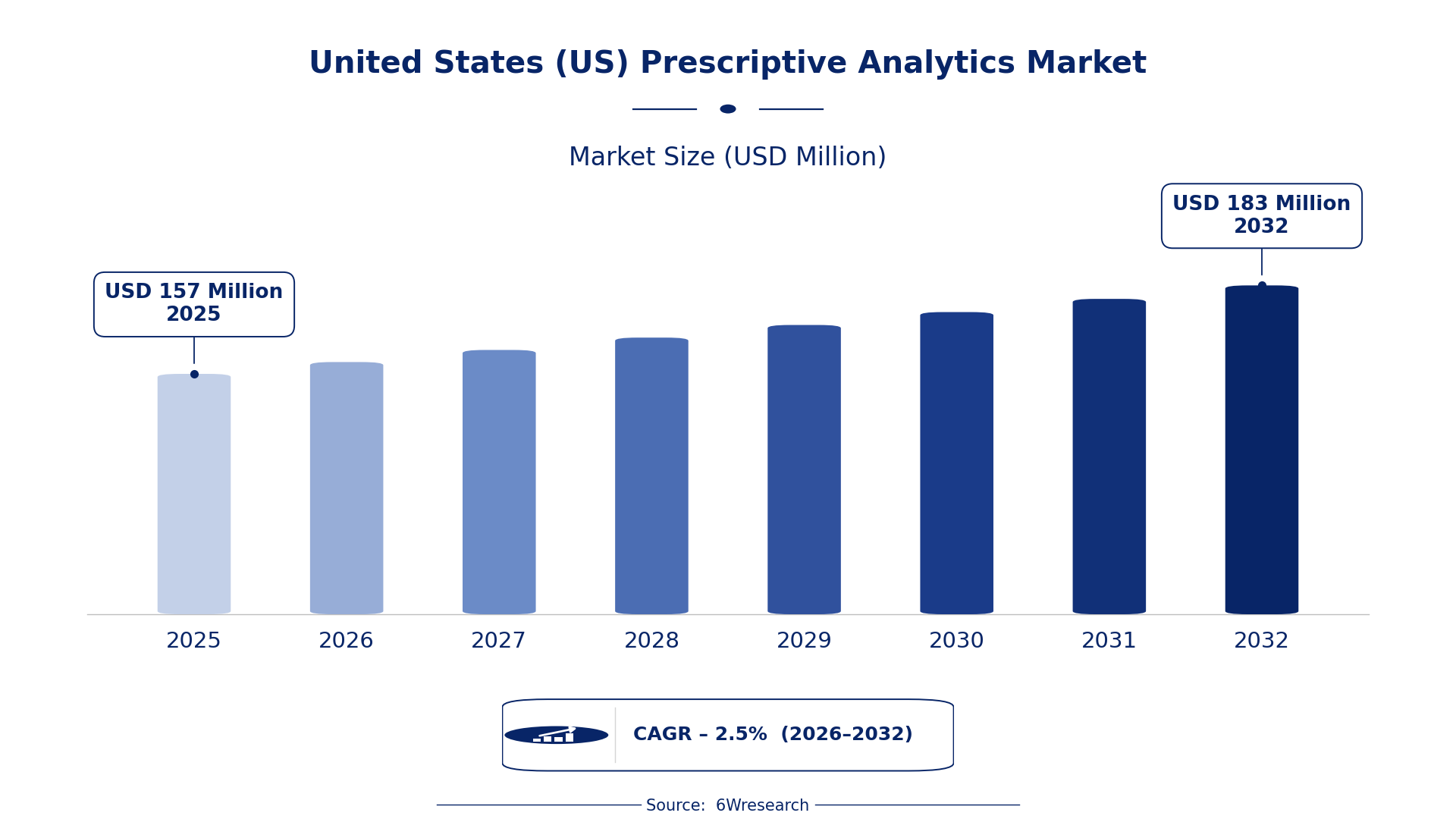
The United States (US) Prescriptive Analytics Market was estimated at USD 157 Million in 2025 and is projected to reach USD 183 Million by 2032, growing at a CAGR of 2.5% from 2026 to 2032.
United States (US) Prescriptive Analytics Market Synopsis
The most potent driver in the United States Prescriptive Analytics Market is the surge in data-driven decision-making across multiple sectors. Organizations are increasingly recognizing the value of turning vast datasets into actionable insights, which is fundamental for staying competitive in today’s economy.
As industries like healthcare, finance, and retail adopt advanced analytics tools, the demand for prescriptive analytics continues to grow. Companies are eager to enhance operational efficiency and customer experience, making these analytics solutions indispensable for modern business strategies.
United States (US) Prescriptive Analytics Market Year-wise Growth Rate and Key Drivers
This graph illustrates the annual growth rates of the United States (US) Prescriptive Analytics Market from 2021 to 2032, highlighting a steady upward trajectory and projected expansion over the forecast period.
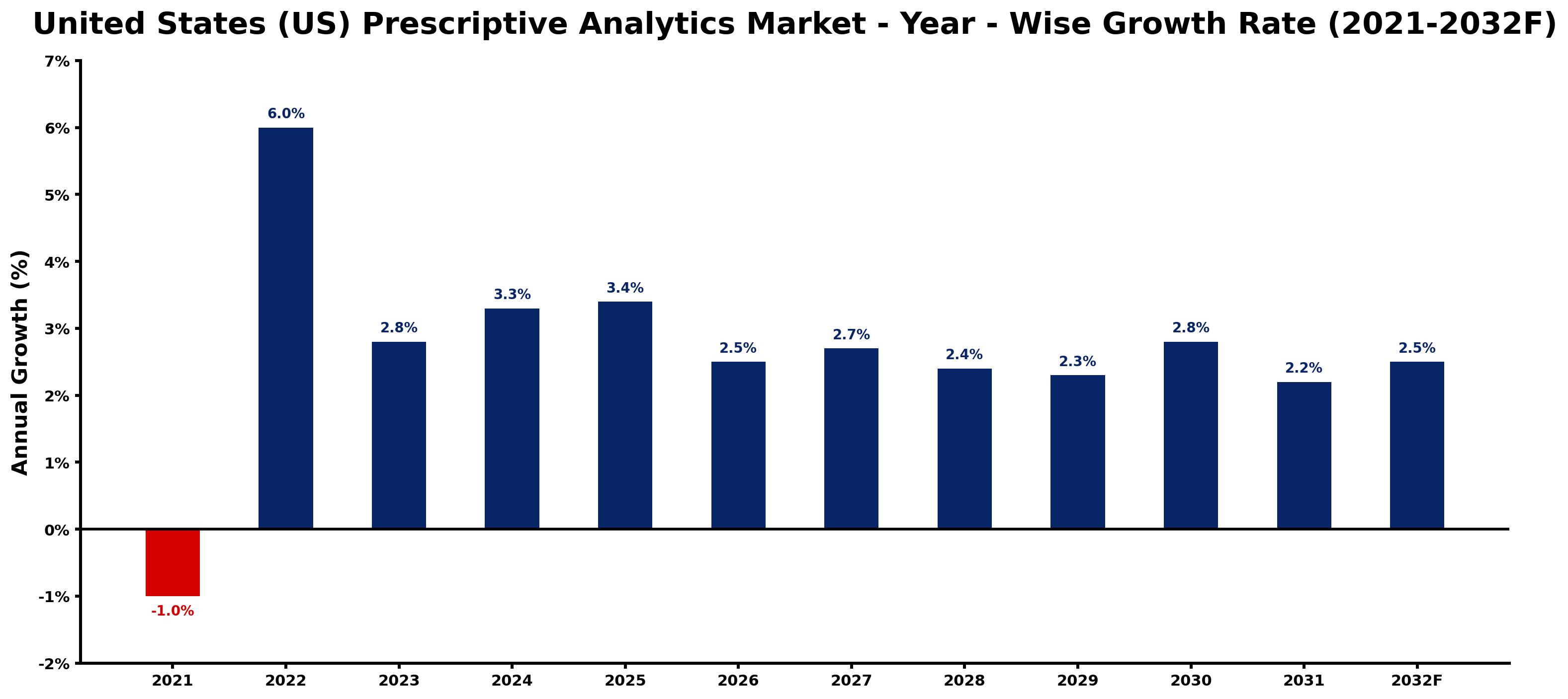
The table below presents the year‑wise growth rates along with the key drivers influencing the market
| Year | Growth Rate | Major Drivers |
| 2021 | -1.0% | Increased demand for holistic analytics solutions overshadowed prescriptive capabilities. |
| 2022 | 6.0% | Increased demand for data-driven decision-making processes. |
| 2023 | 2.8% | Growth of AI technologies in healthcare analytics sector. |
| 2024 | 3.3% | Implementation of FDA regulations enhancing data transparency. |
| 2025 | 3.4% | Rise in e-commerce boosting predictive sales analytics needs. |
| 2026 | 2.5% | Investment in urban planning driven by data analytics outputs. |
| 2027 | 2.7% | Surge in IoT data necessitating actionable insights generation. |
| 2028 | 2.4% | Advancements in machine learning improving consumer behavior predictions. |
| 2029 | 2.3% | Regulatory pressure for compliance analytics in finance sector. |
| 2030 | 2.8% | Demand for risk management solutions in insurance industry. |
| 2031 | 2.2% | Focus on sustainability analytics in corporate governance protocols. |
| 2032 | 2.5% | Increase in retail analytics for personalized customer experiences. |
Note: Market size estimations and growth projections presented in this report are based on 6Wresearch's proprietary forecasting methodology, utilizing the latest available industry data, government publications, and primary research inputs.
United States (US) Prescriptive Analytics Market Key Takeaways
Below are some of the specific key takeaways from the market, including:
- The integration of AI and machine learning is enhancing the effectiveness of prescriptive analytics tools.
- Real-time data processing capabilities are becoming a crucial requirement for businesses aiming to improve decision-making.
- Cloud-based prescriptive analytics solutions are gaining traction for their scalability and cost-efficiency.
- Investment in prescriptive analytics is increasing across sectors, particularly in healthcare and finance.
- Data privacy regulations are influencing how companies approach analytics, with a focus on compliance and security.
Evaluation of Restraints in United States (US) Prescriptive Analytics Market
The growth of the US Prescriptive Analytics Market is hindered by several factors. Chief among these are the concerns surrounding data privacy and security, particularly as regulations like GDPR and the California Consumer Privacy Act impose strict guidelines on data usage. Companies are often cautious about implementing analytics solutions that require extensive customer data, leading to a hesitation in adoption.
Integrating prescriptive analytics tools with existing systems can also be problematic. Many businesses grapple with the complexity and costs associated with upgrading legacy systems to accommodate new technologies. on top of that, there is a notable shortage of skilled professionals who can effectively implement and manage these advanced analytics solutions, which further complicates market growth.
United States (US) Prescriptive Analytics Market Trends
The current trends shaping the US Prescriptive Analytics Market include a marked increase in the use of AI and machine learning technologies. These innovations are enhancing the predictive capabilities of analytics tools, making them more effective at providing actionable insights. Additionally, the demand for real-time prescriptive analytics is on the rise, driven by businesses looking for immediate data-driven guidance to inform their decisions.
Cloud computing is also a significant trend, with more organizations opting for cloud-based prescriptive analytics solutions due to their scalability and reduced costs. As sectors like healthcare and finance continue to expand their analytics applications, the market is witnessing a broadening of use cases, further driving demand.
United States (US) Prescriptive Analytics Market Opportunities
The opportunities in the US Prescriptive Analytics Market are substantial, particularly as businesses seek to refine their decision-making processes. Key sectors are increasingly investing in analytics to enhance efficiency and gain competitive advantages. In healthcare, for instance, prescriptive analytics can optimize patient care and resource allocation. Similarly, in finance, organizations are adopting these solutions to improve risk management and forecasting.
Investors should look to software development firms that specialize in prescriptive analytics, as well as consulting services that assist companies in implementing analytics strategies. With the continuous push towards advanced analytics, the market is rich with potential for forward-thinking investors.
Government Initiatives in the United States (US) Prescriptive Analytics Market
Government policies and initiatives are actively shaping the growth of the prescriptive analytics market in the United States. By emphasizing the need for data analytics in decision-making, various public sector priorities are fostering an environment conducive to innovation. Programs aimed at enhancing data analytics capabilities are crucial for both government operations and private sector collaboration.
- A recently completed initiative, the Open Government Data Act, has made government data more accessible, encouraging businesses to utilize this data for analytics.
- Currently ongoing is the Federal Data Strategy, which aims to modernize data practices across federal agencies to improve decision-making through enhanced analytics.
- Planned for the future is the National Artificial Intelligence Initiative Act, which will prioritize funding for AI research, a critical component of prescriptive analytics.
- Public-private partnerships are being promoted to advance data analytics capabilities, fostering collaboration between governmental bodies and the tech industry.
Future Insights of the United States (US) Prescriptive Analytics Market
Looking ahead to 2026-2032, the United States Prescriptive Analytics Market is set to experience robust growth, driven by the escalating demand for data-driven insights across industries. As businesses increasingly prioritize operational efficiency and customer engagement, prescriptive analytics will become essential. The ongoing advancements in AI and machine learning will further enhance the capabilities of these analytics solutions, ensuring they remain at the forefront of decision-making processes.
As organizations strive for a competitive edge, the market is expected to expand, offering significant opportunities for vendors to develop innovative solutions that address the evolving needs of businesses in various sectors.
United States (US) Prescriptive Analytics Market Latest Developments
The past 12-14 months have seen a dynamic shift in the United States Prescriptive Analytics Market, with several key developments indicating a strong forward momentum. Organizations are increasingly investing in advanced analytics solutions to adapt to changing market conditions and consumer expectations. This trend is reflected in the growing number of collaborations and product launches aimed at enhancing analytics capabilities.
- A major technology vendor launched a new suite of prescriptive analytics tools in Q1 2025, focusing on real-time decision-making for retail businesses.
- In mid-2025, a prominent analytics firm initiated a partnership with a healthcare provider to enhance patient care through advanced prescriptive analytics.
- An ongoing project aims to integrate prescriptive analytics into financial services, with pilot implementations expected by late 2025.
- A rollout of a cloud-based prescriptive analytics platform is planned for early 2026, targeting small to medium enterprises looking to leverage advanced analytics.
United States (US) Prescriptive Analytics Market - Key Attractiveness of the Report
- 10 Years of Market Numbers
- Historical Data Starting from 2022 to 2025
- Base Year: 2025
- Forecast Data until 2032
- Key Performance Indicators Impacting the Market
- Major Upcoming Developments and Projects
Key Highlights of the Report:
- United States (US) Prescriptive Analytics Market Outlook
- Market Size of United States (US) Prescriptive Analytics Market, 2025
- Forecast of United States (US) Prescriptive Analytics Market, 2032
- Historical Data and Forecast of United States (US) Prescriptive Analytics Revenues & Volume for the Period 2022-2032F
- United States (US) Prescriptive Analytics Market Trend Evolution
- United States (US) Prescriptive Analytics Market Drivers and Challenges
- United States (US) Prescriptive Analytics Price Trends
- United States (US) Prescriptive Analytics Porter's Five Forces
- United States (US) Prescriptive Analytics Industry Life Cycle
- Historical Data and Forecast of United States (US) Prescriptive Analytics Market Revenues & Volume By Application for the Period 2022-2032F
- Historical Data and Forecast of United States (US) Prescriptive Analytics Market Revenues & Volume By Risk Management for the Period 2022-2032F
- Historical Data and Forecast of United States (US) Prescriptive Analytics Market Revenues & Volume By Operation Management for the Period 2022-2032F
- Historical Data and Forecast of United States (US) Prescriptive Analytics Market Revenues & Volume By Revenue Management for the Period 2022-2032F
- Historical Data and Forecast of United States (US) Prescriptive Analytics Market Revenues & Volume By Network Management for the Period 2022-2032F
- Historical Data and Forecast of United States (US) Prescriptive Analytics Market Revenues & Volume By Workforce Management for the Period 2022-2032F
- Historical Data and Forecast of United States (US) Prescriptive Analytics Market Revenues & Volume By Supply Chain Management for the Period 2022-2032F
- Historical Data and Forecast of United States (US) Prescriptive Analytics Market Revenues & Volume By Others for the Period 2022-2032F
- Historical Data and Forecast of United States (US) Prescriptive Analytics Market Revenues & Volume By Data Type for the Period 2022-2032F
- Historical Data and Forecast of United States (US) Prescriptive Analytics Market Revenues & Volume By Unstructured for the Period 2022-2032F
- Historical Data and Forecast of United States (US) Prescriptive Analytics Market Revenues & Volume By Semi-Structured for the Period 2022-2032F
- Historical Data and Forecast of United States (US) Prescriptive Analytics Market Revenues & Volume By Structured for the Period 2022-2032F
- Historical Data and Forecast of United States (US) Prescriptive Analytics Market Revenues & Volume By Component for the Period 2022-2032F
- Historical Data and Forecast of United States (US) Prescriptive Analytics Market Revenues & Volume By Software for the Period 2022-2032F
- Historical Data and Forecast of United States (US) Prescriptive Analytics Market Revenues & Volume By Services for the Period 2022-2032F
- Historical Data and Forecast of United States (US) Prescriptive Analytics Market Revenues & Volume By Deployment Mode for the Period 2022-2032F
- Historical Data and Forecast of United States (US) Prescriptive Analytics Market Revenues & Volume By Cloud for the Period 2022-2032F
- Historical Data and Forecast of United States (US) Prescriptive Analytics Market Revenues & Volume By On-premises for the Period 2022-2032F
- Historical Data and Forecast of United States (US) Prescriptive Analytics Market Revenues & Volume By Organization Size for the Period 2022-2032F
- Historical Data and Forecast of United States (US) Prescriptive Analytics Market Revenues & Volume By Large enterprises for the Period 2022-2032F
- Historical Data and Forecast of United States (US) Prescriptive Analytics Market Revenues & Volume By Small and medium-sized enterprises (SMEs) for the Period 2022-2032F
- Historical Data and Forecast of United States (US) Prescriptive Analytics Market Revenues & Volume By Vertical for the Period 2022-2032F
- Historical Data and Forecast of United States (US) Prescriptive Analytics Market Revenues & Volume By BFSI for the Period 2022-2032F
- Historical Data and Forecast of United States (US) Prescriptive Analytics Market Revenues & Volume By Retail and eCommerce for the Period 2022-2032F
- Historical Data and Forecast of United States (US) Prescriptive Analytics Market Revenues & Volume By Media and Entertainment for the Period 2022-2032F
- Historical Data and Forecast of United States (US) Prescriptive Analytics Market Revenues & Volume By Manufacturing for the Period 2022-2032F
- Historical Data and Forecast of United States (US) Prescriptive Analytics Market Revenues & Volume By Travel and Hospitality for the Period 2022-2032F
- Historical Data and Forecast of United States (US) Prescriptive Analytics Market Revenues & Volume By Energy and Utilities for the Period 2022-2032F
- Historical Data and Forecast of United States (US) Prescriptive Analytics Market Revenues & Volume By Telecom and IT for the Period 2022-2032F
- United States (US) Prescriptive Analytics Import Export Trade Statistics
- Market Opportunity Assessment By Application
- Market Opportunity Assessment By Data Type
- Market Opportunity Assessment By Component
- Market Opportunity Assessment By Deployment Mode
- Market Opportunity Assessment By Organization Size
- Market Opportunity Assessment By Vertical
- United States (US) Prescriptive Analytics Top Companies Market Share
- United States (US) Prescriptive Analytics Competitive Benchmarking By Technical and Operational Parameters
- United States (US) Prescriptive Analytics Company Profiles
- United States (US) Prescriptive Analytics Key Strategic Recommendations






































