United Kingdom (UK) Printed Electronics Market Size, Share & Growth Rate
The United Kingdom (UK) Printed Electronics Market was estimated at USD 353 Million in 2025 and is projected to reach USD 439 Million by 2032, growing at a CAGR of 3.2% from 2026 to 2032. This growth trajectory reflects a robust demand for innovative and flexible electronic components, especially as industries increasingly adopt printed electronics for applications ranging from consumer gadgets to automotive technologies. The convergence of advancements in manufacturing processes and the Internet of Things (IoT) further fuels this upward trend.
United Kingdom (UK) Printed Electronics Market Year-wise Growth Rate and Key Drivers
This graph highlights how the United Kingdom (UK) Printed Electronics Market has steadily grown over the years, supported by major growth factors.
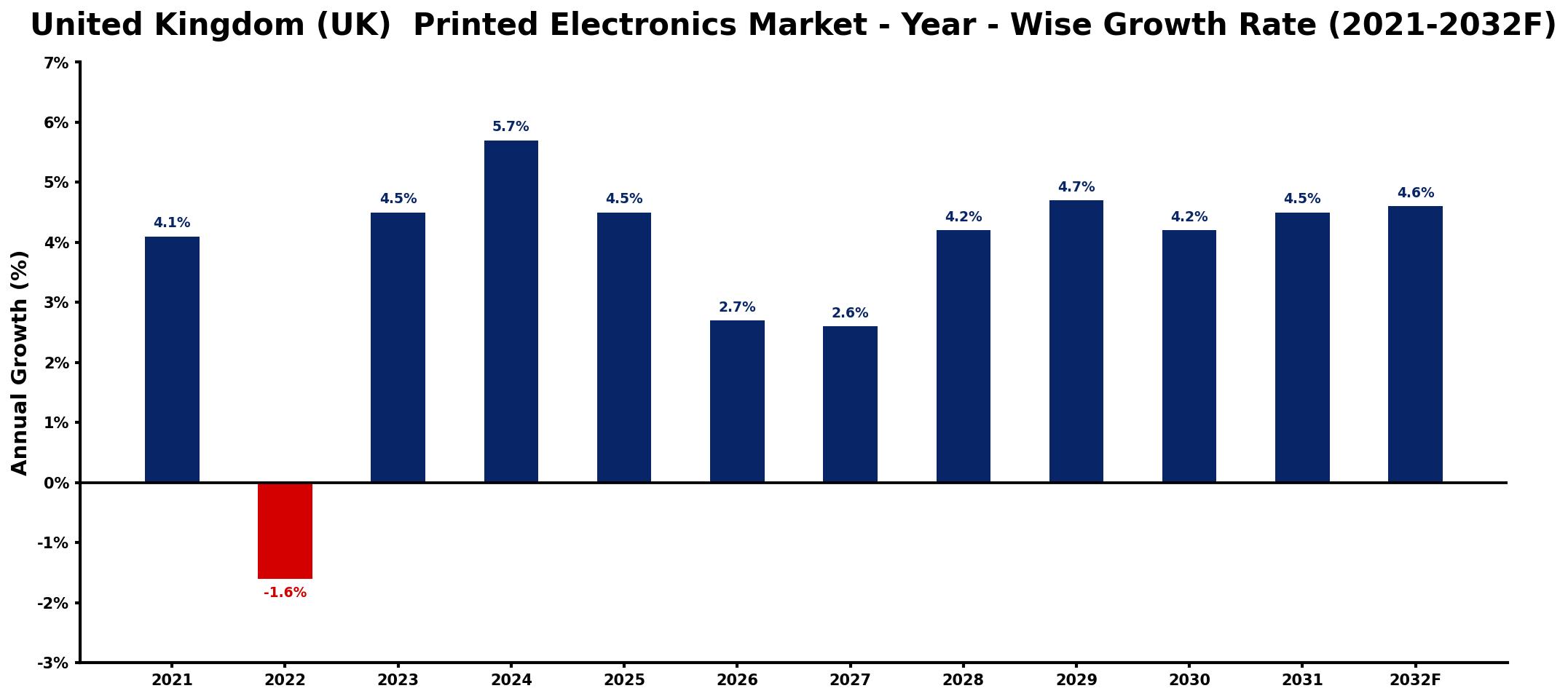
The table below presents the year‑wise growth rates along with the key drivers influencing the market
| Year | Growth Rate | Major Drivers |
| 2021 | 4.1% | Increase in manufacturing capacity investments |
| 2022 | -1.6% | Decrease in consumer spending patterns |
| 2023 | 4.5% | Growth in healthcare technology applications |
| 2024 | 5.7% | Expansion of renewable energy solutions |
| 2025 | 4.5% | Rising demand for smart packaging |
| 2026 | 2.7% | Advancements in sensor technology adoption |
| 2027 | 2.6% | Increased focus on sustainability initiatives |
| 2028 | 4.2% | growing automotive sector requirements |
| 2029 | 4.7% | Rising interest in wearable devices |
| 2030 | 4.2% | increased pharmaceutical industry usage |
| 2031 | 4.5% | rising export shipment volumes |
| 2032 | 4.6% | growing emerging market penetration |
Note: Market size estimations and growth projections presented in this report are based on 6Wresearch's proprietary forecasting methodology, utilizing the latest available industry data, government publications, and primary research inputs.
United Kingdom (UK) Printed Electronics Market Synopsis
Innovation in flexible electronics is the strongest force currently shaping the UK printed electronics market. As industries pivot towards lightweight and cost-effective solutions, printed electronics have emerged as a reliable alternative for developing modern devices. Increasing applications in smart packaging and wearable technologies are also propelling market growth.
The ongoing miniaturization of electronic devices, coupled with advancements in printing technologies, is enhancing the functionality and applicability of printed electronics across various sectors. This increased focus on sustainability and efficient manufacturing processes aligns with consumer demand for eco-friendly products, further invigorating market dynamics.
United Kingdom (UK) Printed Electronics Market Key Takeaways
- The UK printed electronics market is projected to grow at a CAGR of 3.2% from 2026 to 2032.
- Advancements in flexible electronics and IoT-connected devices are key drivers of market expansion.
- Applications in smart packaging, RFID tags, and wearable technology are gaining momentum.
- Government policies that promote innovation and sustainability are positively impacting market growth.
- Technological innovations in organic semiconductors and 3D printing are enhancing product offerings.
Evaluation of Restraints in United Kingdom (UK) Printed Electronics Market
Despite the positive outlook, the UK printed electronics market faces real challenges that could impede growth. Issues related to the scalability of manufacturing processes remain significant, as many existing methods are not yet capable of meeting increasing production demands. Additionally, ensuring the reliability and durability of printed circuits poses a challenge, especially when integrating these components into mainstream applications like IoT and wearables. These factors necessitate focused efforts on research and development to improve manufacturing techniques and enhance product longevity.
United Kingdom (UK) Printed Electronics Market Trends
Emerging trends in the UK printed electronics market highlight a shift towards more sustainable practices, particularly through the adoption of eco-friendly materials and processes. The rise of smart textiles is also notable, as manufacturers explore new applications in apparel and healthcare. Additionally, innovations in inkjet printing technologies are enabling more precise and varied applications, expanding the market's potential.
United Kingdom (UK) Printed Electronics Market Opportunities
Growth and investment opportunities within the UK printed electronics market are abundant. The demand for smart packaging solutions is on the rise, driven by consumer preferences for sustainable and informative products. Moreover, the burgeoning field of wearable technology, which requires lightweight and flexible electronics, presents significant opportunities for growth. Theres also an ongoing need for research into new materials and processes that enhance the efficiency of printed electronics, paving the way for innovative product developments.
Government Initiatives in the United Kingdom (UK) Printed Electronics Market
The UK government plays a pivotal role in fostering the printed electronics market through various initiatives. Policies aimed at promoting innovation, competitiveness, and sustainability are crucial for advancing the sector. Funding for research into new materials and advanced manufacturing processes supports ongoing development efforts. Additionally, regulatory frameworks ensure the safety and performance standards of printed electronic components, enabling a more robust market environment.
Future Insights of the United Kingdom (UK) Printed Electronics Market
Looking ahead to 2026-2032, the UK printed electronics market is poised for substantial growth. The continuous evolution of technology and an increasing emphasis on environmentally sustainable solutions are expected to drive further adoption. As industries embrace digital transformation and smart technologies, printed electronics will play an integral role in shaping future innovations. The alignment of market developments with government support and consumer demand will be crucial for realizing the full potential of this sector.
United Kingdom (UK) Printed Electronics Market Latest Developments (2025 - 2026)
Recent developments in the UK printed electronics market indicate a heightened focus on advancing manufacturing capabilities and enhancing material properties. Research collaborations between academic institutions and industry leaders have intensified, with many projects aiming to create more efficient production techniques. Additionally, new partnerships are emerging to foster innovation in areas such as flexible displays and smart packaging solutions, signaling a proactive approach to meeting market demands.
United Kingdom (UK) Printed Electronics Market - Key Attractiveness of the Report
- 10 Years of Market Numbers
- Historical Data Starting from 2022 to 2025
- Base Year: 2025
- Forecast Data until 2032
- Key Performance Indicators Impacting the Market
- Major Upcoming Developments and Projects
Key Highlights of the Report:
- United Kingdom (UK) Printed Electronics Market Outlook
- Market Size of United Kingdom (UK) Printed Electronics Market, 2025
- Forecast of United Kingdom (UK) Printed Electronics Market, 2032
- Historical Data and Forecast of United Kingdom (UK) Printed Electronics Revenues & Volume for the Period 2022-2032F
- United Kingdom (UK) Printed Electronics Market Trend Evolution
- United Kingdom (UK) Printed Electronics Market Drivers and Challenges
- United Kingdom (UK) Printed Electronics Price Trends
- United Kingdom (UK) Printed Electronics Porter's Five Forces
- United Kingdom (UK) Printed Electronics Industry Life Cycle
- Historical Data and Forecast of United Kingdom (UK) Printed Electronics Market Revenues & Volume By Material for the Period 2022-2032F
- Historical Data and Forecast of United Kingdom (UK) Printed Electronics Market Revenues & Volume By Ink for the Period 2022-2032F
- Historical Data and Forecast of United Kingdom (UK) Printed Electronics Market Revenues & Volume By Substrate for the Period 2022-2032F
- Historical Data and Forecast of United Kingdom (UK) Printed Electronics Market Revenues & Volume By Technology for the Period 2022-2032F
- Historical Data and Forecast of United Kingdom (UK) Printed Electronics Market Revenues & Volume By Screen for the Period 2022-2032F
- Historical Data and Forecast of United Kingdom (UK) Printed Electronics Market Revenues & Volume By Inkjet for the Period 2022-2032F
- Historical Data and Forecast of United Kingdom (UK) Printed Electronics Market Revenues & Volume By Flexographic for the Period 2022-2032F
- Historical Data and Forecast of United Kingdom (UK) Printed Electronics Market Revenues & Volume By Gravure for the Period 2022-2032F
- Historical Data and Forecast of United Kingdom (UK) Printed Electronics Market Revenues & Volume By Device for the Period 2022-2032F
- Historical Data and Forecast of United Kingdom (UK) Printed Electronics Market Revenues & Volume By Displays for the Period 2022-2032F
- Historical Data and Forecast of United Kingdom (UK) Printed Electronics Market Revenues & Volume By Photovoltaic for the Period 2022-2032F
- Historical Data and Forecast of United Kingdom (UK) Printed Electronics Market Revenues & Volume By Lighting for the Period 2022-2032F
- Historical Data and Forecast of United Kingdom (UK) Printed Electronics Market Revenues & Volume By RFID for the Period 2022-2032F
- Historical Data and Forecast of United Kingdom (UK) Printed Electronics Market Revenues & Volume By Others for the Period 2022-2032F
- United Kingdom (UK) Printed Electronics Import Export Trade Statistics
- Market Opportunity Assessment By Material
- Market Opportunity Assessment By Technology
- Market Opportunity Assessment By Device
- United Kingdom (UK) Printed Electronics Top Companies Market Share
- United Kingdom (UK) Printed Electronics Competitive Benchmarking By Technical and Operational Parameters
- United Kingdom (UK) Printed Electronics Company Profiles
- United Kingdom (UK) Printed Electronics Key Strategic Recommendations






































