United Kingdom (UK) Security Analytics Market Size & Growth Rate (2026-2032)
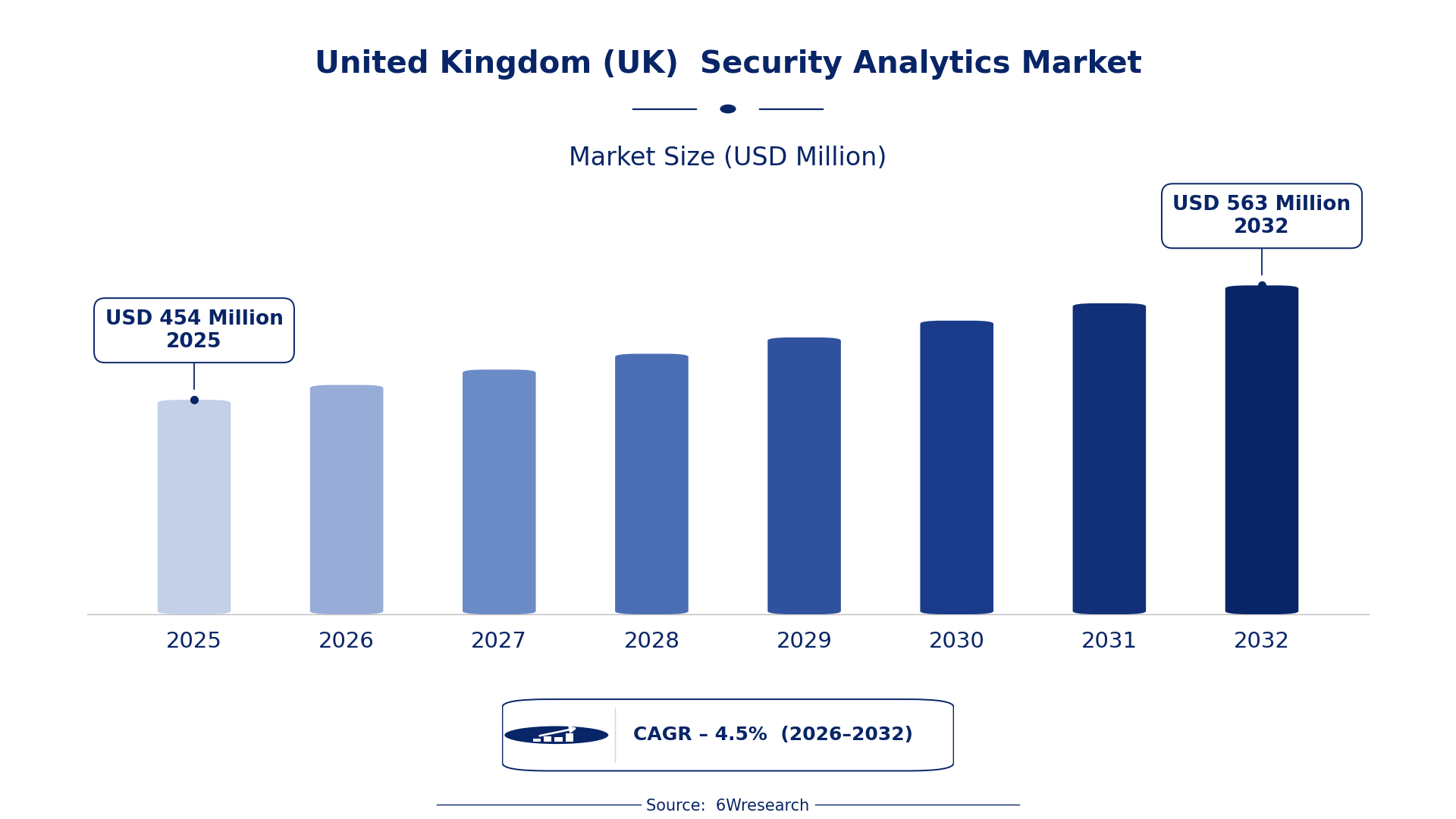
The United Kingdom (UK) Security Analytics Market was estimated at USD 454 Million in 2025 and is projected to reach USD 563 Million by 2032, growing at a CAGR of 4.5% from 2026 to 2032.
United Kingdom (UK) Security Analytics Market Synopsis
The escalating complexity of cyber threats is the most formidable force currently reshaping the United Kingdom (UK) Security Analytics Market. As malicious actors deploy increasingly sophisticated tactics, organizations must urgently enhance their security measures to protect sensitive information and maintain operational integrity.
Driven by regulatory compliance, particularly the General Data Protection Regulation (GDPR), companies are investing heavily in security analytics. This surge in investment is not just a reaction to threat landscapes but also a proactive strategy to ensure data protection and enhance trust with customers.
United Kingdom (UK) Security Analytics Market Year-wise Growth Rate and Key Drivers
This graph illustrates the annual growth rates of the United Kingdom (UK) Security Analytics Market from 2021 to 2032, highlighting a steady upward trajectory and projected expansion over the forecast period.
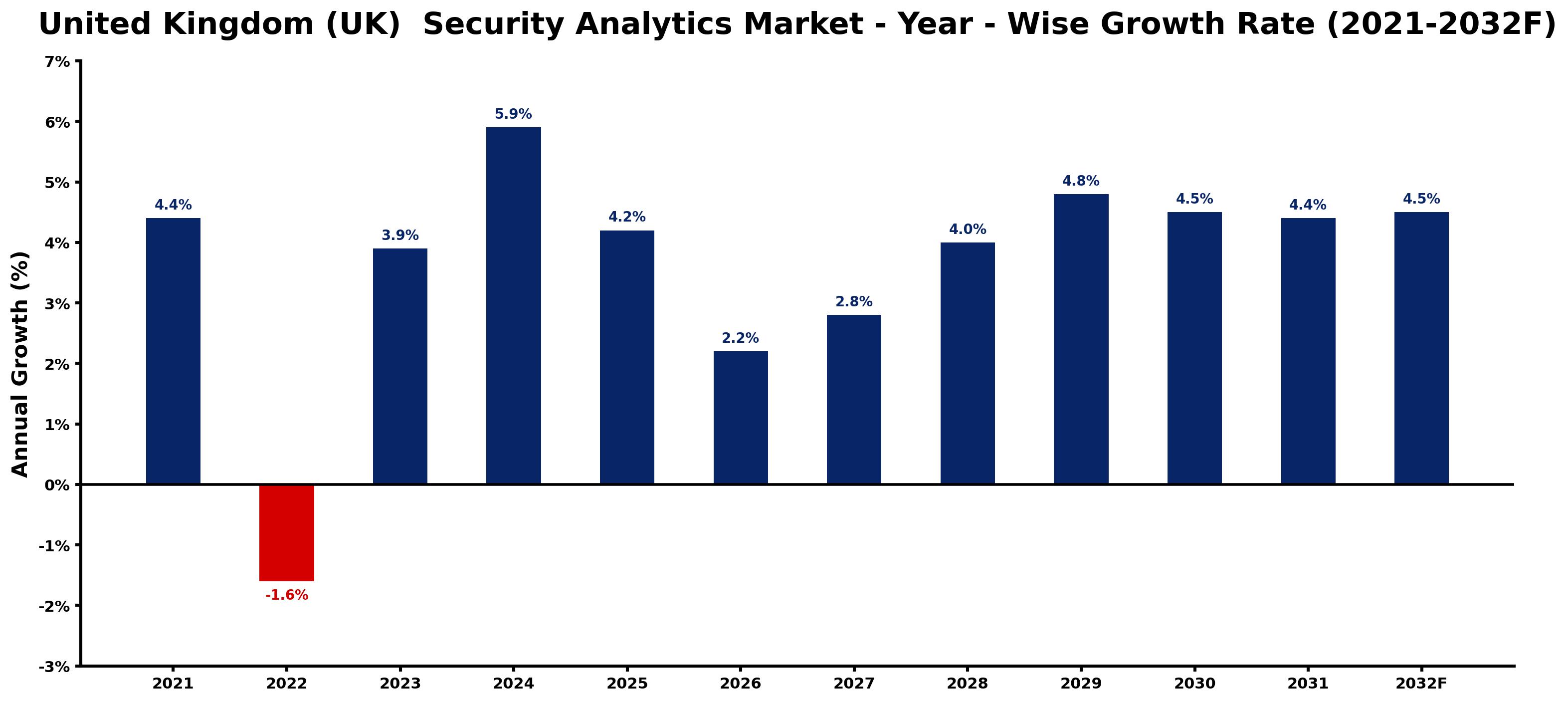
The table below presents the year‑wise growth rates along with the key drivers influencing the market
| Year | Growth Rate | Major Drivers |
| 2021 | 4.4% | Increased focus on UK cybersecurity threat intelligence sharing. |
| 2022 | -1.6% | Delayed adoption of GDPR compliance-driven solutions in UK |
| 2023 | 3.9% | Heightened ransomware attack rates driving security investments. |
| 2024 | 5.9% | Government's National Cyber Strategy funding cybersecurity initiatives. |
| 2025 | 4.2% | Growing adoption of advanced AI for threat detection. |
| 2026 | 2.2% | Increased scrutiny on data protection by ICO regulations. |
| 2027 | 2.8% | Rise in remote work necessitating security analytics solutions. |
| 2028 | 4.0% | Emergence of UK-specific cybersecurity startups boosting innovation. |
| 2029 | 4.8% | Regulatory mandates for enhanced security measures in banking. |
| 2030 | 4.5% | Public sector digital transformation driving security analytics growth. |
| 2031 | 4.4% | Investment in smart city security addressing urban threats. |
| 2032 | 4.5% | Enhanced collaboration between private and public cybersecurity sectors. |
Note: Market size estimations and growth projections presented in this report are based on 6Wresearch's proprietary forecasting methodology, utilizing the latest available industry data, government publications, and primary research inputs.
United Kingdom (UK) Security Analytics Market Key Takeaways
Below are some of the specific key takeaways from the market, including:
- The increasing sophistication of cyber threats is driving demand for advanced security analytics solutions.
- Organizations are investing in real-time monitoring and machine learning capabilities to enhance threat detection.
- Cloud-based security analytics solutions are gaining traction as businesses transition to digital environments.
- Regulatory compliance with GDPR is fueling investments in data protection and security analytics tools.
- Opportunities for collaboration between solution providers and end-users are on the rise to tackle security challenges effectively.
Evaluation of Restraints in United Kingdom (UK) Security Analytics Market
While the UK Security Analytics Market is flourishing, it faces notable challenges that could hinder growth. A critical issue is the shortage of skilled cybersecurity professionals. The effectiveness of security analytics tools is contingent on having trained experts who can interpret data and respond promptly to threats. on top of that, the rapidly evolving nature of cyber threats means that organizations must continuously adapt their strategies, often outpacing their available resources.
Additionally, compliance with GDPR and other regulatory frameworks requires organizations to implement stringent data handling practices, which can create friction in deploying advanced security analytics solutions. These factors call for increased investment in training and development to ensure that businesses can fully capitalize on the benefits of security analytics.
United Kingdom (UK) Security Analytics Market Trends
The shift toward proactive security measures is becoming a hallmark of the UK Security Analytics Market. Businesses are increasingly leaning on machine learning and artificial intelligence for enhanced threat detection capabilities. Real-time monitoring is now a standard feature, enabling organizations to respond swiftly to potential breaches.
on top of that, the adoption of cloud-based solutions continues to accelerate, driven by the ongoing digital transformation. Companies are recognizing the advantages of flexible, scalable security analytics solutions that can adapt to their growing needs, particularly in hybrid environments.
United Kingdom (UK) Security Analytics Market Opportunities
The prospects for growth in the UK Security Analytics Market are bright, particularly in sectors keen on enhancing their cybersecurity posture. Organizations are increasingly recognizing the need for integrated security solutions that combine threat intelligence and user behavior analytics.
Investment opportunities lie within AI and machine learning-driven platforms, which can significantly enhance predictive analytics capabilities. on top of that, businesses are keen to partner with providers that offer comprehensive solutions tailored to their specific requirements, setting the stage for dynamic partnerships and innovative developments.
Government Initiatives in the United Kingdom (UK) Security Analytics Market
Government policies are playing a crucial role in shaping the United Kingdom (UK) Security Analytics Market. The emphasis on building a resilient cybersecurity framework is evident through various initiatives aimed at fostering collaboration between public and private sectors. Regulatory frameworks, such as GDPR, require organizations to bolster their security analytics capabilities, further underscoring the importance of adhering to compliance standards.
- A recently completed initiative under the National Cyber Security Strategy focused on enhancing workforce skills to better address cybersecurity challenges.
- Currently, the UK government is promoting a collaborative cybersecurity program involving partnerships between businesses and academic institutions to foster innovation.
- A planned upcoming initiative aims to launch a national cybersecurity exercise, expected to improve readiness against evolving cyber threats by 2027.
- The establishment of an advisory body to facilitate discussions on best practices for GDPR compliance is in progress, reinforcing the importance of data protection.
- Recent updates to the Cybersecurity Innovation Fund are set to support startups developing security analytics technologies, further driving market growth.
Future Insights of the United Kingdom (UK) Security Analytics Market
The United Kingdom (UK) Security Analytics Market is on a trajectory of sustained growth through 2032. As organizations prioritize cybersecurity investments, the demand for comprehensive security analytics solutions will continue to rise. The integration of advanced technologies like artificial intelligence will redefine threat detection and incident response strategies, creating an environment ripe for innovation.
on top of that, as regulatory pressures intensify, businesses will seek out solutions that not only address security concerns but also ensure compliance with evolving data protection regulations. This combination of factors positions the UK market as a fertile ground for new ideas and collaborations.
United Kingdom (UK) Security Analytics Market Latest Developments
In the past year, the United Kingdom (UK) Security Analytics Market has seen a flurry of activity as organizations adapt to heightened cybersecurity demands. Companies are increasingly embracing innovative technologies to enhance their security measures, reflecting a market hungry for effective solutions.
- A leading cybersecurity provider launched an AI-driven analytics tool in early 2025, aimed at improving threat detection capabilities for mid-sized businesses.
- An ongoing initiative by a consortium of UK firms is focused on developing advanced threat intelligence platforms, scheduled for completion by late 2025.
- A major technology vendor is planning a significant upgrade to its security analytics suite, expected to roll out in Q4 2026 to incorporate machine learning capabilities.
- Several partnerships have been formed between academia and industry players to drive research and development in security analytics technologies, with activities currently underway.
- New training programs for cybersecurity professionals have been introduced by industry associations in mid-2025, enhancing the skills needed to operate advanced security analytics tools.
United Kingdom (UK) Security Analytics Market - Key Attractiveness of the Report
- 10 Years of Market Numbers
- Historical Data Starting from 2022 to 2025
- Base Year: 2025
- Forecast Data until 2032
- Key Performance Indicators Impacting the Market
- Major Upcoming Developments and Projects
Key Highlights of the Report:
- United Kingdom (UK) Security Analytics Market Outlook
- Market Size of United Kingdom (UK) Security Analytics Market, 2025
- Forecast of United Kingdom (UK) Security Analytics Market, 2032
- Historical Data and Forecast of United Kingdom (UK) Security Analytics Revenues & Volume for the Period 2022-2032F
- United Kingdom (UK) Security Analytics Market Trend Evolution
- United Kingdom (UK) Security Analytics Market Drivers and Challenges
- United Kingdom (UK) Security Analytics Price Trends
- United Kingdom (UK) Security Analytics Porter's Five Forces
- United Kingdom (UK) Security Analytics Industry Life Cycle
- Historical Data and Forecast of United Kingdom (UK) Security Analytics Market Revenues & Volume By Application for the Period 2022-2032F
- Historical Data and Forecast of United Kingdom (UK) Security Analytics Market Revenues & Volume By Web Security Analytics for the Period 2022-2032F
- Historical Data and Forecast of United Kingdom (UK) Security Analytics Market Revenues & Volume By Network Security Analytics for the Period 2022-2032F
- Historical Data and Forecast of United Kingdom (UK) Security Analytics Market Revenues & Volume By Endpoint SecurityAnalytics for the Period 2022-2032F
- Historical Data and Forecast of United Kingdom (UK) Security Analytics Market Revenues & Volume By Application Security Analytics for the Period 2022-2032F
- Historical Data and Forecast of United Kingdom (UK) Security Analytics Market Revenues & Volume By Others(Content Security, ICS Security, Database Security, Cloud Security) for the Period 2022-2032F
- Historical Data and Forecast of United Kingdom (UK) Security Analytics Market Revenues & Volume By Vertical for the Period 2022-2032F
- Historical Data and Forecast of United Kingdom (UK) Security Analytics Market Revenues & Volume By BFSI for the Period 2022-2032F
- Historical Data and Forecast of United Kingdom (UK) Security Analytics Market Revenues & Volume By Retail and eCommerce for the Period 2022-2032F
- Historical Data and Forecast of United Kingdom (UK) Security Analytics Market Revenues & Volume By Media and Entertainment for the Period 2022-2032F
- Historical Data and Forecast of United Kingdom (UK) Security Analytics Market Revenues & Volume By Travel and Hospitality for the Period 2022-2032F
- Historical Data and Forecast of United Kingdom (UK) Security Analytics Market Revenues & Volume By Telecom and IT for the Period 2022-2032F
- Historical Data and Forecast of United Kingdom (UK) Security Analytics Market Revenues & Volume By Healthcare for the Period 2022-2032F
- Historical Data and Forecast of United Kingdom (UK) Security Analytics Market Revenues & Volume By Others(automobile, government, and education) for the Period 2022-2032F
- Historical Data and Forecast of United Kingdom (UK) Security Analytics Market Revenues & Volume By Component for the Period 2022-2032F
- Historical Data and Forecast of United Kingdom (UK) Security Analytics Market Revenues & Volume By Platform for the Period 2022-2032F
- Historical Data and Forecast of United Kingdom (UK) Security Analytics Market Revenues & Volume By Services for the Period 2022-2032F
- Historical Data and Forecast of United Kingdom (UK) Security Analytics Market Revenues & Volume By Professional Services for the Period 2022-2032F
- Historical Data and Forecast of United Kingdom (UK) Security Analytics Market Revenues & Volume By Deployment Mode for the Period 2022-2032F
- Historical Data and Forecast of United Kingdom (UK) Security Analytics Market Revenues & Volume By Cloud for the Period 2022-2032F
- Historical Data and Forecast of United Kingdom (UK) Security Analytics Market Revenues & Volume By On-premises for the Period 2022-2032F
- Historical Data and Forecast of United Kingdom (UK) Security Analytics Market Revenues & Volume By Organization Size for the Period 2022-2032F
- Historical Data and Forecast of United Kingdom (UK) Security Analytics Market Revenues & Volume By Large enterprises for the Period 2022-2032F
- Historical Data and Forecast of United Kingdom (UK) Security Analytics Market Revenues & Volume By Small and medium-sized enterprises (SMEs) for the Period 2022-2032F
- United Kingdom (UK) Security Analytics Import Export Trade Statistics
- Market Opportunity Assessment By Application
- Market Opportunity Assessment By Vertical
- Market Opportunity Assessment By Component
- Market Opportunity Assessment By Deployment Mode
- Market Opportunity Assessment By Organization Size
- United Kingdom (UK) Security Analytics Top Companies Market Share
- United Kingdom (UK) Security Analytics Competitive Benchmarking By Technical and Operational Parameters
- United Kingdom (UK) Security Analytics Company Profiles
- United Kingdom (UK) Security Analytics Key Strategic Recommendations






































