United Kingdom (UK) Wealth Management Platform Market Size & Growth Rate (2026-2032)
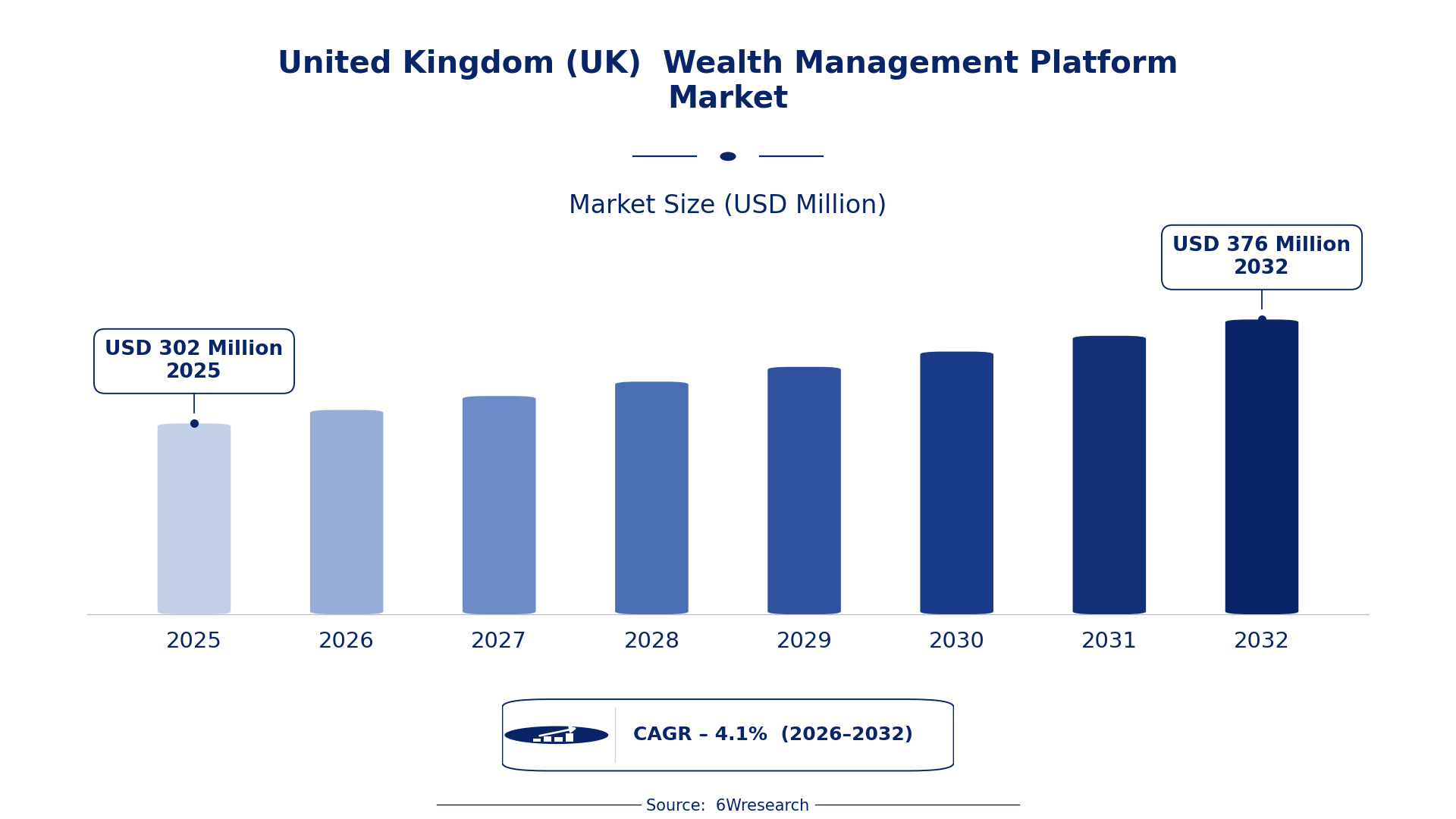
The United Kingdom (UK) Wealth Management Platform Market was estimated at USD 302 Million in 2025 and is projected to reach USD 376 Million by 2032, growing at a CAGR of 4.1% from 2026 to 2032.
United Kingdom (UK) Wealth Management Platform Market Synopsis
The UK wealth management platform market is witnessing a transformative shift, driven by the increasing digitalization of financial services. Financial institutions are increasingly adopting sophisticated platforms that enhance client engagement, compliance, and operational efficiency.
Clients today demand personalized investment strategies and transparent reporting, pushing wealth management firms to invest in advanced technology. The rise of fintech innovations, including AI and robo-advisory solutions, is further reshaping how wealth management services are delivered in the UK.
United Kingdom (UK) Wealth Management Platform Market Year-wise Growth Rate and Key Drivers
This graph illustrates the annual growth rates of the United Kingdom (UK) Wealth Management Platform Market from 2021 to 2032, highlighting a steady upward trajectory and projected expansion over the forecast period.
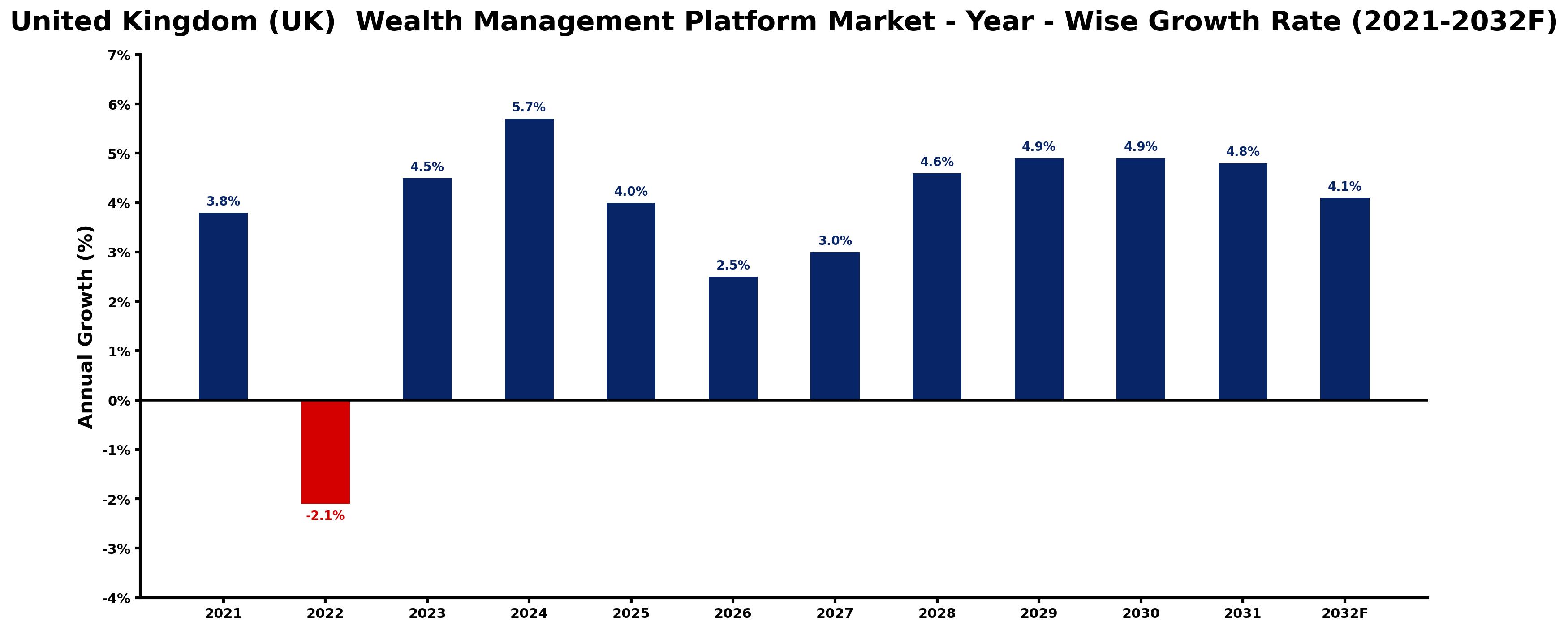
The table below presents the year‑wise growth rates along with the key drivers influencing the market
| Year | Growth Rate | Major Drivers |
| 2021 | 3.8% | Increased demand for personalized digital investment solutions. |
| 2022 | -2.1% | Effect of UK Financial Conduct Authority regulatory changes |
| 2023 | 4.5% | Rise in high-net-worth individuals seeking tailored portfolios. |
| 2024 | 5.7% | Regulatory support for fintech innovations fostering competition. |
| 2025 | 4.0% | Growing adoption of ESG investment strategies among clients. |
| 2026 | 2.5% | Enhanced cybersecurity measures improving consumer trust in platforms. |
| 2027 | 3.0% | Government incentives for startups in wealth management tech. |
| 2028 | 4.6% | Surge in mobile app usage for financial management. |
| 2029 | 4.9% | Booming interest in cryptocurrency investments among wealthy clients. |
| 2030 | 4.9% | Proliferation of online financial education resources for consumers. |
| 2031 | 4.8% | Increased integration of AI for analytics in wealth management. |
| 2032 | 4.1% | Shift towards sustainable investing driving client portfolio choices. |
Note: Market size estimations and growth projections presented in this report are based on 6Wresearch's proprietary forecasting methodology, utilizing the latest available industry data, government publications, and primary research inputs.
United Kingdom (UK) Wealth Management Platform Market Key Takeaways
Below are some of the specific key takeaways from the market, including:
- The market is experiencing a steady growth trajectory driven by increasing client expectations for personalized services.
- Technological advancements are reshaping the operational frameworks of wealth management firms.
- Compliance with stringent regulatory standards is crucial for sustained market growth.
- High implementation costs remain a barrier for smaller firms seeking to adopt new technologies.
- The increasing wealth of individuals and institutions is boosting demand for comprehensive wealth management solutions.
Evaluation of Restraints in United Kingdom (UK) Wealth Management Platform Market
The UK wealth management platform market grapples with several restraints that hinder its growth potential. High implementation and maintenance costs deter smaller firms from adopting advanced platforms, limiting their competitiveness. on top of that, ensuring compliance with complex regulatory frameworks adds to operational challenges. Firms must continuously innovate to enhance user experience, which requires significant investments in research and development. Additionally, the rising competition from alternative wealth management solutions necessitates a proactive approach to retain clients and improve service offerings.
United Kingdom (UK) Wealth Management Platform Market Trends
As the market evolves, several trends are influencing demand and technology adoption. The integration of AI-driven analytics is becoming standard, enabling wealth managers to offer tailored investment strategies. Meanwhile, the popularity of robo-advisory solutions is growing, particularly among younger investors seeking cost-effective management options. Additionally, the demand for transparent reporting and real-time portfolio tracking is prompting firms to enhance their platforms. Sustainability is also a key focus, with more clients prioritizing ESG (environmental, social, and governance) factors in their investment decisions.
United Kingdom (UK) Wealth Management Platform Market Opportunities
The future holds significant growth opportunities for wealth management platforms in the UK. The increasing adoption of digital solutions presents a chance for firms to streamline operations and enhance customer experiences. on top of that, the rise of ESG investing opens new avenues for wealth managers to attract clients interested in socially responsible investment options. Collaborations with fintech firms can lead to innovative solutions that cater to evolving client needs. Additionally, the growing segment of high-net-worth individuals is driving demand for customized wealth management services, presenting a lucrative market for tailored solutions.
Government Initiatives in the United Kingdom (UK) Wealth Management Platform Market
Government policies in the UK are increasingly focusing on enhancing the wealth management platform market through regulatory reforms and support for technological advancements. These initiatives aim to promote transparency, client protection, and innovation within the financial services sector, establishing a conducive environment for market growth.
- A regulatory framework introduced in 2025 mandating billing transparency is now in the implementation phase.
- A national digital infrastructure upgrade programme currently underway aims to enhance access to digital wealth management solutions across the UK.
- Ongoing discussions in parliament about promoting fintech innovation are likely to yield new policies aimed at supporting wealth management platforms.
- A planned public-private initiative expected to expand investment analytics tools is set to enhance client engagement strategies by 2028.
Future Insights of the United Kingdom (UK) Wealth Management Platform Market
Looking ahead to 2026-2032, the UK wealth management platform market is on a path of steady growth. As firms continue to embrace digital transformation, the integration of advanced technologies will reshape client interactions and service delivery. Increased regulatory scrutiny will drive demand for platforms that ensure compliance while offering transparency. Firms that prioritize user experience and invest in innovative solutions will likely gain a competitive edge. The focus on sustainable investing will also influence product offerings, aligning with the values of a growing number of investors.
United Kingdom (UK) Wealth Management Platform Market Latest Developments
Over the past year, the UK wealth management platform market has seen a flurry of activity as firms strive to adapt to changing client demands and regulatory pressures. Innovations in technology and service offerings have become a focal point, with many players exploring strategic partnerships to enhance their capabilities.
- A major technology vendor rolled out an AI-driven analytics tool in early 2025 to help wealth managers optimize their investment strategies.
- An initiative that began in mid-2025 and remains underway aims to enhance cybersecurity measures across wealth management platforms, addressing growing concerns over data privacy.
- A leading regional operator launched a new robo-advisory service in late 2025, targeting younger investors looking for accessible investment solutions.
- Upcoming regulations, expected to be introduced by early 2026, will require enhanced client reporting standards, prompting many firms to upgrade their platforms.
United Kingdom (UK) Wealth Management Platform Market - Key Attractiveness of the Report
- 10 Years of Market Numbers
- Historical Data Starting from 2022 to 2025
- Base Year: 2025
- Forecast Data until 2032
- Key Performance Indicators Impacting the Market
- Major Upcoming Developments and Projects
Key Highlights of the Report:
- United Kingdom (UK) Wealth Management Platform Market Outlook
- Market Size of United Kingdom (UK) Wealth Management Platform Market, 2025
- Forecast of United Kingdom (UK) Wealth Management Platform Market, 2032
- Historical Data and Forecast of United Kingdom (UK) Wealth Management Platform Revenues & Volume for the Period 2022-2032F
- United Kingdom (UK) Wealth Management Platform Market Trend Evolution
- United Kingdom (UK) Wealth Management Platform Market Drivers and Challenges
- United Kingdom (UK) Wealth Management Platform Price Trends
- United Kingdom (UK) Wealth Management Platform Porter's Five Forces
- United Kingdom (UK) Wealth Management Platform Industry Life Cycle
- Historical Data and Forecast of United Kingdom (UK) Wealth Management Platform Market Revenues & Volume By Advisory Model for the Period 2022-2032F
- Historical Data and Forecast of United Kingdom (UK) Wealth Management Platform Market Revenues & Volume By Human Advisory for the Period 2022-2032F
- Historical Data and Forecast of United Kingdom (UK) Wealth Management Platform Market Revenues & Volume By Robo Advisory for the Period 2022-2032F
- Historical Data and Forecast of United Kingdom (UK) Wealth Management Platform Market Revenues & Volume By Hybrid for the Period 2022-2032F
- Historical Data and Forecast of United Kingdom (UK) Wealth Management Platform Market Revenues & Volume By Business Function for the Period 2022-2032F
- Historical Data and Forecast of United Kingdom (UK) Wealth Management Platform Market Revenues & Volume By Financial advice management for the Period 2022-2032F
- Historical Data and Forecast of United Kingdom (UK) Wealth Management Platform Market Revenues & Volume By Portfolio, accounting, and trading management for the Period 2022-2032F
- Historical Data and Forecast of United Kingdom (UK) Wealth Management Platform Market Revenues & Volume By Performance management for the Period 2022-2032F
- Historical Data and Forecast of United Kingdom (UK) Wealth Management Platform Market Revenues & Volume By Risk and compliance management for the Period 2022-2032F
- Historical Data and Forecast of United Kingdom (UK) Wealth Management Platform Market Revenues & Volume By Reporting for the Period 2022-2032F
- Historical Data and Forecast of United Kingdom (UK) Wealth Management Platform Market Revenues & Volume By Others for the Period 2022-2032F
- Historical Data and Forecast of United Kingdom (UK) Wealth Management Platform Market Revenues & Volume By Deployment Model for the Period 2022-2032F
- Historical Data and Forecast of United Kingdom (UK) Wealth Management Platform Market Revenues & Volume By Cloud for the Period 2022-2032F
- Historical Data and Forecast of United Kingdom (UK) Wealth Management Platform Market Revenues & Volume By On-premises for the Period 2022-2032F
- Historical Data and Forecast of United Kingdom (UK) Wealth Management Platform Market Revenues & Volume By End -User Industry for the Period 2022-2032F
- Historical Data and Forecast of United Kingdom (UK) Wealth Management Platform Market Revenues & Volume By Banks for the Period 2022-2032F
- Historical Data and Forecast of United Kingdom (UK) Wealth Management Platform Market Revenues & Volume By Investment management firms for the Period 2022-2032F
- Historical Data and Forecast of United Kingdom (UK) Wealth Management Platform Market Revenues & Volume By Trading and exchange firms for the Period 2022-2032F
- Historical Data and Forecast of United Kingdom (UK) Wealth Management Platform Market Revenues & Volume By Brokerage firms for the Period 2022-2032F
- Historical Data and Forecast of United Kingdom (UK) Wealth Management Platform Market Revenues & Volume By Others for the Period 2022-2032F
- United Kingdom (UK) Wealth Management Platform Import Export Trade Statistics
- Market Opportunity Assessment By Advisory Model
- Market Opportunity Assessment By Business Function
- Market Opportunity Assessment By Deployment Model
- Market Opportunity Assessment By End -User Industry
- United Kingdom (UK) Wealth Management Platform Top Companies Market Share
- United Kingdom (UK) Wealth Management Platform Competitive Benchmarking By Technical and Operational Parameters
- United Kingdom (UK) Wealth Management Platform Company Profiles
- United Kingdom (UK) Wealth Management Platform Key Strategic Recommendations






































