US Abaca Fiber Market (2025-2031) | Outlook, Value, Growth, Forecast, Companies, Size, Share, Industry, Trends, Revenue & Analysis
Market Forecast By Product (Pulp & paper, Fiber Craft, Cordage, Textile, Others) And Competitive Landscape
| Product Code: ETC236761 | Publication Date: Aug 2022 | Updated Date: Nov 2025 | Product Type: Market Research Report | |
| Publisher: 6Wresearch | Author: Ravi Bhandari | No. of Pages: 75 | No. of Figures: 35 | No. of Tables: 20 |
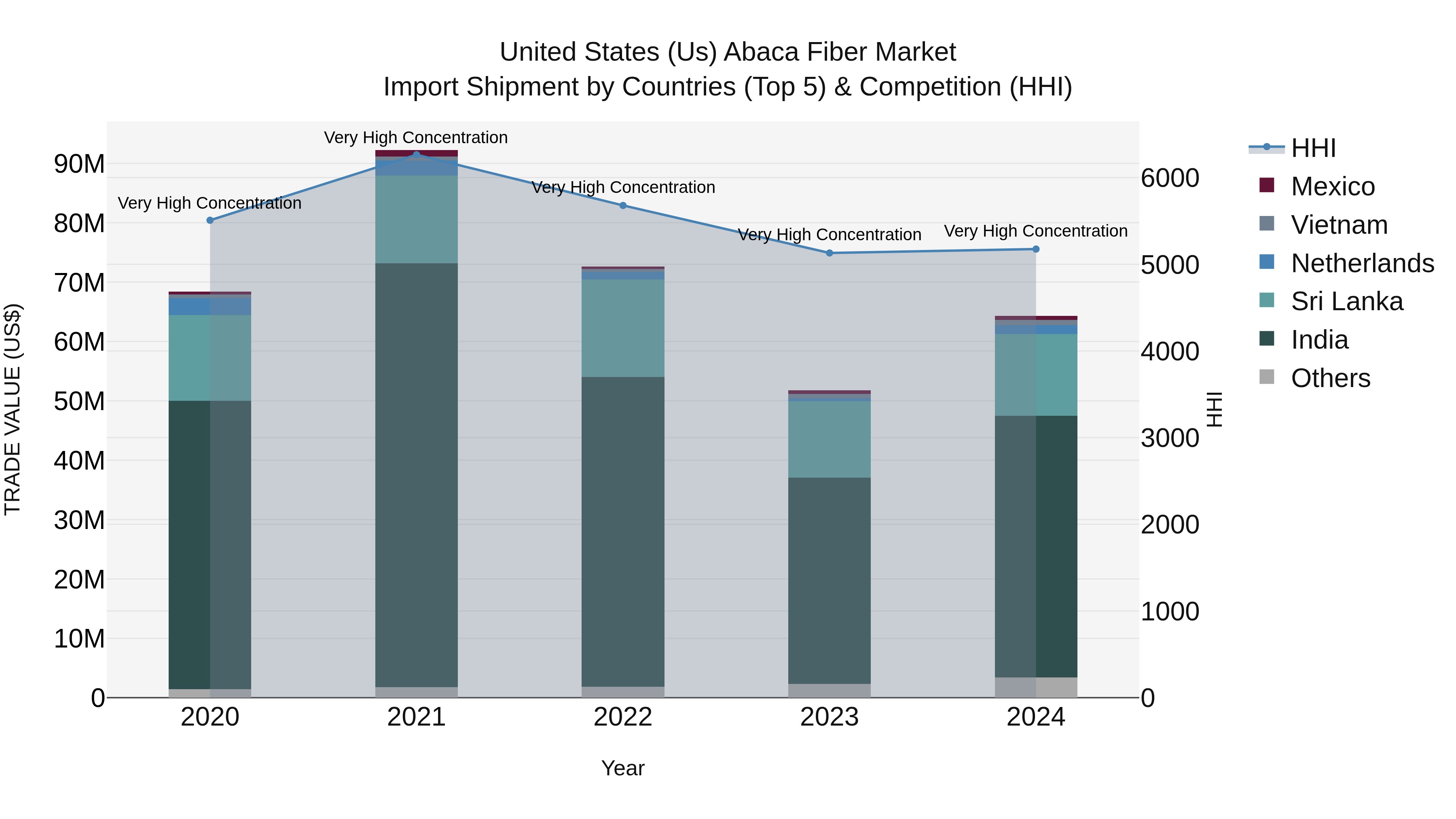
United States (US) Abaca Fiber Market Top 5 Importing Countries and Market Competition (HHI) Analysis
In 2024, the United States continued to import significant quantities of abaca fiber, with top exporting countries including India, Sri Lanka, Netherlands, Latvia, and Vietnam. The high Herfindahl-Hirschman Index (HHI) indicates a concentrated market, while the compound annual growth rate (CAGR) from 2020 to 2024 experienced a slight decline at -1.52%. However, the impressive growth rate of 24.3% from 2023 to 2024 suggests a positive trend in the demand for abaca fiber in the U.S. market. This data highlights the evolving dynamics of the abaca fiber import industry in the United States.
US Abaca Fiber Market Highlights
| Report Name | US Abaca Fiber Market |
| Forecast period | 2025-2031 |
| CAGR | 11.9% |
| Growing Sector | Textile |
Topics Covered in the US Abaca Fiber Market Report
The US Abaca Fiber market report thoroughly covers the market by product and competitive Landscape. The report provides an unbiased and detailed analysis of the on-going market trends, opportunities/high growth areas, and market drivers which would help the stakeholders to devise and align their market strategies according to the current and future market dynamics.
US Abaca Fiber Market Synopsis
The United States abaca fiber market has exhibited steady growth due to the increasing demand for sustainable and eco-friendly materials in various industries. Abaca, also known as 'Manila hemp', is a natural fiber extracted from the leaves of the abaca plant, predominantly cultivated in the Philippines. It is renowned for its strength, durability, and resistance to water, making it valuable in the production of specialty papers, ropes, fabrics, and composites. As consumers and manufacturers alike seek greener alternatives to synthetic fibers, abaca is seeing a surge in usage within the automotive, furniture, and textile sectors in the US market. Additionally, one of the most significant emerging trends in the United States abaca fiber market is the innovation in biodegradable composites. These composites, which integrate abaca with other materials, are gaining traction in the automotive industry for manufacturing interior components. Additionally, there is a rising trend in the use of abaca fiber for handmade and artisanal home decor items, as the push for sustainability and unique aesthetics drives consumer interest. Furthermore, advancements in agricultural technology are leading to higher yields and better quality abaca fibers, which, in turn, positively impacts the supply chain, contributing to the market's growth.
According to 6Wresearch, US Abaca Fiber market size is projected to grow at a CAGR of 11.9% during 2025-2031. The expansion of the United States abaca fiber market is powered by several key drivers. Robust consumer awareness and a shift towards environmentally sustainable products motivate industries to adopt abaca as an eco-conscious alternative to synthetic materials. In parallel, government policies that support environmentally friendly practices and the use of natural materials further bolster the market.
The versatility of abaca fiber, suitable for an extensive range of applications, from tea bags and meat casings to currency paper production, also underpins its sustained demand. Additionally, international trade agreements that fortify the economic ties between the US and the Philippines ensure a stable supply of abaca, enhancing the market's stability and potential for growth. With these myriad forces in play, the US abaca fiber market is poised to continue its upward trajectory.
Government Initiatives Introduced in the US Abaca Fiber Market
Leveraging government initiatives is critical to the growth of the abaca fiber market. The United States Department of Agriculture (USDA) runs programs intended to support sustainable agricultural practices, which include the cultivation of abaca. Financial incentives, grants, and technical assistance are afforded to farmers looking to adopt eco-friendly crops and techniques. In addition, trade policies have been adjusted to favor imports of sustainable materials like abaca, with reduced tariffs and facilitated customs procedures, providing further stimulus to the market. Disparately, these agendas have enhanced the US Abaca Fiber Market Share. Further, these government-backed measures not only reinforce market expansion but also ensure that sustainability is threaded through the fabric of economic development.
Key Players in the US Abaca Fiber Market
In the vibrant ecosystem of the US abaca fiber market, key companies play a pivotal role, including Ching Bee Trading Corporation, known for its high-quality supply of abaca products, and CMC Abaca, which has carved out a niche in specialized abaca fiber crafts and fabrics. Renowned paper industry giants like Gilman Paper Company have also started incorporating abaca into their currency paper segment, capitalizing on its durability and eco-friendly properties. In addition, the firms’ grasp enormous US Abaca Fiber Market Revenues. Moreover, the Tag Fibers, Inc. stands out for its innovative use of abaca in creating composite materials, augmenting the versatility of the fiber. These companies, among others, are driving innovation and market growth, sculpting the future of sustainable materials.
Future Insights of the US Abaca Fiber Market
The drive towards greener products is likely to increase its demand across various sectors including automotive, construction, and fashion. The automotive industry, in particular, shows promise for abaca, as manufacturers seek to reduce vehicle weights and increase fuel efficiency with sustainable composite materials. In construction, abaca's natural durability and resistance to environmental factors position it as an ideal candidate for eco-friendly building components. The fashion industry, with its growing emphasis on sustainable textiles, could also see a surge in the use of abaca fabrics. As technological innovations emerge, the processing of abaca fiber will become more efficient, further bolstering its market presence and sustainability profile.
Market Analysis by Product Type
According to Ravi Bhandari, Research Head, 6Wresearch, in addition to its established role in the pulp and paper sector, abaca fiber is increasingly used in a diverse array of products across multiple industries. In Pulp & Paper, it is prized for its strength and resistance to tearing, making it an excellent choice for speciality papers like tea bags, meat casings, and currency notes. Fiber Craft artisans favor abaca for its flexibility and durability, crafting it into baskets, mats, and decorative items. The Cordage industry relies on abaca for its natural tensile strength, producing ropes and twines that are robust yet biodegradable. In Textile, abaca is woven into fabrics that offer a sustainable alternative to synthetic materials, appealing to eco-conscious consumers and designers. Under the Others category, abaca is innovatively used in composites for automotive applications, home furnishings, and geotextiles, exemplifying its versatility and potential for expansion into new markets.
Market Analysis by Application
The myriad applications of abaca fiber extend beyond traditional uses, reflecting its adaptability and eco-friendly properties. It is making strides in automotive composites for its strength-to-weight ratio, contributing to lighter, more fuel-efficient vehicles. In home decor, abaca's natural aesthetic provides a rustic charm to furnishings, while its utility in geotextiles showcases its effectiveness in soil erosion control. Additionally, the emergence of abaca in electronic components as an insulator, due to its low conductivity and high heat resistance, underscores the fiber's innovativeness in adapting to the evolving needs of diverse industries.
Key Attractiveness of the Report
- 10 Years Market Numbers.
- Historical Data Starting from 2021 to 2024.
- Base Year: 2024.
- Forecast Data until 2031.
- Key Performance Indicators Impacting the Market.
- Major Upcoming Developments and Projects.
Key Highlights of the Report:
- US Abaca Fiber Market Overview
- US Abaca Fiber Market Outlook
- US Abaca Fiber Market Forecast
- Market Size of US Abaca Fiber Market, 2024
- Forecast of US Abaca Fiber Market, 2031
- Historical Data and Forecast of US Abaca Fiber Revenues & Volume for the Period 2021 - 2031
- US Abaca Fiber Market Trend Evolution
- US Abaca Fiber Market Drivers and Challenges
- US Abaca Fiber Price Trends
- US Abaca Fiber Porter's Five Forces
- US Abaca Fiber Industry Life Cycle
- Historical Data and Forecast of US Abaca Fiber Market Revenues & Volume, By Product for the Period 2021 - 2031
- Historical Data and Forecast of US Abaca Fiber Market Revenues & Volume, By Pulp & paper for the Period 2021 - 2031
- Historical Data and Forecast of US Abaca Fiber Market Revenues & Volume, By Fiber Craft for the Period 2021 - 2031
- Historical Data and Forecast of US Abaca Fiber Market Revenues & Volume, By Cordage for the Period 2021 - 2031
- Historical Data and Forecast of US Abaca Fiber Market Revenues & Volume, By Textile for the Period 2021 - 2031
- Historical Data and Forecast of US Abaca Fiber Market Revenues & Volume, By Others for the Period 2021 - 2031
- US Abaca Fiber Import Export Trade Statistics
- Market Opportunity Assessment, By Product
- US Abaca Fiber Top Companies Market Share
- US Abaca Fiber Competitive Benchmarking, By Technical and Operational Parameters
- US Abaca Fiber Company Profiles
- US Abaca Fiber Key Strategic Recommendations
Markets Covered
The US Abaca Fiber market report provides a detailed analysis of the following market segments:
By Product
- Pulp & Paper
- Fiber Craft
- Cordage
- Textile
- Others
US Abaca Fiber Market (2025-2031): FAQs
The market growth is driven by robust consumer awareness and a shift towards environmentally sustainable products motivate industries to adopt abaca as an eco-conscious alternative to synthetic materials.
Pulp & Paper is the most popular product type and is projected to register massive growth in future.
The textile industry stands out as a key performing sector for abaca fiber. This sector holds the ultimate market share.
Gilman Paper Company and Tag Fibers, Inc are some of the prominent players in the US Abaca Fiber market.
6Wresearch actively monitors the US Abaca Fiber Market and publishes its comprehensive annual report, highlighting emerging trends, growth drivers, revenue analysis, and forecast outlook. Our insights help businesses to make data-backed strategic decisions with ongoing market dynamics. Our analysts track relevent industries related to the US Abaca Fiber Market, allowing our clients with actionable intelligence and reliable forecasts tailored to emerging regional needs.
Yes, we provide customisation as per your requirements. To learn more, feel free to contact us on sales@6wresearch.com
| 1 Executive Summary |
| 2 Introduction |
| 2.1 Key Highlights of the Report |
| 2.2 Report Description |
| 2.3 Market Scope & Segmentation |
| 2.4 Research Methodology |
| 2.5 Assumptions |
| 3 US Abaca Fiber Market Overview |
| 3.1 US Country Macro Economic Indicators |
| 3.2 US Abaca Fiber Market Revenues & Volume, 2021 & 2031F |
| 3.3 US Abaca Fiber Market - Industry Life Cycle |
| 3.4 US Abaca Fiber Market - Porter's Five Forces |
| 3.5 US Abaca Fiber Market Revenues & Volume Share, By Product, 2021 & 2031F |
| 4 US Abaca Fiber Market Dynamics |
| 4.1 Impact Analysis |
| 4.2 Market Drivers |
| 4.2.1 Increasing demand for sustainable and eco-friendly materials in various industries |
| 4.2.2 Growing awareness about the benefits of abaca fiber such as its strength and durability |
| 4.2.3 Government initiatives promoting the use of natural fibers in various applications |
| 4.3 Market Restraints |
| 4.3.1 Fluctuating raw material prices affecting the production cost of abaca fiber |
| 4.3.2 Limited availability of skilled labor for abaca fiber extraction and processing |
| 4.3.3 Competition from synthetic fibers in some end-use industries |
| 5 US Abaca Fiber Market Trends |
| 6 US Abaca Fiber Market, By Types |
| 6.1 US Abaca Fiber Market, By Product |
| 6.1.1 Overview and Analysis |
| 6.1.2 US Abaca Fiber Market Revenues & Volume, By Product, 2021 - 2031F |
| 6.1.3 US Abaca Fiber Market Revenues & Volume, By Pulp & paper, 2021 - 2031F |
| 6.1.4 US Abaca Fiber Market Revenues & Volume, By Fiber Craft, 2021 - 2031F |
| 6.1.5 US Abaca Fiber Market Revenues & Volume, By Cordage, 2021 - 2031F |
| 6.1.6 US Abaca Fiber Market Revenues & Volume, By Textile, 2021 - 2031F |
| 6.1.7 US Abaca Fiber Market Revenues & Volume, By Others, 2021 - 2031F |
| 7 US Abaca Fiber Market Import-Export Trade Statistics |
| 7.1 US Abaca Fiber Market Export to Major Countries |
| 7.2 US Abaca Fiber Market Imports from Major Countries |
| 8 US Abaca Fiber Market Key Performance Indicators |
| 8.1 Adoption rate of abaca fiber in new industries or applications |
| 8.2 Investment in research and development for improving abaca fiber quality and production efficiency |
| 8.3 Number of partnerships or collaborations between abaca fiber producers and end-users for product development |
| 9 US Abaca Fiber Market - Opportunity Assessment |
| 9.1 US Abaca Fiber Market Opportunity Assessment, By Product, 2021 & 2031F |
| 10 US Abaca Fiber Market - Competitive Landscape |
| 10.1 US Abaca Fiber Market Revenue Share, By Companies, 2024 |
| 10.2 US Abaca Fiber Market Competitive Benchmarking, By Operating and Technical Parameters |
| 11 Company Profiles |
| 12 Recommendations |
| 13 Disclaimer |
Global Go To Market Strategy - 2030
Export potential enables firms to identify high-growth global markets with greater confidence by combining advanced trade intelligence with a structured quantitative methodology. The framework analyzes emerging demand trends and country-level import patterns while integrating macroeconomic and trade datasets such as GDP and population forecasts, bilateral import–export flows, tariff structures, elasticity differentials between developed and developing economies, geographic distance, and import demand projections. Using weighted trade values from 2020–2024 as the base period to project country-to-country export potential for 2030, these inputs are operationalized through calculated drivers such as gravity model parameters, tariff impact factors, and projected GDP per-capita growth. Through an analysis of hidden potentials, demand hotspots, and market conditions that are most favorable to success, this method enables firms to focus on target countries, maximize returns, and global expansion with data, backed by accuracy.
By factoring in the projected importer demand gap that is currently unmet and could be potential opportunity, it identifies the potential for the Exporter (Country) among 190 countries, against the general trade analysis, which identifies the biggest importer or exporter.
To discover high-growth global markets and optimize your business strategy:
Click Here
Pricing
- Single User License$ 1,995
- Department License$ 2,400
- Site License$ 3,120
- Global License$ 3,795

Leadership Perspectives from Industry Events
Search
Thought Leadership and Analyst Meet





Our Clients








6WResearch In News
- India Air Conditioner Market Set for Strong Rebound in 2026 After Weather-Led Correction and GST-Driven Recovery: 6Wresearch
- ADAS in India: How Automatic Emergency Braking, Blind Spot Detection & Driver Monitoring are Transforming Road Safety
- Doha a strategic location for EV manufacturing hub: IPA Qatar
- Demand for luxury TVs surging in the GCC, says Samsung
- Empowering Growth: The Thriving Journey of Bangladesh’s Cable Industry
- Demand for luxury TVs surging in the GCC, says Samsung
Latest Reports
- Nicaragua RPG Gaming Market (2026-2032)
- New Zealand RPG Gaming Market (2026-2032)
- Netherlands RPG Gaming Market (2026-2032)
- Nauru RPG Gaming Market (2026-2032)
- Namibia RPG Gaming Market (2026-2032)
- Mozambique RPG Gaming Market (2026-2032)
- Montenegro RPG Gaming Market (2026-2032)
- Mongolia RPG Gaming Market (2026-2032)
- Monaco RPG Gaming Market (2026-2032)
- Micronesia RPG Gaming Market (2026-2032)
Industry Events and Analyst Meet

EV India Expo 2026

HIMTEX 2026

India Refining Summit 2026

India EV Show 2026

EV tech India Expo 2026
Whitepaper
- Middle East & Africa Commercial Security Market Click here to view more.
- Middle East & Africa Fire Safety Systems & Equipment Market Click here to view more.
- GCC Drone Market Click here to view more.
- Middle East Lighting Fixture Market Click here to view more.
- GCC Physical & Perimeter Security Market Click here to view more.


