United States (US) App Analytics Market Size & Growth Rate (2026-2032)
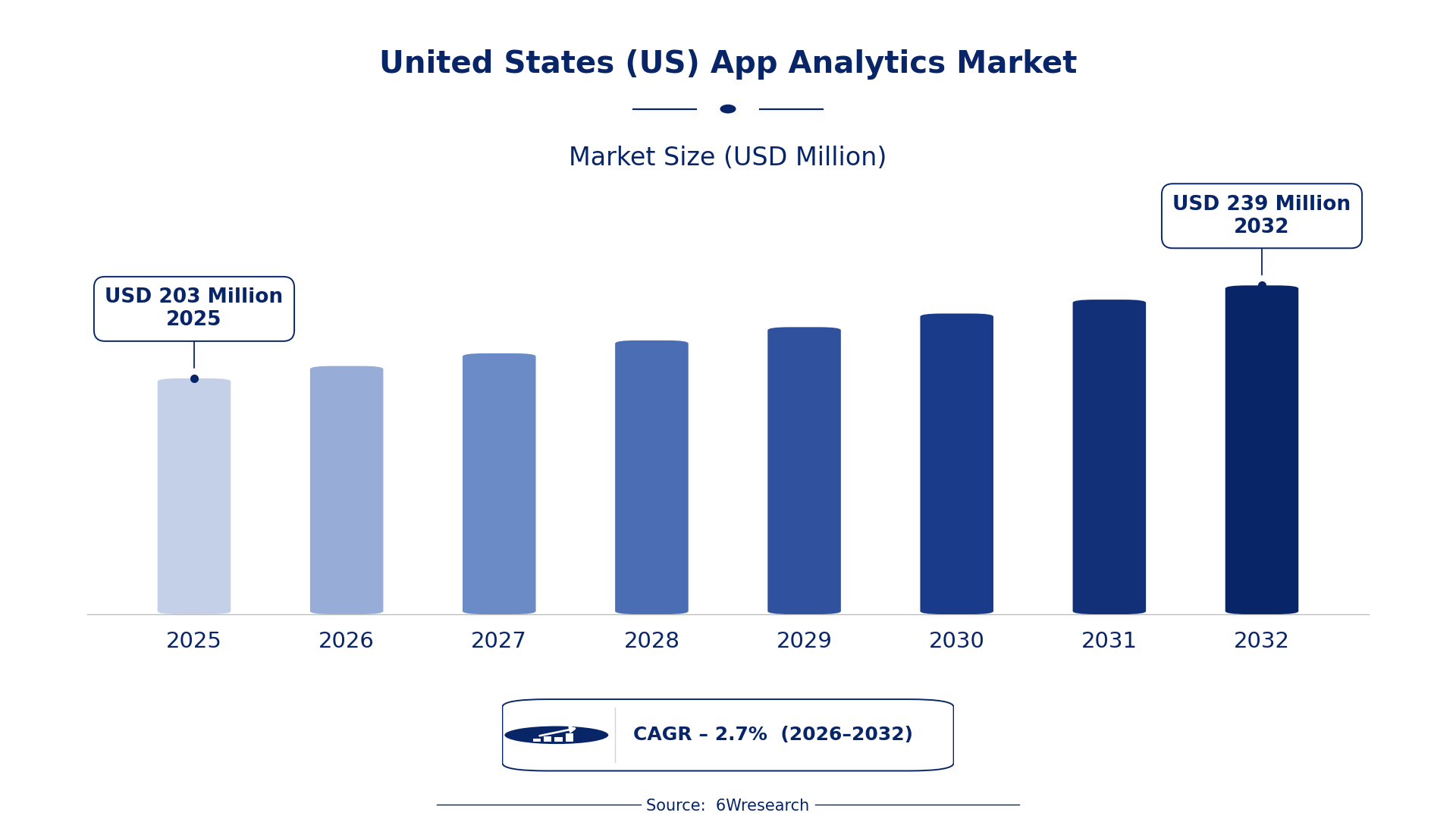
The United States (US) App Analytics Market was estimated at USD 203 Million in 2025 and is projected to reach USD 239 Million by 2032, growing at a CAGR of 2.7% from 2026 to 2032.
United States (US) App Analytics Market Synopsis
The increasing prevalence of mobile applications across industries is driving demand for app analytics in the United States. Businesses are eager to harness detailed insights into user behavior, engagement metrics, and app performance to enhance user experience and maximize revenue potential.
As organizations prioritize data-driven decision-making, the need for advanced analytics capabilities has surged. Tools that offer real-time insights and user segmentation are now essential, ensuring that companies remain competitive in a crowded marketplace.
United States (US) App Analytics Market Year-wise Growth Rate and Key Drivers
This graph illustrates the annual growth rates of the United States (US) App Analytics Market from 2021 to 2032, highlighting a steady upward trajectory and projected expansion over the forecast period.
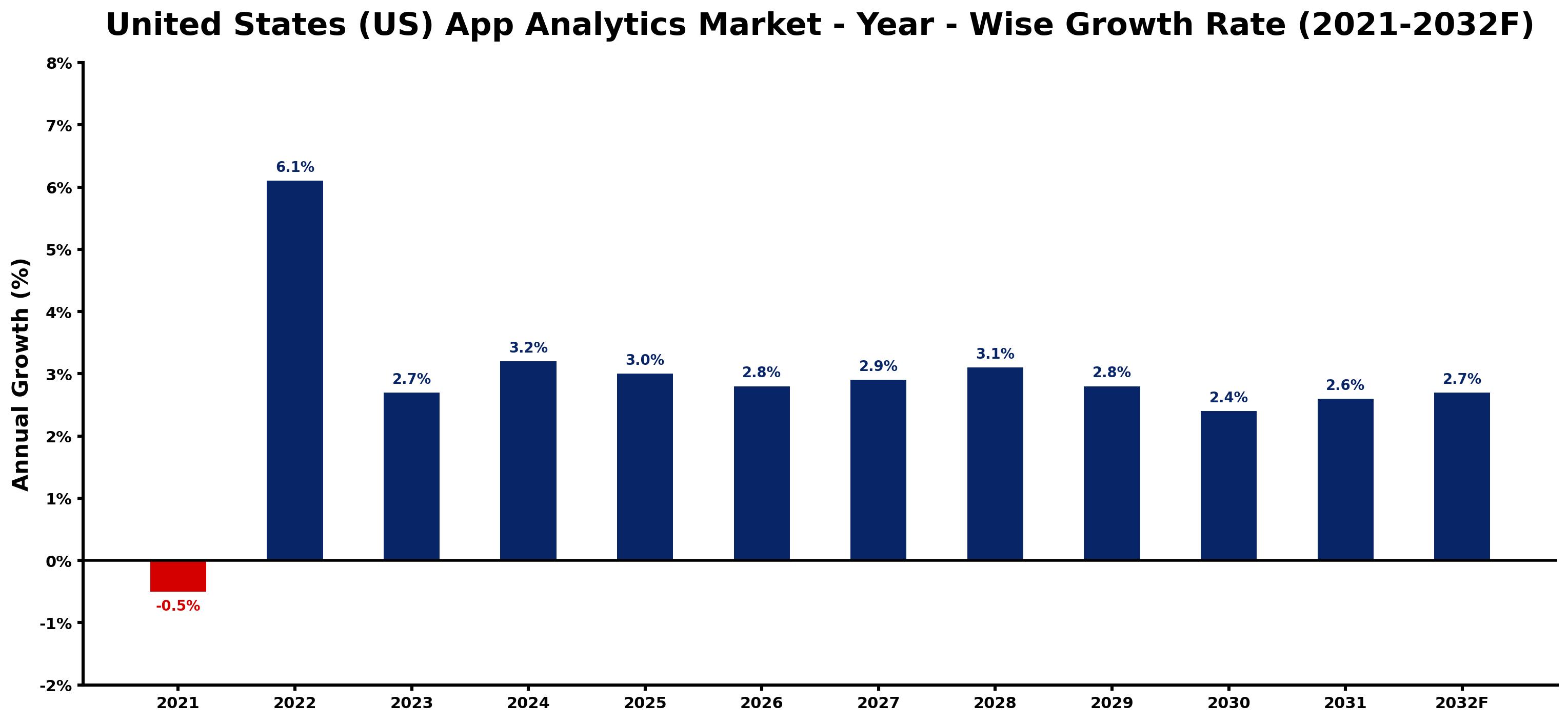
The table below presents the year‑wise growth rates along with the key drivers influencing the market
| Year | Growth Rate | Major Drivers |
| 2021 | -0.5% | Privacy regulations from California limiting data access |
| 2022 | 6.1% | Rising mobile app downloads amid pandemic-driven digital growth. |
| 2023 | 2.7% | Increased investment in app monetization strategies by startups. |
| 2024 | 3.2% | Surge in app-based telehealth solutions post-COVID-19. |
| 2025 | 3.0% | Growing importance of user data privacy regulations for apps. |
| 2026 | 2.8% | Emergence of AI-driven personalization in consumer apps. |
| 2027 | 2.9% | High smartphone penetration fostering app engagement rates. |
| 2028 | 3.1% | Collaborations between app developers and educational institutions. |
| 2029 | 2.8% | Demand for analytics tools to enhance app user experience. |
| 2030 | 2.4% | Shift towards multi-platform app strategies in tech firms. |
| 2031 | 2.6% | Integration of blockchain technology in app analytics platforms. |
| 2032 | 2.7% | Increased focus on app performance metrics by enterprises. |
Note: Market size estimations and growth projections presented in this report are based on 6Wresearch's proprietary forecasting methodology, utilizing the latest available industry data, government publications, and primary research inputs.
United States (US) App Analytics Market Key Takeaways
Below are some of the specific key takeaways from the market, including:
- The market is experiencing consistent growth due to rising mobile app usage and a focus on user engagement.
- Advanced analytics tools that provide real-time monitoring and attribution analysis are in high demand.
- Compliance with data privacy regulations is shaping the development of analytics solutions.
- Artificial intelligence and machine learning are increasingly integrated into app analytics platforms.
- Investment opportunities are abundant as businesses seek to enhance app performance through analytics.
Evaluation of Restraints in United States (US) App Analytics Market
The competitive nature of the US App Analytics Market poses a notable challenge, as numerous providers vie for attention. This competition creates confusion for businesses attempting to select the most suitable analytics tools for their needs. Additionally, rapid technological advancements require analytics providers to continuously innovate, ensuring their offerings stay relevant. Another pressing concern is the need to comply with stringent data privacy regulations, which complicates how companies gather and analyze user data while maintaining ethical standards.
United States (US) App Analytics Market Trends
Key trends are reshaping the US App Analytics Market, primarily driven by a heightened demand for data-driven insights. Businesses increasingly rely on advanced analytics tools that deliver real-time monitoring and detailed user behavior tracking. Another growing focus is on data privacy and security, pushing companies to develop solutions that prioritize user data protection.
Integration of artificial intelligence and machine learning capabilities is also transforming the market. These technologies enhance analytics tools, enabling more accurate predictions and tailored recommendations, which ultimately enrich the user experience.
United States (US) App Analytics Market Opportunities
The US App Analytics Market is ripe with investment opportunities, particularly as mobile applications continue to proliferate. Companies are increasingly turning to analytics solutions to optimize user engagement and app performance. The surge in mobile commerce and widespread smartphone adoption further fuels demand for sophisticated analytics tools. Additionally, the competitive environment encourages ongoing innovation, presenting a dynamic sector for investors aiming to capitalize on advancements in the digital economy.
Government Initiatives in the United States (US) App Analytics Market
Government policy plays a crucial role in shaping the United States App Analytics Market, particularly through data privacy regulations. While there are no specific policies dedicated solely to app analytics, existing laws impact how companies operate within this space. The Federal Trade Commission (FTC) and the Department of Justice (DOJ) enforce regulations that affect market competition and consumer protection.
- A regulatory framework introduced in 2025 mandates greater transparency in data collection practices.
- A national initiative focusing on enhancing digital infrastructure is currently underway, promoting better analytics capabilities.
- Ongoing discussions around potential updates to the California Consumer Privacy Act (CCPA) may influence future compliance requirements for app analytics firms.
- Future policies aimed at improving data security measures are anticipated to emerge in response to growing public concern over privacy.
Future Insights of the United States (US) App Analytics Market
Looking ahead to 2026-2032, the United States App Analytics Market is on track for steady growth. The increasing adoption of mobile apps across diverse sectors is expected to fuel demand for analytics solutions. As companies focus on enhancing user engagement and retention, the need for actionable insights will remain paramount. Technological advancements, particularly in artificial intelligence and machine learning, will further empower analytics tools, enabling businesses to derive deeper insights and refine their strategies.
United States (US) App Analytics Market Latest Developments
Recent activity in the US App Analytics Market indicates a strong push towards innovation and enhanced capabilities. Over the last 12-14 months, companies have been actively developing new solutions to meet the evolving demands of businesses and consumers alike.
- A leading analytics provider launched a new platform in early 2025, incorporating advanced user behavior tracking features.
- An ongoing initiative started in mid-2025 is focused on integrating machine learning capabilities into existing analytics tools to improve predictive accuracy.
- A major technology vendor is expected to roll out an upgraded analytics suite by mid-2026, designed to enhance data visualization and user interaction.
- A partnership between analytics firms to develop a unified platform for cross-channel analytics is currently underway, aiming for completion by late 2025.
United States (US) App Analytics Market - Key Attractiveness of the Report
- 10 Years of Market Numbers
- Historical Data Starting from 2022 to 2025
- Base Year: 2025
- Forecast Data until 2032
- Key Performance Indicators Impacting the Market
- Major Upcoming Developments and Projects
Key Highlights of the Report:
- United States (US) App Analytics Market Outlook
- Market Size of United States (US) App Analytics Market, 2025
- Forecast of United States (US) App Analytics Market, 2032
- Historical Data and Forecast of United States (US) App Analytics Revenues & Volume for the Period 2022-2032F
- United States (US) App Analytics Market Trend Evolution
- United States (US) App Analytics Market Drivers and Challenges
- United States (US) App Analytics Price Trends
- United States (US) App Analytics Porter's Five Forces
- United States (US) App Analytics Industry Life Cycle
- Historical Data and Forecast of United States (US) App Analytics Market Revenues & Volume By Component for the Period 2022-2032F
- Historical Data and Forecast of United States (US) App Analytics Market Revenues & Volume By Software for the Period 2022-2032F
- Historical Data and Forecast of United States (US) App Analytics Market Revenues & Volume By Services for the Period 2022-2032F
- Historical Data and Forecast of United States (US) App Analytics Market Revenues & Volume By Application for the Period 2022-2032F
- Historical Data and Forecast of United States (US) App Analytics Market Revenues & Volume By Revenue analytics for the Period 2022-2032F
- Historical Data and Forecast of United States (US) App Analytics Market Revenues & Volume By App performance analytics and operations for the Period 2022-2032F
- Historical Data and Forecast of United States (US) App Analytics Market Revenues & Volume By User analytics for the Period 2022-2032F
- Historical Data and Forecast of United States (US) App Analytics Market Revenues & Volume By Ad monitoring and marketing analytics for the Period 2022-2032F
- Historical Data and Forecast of United States (US) App Analytics Market Revenues & Volume By Type for the Period 2022-2032F
- Historical Data and Forecast of United States (US) App Analytics Market Revenues & Volume By Mobile app analytics for the Period 2022-2032F
- Historical Data and Forecast of United States (US) App Analytics Market Revenues & Volume By Web app analytics for the Period 2022-2032F
- Historical Data and Forecast of United States (US) App Analytics Market Revenues & Volume By Vertical for the Period 2022-2032F
- Historical Data and Forecast of United States (US) App Analytics Market Revenues & Volume By Banking, Financial Services, and Insurance (BFSI) for the Period 2022-2032F
- Historical Data and Forecast of United States (US) App Analytics Market Revenues & Volume By Retail for the Period 2022-2032F
- Historical Data and Forecast of United States (US) App Analytics Market Revenues & Volume By Media and entertainment for the Period 2022-2032F
- Historical Data and Forecast of United States (US) App Analytics Market Revenues & Volume By Logistics, travel, and transportation for the Period 2022-2032F
- Historical Data and Forecast of United States (US) App Analytics Market Revenues & Volume By Telecom and IT for the Period 2022-2032F
- Historical Data and Forecast of United States (US) App Analytics Market Revenues & Volume By Others for the Period 2022-2032F
- United States (US) App Analytics Import Export Trade Statistics
- Market Opportunity Assessment By Component
- Market Opportunity Assessment By Application
- Market Opportunity Assessment By Type
- Market Opportunity Assessment By Vertical
- United States (US) App Analytics Top Companies Market Share
- United States (US) App Analytics Competitive Benchmarking By Technical and Operational Parameters
- United States (US) App Analytics Company Profiles
- United States (US) App Analytics Key Strategic Recommendations






































