United States (US) Application Release Automation Market Size & Growth Rate (2026-2032)
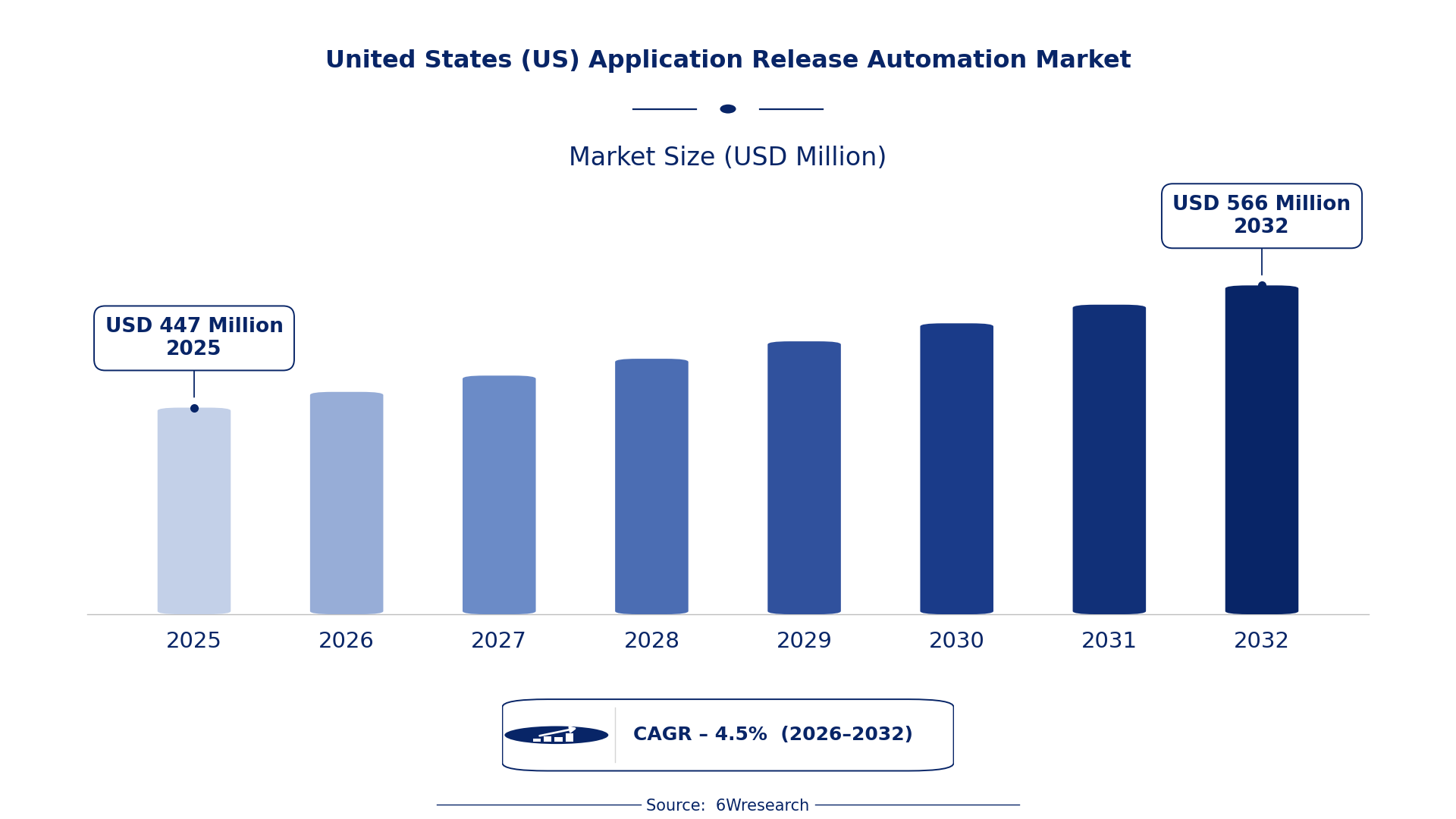
The United States (US) Application Release Automation Market was estimated at USD 447 Million in 2025 and is projected to reach USD 566 Million by 2032, growing at a CAGR of 4.5% from 2026 to 2032.
United States (US) Application Release Automation Market Synopsis
The United States Application Release Automation Market has gained remarkable momentum in recent years, driven primarily by the rising adoption of DevOps practices. As organizations increasingly prioritize efficiency and speed in software deployment, the demand for automation solutions has surged, reshaping how applications are released.
Looking ahead, the market is set to expand further, fueled by a growing emphasis on continuous delivery and cloud-native technologies. Companies are seeking advanced tools that not only streamline the release process but also integrate seamlessly with existing infrastructure, ensuring a competitive edge in a fast-paced digital landscape.
United States (US) Application Release Automation Market Year-wise Growth Rate and Key Drivers
This graph illustrates the annual growth rates of the United States (US) Application Release Automation Market from 2021 to 2032, highlighting a steady upward trajectory and projected expansion over the forecast period.
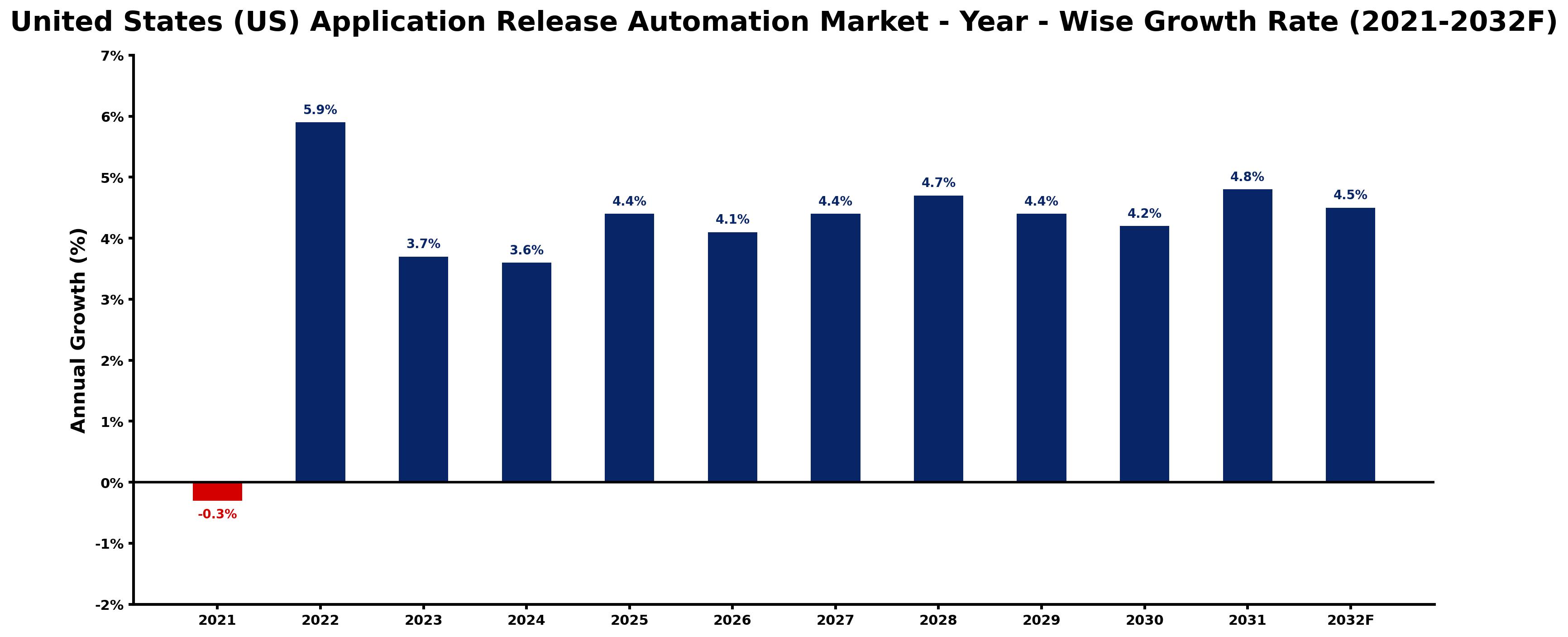
The table below presents the year‑wise growth rates along with the key drivers influencing the market
| Year | Growth Rate | Major Drivers |
| 2021 | -0.3% | Slow adoption of CI/CD practices in enterprises |
| 2022 | 5.9% | Increase in remote work driving DevOps adoption. |
| 2023 | 3.7% | Growing cybersecurity regulations enhance need for automated compliance. |
| 2024 | 3.6% | Rise in enterprise cloud migration accelerates automation solutions. |
| 2025 | 4.4% | Demand for faster software cycles boosts automation investments. |
| 2026 | 4.1% | Increased focus on agile development methodologies drives growth. |
| 2027 | 4.4% | Enhanced data privacy laws spur automated testing requirements. |
| 2028 | 4.7% | Adoption of AI tools streamlines release automation processes. |
| 2029 | 4.4% | Emergence of low-code platforms facilitates quicker deployment times. |
| 2030 | 4.2% | Investment in digital transformation initiatives fuels automation needs. |
| 2031 | 4.8% | Growth of personalized user experiences drives frequent releases. |
| 2032 | 4.5% | Incentives for innovation in tech firms boost automation focus. |
Note: Market size estimations and growth projections presented in this report are based on 6Wresearch's proprietary forecasting methodology, utilizing the latest available industry data, government publications, and primary research inputs.
United States (US) Application Release Automation Market Key Takeaways
Below are some of the specific key takeaways from the market, including:
- The market is experiencing a paradigm shift toward automation, enhancing productivity and software quality.
- Cloud-native technologies and DevOps practices are major drivers of market adoption.
- Integration of AI and machine learning is becoming commonplace in automation tools.
- There is a strong focus on user experience and customizable features among vendors.
- The competitive landscape is intensifying, with continual innovations to meet diverse business needs.
Evaluation of Restraints in United States (US) Application Release Automation Market
Despite the promising growth trajectory, the market faces several restraints. The complexity of managing diverse IT environments remains a significant hurdle. Organizations often struggle to integrate automation solutions with legacy systems, which can disrupt existing workflows. on top of that, security concerns regarding automated processes and the need to comply with various regulations can hinder adoption rates. The skills gap in the workforce, particularly in automation expertise, poses an additional challenge for organizations aiming to implement effective release automation strategies.
United States (US) Application Release Automation Market Trends
Several trends are shaping the future of the Application Release Automation market in the US. A notable trend is the demand for automation tools that enhance efficiency while minimizing errors. Companies are increasingly adopting cloud-native technologies to support CI/CD pipelines, aligning with modern software development methodologies. The integration of AI and machine learning capabilities into release automation tools is also on the rise, providing organizations with enhanced predictive analytics. User-centric design is gaining traction, with vendors focusing on creating intuitive interfaces and customizable features to cater to varied organizational needs.
United States (US) Application Release Automation Market Opportunities
The US Application Release Automation market is ripe with investment opportunities. As organizations seek to streamline software deployment, there is a clear demand for advanced automation tools that can support rapid application releases. Key areas of investment include DevOps platforms and CI/CD tools, which are essential for maintaining a competitive edge. Solutions focused on release orchestration and application performance monitoring are also gaining traction, providing avenues for companies to enhance their offerings and meet the evolving demands of enterprises.
Government Initiatives in the United States (US) Application Release Automation Market
Government policies and initiatives significantly influence the Application Release Automation market in the US. While there are no specific policies directly targeting this sector, various regulations related to cybersecurity and data privacy impact operational standards. The government's push for innovation, particularly through support for emerging technologies, is fostering a favorable environment for ARA vendors. Increased adoption of automation tools in public sector IT modernization efforts is creating new opportunities for market players.
- A recent initiative focused on enhancing cybersecurity protocols for government agencies has highlighted the importance of secure application deployments.
- Ongoing efforts under the Modernizing Government Technology (MGT) Act are encouraging federal agencies to adopt automation practices in their IT frameworks.
- A planned public-private partnership expected to launch by 2026 aims to improve digital infrastructure, which will indirectly benefit the ARA market.
- Current discussions around data privacy regulations are likely to influence future compliance requirements, impacting automation strategies.
Future Insights of the United States (US) Application Release Automation Market
The future of the United States Application Release Automation Market appears bright, with significant growth anticipated from 2026 to 2032. As organizations increasingly embrace automation to enhance software quality and accelerate delivery, the demand for sophisticated ARA solutions will intensify. Emerging technologies such as AI and machine learning will further drive innovation, providing organizations with advanced capabilities for predictive analytics and improved decision-making. The emphasis on continuous delivery and cloud-native solutions will shape the competitive landscape, presenting opportunities for vendors who can adapt to these trends.
United States (US) Application Release Automation Market Latest Developments
In the past year, the United States Application Release Automation Market has seen a flurry of activity as companies strive to innovate and stay ahead. Key developments reflect a growing focus on enhancing automation capabilities and user experience. As businesses pivot toward more agile methodologies, the demand for tailored solutions has become paramount.
- A major technology vendor launched a new release orchestration tool in early 2025, aimed at improving integration with existing CI/CD pipelines.
- An ongoing initiative by a leading regional operator to enhance its automation capabilities has resulted in a significant reduction in deployment times since mid-2025.
- By late 2026, a new product rollout is expected that incorporates AI-driven insights into the release process, facilitating better decision-making for developers.
- A partnership between automation solution providers and cloud service platforms is underway, enhancing the interoperability of automation tools with cloud environments.
United States (US) Application Release Automation Market - Key Attractiveness of the Report
- 10 Years of Market Numbers
- Historical Data Starting from 2022 to 2025
- Base Year: 2025
- Forecast Data until 2032
- Key Performance Indicators Impacting the Market
- Major Upcoming Developments and Projects
Key Highlights of the Report:
- United States (US) Application Release Automation Market Outlook
- Market Size of United States (US) Application Release Automation Market, 2025
- Forecast of United States (US) Application Release Automation Market, 2032
- Historical Data and Forecast of United States (US) Application Release Automation Revenues & Volume for the Period 2022-2032F
- United States (US) Application Release Automation Market Trend Evolution
- United States (US) Application Release Automation Market Drivers and Challenges
- United States (US) Application Release Automation Price Trends
- United States (US) Application Release Automation Porter's Five Forces
- United States (US) Application Release Automation Industry Life Cycle
- Historical Data and Forecast of United States (US) Application Release Automation Market Revenues & Volume By Component for the Period 2022-2032F
- Historical Data and Forecast of United States (US) Application Release Automation Market Revenues & Volume By Tool for the Period 2022-2032F
- Historical Data and Forecast of United States (US) Application Release Automation Market Revenues & Volume By Services for the Period 2022-2032F
- Historical Data and Forecast of United States (US) Application Release Automation Market Revenues & Volume By Vertical for the Period 2022-2032F
- Historical Data and Forecast of United States (US) Application Release Automation Market Revenues & Volume By BFSI for the Period 2022-2032F
- Historical Data and Forecast of United States (US) Application Release Automation Market Revenues & Volume By ITEs for the Period 2022-2032F
- Historical Data and Forecast of United States (US) Application Release Automation Market Revenues & Volume By Telecommunications for the Period 2022-2032F
- Historical Data and Forecast of United States (US) Application Release Automation Market Revenues & Volume By Manufacturing for the Period 2022-2032F
- Historical Data and Forecast of United States (US) Application Release Automation Market Revenues & Volume By Deployment Type for the Period 2022-2032F
- Historical Data and Forecast of United States (US) Application Release Automation Market Revenues & Volume By On-Premises for the Period 2022-2032F
- Historical Data and Forecast of United States (US) Application Release Automation Market Revenues & Volume By Cloud for the Period 2022-2032F
- Historical Data and Forecast of United States (US) Application Release Automation Market Revenues & Volume By Organization Size for the Period 2022-2032F
- United States (US) Application Release Automation Import Export Trade Statistics
- Market Opportunity Assessment By Component
- Market Opportunity Assessment By Vertical
- Market Opportunity Assessment By Deployment Type
- Market Opportunity Assessment By Organization Size
- United States (US) Application Release Automation Top Companies Market Share
- United States (US) Application Release Automation Competitive Benchmarking By Technical and Operational Parameters
- United States (US) Application Release Automation Company Profiles
- United States (US) Application Release Automation Key Strategic Recommendations






































