United States (US) Automotive Brake Pads Market Top 5 Importing Countries and Market Competition (HHI) Analysis
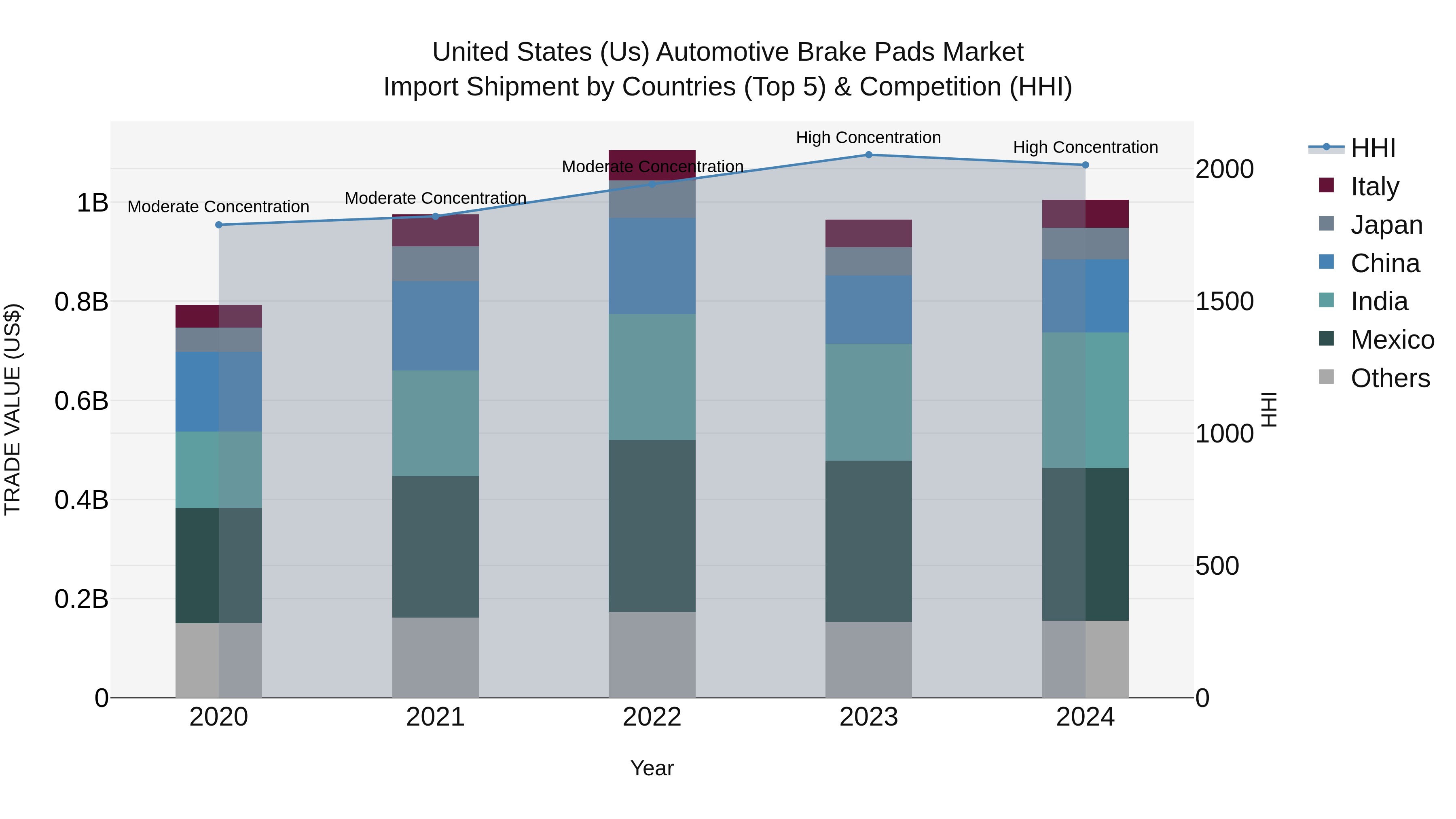
In 2024, the United States continued to see significant imports of automotive brake pads, with top exporters being Mexico, India, China, Japan, and Italy. The market exhibited high concentration with a high Herfindahl-Hirschman Index (HHI). The compound annual growth rate (CAGR) from 2020 to 2024 stood at a promising 6.09%, indicating sustained expansion. Moreover, the growth rate in 2024 alone was strong at 4.11%, underscoring the robust demand for automotive brake pads in the US market. This trend highlights the competitiveness and attractiveness of the US automotive industry to global suppliers.
USA Export Potential Assessment For Automotive Brake Pads Market (Values in USD Thousand)
United States (US) Automotive Brake Pads Market Overview
The United States Automotive Brake Pads Market is a highly competitive and rapidly evolving industry driven by factors such as increasing vehicle sales, technological advancements, and stringent safety regulations. The market is characterized by a wide range of players offering various types of brake pads including ceramic, semi-metallic, and organic. Major trends in the market include a shift towards eco-friendly and low-noise brake pads, as well as the rising popularity of electric vehicles which require specialized brake pads. Key players in the US market include Akebono Brake Corporation, Bosch, ACDelco, and Federal-Mogul Corporation. The market is expected to witness steady growth in the coming years as consumers prioritize safety and performance in their vehicles, leading to a higher demand for advanced brake pad technologies.
United States (US) Automotive Brake Pads Market Trends
The US Automotive Brake Pads Market is currently experiencing a shift towards eco-friendly and high-performance brake pad options. There is a growing demand for ceramic and low-metallic brake pads due to their reduced noise, dust, and superior braking performance compared to traditional semi-metallic pads. Additionally, advancements in brake pad technology, such as the development of carbon ceramic brake pads for high-performance vehicles, are gaining traction among enthusiasts. Manufacturers are also focusing on developing longer-lasting brake pads to cater to consumers seeking durability and cost-effectiveness. Overall, the market is witnessing a trend towards innovative and sustainable brake pad solutions to meet the evolving needs of consumers in the US automotive industry.
United States (US) Automotive Brake Pads Market Challenges
The US Automotive Brake Pads Market faces several challenges, including intense competition among key players, price volatility of raw materials such as steel and copper, and the increasing demand for electric vehicles (EVs) that may require different braking systems. Additionally, factors such as fluctuating consumer preferences, stringent government regulations on vehicle emissions and safety standards, and the impact of the COVID-19 pandemic on overall vehicle sales and production have also contributed to the challenges in the market. Companies in the US Automotive Brake Pads Market need to constantly innovate, invest in research and development for advanced braking technologies, and adapt to changing market dynamics to stay competitive and meet evolving customer needs.
United States (US) Automotive Brake Pads Market Investment Opportunities
The US Automotive Brake Pads Market presents attractive investment opportunities due to several factors, including the growing demand for high-quality brake pads driven by increasing vehicle sales and a focus on vehicle safety. Technological advancements, such as the development of ceramic and semi-metallic brake pads, are also contributing to market growth. Additionally, the trend towards electric vehicles (EVs) presents opportunities for brake pad manufacturers to innovate and cater to the specific needs of EV braking systems. Investing in research and development to create eco-friendly and durable brake pad materials, as well as targeting niche markets like performance vehicles or commercial fleets, could be strategic moves for investors looking to capitalize on the evolving automotive brake pads market in the US.
United States (US) Automotive Brake Pads Market Government Policy
The US government has implemented regulations and standards to ensure the safety and environmental sustainability of automotive brake pads. The Federal Motor Vehicle Safety Standards (FMVSS) set requirements for brake performance and durability to protect consumers. Additionally, the Environmental Protection Agency (EPA) regulates the use of certain hazardous materials in brake pad manufacturing to reduce environmental impact. California`s Proposition 65 mandates warning labels on products containing chemicals known to cause cancer or reproductive harm, impacting brake pad manufacturers. Overall, government policies in the US Automotive Brake Pads Market aim to enhance safety, quality, and sustainability standards while also addressing environmental concerns and protecting consumer health.
United States (US) Automotive Brake Pads Market Future Outlook
The future outlook for the United States Automotive Brake Pads Market is expected to remain positive, driven by factors such as increasing vehicle sales, technological advancements in brake pad materials, and a growing emphasis on vehicle safety. With the rising demand for electric vehicles and the ongoing trend towards lightweight and high-performance brake pads, the market is likely to witness steady growth in the coming years. Additionally, stringent regulations regarding vehicle emissions and safety standards will further propel the adoption of advanced brake pad technologies in the US automotive industry. Overall, the market is poised for expansion, with opportunities for key players to innovate and differentiate their offerings to meet the evolving needs of consumers and regulatory requirements.
Key Highlights of the Report:
- United States (US) Automotive Brake Pads Market Outlook
- Market Size of United States (US) Automotive Brake Pads Market, 2021
- Forecast of United States (US) Automotive Brake Pads Market, 2031
- Historical Data and Forecast of United States (US) Automotive Brake Pads Revenues & Volume for the Period 2018 - 2031
- United States (US) Automotive Brake Pads Market Trend Evolution
- United States (US) Automotive Brake Pads Market Drivers and Challenges
- United States (US) Automotive Brake Pads Price Trends
- United States (US) Automotive Brake Pads Porter's Five Forces
- United States (US) Automotive Brake Pads Industry Life Cycle
- Historical Data and Forecast of United States (US) Automotive Brake Pads Market Revenues & Volume By Vehicle for the Period 2018 - 2031
- Historical Data and Forecast of United States (US) Automotive Brake Pads Market Revenues & Volume By Passenger Car for the Period 2018 - 2031
- Historical Data and Forecast of United States (US) Automotive Brake Pads Market Revenues & Volume By LCV for the Period 2018 - 2031
- Historical Data and Forecast of United States (US) Automotive Brake Pads Market Revenues & Volume By HCV for the Period 2018 - 2031
- Historical Data and Forecast of United States (US) Automotive Brake Pads Market Revenues & Volume By Two-wheelers for the Period 2018 - 2031
- Historical Data and Forecast of United States (US) Automotive Brake Pads Market Revenues & Volume By Material for the Period 2018 - 2031
- Historical Data and Forecast of United States (US) Automotive Brake Pads Market Revenues & Volume By Semi-metallic for the Period 2018 - 2031
- Historical Data and Forecast of United States (US) Automotive Brake Pads Market Revenues & Volume By Non-asbestos Organic (NAO) for the Period 2018 - 2031
- Historical Data and Forecast of United States (US) Automotive Brake Pads Market Revenues & Volume By Low-metallic NAO for the Period 2018 - 2031
- Historical Data and Forecast of United States (US) Automotive Brake Pads Market Revenues & Volume By Ceramic for the Period 2018 - 2031
- Historical Data and Forecast of United States (US) Automotive Brake Pads Market Revenues & Volume By Sales Outlet for the Period 2018 - 2031
- Historical Data and Forecast of United States (US) Automotive Brake Pads Market Revenues & Volume By OEM for the Period 2018 - 2031
- Historical Data and Forecast of United States (US) Automotive Brake Pads Market Revenues & Volume By Aftermarket for the Period 2018 - 2031
- Historical Data and Forecast of United States (US) Automotive Brake Pads Market Revenues & Volume By Position for the Period 2018 - 2031
- Historical Data and Forecast of United States (US) Automotive Brake Pads Market Revenues & Volume By Front for the Period 2018 - 2031
- Historical Data and Forecast of United States (US) Automotive Brake Pads Market Revenues & Volume By Front & Rear for the Period 2018 - 2031
- United States (US) Automotive Brake Pads Import Export Trade Statistics
- Market Opportunity Assessment By Vehicle
- Market Opportunity Assessment By Material
- Market Opportunity Assessment By Sales Outlet
- Market Opportunity Assessment By Position
- United States (US) Automotive Brake Pads Top Companies Market Share
- United States (US) Automotive Brake Pads Competitive Benchmarking By Technical and Operational Parameters
- United States (US) Automotive Brake Pads Company Profiles
- United States (US) Automotive Brake Pads Key Strategic Recommendations






































