United States (US) Aviation Test Equipment Market Size, Share & Growth Rate
The United States (US) Aviation Test Equipment Market was estimated at USD 238 Million in 2025 and is projected to reach USD 280 Million by 2032, growing at a CAGR of 2.3% from 2026 to 2032. This growth is primarily driven by the increasing demand for both commercial and military aircraft, coupled with stringent safety and regulatory standards. Furthermore, advancements in technology are propelling the market as manufacturers seek more efficient and reliable testing solutions for the complex systems found in modern aircraft.
United States (US) Aviation Test Equipment Market Year-wise Growth Rate and Key Drivers
This graph highlights how the United States (US) Aviation Test Equipment Market has steadily grown over the years, supported by major growth factors.
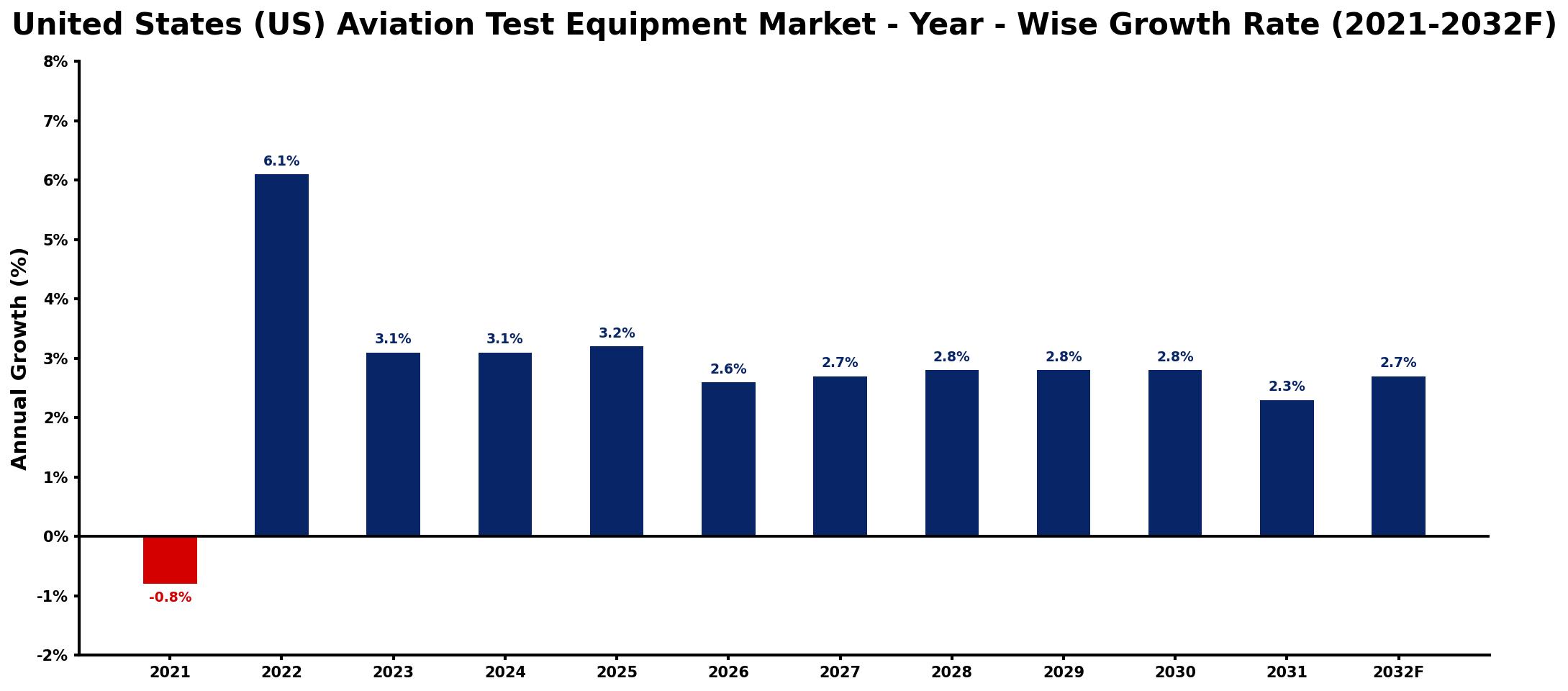
The table below presents the year‑wise growth rates along with the key drivers influencing the market
| Year | Growth Rate | Major Drivers |
| 2021 | -0.8% | reduced defense spending initiatives |
| 2022 | 6.1% | increased commercial flight demand |
| 2023 | 3.1% | rising investments in R&D |
| 2024 | 3.1% | expansion of aerospace sector |
| 2025 | 3.2% | growing focus on safety regulations |
| 2026 | 2.6% | advancements in simulation technology |
| 2027 | 2.7% | emergence of electric propulsion systems |
| 2028 | 2.8% | enhanced training program investments |
| 2029 | 2.8% | growth in drone applications |
| 2030 | 2.8% | increased global travel recovery |
| 2031 | 2.3% | growing automotive sector requirements |
| 2032 | 2.7% | rising interest in space exploration |
Note: Market size estimations and growth projections presented in this report are based on 6Wresearch's proprietary forecasting methodology, utilizing the latest available industry data, government publications, and primary research inputs.
United States (US) Aviation Test Equipment Market Synopsis
The primary force shaping the US Aviation Test Equipment Market is the relentless pursuit of aircraft safety and performance optimization. As aviation technologies advance, the need for precise and specialized testing equipment has intensified, driving investments and innovation within the sector. The interplay of increased air traffic and the aging aircraft fleet is further accentuating the demand for sophisticated test solutions.
Additionally, the integration of emerging technologies, such as artificial intelligence and data analytics, is transforming testing methodologies and enhancing predictive maintenance capabilities. As aircraft systems become increasingly intricate, the aviation industry recognizes the need for advanced testing equipment to ensure operational efficiency and compliance with regulatory standards.
United States (US) Aviation Test Equipment Market Key Takeaways
- The market is driven by advancements in aircraft technology and a focus on enhanced safety standards.
- Ongoing digitalization and automation are key factors influencing the demand for innovative testing solutions.
- Investment in portable and handheld testing devices is rising, reflecting the need for flexibility in maintenance operations.
- Regulatory compliance remains a critical challenge for manufacturers in this competitive landscape.
- There are significant opportunities in developing test equipment for new aircraft technologies, including electric and unmanned vehicles.
Evaluation of Restraints in United States (US) Aviation Test Equipment Market
Despite the growth potential, the US Aviation Test Equipment Market faces several constraints that could hinder its progress. The rapid pace of technological advancements in aircraft systems necessitates constant updates to testing equipment, leading to substantial research and development investments. Moreover, stringent regulatory frameworks require that manufacturers comply with rigorous safety standards, which can complicate product development and drive costs upward. Additionally, established companies dominate the market, making it challenging for new entrants to compete effectively and capture market share.
United States (US) Aviation Test Equipment Market Trends
A notable trend in the US Aviation Test Equipment Market is the increasing integration of artificial intelligence and machine learning capabilities into testing equipment. This trend enables predictive maintenance and enhances overall operational performance. The demand for portable testing devices is also rising, reflecting the industry's focus on improving maintenance efficiency and reducing downtime. Furthermore, the shift towards digital solutions is prompting investments in advanced analytics and automation technologies to optimize testing processes.
United States (US) Aviation Test Equipment Market Opportunities
The market presents significant investment opportunities as the aviation sector evolves. There is a growing requirement for specialized avionics and engine testing equipment to accommodate modern aircraft systems. Additionally, the rise of electric and unmanned aerial vehicles is creating a demand for innovative testing solutions that address new operational challenges. Companies that invest in the development of cutting-edge technology and integrated testing solutions stand to gain a competitive advantage and capture a larger market share.
Government Initiatives in the United States (US) Aviation Test Equipment Market
The US government plays a crucial role in shaping the Aviation Test Equipment Market through regulatory oversight and funding initiatives. The Federal Aviation Administration (FAA) establishes safety standards and protocols that impact equipment testing and maintenance practices across the industry. Furthermore, the Department of Defense (DOD) drives demand for advanced aviation test equipment through military contracts, ensuring compliance with stringent safety and performance criteria. Ongoing government support for research and development also fosters innovation within the market.
Future Insights of the United States (US) Aviation Test Equipment Market
Looking ahead to 2026-2032, the United States Aviation Test Equipment Market is expected to thrive, fueled by continuous advancements in aviation technology. An increase in the fleet size and air traffic, along with an unwavering commitment to safety, will bolster demand for sophisticated testing equipment. The growing emphasis on efficiency and compliance with stringent regulations will further propel market growth, making the landscape ripe for innovation and investment in state-of-the-art testing solutions.
United States (US) Aviation Test Equipment Market Latest Developments (2025 - 2026)
Recent developments in the US Aviation Test Equipment Market indicate a significant shift towards the adoption of smart technologies and automated testing solutions. Companies are increasingly focusing on enhancing the connectivity of testing equipment, leading to more efficient data collection and analysis. Furthermore, collaborations between technology firms and aviation equipment manufacturers are fostering the development of integrated solutions that cater to the evolving needs of the market.
United States (US) Aviation Test Equipment Market - Key Attractiveness of the Report
- 10 Years of Market Numbers
- Historical Data Starting from 2022 to 2025
- Base Year: 2025
- Forecast Data until 2032
- Key Performance Indicators Impacting the Market
- Major Upcoming Developments and Projects
Key Highlights of the Report:
- United States (US) Aviation Test Equipment Market Outlook
- Market Size of United States (US) Aviation Test Equipment Market, 2025
- Forecast of United States (US) Aviation Test Equipment Market, 2032
- Historical Data and Forecast of United States (US) Aviation Test Equipment Revenues & Volume for the Period 2022-2032F
- United States (US) Aviation Test Equipment Market Trend Evolution
- United States (US) Aviation Test Equipment Market Drivers and Challenges
- United States (US) Aviation Test Equipment Price Trends
- United States (US) Aviation Test Equipment Porter's Five Forces
- United States (US) Aviation Test Equipment Industry Life Cycle
- Historical Data and Forecast of United States (US) Aviation Test Equipment Market Revenues & Volume By Product for the Period 2022-2032F
- Historical Data and Forecast of United States (US) Aviation Test Equipment Market Revenues & Volume By Electrical Aviation Test Equipment for the Period 2022-2032F
- Historical Data and Forecast of United States (US) Aviation Test Equipment Market Revenues & Volume By Hydraulic Aviation Test Equipment for the Period 2022-2032F
- Historical Data and Forecast of United States (US) Aviation Test Equipment Market Revenues & Volume By Power Aviation Test Equipment for the Period 2022-2032F
- Historical Data and Forecast of United States (US) Aviation Test Equipment Market Revenues & Volume By Pneumatic Aviation Test Equipment for the Period 2022-2032F
- Historical Data and Forecast of United States (US) Aviation Test Equipment Market Revenues & Volume By End User for the Period 2022-2032F
- Historical Data and Forecast of United States (US) Aviation Test Equipment Market Revenues & Volume By Commercial for the Period 2022-2032F
- Historical Data and Forecast of United States (US) Aviation Test Equipment Market Revenues & Volume By Defense/Military Sector for the Period 2022-2032F
- United States (US) Aviation Test Equipment Import Export Trade Statistics
- Market Opportunity Assessment By Product
- Market Opportunity Assessment By End User
- United States (US) Aviation Test Equipment Top Companies Market Share
- United States (US) Aviation Test Equipment Competitive Benchmarking By Technical and Operational Parameters
- United States (US) Aviation Test Equipment Company Profiles
- United States (US) Aviation Test Equipment Key Strategic Recommendations






































