United States (US) Bathroom Furniture Market Summary
The united states (us) bathroom furniture market was estimated at USD 233 Million in 2025 and is projected to reach USD 274 Million by 2032, growing at a CAGR of 3.0% from 2026 to 2032.
United States (US) Bathroom Furniture Market Year-wise Growth Rate and Key Drivers
This graph highlights how the United States (US) Bathroom Furniture Market has steadily grown over the past five years, supported by major growth factors.
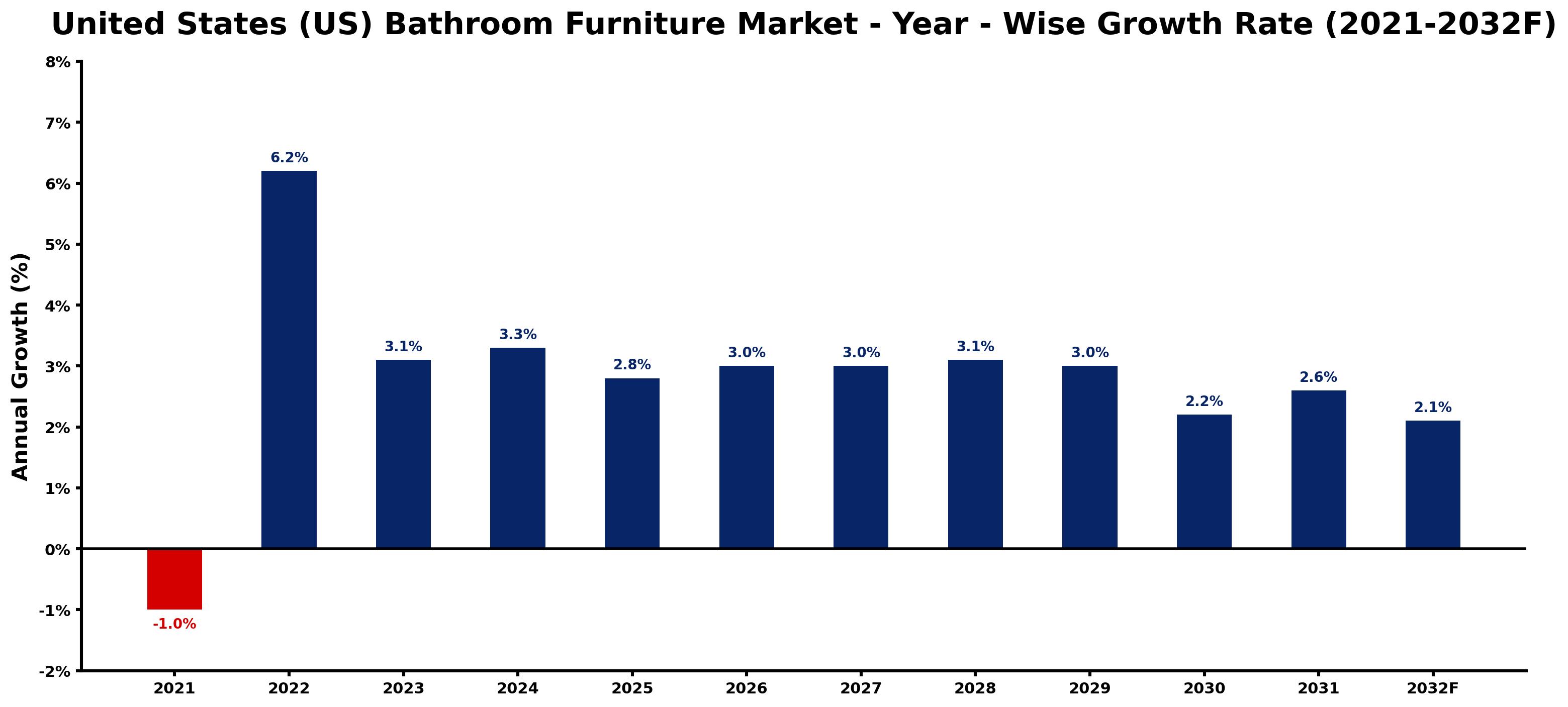
The table below presents the year wise growth rates along with the key drivers influencing the market
| Year | Growth Rate | Major Drivers |
| 2021 | -1.0% | Supply chain disruptions led to delays in deliveries, causing fundamental shortages in bathroom furniture availability. |
| 2022 | 6.2% | Investments in sustainable materials gained traction among eco-conscious consumers seeking bathroom solutions. |
| 2023 | 3.1% | The surge in remote work prompted homeowners to enhance personal spaces, including bathrooms. |
| 2024 | 3.3% | Innovations in compact design attracted urban dwellers with limited bathroom space requirements. |
| 2025 | 2.8% | Luxury bathroom updates became popular among millennials seeking to elevate home aesthetics. |
| 2026 | 3.0% | Technological integration in furniture, like smart vanities, appealed to tech-savvy consumers. |
| 2027 | 3.0% | Increased awareness of wellness trends spurred demand for calming bathroom environments. |
| 2028 | 3.1% | E-commerce platforms expanded, providing wider access to diverse bathroom furniture selections. |
| 2029 | 3.0% | Collaborations between designers and brands introduced limited-edition bathroom collections. |
| 2030 | 2.2% | Sustainable production methods became mainstream, aligning with consumer preference for responsible sourcing. |
| 2031 | 2.6% | The trend towards minimalism fueled interest in streamlined, multifunctional bathroom furniture solutions. |
| 2032 | 2.1% | Urbanization continued to drive innovations in adaptable furniture for diverse living situations. |
Note - Market size estimations and growth projections presented in this report are based on 6Wresearch's advanced forecasting approach, validated with industry datasets as of June 2026.
United States (US) Bathroom Furniture Market Synopsis
The United States (US) Bathroom Furniture Market is projected to reach 3.0% and witness significant growth during the forecast period (2026-2032). The market encompasses a variety of products including vanities, cabinets, mirrors, and storage solutions, reflecting the diverse needs of consumers eager to enhance their bathroom spaces. Factors such as urbanization, increased disposable incomes, and a growing focus on home aesthetics are propelling this sector towards expansion. Industry players are adapting by introducing innovative designs and sustainable practices to meet the evolving consumer demands.
United States (US) Bathroom Furniture Market Growth Drivers
The growth of the United States (US) Bathroom Furniture Market is underpinned by several key drivers:
- The rise in urbanization is leading to smaller living spaces, which is increasing the demand for space-saving and multifunctional bathroom furniture.
- An uptick in disposable incomes allows consumers to invest in high-quality and luxurious bathroom furnishings that reflect personal style and enhance home value.
- Renovation and remodeling activities in both the residential and commercial sectors are on the rise, fueled by consumers' desire to improve functionality and aesthetics.
- Technological advancements are enabling the integration of smart features in bathroom furniture, such as LED lighting and automation, which appeal to tech-savvy consumers.
- The growing emphasis on eco-friendliness is pushing manufacturers to innovate and provide sustainable options, aligning with consumer preferences for environmentally responsible products.
United States (US) Bathroom Furniture Market Trends and Opportunities
Current trends within the United States (US) Bathroom Furniture Market indicate a shift towards modern design principles with an emphasis on minimalism and efficiency:
- There is a marked increase in demand for compact and multifunctional pieces, such as vanities with integrated storage, tailored to maximize utility in small spaces.
- Customization is emerging as a pivotal trend, allowing consumers to design unique bathroom furniture pieces that reflect their personal tastes and requirements.
- Smart technology integration is not only enhancing functionality but also transforming the bathroom into a high-tech space, attracting buyers looking for modern conveniences.
- Furniture made from sustainable materials, including recycled products, is gaining traction, reflecting a consumer preference for eco-conscious purchasing decisions.
- The rise of e-commerce platforms facilitates access to a wider variety of products, providing consumers with more choices and customization options for their bathroom furniture needs.
United States (US) Bathroom Furniture Market Challenges and Restraints
Despite the positive outlook, the United States (US) Bathroom Furniture Market faces several challenges that could hinder growth:
- Intense competition among domestic and international manufacturers can lead to price wars, challenging profitability for many companies in the sector.
- Fluctuations in raw material prices may affect production costs and pricing strategies, creating uncertainty for manufacturers and consumers alike.
- Consumer preferences are continually evolving, requiring constant innovation and adaptation from manufacturers in order to meet new demands.
- The focus on sustainability adds pressure to develop eco-friendly products while ensuring they maintain quality and affordability.
- Economic downturns, particularly those influenced by external factors such as the recent pandemic, can reduce consumer spending on non-essential home improvements, impacting sales.
United States (US) Bathroom Furniture Market Investment Opportunities
The investment landscape within the United States (US) Bathroom Furniture Market is shaped by various emerging opportunities:
- There is a growing potential for innovative storage solutions that promote space efficiency, appealing to urban consumers facing space constraints.
- Investing in sustainable production methods and materials can tap into the increasing consumer demand for environmentally friendly products.
- The luxury segment is expanding as consumers seek spa-like bathrooms, presenting opportunities for high-end product offerings.
- Smart bathroom technology, including automated features and enhanced lighting, provides avenues for investment in new product categories catering to tech-focused consumers.
- The growing trend towards online purchasing offers significant opportunities for creating e-commerce platforms that enhance accessibility and customization of bathroom furniture.
United States (US) Bathroom Furniture Market Government Investment and Initiatives
Government policies related to the United States (US) Bathroom Furniture Market predominantly revolve around environmental regulations, safety standards, and trade policies:
- Environmental regulations are increasingly affecting the choice of materials in bathroom furniture manufacturing, aiming to reduce the ecological footprint of production processes.
- Safety standards established by governmental agencies ensure that products meet specific quality requirements, influencing design and manufacturing practices across the sector.
- Public spending initiatives focused on infrastructure and housing improvements can lead to an increased demand for bathroom renovations in both residential and commercial sectors.
- Trade policies, including tariffs, can impact the pricing and availability of imported materials, affecting market competitiveness and development.
- Government incentives promoting sustainable practices could catalyze innovation and investment in eco-friendly bathroom furniture production.
United States (US) Bathroom Furniture Market Latest Developments (May 2025 - June 2026)
From May 2025 to June 2026, the United States (US) Bathroom Furniture Market has witnessed several notable developments that reflect the industry's direction:
- There has been a continued rise in the integration of smart technology in bathroom furniture, with manufacturers emphasizing innovative functionalities to enhance user experience.
- Consumer preferences have increasingly shifted towards customizable and unique bathroom solutions, driving companies to offer more personalized product options.
- The emphasis on sustainability has led to more manufacturers committing to eco-friendly practices and materials in response to growing consumer demand.
- Renovation projects have surged, particularly in urban areas, where smaller spaces have necessitated the development of multifunctional furniture.
- The impact of e-commerce has expanded, with many consumers opting to purchase bathroom furniture online, resulting in a shift in marketing strategies towards digital platforms.
United States (US) Bathroom Furniture Market - Key Attractiveness of the Report
- 10 Years of Market Numbers
- Historical Data Starting from 2022 to 2025
- Base Year: 2025
- Forecast Data until 2032
- Key Performance Indicators Impacting the Market
- Major Upcoming Developments and Projects
Key Highlights of the Report:
- United States (US) Bathroom Furniture Market Outlook
- Market Size of United States (US) Bathroom Furniture Market, 2025
- Forecast of United States (US) Bathroom Furniture Market, 2032F
- Historical Data and Forecast of United States (US) Bathroom Furniture Revenues & Volume for the Period 2022-2032F
- United States (US) Bathroom Furniture Market Trend Evolution
- United States (US) Bathroom Furniture Market Drivers and Challenges
- United States (US) Bathroom Furniture Price Trends
- United States (US) Bathroom Furniture Porter's Five Forces
- United States (US) Bathroom Furniture Industry Life Cycle
- Historical Data and Forecast of United States (US) Bathroom Furniture Market Revenues & Volume By Type for the Period 2022-2032F
- Historical Data and Forecast of United States (US) Bathroom Furniture Market Revenues & Volume By Bath Vanities for the Period 2022-2032F
- Historical Data and Forecast of United States (US) Bathroom Furniture Market Revenues & Volume By Console Vanity for the Period 2022-2032F
- Historical Data and Forecast of United States (US) Bathroom Furniture Market Revenues & Volume By Vanity Tops for the Period 2022-2032F
- Historical Data and Forecast of United States (US) Bathroom Furniture Market Revenues & Volume By Bathroom Mirrors for the Period 2022-2032F
- Historical Data and Forecast of United States (US) Bathroom Furniture Market Revenues & Volume By Other for the Period 2022-2032F
- Historical Data and Forecast of United States (US) Bathroom Furniture Market Revenues & Volume By Application for the Period 2022-2032F
- Historical Data and Forecast of United States (US) Bathroom Furniture Market Revenues & Volume By Household for the Period 2022-2032F
- Historical Data and Forecast of United States (US) Bathroom Furniture Market Revenues & Volume By Commercial for the Period 2022-2032F
- Historical Data and Forecast of United States (US) Bathroom Furniture Market Revenues & Volume By Other for the Period 2022-2032F
- United States (US) Bathroom Furniture Import Export Trade Statistics
- Market Opportunity Assessment By Type
- Market Opportunity Assessment By Application
- United States (US) Bathroom Furniture Top Companies Market Share
- United States (US) Bathroom Furniture Competitive Benchmarking By Technical and Operational Parameters
- United States (US) Bathroom Furniture Company Profiles
- United States (US) Bathroom Furniture Key Strategic Recommendations






































