United States (US) Binoculars Market Top 5 Importing Countries and Market Competition (HHI) Analysis
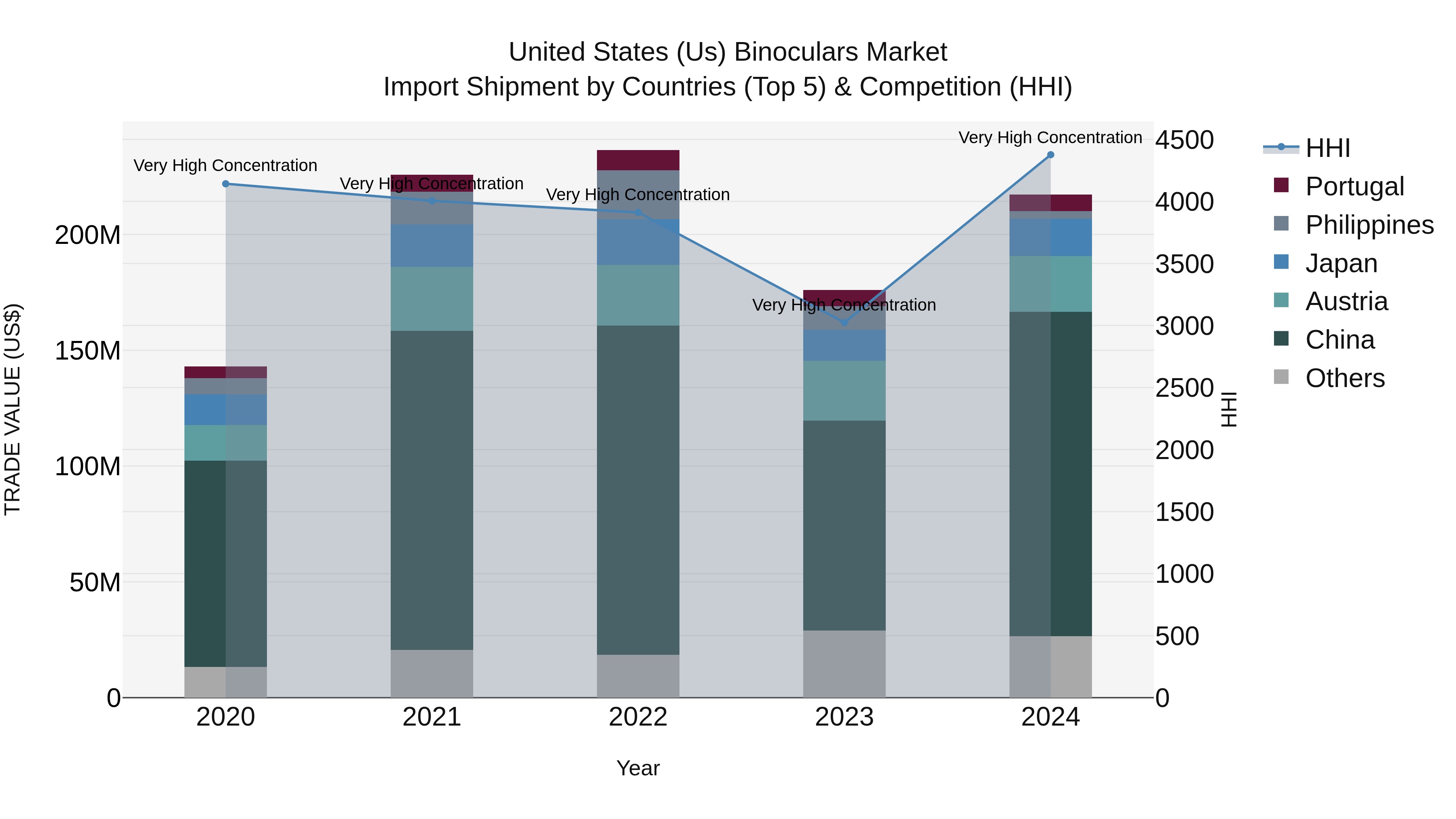
In 2024, the United States continued to see strong growth in binoculars import shipments, with top exporting countries including China, Austria, Japan, Lithuania, and Portugal. The High Herfindahl-Hirschman Index (HHI) indicates a high concentration among these exporters. The Compound Annual Growth Rate (CAGR) from 2020 to 2024 stood at an impressive 11.0%, with a notable growth rate of 23.39% from 2023 to 2024. This data suggests a thriving market for binocular imports in the US, driven by a diverse range of suppliers and sustained growth momentum.
USA Export Potential Assessment For Binoculars Market (Values in USD Thousand)
United States (US) Binoculars Market Overview
The United States binoculars market is a mature and highly competitive industry characterized by a wide range of product offerings catering to various consumer segments. Key trends driving market growth include increasing interest in outdoor activities such as birdwatching, hiking, and hunting, as well as the popularity of spectator sports and concerts. Technological advancements, such as image stabilization and night vision capabilities, are also influencing consumer purchasing decisions. The market is dominated by established players like Nikon, Bushnell, and Vortex Optics, but there is also a growing presence of niche and online brands offering specialized features and competitive pricing. E-commerce channels are playing a significant role in driving sales, offering consumers convenience and a wide selection of products. Overall, the US binoculars market is expected to continue growing as consumers seek high-quality optics for recreational and professional use.
United States (US) Binoculars Market Trends
The US binoculars market is witnessing several notable trends. One key trend is the increasing demand for technologically advanced features in binoculars, such as image stabilization, built-in rangefinders, and digital connectivity. Outdoor enthusiasts and wildlife watchers are particularly driving this demand for enhanced functionality. Additionally, there is a growing interest in compact and lightweight binoculars, catering to the needs of travelers and hikers who prioritize portability. Another trend is the rising popularity of night vision binoculars for activities like camping, hunting, and security applications. Sustainability is also becoming a focus, with eco-friendly materials and manufacturing processes gaining traction among environmentally conscious consumers. Overall, the US binoculars market is evolving to meet the diverse needs of consumers seeking innovation, convenience, and sustainability in their optical devices.
United States (US) Binoculars Market Challenges
In the US Binoculars Market, one major challenge is increasing competition from smartphones with advanced camera capabilities, which offer convenience and versatility in capturing images from a distance. Additionally, economic uncertainty and fluctuations in consumer spending may impact the demand for binoculars as they are often considered non-essential items. Another challenge is the rising popularity of outdoor recreational activities, such as bird watching and hiking, which could potentially drive demand for binoculars but also require manufacturers to innovate and offer products with enhanced features to cater to specific consumer needs. Furthermore, the impact of the COVID-19 pandemic on supply chains and manufacturing processes could lead to disruptions and affect the availability of binoculars in the market. Overall, companies in the US Binoculars Market need to adapt to changing consumer preferences and market dynamics to stay competitive and sustain growth.
United States (US) Binoculars Market Investment Opportunities
The United States Binoculars Market presents several promising investment opportunities for growth and innovation. With the increasing popularity of outdoor activities such as birdwatching, hiking, and hunting, the demand for high-quality binoculars is on the rise. Investors can explore opportunities in developing advanced technology features like image stabilization, enhanced magnification, and lightweight materials to cater to the evolving needs of consumers. Additionally, there is a growing trend towards digital binoculars with built-in cameras and smartphone connectivity, creating a niche market segment for innovation. Collaborating with retail partners, expanding distribution channels, and investing in robust marketing strategies can further drive growth in this market. Overall, the US Binoculars Market offers avenues for investment in product differentiation and technological advancements to capture a larger share of the expanding outdoor recreation market.
United States (US) Binoculars Market Government Policy
Government policies related to the US Binoculars Market primarily focus on regulation and import/export laws. The US government has regulations in place to ensure the safety and quality of binoculars sold in the market, particularly in terms of optical performance standards. Additionally, there are import tariffs and duties imposed on binoculars brought into the country, which can impact pricing and availability for consumers. Regulations related to environmental protection and wildlife conservation also play a role in the binoculars market, especially in terms of restrictions on certain materials or components used in manufacturing. Overall, government policies aim to maintain a fair and competitive market while ensuring consumer protection and environmental sustainability in the US binoculars industry.
United States (US) Binoculars Market Future Outlook
The future outlook for the United States Binoculars Market appears promising, with a projected growth driven by various factors such as increasing outdoor recreational activities, wildlife observation, bird watching, and sports events. Technological advancements leading to the introduction of innovative features like image stabilization, night vision, and enhanced durability are expected to attract more consumers. Additionally, the rise in interest among travelers for sightseeing and adventure activities will further stimulate market growth. E-commerce platforms providing a convenient purchasing experience and the growing trend of online product reviews will also contribute to the market expansion. Overall, the US Binoculars Market is anticipated to experience steady growth in the coming years, presenting opportunities for manufacturers and retailers to capitalize on the increasing demand.
Key Highlights of the Report:
- United States (US) Binoculars Market Outlook
- Market Size of United States (US) Binoculars Market, 2021
- Forecast of United States (US) Binoculars Market, 2027
- Historical Data and Forecast of United States (US) Binoculars Revenues & Volume for the Period 2018 - 2027
- United States (US) Binoculars Market Trend Evolution
- United States (US) Binoculars Market Drivers and Challenges
- United States (US) Binoculars Price Trends
- United States (US) Binoculars Porter's Five Forces
- United States (US) Binoculars Industry Life Cycle
- Historical Data and Forecast of United States (US) Binoculars Market Revenues & Volume By Product Types for the Period 2018 - 2027
- Historical Data and Forecast of United States (US) Binoculars Market Revenues & Volume By Roof Prism Binoculars for the Period 2018 - 2027
- Historical Data and Forecast of United States (US) Binoculars Market Revenues & Volume By Porro Prism Binoculars for the Period 2018 - 2027
- Historical Data and Forecast of United States (US) Binoculars Market Revenues & Volume By Others for the Period 2018 - 2027
- Historical Data and Forecast of United States (US) Binoculars Market Revenues & Volume By Applications for the Period 2018 - 2027
- Historical Data and Forecast of United States (US) Binoculars Market Revenues & Volume By Hunting & shooting Series for the Period 2018 - 2027
- Historical Data and Forecast of United States (US) Binoculars Market Revenues & Volume By Outdoor Series for the Period 2018 - 2027
- Historical Data and Forecast of United States (US) Binoculars Market Revenues & Volume By Marine Series for the Period 2018 - 2027
- Historical Data and Forecast of United States (US) Binoculars Market Revenues & Volume By Tactical and Military Series for the Period 2018 - 2027
- Historical Data and Forecast of United States (US) Binoculars Market Revenues & Volume By Others for the Period 2018 - 2027
- United States (US) Binoculars Import Export Trade Statistics
- Market Opportunity Assessment By Product Types
- Market Opportunity Assessment By Applications
- United States (US) Binoculars Top Companies Market Share
- United States (US) Binoculars Competitive Benchmarking By Technical and Operational Parameters
- United States (US) Binoculars Company Profiles
- United States (US) Binoculars Key Strategic Recommendations






































