United States (US) Bottle Filling Machine Market Size, Share & Growth Rate
The United States (US) Bottle Filling Machine Market was estimated at USD 108 Million in 2025 and is projected to reach USD 127 Million by 2032, growing at a CAGR of 2.3% from 2026 to 2032. This growth trajectory is primarily fueled by the rising demand for bottled beverages, as well as an increasing focus on automation within manufacturing processes. Alongside these trends, compliance with stringent safety and hygiene regulations further drives investment in advanced filling technologies across various industries.
United States (US) Bottle Filling Machine Market Year-wise Growth Rate and Key Drivers
This graph highlights how the United States (US) Bottle Filling Machine Market has steadily grown over the years, supported by major growth factors.
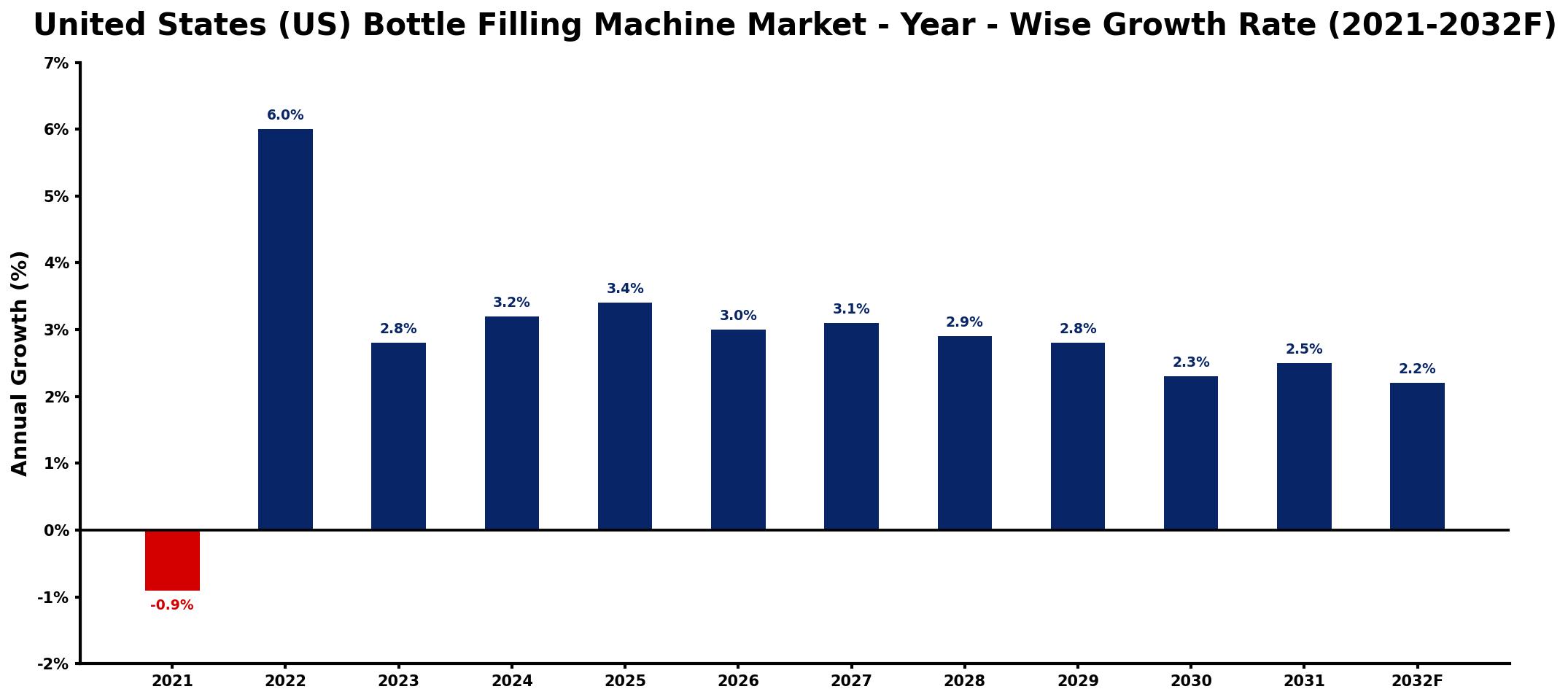
The table below presents the year‑wise growth rates along with the key drivers influencing the market
| Year | Growth Rate | Major Drivers |
| 2021 | -0.9% | decreased consumer demand for packaging |
| 2022 | 6.0% | rising demand from beverage sector |
| 2023 | 2.8% | expansion of e-commerce distribution channels |
| 2024 | 3.2% | increased investment in automation technologies |
| 2025 | 3.4% | growth in sustainable packaging initiatives |
| 2026 | 3.0% | growing downstream application demand |
| 2027 | 3.1% | emerging markets increasing production capacity |
| 2028 | 2.9% | advancements in production efficiency techniques |
| 2029 | 2.8% | growing regional consumption patterns |
| 2030 | 2.3% | heightened interest in eco-friendly solutions |
| 2031 | 2.5% | expanding healthcare application demand |
| 2032 | 2.2% | increased regulatory support for innovation |
Note: Market size estimations and growth projections presented in this report are based on 6Wresearch's proprietary forecasting methodology, utilizing the latest available industry data, government publications, and primary research inputs.
United States (US) Bottle Filling Machine Market Synopsis
The US Bottle Filling Machine Market has recently gained momentum, thanks to a burgeoning beverage sector and heightened awareness of operational efficiency. As industries adapt to evolving consumer preferences, the market is on an upward trajectory, with significant investments in innovative technologies that enhance production speed and accuracy.
Looking ahead, the market is set to evolve further, influenced by shifting trends toward sustainability and eco-friendly practices. As manufacturers strive to integrate energy-efficient processes and materials, the landscape of bottle filling machinery will be transformed to accommodate these new paradigms, presenting opportunities for growth and modernization.
United States (US) Bottle Filling Machine Market Key Takeaways
- The US Bottle Filling Machine Market is expected to grow steadily, reflecting the increasing consumption of bottled beverages.
- Technological advancements in automation are central to enhancing production efficiency across the industry.
- Sustainability is becoming a focal point, with rising demand for eco-friendly filling solutions.
- Manufacturers face the dual pressures of competition and compliance with stringent regulatory standards.
- Investment opportunities abound for those focused on customization and advanced filling technologies.
Evaluation of Restraints in United States (US) Bottle Filling Machine Market
Despite its robust growth potential, the US Bottle Filling Machine Market is not without its challenges. A key restraint is the escalating competition among manufacturers, which places downward pressure on pricing and profitability. Additionally, rising labor costs are impacting production expenditures, creating a need for firms to adopt more efficient automated solutions. Compliance with strict regulatory standards can also complicate operations, requiring continuous innovation and adaptation to maintain market relevance. Furthermore, fluctuations in raw material costs pose a significant risk, as do issues related to the availability of skilled labor necessary for machine operation and maintenance.
United States (US) Bottle Filling Machine Market Trends
Several notable trends are shaping the US Bottle Filling Machine Market. The rise of craft breweries and the increasing popularity of bottled water are driving demand for versatile filling solutions that accommodate a range of bottle sizes and materials. Additionally, manufacturers are gravitating towards machines that promise enhanced speed, accuracy, and minimal downtime. The emphasis on sustainability is leading to the development of eco-friendly filling machines designed to reduce waste and energy consumption, indicating a significant shift in industry standards and practices.
United States (US) Bottle Filling Machine Market Opportunities
The US Bottle Filling Machine Market is ripe with investment opportunities, particularly for stakeholders looking to innovate. The continuous growth in the bottled beverage industry, coupled with the push towards automation, suggests that investments in high-speed and automated filling technologies can yield substantial returns. Moreover, with sustainability becoming a critical concern for consumers and companies alike, there is an exciting avenue for investments in eco-conscious filling machines. Businesses focusing on custom solutions tailored to diverse product specifications and packaging demands are positioned to thrive amid this competitive landscape.
Government Initiatives in the United States (US) Bottle Filling Machine Market
Government policies in the US, including regulatory frameworks set by the Food and Drug Administration (FDA) and the Occupational Safety and Health Administration (OSHA), are pivotal in shaping the Bottle Filling Machine Market. These regulations ensure product safety and quality, fostering a trustworthy environment for consumers. Additionally, various tax incentives and grants promote investments in sustainable equipment, further stimulating market innovation and growth. Through trade policies aimed at supporting domestic manufacturing, the government enhances competitiveness while prioritizing consumer safety and environmental stewardship.
Future Insights of the United States (US) Bottle Filling Machine Market
The future of the US Bottle Filling Machine Market is promising, with expectations for steady growth from 2026 to 2032. As manufacturers increasingly adopt advanced technologies such as IoT and artificial intelligence, the landscape of production facilities will transform, allowing for greater efficiency and responsiveness to market demands. The continuing emphasis on sustainable practices will likely drive innovation in filling machine design, aligning with consumer preferences for eco-friendly products. This combination of technological advancement and sustainability will position the market favorably for expansion in the coming years.
United States (US) Bottle Filling Machine Market Latest Developments (2025 - 2026)
In recent months, the US Bottle Filling Machine Market has seen significant advancements, particularly in technology and sustainability. Manufacturers are increasingly focusing on automating processes and integrating smart technologies to optimize production lines. Additionally, there has been a noteworthy uptick in investments towards eco-friendly filling solutions as companies respond to consumer demand for sustainable packaging. Collaborations aimed at enhancing machine functionality and energy efficiency are also emerging, indicating a shift towards more integrated manufacturing solutions.
United States (US) Bottle Filling Machine Market - Key Attractiveness of the Report
- 10 Years of Market Numbers
- Historical Data Starting from 2022 to 2025
- Base Year: 2025
- Forecast Data until 2032
- Key Performance Indicators Impacting the Market
- Major Upcoming Developments and Projects
Key Highlights of the Report:
- United States (US) Bottle Filling Machine Market Outlook
- Market Size of United States (US) Bottle Filling Machine Market, 2025
- Forecast of United States (US) Bottle Filling Machine Market, 2032
- Historical Data and Forecast of United States (US) Bottle Filling Machine Revenues & Volume for the Period 2022-2032F
- United States (US) Bottle Filling Machine Market Trend Evolution
- United States (US) Bottle Filling Machine Market Drivers and Challenges
- United States (US) Bottle Filling Machine Price Trends
- United States (US) Bottle Filling Machine Porter's Five Forces
- United States (US) Bottle Filling Machine Industry Life Cycle
- Historical Data and Forecast of United States (US) Bottle Filling Machine Market Revenues & Volume By Bottle Type for the Period 2022-2032F
- Historical Data and Forecast of United States (US) Bottle Filling Machine Market Revenues & Volume By PET Bottles for the Period 2022-2032F
- Historical Data and Forecast of United States (US) Bottle Filling Machine Market Revenues & Volume By Glass Bottles for the Period 2022-2032F
- Historical Data and Forecast of United States (US) Bottle Filling Machine Market Revenues & Volume By Others for the Period 2022-2032F
- Historical Data and Forecast of United States (US) Bottle Filling Machine Market Revenues & Volume By Application for the Period 2022-2032F
- Historical Data and Forecast of United States (US) Bottle Filling Machine Market Revenues & Volume By Food Products for the Period 2022-2032F
- Historical Data and Forecast of United States (US) Bottle Filling Machine Market Revenues & Volume By Beverages for the Period 2022-2032F
- Historical Data and Forecast of United States (US) Bottle Filling Machine Market Revenues & Volume By Chemicals & Pharmaceuticals for the Period 2022-2032F
- Historical Data and Forecast of United States (US) Bottle Filling Machine Market Revenues & Volume By Cosmetics for the Period 2022-2032F
- United States (US) Bottle Filling Machine Import Export Trade Statistics
- Market Opportunity Assessment By Bottle Type
- Market Opportunity Assessment By Application
- United States (US) Bottle Filling Machine Top Companies Market Share
- United States (US) Bottle Filling Machine Competitive Benchmarking By Technical and Operational Parameters
- United States (US) Bottle Filling Machine Company Profiles
- United States (US) Bottle Filling Machine Key Strategic Recommendations






































