United States (US) Brain Health Supplements Market Size, Share & Growth Rate
The United States (US) Brain Health Supplements Market was estimated at USD 400 Million in 2025 and is projected to reach USD 546 Million by 2032, growing at a CAGR of 4.5% from 2026 to 2032. This growth trajectory is primarily fueled by increasing consumer awareness regarding cognitive health and a notable rise in neurological disorders. As the population ages and mental wellness garners more attention, the demand for supplements designed to enhance memory, focus, and overall cognitive function is set to intensify.
United States (US) Brain Health Supplements Market Year-wise Growth Rate and Key Drivers
This graph highlights how the United States (US) Brain Health Supplements Market has steadily grown over the years, supported by major growth factors.
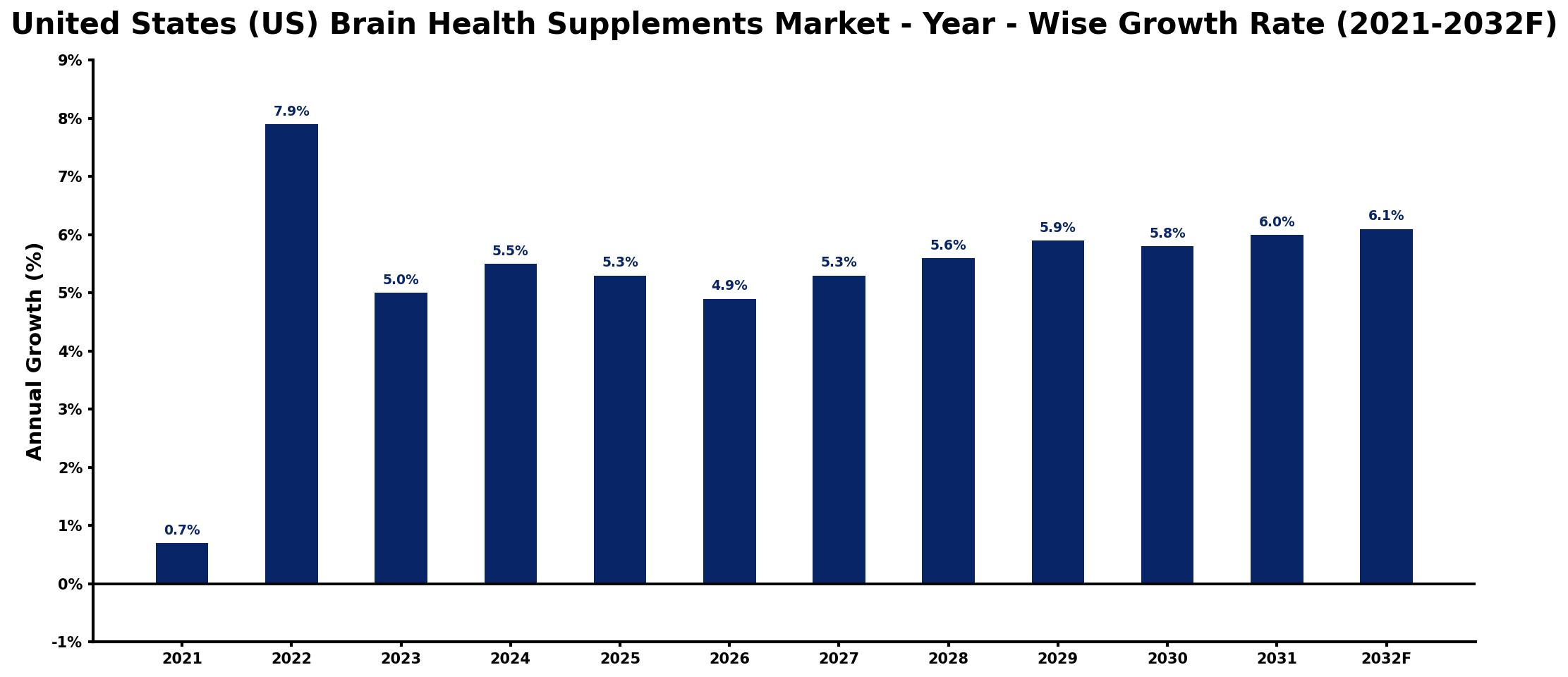
The table below presents the year‑wise growth rates along with the key drivers influencing the market
| Year | Growth Rate | Major Drivers |
| 2021 | 0.7% | Rising consumer awareness trends |
| 2022 | 7.9% | Increased focus on mental wellness |
| 2023 | 5.0% | Growing demand for cognitive support |
| 2024 | 5.5% | Expansion of retail distribution channels |
| 2025 | 5.3% | Investments in innovative formulations |
| 2026 | 4.9% | Emergence of new market players |
| 2027 | 5.3% | Growing popularity of holistic approaches |
| 2028 | 5.6% | Increased research funding initiatives |
| 2029 | 5.9% | Surge in online purchasing platforms |
| 2030 | 5.8% | Enhanced marketing strategies adoption |
| 2031 | 6.0% | growing emerging market penetration |
| 2032 | 6.1% | Rising interest in preventive care |
Note: Market size estimations and growth projections presented in this report are based on 6Wresearch's proprietary forecasting methodology, utilizing the latest available industry data, government publications, and primary research inputs.
United States (US) Brain Health Supplements Market Synopsis
The US Brain Health Supplements Market has witnessed robust momentum recently, catalyzed by a surge in health consciousness. However, the market is poised for further evolution as innovations in formulation and ingredient sourcing take center stage. As more consumers seek effective ways to enhance brain performance, the landscape will adapt to accommodate these growing needs.
In particular, products enriched with natural ingredients and personalized formulations are emerging as key differentiators. This shift not only caters to diverse consumer preferences but also aligns with the increasing trend towards preventive healthcare measures, underscoring a promising outlook for the market.
United States (US) Brain Health Supplements Market Key Takeaways
- Rising awareness about cognitive health is driving consumer demand across demographics.
- Natural and plant-based ingredients are becoming increasingly popular among consumers.
- Online retail channels are expanding access and convenience for purchasing supplements.
- The aging population presents significant opportunities for targeted product development.
- Investment in personalized nutrition is shaping future product innovation in the market.
Evaluation of Restraints in United States (US) Brain Health Supplements Market
Despite the overall positive growth outlook, several restraints may inhibit the US Brain Health Supplements Market. A highly competitive landscape means manufacturers face continual pressure to innovate while managing costs. Additionally, regulatory scrutiny over health claims necessitates that companies remain compliant with evolving guidelines, often requiring a dedicated focus on transparency and product integrity. As consumers become more discerning about ingredients, brands must not only ensure efficacy but also cultivate trust and brand loyalty amid an influx of choices available in the market.
United States (US) Brain Health Supplements Market Trends
Emerging trends in the US Brain Health Supplements Market point towards a rising preference for nootropic compounds that promise enhanced cognitive performance. Younger consumers, in particular, are leaning towards these formulations, aligning with lifestyle choices that prioritize mental acuity. Additionally, the increasing incorporation of adaptogenic herbs and functional mushrooms in supplements reflects a broader trend toward holistic well-being. The focus is shifting towards clean-label products, where consumers demand transparency regarding ingredient sources and potential benefits.
United States (US) Brain Health Supplements Market Opportunities
The market presents diverse investment opportunities, driven by growing demand from various segments. Innovative products targeting specific age demographics, such as seniors facing cognitive decline or students seeking improved concentration, are particularly promising. Furthermore, leveraging e-commerce strategies could enhance distribution, making products readily available to health-conscious consumers. Collaborations with health professionals and research institutions can also create pathways for developing scientifically supported supplements, positioning brands as leaders in a rapidly growing field.
Government Initiatives in the United States (US) Brain Health Supplements Market
The US Brain Health Supplements Market operates under the oversight of the Food and Drug Administration (FDA) in accordance with the Dietary Supplement Health and Education Act (DSHEA) of 1994. While there is no requirement for pre-market approval, manufacturers must adhere to strict safety and labeling compliance regulations. The Federal Trade Commission (FTC) further regulates advertising practices, aiming to prevent misleading claims and ensuring consumer protection. This regulatory framework emphasizes the need for transparency, safety, and efficacy in the market.
Future Insights of the United States (US) Brain Health Supplements Market
Looking ahead to 2026-2032, the US Brain Health Supplements Market is set for a robust expansion fueled by a continuing emphasis on mental wellness. The aging population, increasingly aware of cognitive health benefits, is anticipated to drive demand for effective supplements. Innovations in product development, especially those integrating natural and personalized elements, are expected to create new market segments. As online retail continues to grow, it will significantly enhance consumer access, establishing a more dynamic and inclusive marketplace.
United States (US) Brain Health Supplements Market Latest Developments (2025 - 2026)
Recent developments in the US Brain Health Supplements Market indicate a shift toward multi-functional formulations that address various aspects of cognitive health. Companies are increasingly investing in clinical trials to substantiate health claims and enhance credibility. Furthermore, partnerships between supplement manufacturers and healthcare providers are being cultivated to facilitate consumer education about cognitive health products. The surge in online retail platforms has also prompted brands to enhance their digital marketing strategies to engage consumers effectively.
United States (US) Brain Health Supplements Market - Key Attractiveness of the Report
- 10 Years of Market Numbers
- Historical Data Starting from 2022 to 2025
- Base Year: 2025
- Forecast Data until 2032
- Key Performance Indicators Impacting the Market
- Major Upcoming Developments and Projects
Key Highlights of the Report:
- United States (US) Brain Health Supplements Market Outlook
- Market Size of United States (US) Brain Health Supplements Market, 2025
- Forecast of United States (US) Brain Health Supplements Market, 2032
- Historical Data and Forecast of United States (US) Brain Health Supplements Revenues & Volume for the Period 2022-2032F
- United States (US) Brain Health Supplements Market Trend Evolution
- United States (US) Brain Health Supplements Market Drivers and Challenges
- United States (US) Brain Health Supplements Price Trends
- United States (US) Brain Health Supplements Porter's Five Forces
- United States (US) Brain Health Supplements Industry Life Cycle
- Historical Data and Forecast of United States (US) Brain Health Supplements Market Revenues & Volume By Product for the Period 2022-2032F
- Historical Data and Forecast of United States (US) Brain Health Supplements Market Revenues & Volume By Natural Molecules for the Period 2022-2032F
- Historical Data and Forecast of United States (US) Brain Health Supplements Market Revenues & Volume By Herbal Extract for the Period 2022-2032F
- Historical Data and Forecast of United States (US) Brain Health Supplements Market Revenues & Volume By Vitamins and Minerals for the Period 2022-2032F
- Historical Data and Forecast of United States (US) Brain Health Supplements Market Revenues & Volume By Application for the Period 2022-2032F
- Historical Data and Forecast of United States (US) Brain Health Supplements Market Revenues & Volume By Memory Enhancement for the Period 2022-2032F
- Historical Data and Forecast of United States (US) Brain Health Supplements Market Revenues & Volume By Attention and Focus for the Period 2022-2032F
- Historical Data and Forecast of United States (US) Brain Health Supplements Market Revenues & Volume By Depression and Mood for the Period 2022-2032F
- Historical Data and Forecast of United States (US) Brain Health Supplements Market Revenues & Volume By Sleep and Recovery for the Period 2022-2032F
- Historical Data and Forecast of United States (US) Brain Health Supplements Market Revenues & Volume By Anti-aging and Longevity for the Period 2022-2032F
- Historical Data and Forecast of United States (US) Brain Health Supplements Market Revenues & Volume By Stress & Anxiety for the Period 2022-2032F
- United States (US) Brain Health Supplements Import Export Trade Statistics
- Market Opportunity Assessment By Product
- Market Opportunity Assessment By Application
- United States (US) Brain Health Supplements Top Companies Market Share
- United States (US) Brain Health Supplements Competitive Benchmarking By Technical and Operational Parameters
- United States (US) Brain Health Supplements Company Profiles
- United States (US) Brain Health Supplements Key Strategic Recommendations






































