United States (US) Cloud Encryption Market Size & Growth Rate (2026-2032)
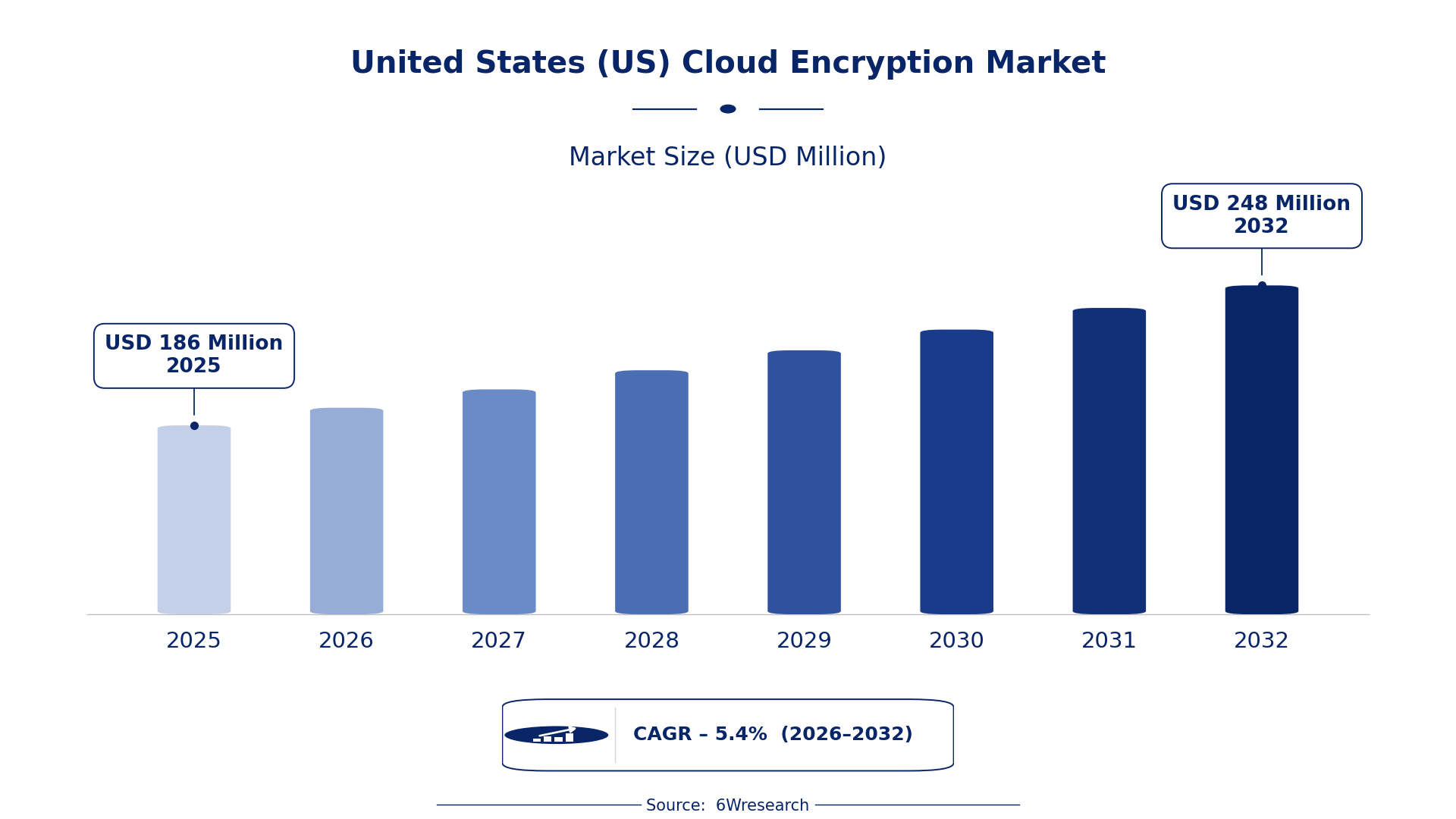
The United States (US) Cloud Encryption Market was estimated at USD 186 Million in 2025 and is projected to reach USD 248 Million by 2032, growing at a CAGR of 5.4% from 2026 to 2032.
United States (US) Cloud Encryption Market Synopsis
The surge in cloud service adoption across multiple sectors in the U.S. is a primary driver of growth in the Cloud Encryption Market. Organizations are prioritizing robust encryption solutions to protect sensitive data from escalating cyber threats and regulatory pressures.
on top of that, the recent shift toward remote work has accelerated the demand for secure cloud environments. As businesses navigate digital transformation, the emphasis on safeguarding data privacy is reshaping investment strategies, making cloud encryption an essential focus.
United States (US) Cloud Encryption Market Year-wise Growth Rate and Key Drivers
This graph illustrates the annual growth rates of the United States (US) Cloud Encryption Market from 2021 to 2032, highlighting a steady upward trajectory and projected expansion over the forecast period.
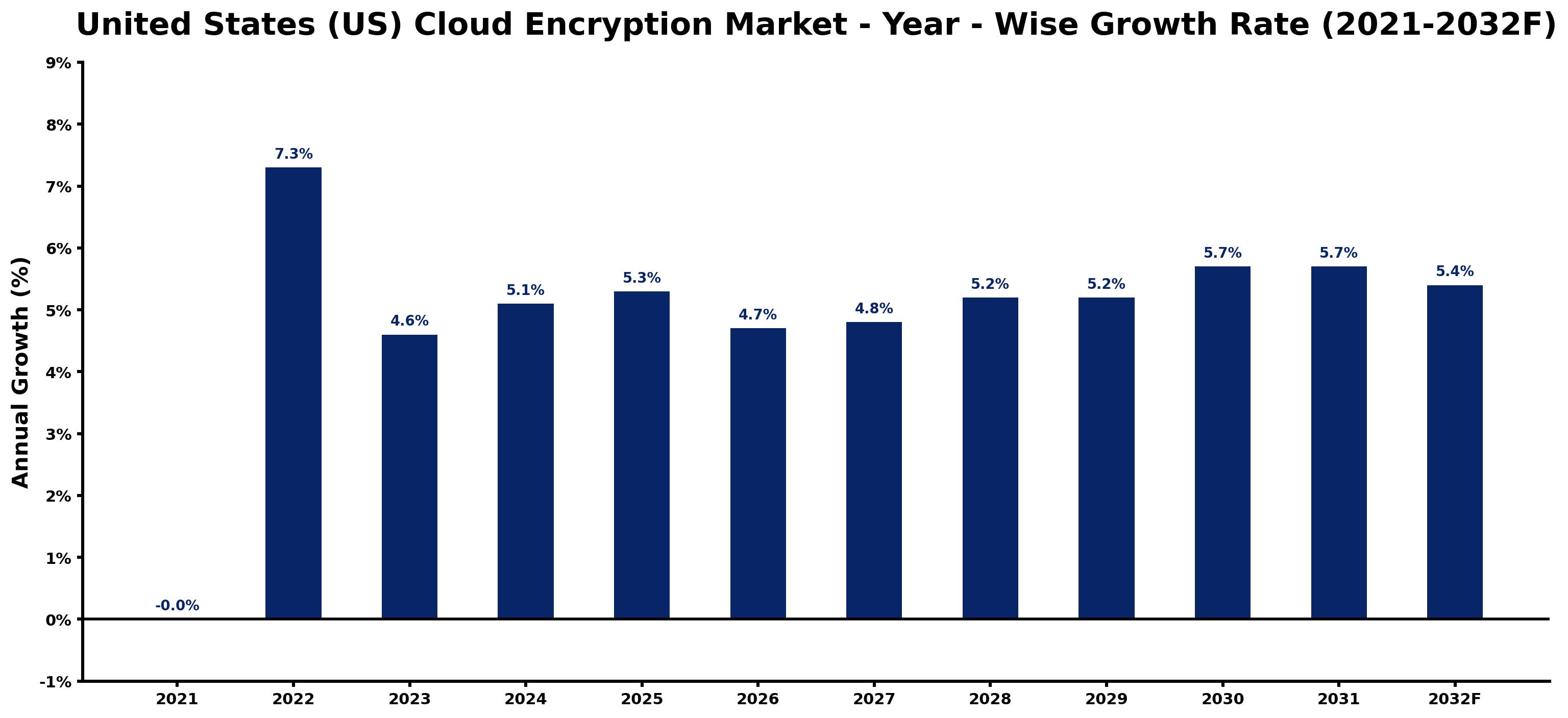
The table below presents the year‑wise growth rates along with the key drivers influencing the market
| Year | Growth Rate | Major Drivers |
| 2021 | -0.0% | Increasing industrial infrastructure investments |
| 2022 | 7.3% | Increased regulations by the FTC on data privacy. |
| 2023 | 4.6% | Surge in ransomware attacks prompting cloud security enhancements. |
| 2024 | 5.1% | Adoption of multi-factor authentication by major corporations. |
| 2025 | 5.3% | Rise in financial services using cloud for data encryption. |
| 2026 | 4.7% | COVID-19 recovery boosting digital transformation initiatives. |
| 2027 | 4.8% | Emergence of hybrid cloud models necessitating advanced encryption. |
| 2028 | 5.2% | Growth of IoT devices increasing data encryption requirements. |
| 2029 | 5.2% | Enhanced cybersecurity insurance policies encouraging cloud encryption. |
| 2030 | 5.7% | Federal government initiatives promoting secure cloud service adoption. |
| 2031 | 5.7% | Increased focus on AI-driven cybersecurity solutions for encryption. |
| 2032 | 5.4% | State-level incentives for businesses securing sensitive data. |
Note: Market size estimations and growth projections presented in this report are based on 6Wresearch's proprietary forecasting methodology, utilizing the latest available industry data, government publications, and primary research inputs.
United States (US) Cloud Encryption Market Key Takeaways
Below are some of the specific key takeaways from the market, including:
- The increasing prevalence of cyber threats is driving organizations to invest in cloud encryption solutions.
- Stricter data protection regulations, including GDPR and CCPA, are compelling businesses to enhance their encryption practices.
- The rapid digital transformation and remote work trends further fuel the market's expansion.
- Continuous advancements in encryption technologies are crucial for staying ahead of evolving security threats.
- Partnerships among technology firms are becoming common to deliver integrated encryption solutions.
Evaluation of Restraints in United States (US) Cloud Encryption Market
Despite the growth, the Cloud Encryption Market faces hurdles that could impede its trajectory. Concerns regarding data privacy regulations create uncertainty for many businesses considering encryption solutions. Implementation complexities also present barriers; organizations grapple with integrating encryption technologies across diverse cloud environments. The lack of standardized encryption practices creates confusion, making it challenging for companies to adopt best practices effectively. Addressing these issues demands a concerted effort from industry stakeholders to enhance interoperability and compliance.
United States (US) Cloud Encryption Market Trends
The market is witnessing a few notable trends that reflect shifting priorities in data security. First, organizations are increasingly embracing advanced encryption technologies such as homomorphic and quantum encryption to tackle complex security challenges. Second, there’s a growing emphasis on data sovereignty, with companies seeking solutions that align with local regulatory requirements. The integration of AI and machine learning into encryption processes is also on the rise, streamlining operations while bolstering security measures.
United States (US) Cloud Encryption Market Opportunities
Investments in the Cloud Encryption Market are expected to flourish, with numerous opportunities emerging. Companies offering innovative solutions such as data encryption software and secure access controls are likely to capture significant market interest. The increasing regulatory environment around data protection further highlights the need for comprehensive encryption solutions. Firms that focus on developing user-friendly interfaces and cloud-native solutions will likely lead the charge in capturing this expanding market.
Government Initiatives in the United States (US) Cloud Encryption Market
Government policies in the U.S. are playing a crucial role in shaping the Cloud Encryption Market. By implementing regulations that emphasize data security and privacy, authorities encourage businesses to adopt effective encryption technologies. Recent initiatives have established a framework to promote best practices and enhance consumer trust in cloud services, directly impacting encryption strategies across sectors.
- A regulatory framework aimed at enhancing encryption practices was introduced in 2025, mandating more stringent data protection measures for cloud service providers.
- Currently underway is a government-led initiative to develop industry standards for encryption technologies, aiming to simplify compliance across varying sectors.
- In 2023, federal agencies like the NIST initiated a public-private partnership to enhance collaboration on encryption research and implementation efforts.
- Upcoming guidelines expected to roll out by 2026 will focus on harmonizing encryption standards across state and federal regulations.
Future Insights of the United States (US) Cloud Encryption Market
Looking ahead to 2026-2032, the United States Cloud Encryption Market will continue to flourish as data security remains paramount. The growing sophistication of cyber threats will compel organizations to invest heavily in encryption solutions. As regulatory scrutiny intensifies, businesses will focus on compliance-driven encryption strategies to mitigate risks. Emerging technologies and the need for comprehensive data protection will drive innovations, ensuring that encryption remains a cornerstone of cloud service offerings.
United States (US) Cloud Encryption Market Latest Developments
Over the past year, the United States Cloud Encryption Market has witnessed a flurry of activity as businesses respond to mounting security challenges. Companies are aggressively advancing their encryption capabilities while navigating a complex regulatory environment. The push for enhanced data protection has led to noteworthy collaborations aimed at fortifying encryption standards.
- A major technology vendor launched an advanced cloud encryption suite in Q2 2025, focusing on AI-powered security features.
- An initiative to improve key management systems began in early 2025 and remains ongoing, aiming to enhance data protection capabilities.
- A regional operator is set to expand its cloud infrastructure and encryption services, with a rollout expected to begin in mid-2026.
- A new public-private project focusing on encryption best practices is currently in development and anticipated to launch in late 2025.
United States (US) Cloud Encryption Market - Key Attractiveness of the Report
- 10 Years of Market Numbers
- Historical Data Starting from 2022 to 2025
- Base Year: 2025
- Forecast Data until 2032
- Key Performance Indicators Impacting the Market
- Major Upcoming Developments and Projects
Key Highlights of the Report:
- United States (US) Cloud Encryption Market Outlook
- Market Size of United States (US) Cloud Encryption Market, 2025
- Forecast of United States (US) Cloud Encryption Market, 2032
- Historical Data and Forecast of United States (US) Cloud Encryption Revenues & Volume for the Period 2022-2032F
- United States (US) Cloud Encryption Market Trend Evolution
- United States (US) Cloud Encryption Market Drivers and Challenges
- United States (US) Cloud Encryption Price Trends
- United States (US) Cloud Encryption Porter's Five Forces
- United States (US) Cloud Encryption Industry Life Cycle
- Historical Data and Forecast of United States (US) Cloud Encryption Market Revenues & Volume By Component for the Period 2022-2032F
- Historical Data and Forecast of United States (US) Cloud Encryption Market Revenues & Volume By Solution for the Period 2022-2032F
- Historical Data and Forecast of United States (US) Cloud Encryption Market Revenues & Volume By Service for the Period 2022-2032F
- Historical Data and Forecast of United States (US) Cloud Encryption Market Revenues & Volume By Service Model for the Period 2022-2032F
- Historical Data and Forecast of United States (US) Cloud Encryption Market Revenues & Volume By Infrastructure-as-a-Service for the Period 2022-2032F
- Historical Data and Forecast of United States (US) Cloud Encryption Market Revenues & Volume By Software-as-a-Service for the Period 2022-2032F
- Historical Data and Forecast of United States (US) Cloud Encryption Market Revenues & Volume By Platform-as-a-Service for the Period 2022-2032F
- Historical Data and Forecast of United States (US) Cloud Encryption Market Revenues & Volume By Organization Size for the Period 2022-2032F
- Historical Data and Forecast of United States (US) Cloud Encryption Market Revenues & Volume By Large Enterprises for the Period 2022-2032F
- Historical Data and Forecast of United States (US) Cloud Encryption Market Revenues & Volume By Small and Medium-sized Enterprises (SMEs) for the Period 2022-2032F
- Historical Data and Forecast of United States (US) Cloud Encryption Market Revenues & Volume By Vertical for the Period 2022-2032F
- Historical Data and Forecast of United States (US) Cloud Encryption Market Revenues & Volume By Banking, Financial Services, and Insurance (BFSI) for the Period 2022-2032F
- Historical Data and Forecast of United States (US) Cloud Encryption Market Revenues & Volume By Healthcare for the Period 2022-2032F
- Historical Data and Forecast of United States (US) Cloud Encryption Market Revenues & Volume By Government and Public Utilities for the Period 2022-2032F
- Historical Data and Forecast of United States (US) Cloud Encryption Market Revenues & Volume By Telecom and IT for the Period 2022-2032F
- Historical Data and Forecast of United States (US) Cloud Encryption Market Revenues & Volume By Retail for the Period 2022-2032F
- Historical Data and Forecast of United States (US) Cloud Encryption Market Revenues & Volume By Aerospace and Defense for the Period 2022-2032F
- Historical Data and Forecast of United States (US) Cloud Encryption Market Revenues & Volume By Others (manufacturing, education, and media and entertainment) for the Period 2022-2032F
- United States (US) Cloud Encryption Import Export Trade Statistics
- Market Opportunity Assessment By Component
- Market Opportunity Assessment By Service Model
- Market Opportunity Assessment By Organization Size
- Market Opportunity Assessment By Vertical
- United States (US) Cloud Encryption Top Companies Market Share
- United States (US) Cloud Encryption Competitive Benchmarking By Technical and Operational Parameters
- United States (US) Cloud Encryption Company Profiles
- United States (US) Cloud Encryption Key Strategic Recommendations






































