United States (US) Consent Management Market Size & Growth Rate (2026-2032)
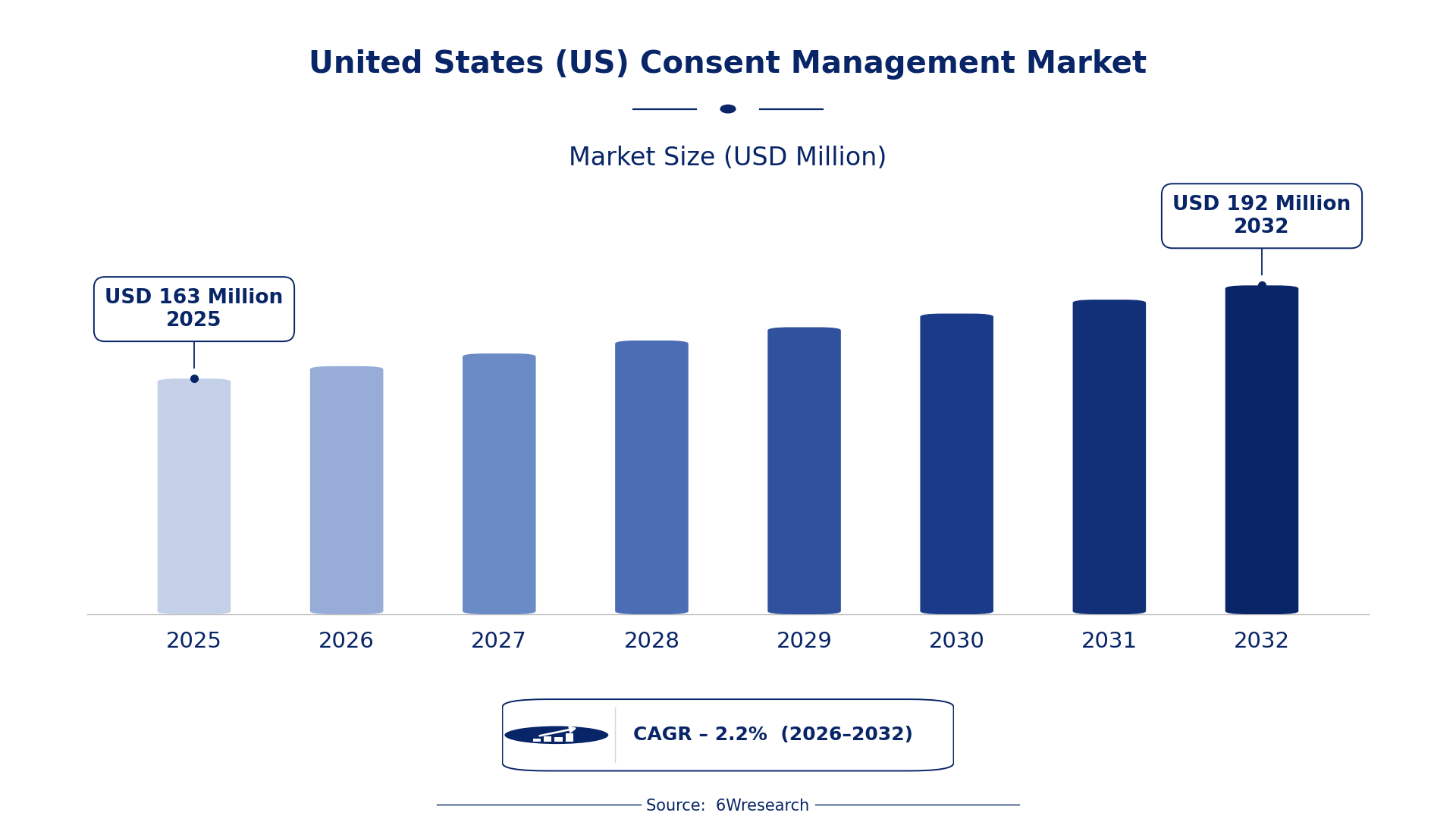
The United States (US) Consent Management Market was estimated at USD 163 Million in 2025 and is projected to reach USD 192 Million by 2032, growing at a CAGR of 2.2% from 2026 to 2032.
United States (US) Consent Management Market Synopsis
The increasing awareness of data privacy among consumers is driving businesses to adopt consent management solutions. Companies are recognizing that transparent data practices not only ensure compliance with regulations but also enhance customer trust.
As regulatory frameworks like the CCPA and GDPR gain traction, organizations are compelled to implement effective consent management strategies. This shift is propelling the growth of specialized technology solutions that simplify compliance and improve user engagement.
United States (US) Consent Management Market Year-wise Growth Rate and Key Drivers
This graph illustrates the annual growth rates of the United States (US) Consent Management Market from 2021 to 2032, highlighting a steady upward trajectory and projected expansion over the forecast period.
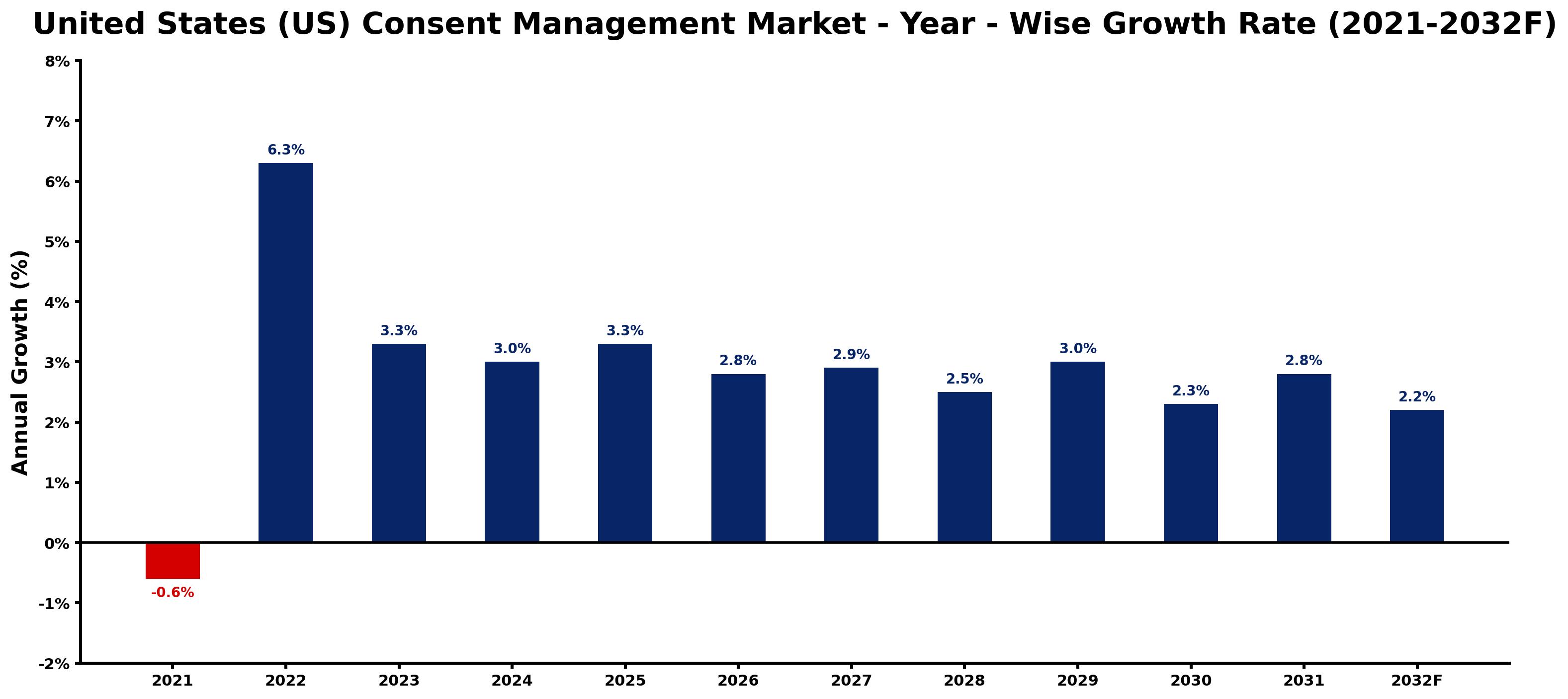
The table below presents the year‑wise growth rates along with the key drivers influencing the market
| Year | Growth Rate | Major Drivers |
| 2021 | -0.6% | CCPA compliance creating complex operational challenges for businesses |
| 2022 | 6.3% | California Consumer Privacy Act drives consent management adoption. |
| 2023 | 3.3% | Increased consumer awareness boosts demand for privacy tools. |
| 2024 | 3.0% | Emerging biometric authentication protocols require consent controls. |
| 2025 | 3.3% | Rise of mobile apps heightens user consent necessity. |
| 2026 | 2.8% | Legal challenges prompt firms to strengthen consent practices. |
| 2027 | 2.9% | Cloud service agreements necessitate clear consent frameworks. |
| 2028 | 2.5% | Focus on data ethics reshapes consent management policies. |
| 2029 | 3.0% | Tech companies face stricter scrutiny over data usage. |
| 2030 | 2.3% | Adoption of decentralized identity models enhances consent relevance. |
| 2031 | 2.8% | Growing privacy regulations encourage proactive consent management. |
| 2032 | 2.2% | Increased cross-border data flows heighten consent requirements. |
Note: Market size estimations and growth projections presented in this report are based on 6Wresearch's proprietary forecasting methodology, utilizing the latest available industry data, government publications, and primary research inputs.
United States (US) Consent Management Market Key Takeaways
Below are some of the specific key takeaways from the market, including:
- The market is experiencing growth driven by heightened consumer awareness regarding data privacy.
- Compliance with regulations like CCPA and GDPR is a primary motivator for adopting consent management solutions.
- Technological innovations such as AI are enhancing the effectiveness of consent management platforms.
- Organizations are increasingly integrating consent management with CRM systems to improve data handling.
- User-friendly interfaces are becoming essential to facilitate better consent transparency.
Evaluation of Restraints in United States (US) Consent Management Market
Despite its growth, the market faces substantial hurdles. Companies are grappling with the complexities of compliance across various jurisdictions, which can be both resource-intensive and confusing. The absence of standardized practices creates inconsistencies that can alienate consumers. on top of that, the rapid pace of technological change means that organizations struggle to keep up with evolving consent management practices, often resulting in outdated or ineffective strategies.
United States (US) Consent Management Market Trends
A marked trend is the shift towards automation in consent management processes. Businesses are increasingly adopting automated solutions to streamline the capturing and management of user consent, minimizing manual errors. Integration with CRM systems is also on the rise, enabling companies to maintain a comprehensive view of customer preferences.
The demand for user-friendly interfaces continues to grow, as organizations recognize that clear consent processes enhance user experience and trust. In parallel, there’s an uptick in the use of advanced analytics to gain insights into consent preferences, which can further inform marketing strategies.
United States (US) Consent Management Market Opportunities
The market offers promising investment opportunities, particularly in developing innovative consent management solutions. Companies that focus on creating tools with granular consent controls and intuitive interfaces stand to gain significantly. As consumers become more vocal about their data rights, there’s a clear opening for businesses that prioritize transparency and user empowerment in their data practices.
Government Initiatives in the United States (US) Consent Management Market
Government regulations are shaping the United States Consent Management Market, emphasizing the need for clear consent practices. As states implement stricter data protection laws, companies must adapt to ensure compliance, which ultimately influences their consent management strategies.
- The California Consumer Privacy Act (CCPA) has been a pivotal regulation driving demand for effective consent management solutions since its implementation in 2020.
- A new regulatory framework is currently being drafted to enhance privacy protections across various states, focusing on explicit user consent and data processing transparency.
- Ongoing efforts by the Federal Trade Commission (FTC) aim to strengthen enforcement of consumer privacy laws, impacting how companies manage consent.
- Planned initiatives by state governments to standardize consent management practices are expected to roll out by 2026, creating a more uniform regulatory environment.
Future Insights of the United States (US) Consent Management Market
Looking ahead to 2026-2032, the United States Consent Management Market is set for sustained growth. As businesses continue to prioritize data privacy in light of evolving regulations, demand for sophisticated consent management solutions will only increase. Organizations will likely invest in cutting-edge technologies that streamline compliance and enhance user trust, thereby positioning themselves favorably in the marketplace.
United States (US) Consent Management Market Latest Developments
The past year has seen notable advancements in the United States Consent Management Market, with companies actively seeking to enhance their compliance capabilities. A surge in product launches and technological innovations reflects the urgency for improved consent management solutions.
- A major technology vendor launched an AI-powered consent management platform in early 2025, designed to simplify compliance for businesses of all sizes.
- An initiative that began in mid-2025 is currently underway to integrate consent management tools with popular CRM systems, enhancing data handling efficiency.
- A planned rollout expected to begin in late 2025 focuses on introducing standardized consent frameworks across various industries.
- Recent partnerships between compliance firms and data analytics companies aim to provide comprehensive solutions to businesses grappling with consent management challenges.
United States (US) Consent Management Market - Key Attractiveness of the Report
- 10 Years of Market Numbers
- Historical Data Starting from 2022 to 2025
- Base Year: 2025
- Forecast Data until 2032
- Key Performance Indicators Impacting the Market
- Major Upcoming Developments and Projects
Key Highlights of the Report:
- United States (US) Consent Management Market Outlook
- Market Size of United States (US) Consent Management Market, 2025
- Forecast of United States (US) Consent Management Market, 2032
- Historical Data and Forecast of United States (US) Consent Management Revenues & Volume for the Period 2022-2032F
- United States (US) Consent Management Market Trend Evolution
- United States (US) Consent Management Market Drivers and Challenges
- United States (US) Consent Management Price Trends
- United States (US) Consent Management Porter's Five Forces
- United States (US) Consent Management Industry Life Cycle
- Historical Data and Forecast of United States (US) Consent Management Market Revenues & Volume By Component for the Period 2022-2032F
- Historical Data and Forecast of United States (US) Consent Management Market Revenues & Volume By Software for the Period 2022-2032F
- Historical Data and Forecast of United States (US) Consent Management Market Revenues & Volume By Services for the Period 2022-2032F
- Historical Data and Forecast of United States (US) Consent Management Market Revenues & Volume By Deployment Type for the Period 2022-2032F
- Historical Data and Forecast of United States (US) Consent Management Market Revenues & Volume By Cloud for the Period 2022-2032F
- Historical Data and Forecast of United States (US) Consent Management Market Revenues & Volume By On-premises for the Period 2022-2032F
- Historical Data and Forecast of United States (US) Consent Management Market Revenues & Volume By Touchpoint for the Period 2022-2032F
- Historical Data and Forecast of United States (US) Consent Management Market Revenues & Volume By Mobile App for the Period 2022-2032F
- Historical Data and Forecast of United States (US) Consent Management Market Revenues & Volume By Web App for the Period 2022-2032F
- Historical Data and Forecast of United States (US) Consent Management Market Revenues & Volume By Organization Size for the Period 2022-2032F
- Historical Data and Forecast of United States (US) Consent Management Market Revenues & Volume By Large Enterprises for the Period 2022-2032F
- Historical Data and Forecast of United States (US) Consent Management Market Revenues & Volume By Small and Medium-sized Enterprises (SMEs) for the Period 2022-2032F
- United States (US) Consent Management Import Export Trade Statistics
- Market Opportunity Assessment By Component
- Market Opportunity Assessment By Deployment Type
- Market Opportunity Assessment By Touchpoint
- Market Opportunity Assessment By Organization Size
- United States (US) Consent Management Top Companies Market Share
- United States (US) Consent Management Competitive Benchmarking By Technical and Operational Parameters
- United States (US) Consent Management Company Profiles
- United States (US) Consent Management Key Strategic Recommendations






































