United States (US) Construction Materials Market (2025-2031) | Share, Revenue, Growth, Value, Industry, Trends, Analysis, Size, Forecast, Outlook & Companies
Market Forecast By Product type (Construction aggregates, Concrete bricks, Cement, Construction metals), By Application (Residential, Commercial, Industrial) And Competitive Landscape
| Product Code: ETC016701 | Publication Date: Jun 2024 | Updated Date: Nov 2025 | Product Type: Report | |
| Publisher: 6Wresearch | Author: Ravi Bhandari | No. of Pages: 70 | No. of Figures: 35 | No. of Tables: 5 |
United States (US) Construction Materials Market Growth Rate
According to 6Wresearch internal database and industry insights, the United States (US) Construction Materials Market is projected to grow at a compound annual growth rate (CAGR) of 5.8% during the forecast period (2025–2031).
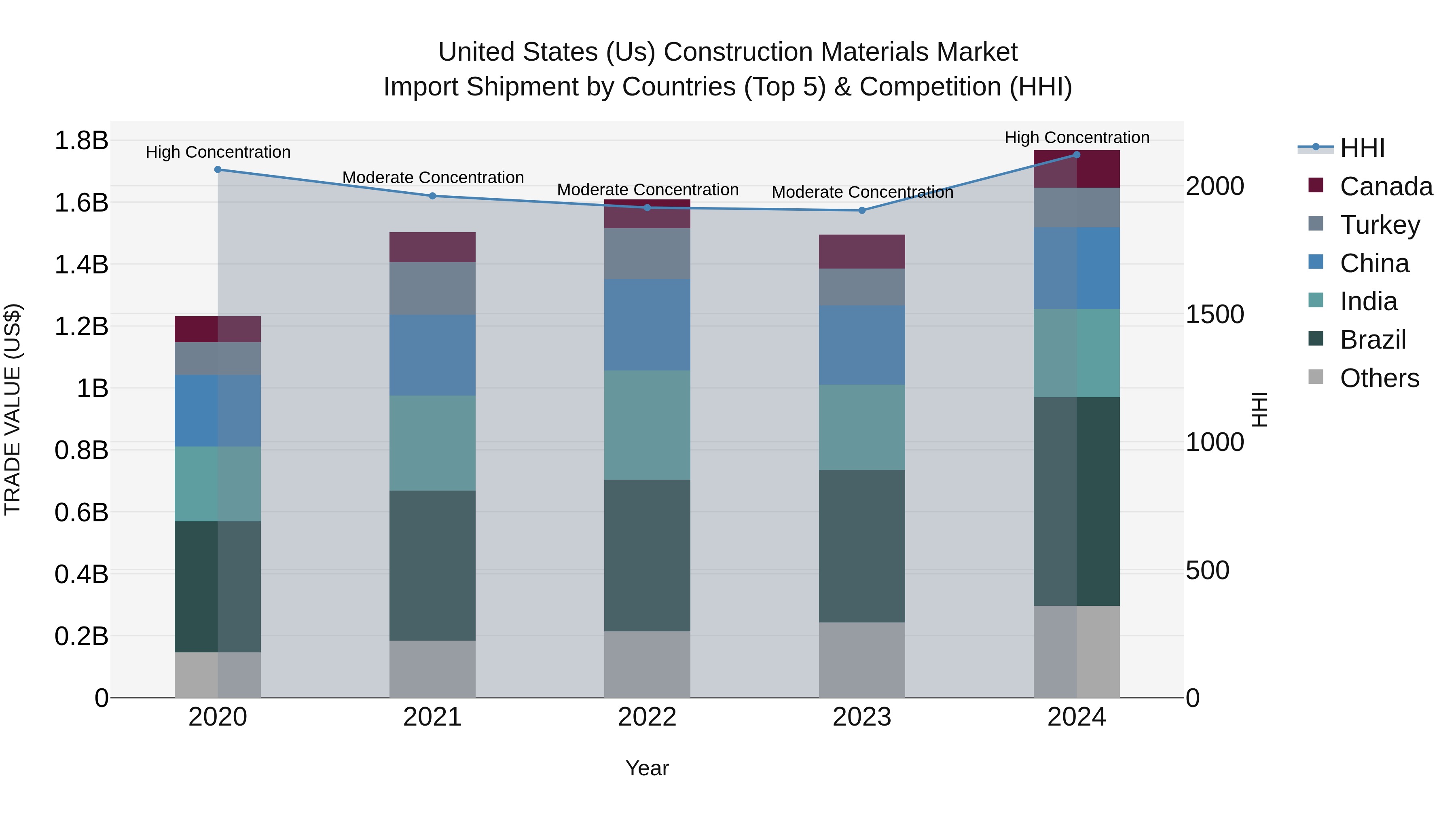
United States (US) Construction Materials Market Top 5 Importing Countries and Market Competition (HHI) Analysis
The United States construction materials import market experienced significant growth in 2024, with top exporting countries being Brazil, India, China, Italy, and Turkey. The Herfindahl-Hirschman Index (HHI) indicating market concentration shifted from moderate to high in 2024, reflecting increased dominance by key players. The Compound Annual Growth Rate (CAGR) from 2020 to 2024 was strong at 9.47%, demonstrating a robust market performance. Additionally, the impressive growth rate of 18.26% from 2023 to 2024 highlights the accelerating pace of import shipments in the construction materials sector.
United States (US) Construction Materials Market Highlights
| Report Name | United States (US) Construction Materials Market |
| Forecast period | 2025-2031 |
| CAGR | 5.8% |
| Growing Sector | Infrastructure and Industrial Construction |
Five-Year Growth Trajectory of the United States (US) Construction Materials Market with Core Drivers
Below mentioned are the evaluation of year-wise growth rate along with key drivers:
| Years | Est. Annual Growth (%) | Growth Drivers |
| 2020 | 1.50% | Stable residential construction and renovation activities sustained cement and concrete requirement despite moderate industrial output. |
| 2021 | 3.20% | Public infrastructure expenses and private housing expansion boosted aggregates and cement consumption. |
| 2022 | 4.10% | Rise in warehouse and logistics center construction increased demand for steel and concrete materials. |
| 2023 | 4.80% | Surge in federal infrastructure investments and non-residential projects strengthened cement and metal segment. |
| 2024 | 5.50% | Development in clean energy, transport projects, and industrial parks accelerated demand for all major construction materials. |
Topics Covered in the United States (US) Construction Materials Market Report
The United States (US) Construction Materials Market report thoroughly covers the market by product and applications. The report provides an unbiased and detailed analysis of ongoing market trends, opportunities/high-growth areas, and market drivers that will help stakeholders devise and align strategies according to current and future market dynamics.
United States (US) Construction Materials Market Synopsis
The United States (US) Construction Materials Industry is anticipated to witness consistent growth over the coming years, driven by rising infrastructure investment, housing developments, and energy projects. Regular spending on roadways, bridges, renewable energy installations, and industrial facilities is propelling demand for aggregates, cement, concrete bricks, and construction metals. The push for sustainable and energy-efficient building materials, supported by domestic manufacturing incentives, is further boosting market expansion.
Evaluation of Growth Drivers in the United States (US) Construction Materials Market
Below mentioned are some prominent drivers and their influence on the United States (US) Construction Materials Market dynamics:
| Drivers | Primary Segments Affected | Why it Matters (Evidence) |
| Federal Infrastructure Investment | Aggregates, Cement | Multi-billion-dollar projects under the Infrastructure Investment and Jobs Act (IIJA) have expanded cement and aggregates demand nationwide. |
| Housing Market Expansion | Concrete Bricks, Cement | Increased single-family and multifamily housing developments boost cement and concrete consumption. |
| Industrial and Manufacturing Growth | Construction Metals, Cement | Huge demand for heavy-duty construction metals and concrete structures due to domestic production and EV features. |
| Renewable Energy Development | Aggregates, Cement | Wind and solar projects drive demand for durable and low-carbon construction materials. |
| Sustainability Regulations | All Material Types | Emphasis on low-carbon and recyclable construction materials increases domestic product innovation. |
United States (US) Construction Materials Market Size is expected to grow steadily at a 5.8% CAGR between 2025 and 2031. The upward trajectory is attributed to the continuous expansion of infrastructure modernization projects, rising residential construction activities, and growing industrial redevelopment initiatives across the country. Growing investments under the Infrastructure Investment and Jobs Act (IIJA), along with rapid urbanization and sustainable building practices. Moreover, the surge in clean energy installations, including solar and wind power facilities, has enlarged the requirement for high-performance and low-carbon construction materials. Additionally, government incentives promoting the use of green and energy-efficient materials are accelerating the adoption of low-emission cement and recycled aggregates have led to United States (US) Construction Materials Market Growth.
Evaluation of Restraints in the United States (US) Construction Materials Market
Below mentioned are some major restraints and their influence on the United States (US) Construction Materials Market dynamics:
| Restraints | Primary Segments Affected | What this Means (Evidence) |
| High Production Costs | Cement, Metals | Rising energy prices increase production costs for cement and steel. |
| Environmental Regulations | Aggregates, Cement | Strict emission standards raise operational costs for manufacturers. |
| Labor Shortage | All Types | Skilled labor shortage slows down construction projects, affecting material consumption. |
| Supply Chain Disruptions | Metals, Cement | Insufficient material and transportation delays lead to price changes. |
| Market Fragmentation | Concrete Bricks | Presence of large number of small players limits technological advancement. |
United States (US) Construction Materials Market Challenges
While the market showcases steady expansion, several challenges exist that obstructs with its rapid development. This includes price volatility in raw materials such as steel and cement, high logistic expenditure due to vast geographical gaps, and regional differences in construction permits. Along with that, other domestic manufacturers face competition from imported metals and price-sensitive customers in low-cost housing projects.
United States (US) Construction Materials Market Trends
Several significant trends are impacting the United States (US) Construction Materials Industry:
- Adoption of Sustainable Construction Materials: Growing use of eco-friendly cement and recycled aggregates to meet green building standards.
- Digitalization of Construction Processes: Increased use of Building Information Modeling (BIM) and digital tracking systems in procurement.
- Low-Carbon Cement Formulations: Introduction of blended cement types to reduce carbon emissions.
- Expansion of Prefabricated Building Systems: Modular construction practices are enhancing project efficiency.
- Recycling and Circular Economy Practices: Enhanced focus on recycled aggregates and metals for resource efficiency.
Investment Opportunities in the United States (US) Construction Materials Industry
Some of the notable investment opportunities are:
- Development of Low-Carbon Cement Plants: Establishing facilities focused on alternative fuels and clinker substitutes.
- Aggregate and Quarry Expansion Projects: Opening new sites near metropolitan centers to reduce logistics costs.
- Partnerships with Renewable Projects: Collaborating with solar and wind developers for foundation and structural materials.
- Advanced Concrete Manufacturing: Investing in prefabrication units to meet modular construction demand.
- Green Material Certification Services: Offering sustainable certification and testing for eco-labeled materials.
Top 5 Leading Players in the United States (US) Construction Materials Market
Below is the list of prominent companies leading in the United States (US) Construction Materials Market Share:
1. Martin Marietta Materials
| Company Name | Martin Marietta Materials |
| Established Year | 1993 |
| Headquarters | Raleigh, North Carolina, USA |
| Official Website | Click Here |
A key producer of aggregates, cement, and ready-mix concrete with nationwide supply for residential, commercial, and public projects.
2. Vulcan Materials Company
| Company Name | Vulcan Materials Company |
| Established Year | 1909 |
| Headquarters | Birmingham, Alabama, USA |
| Official Website | Click Here |
The largest aggregate producer in the US, supporting road, infrastructure, and energy projects through integrated logistics networks.
3. Holcim US
| Company Name | Holcim US |
| Established Year | 1912 |
| Headquarters | Waltham, Massachusetts, USA |
| Official Website | Click Here |
Offers a range of low-carbon cement, concrete, and aggregates focused on green and energy-efficient building materials.
4. Heidelberg Materials North America
| Company Name | Heidelberg Materials North America |
| Established Year | 1874 |
| Headquarters | Irving, Texas, USA |
| Official Website | Click Here |
Supplies cement and aggregates to infrastructure projects and focuses on emission reduction technologies.
5. CRH Americas
| Company Name | CRH Americas |
| Established Year | 1970 |
| Headquarters | Atlanta, Georgia, USA |
| Official Website | Click Here |
A diversified construction material producer offering asphalt, cement, and aggregates for public and private developments.
Government Regulations Introduced in the United States (US) Construction Materials Market
According to the U.S. Federal Government and the Department of Energy data, the Infrastructure Investment and Jobs Act (IIJA) and the Inflation Reduction Act (IRA) have distributed billions for upgrading public infrastructure, energy systems, and manufacturing units. The Buy America provisions mandate domestic sourcing for steel, cement, and aggregates. State-level initiatives such as California’s Green Building Standards Code (CALGreen) and New York’s Low-Carbon Concrete Leadership Act encourage the use of sustainable material and innovation in construction processes.
Future Insights of the United States (US) Construction Materials Market
The United States (US) Construction Materials Industry is expected to continue developing due to sustained infrastructure investment, industrialization, and rising demand for low-carbon construction materials. The increasing incorporation of advanced manufacturing processes, automation in construction, and environmentally friendly materials will likely create new opportunities. The market will become more self-reliant, with a growing emphasis on regional production hubs and sustainable development practices.
Market Segmentation Analysis
The report offers a comprehensive study of the subsequent market segments and their leading categories.
By Product Type – Construction Aggregates to Dominate the Market
According to Rashika, Senior Research Analyst, 6Wresearch, Construction Aggregates are projected to dominate the United States (US) Construction Materials Market Share due to their essential use in road building, bridge foundations, and concrete manufacturing.
By Application – Residential to Dominate the Market
Residential construction holds the largest share, driven by increasing single-family housing, multifamily apartment projects, and renovation activities across the US. The sector’s ongoing expansion fuels consistent demand for cement, bricks, and aggregates in housing and community development projects.
Key Attractiveness of the Report
- 10 Years of Market Numbers
- Historical Data Starting from 2021 to 2024
- Base Year: 2024
- Forecast Data until 2031
- Key Performance Indicators Impacting the Market
- Major Upcoming Developments and Projects
Key Highlights of the Report:
- United States (US) Construction Materials Market Outlook
- Market Size of United States (US) Construction Materials Market, 2024
- Forecast of United States (US) Construction Materials Market, 2031
- Historical Data and Forecast of United States (US) Construction Materials Revenues & Volume for the Period 2021 - 2031
- United States (US) Construction Materials Market Trend Evolution
- United States (US) Construction Materials Market Drivers and Challenges
- United States (US) Construction Materials Price Trends
- United States (US) Construction Materials Porter's Five Forces
- United States (US) Construction Materials Industry Life Cycle
- Historical Data and Forecast of United States (US) Construction Materials Market Revenues & Volume By Product type for the Period 2021 - 2031
- Historical Data and Forecast of United States (US) Construction Materials Market Revenues & Volume By Construction aggregates for the Period 2021 - 2031
- Historical Data and Forecast of United States (US) Construction Materials Market Revenues & Volume By Concrete bricks for the Period 2021 - 2031
- Historical Data and Forecast of United States (US) Construction Materials Market Revenues & Volume By Cement for the Period 2021 - 2031
- Historical Data and Forecast of United States (US) Construction Materials Market Revenues & Volume By Construction metals for the Period 2021 - 2031
- Historical Data and Forecast of United States (US) Construction Materials Market Revenues & Volume By Application for the Period 2021 - 2031
- Historical Data and Forecast of United States (US) Construction Materials Market Revenues & Volume By Residential for the Period 2021 - 2031
- Historical Data and Forecast of United States (US) Construction Materials Market Revenues & Volume By Commercial for the Period 2021 - 2031
- Historical Data and Forecast of United States (US) Construction Materials Market Revenues & Volume By Industrial for the Period 2021 - 2031
- United States (US) Construction Materials Import Export Trade Statistics
- Market Opportunity Assessment By Product type
- Market Opportunity Assessment By Application
- United States (US) Construction Materials Top Companies Market Share
- United States (US) Construction Materials Competitive Benchmarking By Technical and Operational Parameters
- United States (US) Construction Materials Company Profiles
- United States (US) Construction Materials Key Strategic Recommendations
Market Covered
The report offers a comprehensive study of the subsequent market segments:
By Product Type
- Construction Aggregates
- Concrete Bricks
- Cement
- Construction Metals
By Application
- Residential
- Commercial
- Industrial
United States (US) Construction Materials Market (2025-2031): FAQs
The United States (US) Construction Materials Market is projected to grow at a CAGR of 5.8% during the forecast period.
Construction Aggregates dominate due to their extensive use in infrastructure and housing development projects.
Residential segment leads, supported by housing construction, remodeling, and urban expansion.
High energy costs, labor shortage, environmental restrictions, and supply chain constraints are key challenges.
Green materials, low-carbon cement, recycling initiatives, and modular construction techniques are key emerging trends.
| 1 Executive Summary |
| 2 Introduction |
| 2.1 Key Highlights of the Report |
| 2.2 Report Description |
| 2.3 Market Scope & Segmentation |
| 2.4 Research Methodology |
| 2.5 Assumptions |
| 3 United States (US) Construction Materials Market Overview |
| 3.1 United States (US) Country Macro Economic Indicators |
| 3.2 United States (US) Construction Materials Market Revenues & Volume, 2021 & 2031F |
| 3.3 United States (US) Construction Materials Market - Industry Life Cycle |
| 3.4 United States (US) Construction Materials Market - Porter's Five Forces |
| 3.5 United States (US) Construction Materials Market Revenues & Volume Share, By Product type , 2021 & 2031F |
| 3.6 United States (US) Construction Materials Market Revenues & Volume Share, By Application, 2021 & 2031F |
| 4 United States (US) Construction Materials Market Dynamics |
| 4.1 Impact Analysis |
| 4.2 Market Drivers |
| 4.2.1 Increasing infrastructure development projects in the US |
| 4.2.2 Growth in residential construction activities |
| 4.2.3 Adoption of sustainable and energy-efficient construction materials |
| 4.3 Market Restraints |
| 4.3.1 Fluctuating raw material prices |
| 4.3.2 Labor shortages impacting construction timelines |
| 4.3.3 Regulatory challenges and compliance requirements |
| 5 United States (US) Construction Materials Market Trends |
| 6 United States (US) Construction Materials Market, By Types |
| 6.1 United States (US) Construction Materials Market, By Product type |
| 6.1.1 Overview and Analysis |
| 6.1.2 United States (US) Construction Materials Market Revenues & Volume, By Product type ,2021 - 2031F |
| 6.1.3 United States (US) Construction Materials Market Revenues & Volume, By Construction aggregates,2021 - 2031F |
| 6.1.4 United States (US) Construction Materials Market Revenues & Volume, By Concrete bricks,2021 - 2031F |
| 6.1.5 United States (US) Construction Materials Market Revenues & Volume, By Cement,2021 - 2031F |
| 6.1.6 United States (US) Construction Materials Market Revenues & Volume, By Construction metals,2021 - 2031F |
| 6.2 United States (US) Construction Materials Market, By Application |
| 6.2.1 Overview and Analysis |
| 6.2.2 United States (US) Construction Materials Market Revenues & Volume, By Residential,2021 - 2031F |
| 6.2.3 United States (US) Construction Materials Market Revenues & Volume, By Commercial,2021 - 2031F |
| 6.2.4 United States (US) Construction Materials Market Revenues & Volume, By Industrial,2021 - 2031F |
| 7 United States (US) Construction Materials Market Import-Export Trade Statistics |
| 7.1 United States (US) Construction Materials Market Export to Major Countries |
| 7.2 United States (US) Construction Materials Market Imports from Major Countries |
| 8 United States (US) Construction Materials Market Key Performance Indicators |
| 8.1 Average project completion time |
| 8.2 Percentage of construction projects using sustainable materials |
| 8.3 Number of new construction permits issued |
| 8.4 Rate of adoption of energy-efficient construction materials |
| 9 United States (US) Construction Materials Market - Opportunity Assessment |
| 9.1 United States (US) Construction Materials Market Opportunity Assessment, By Product type , 2021 & 2031F |
| 9.2 United States (US) Construction Materials Market Opportunity Assessment, By Application, 2021 & 2031F |
| 10 United States (US) Construction Materials Market - Competitive Landscape |
| 10.1 United States (US) Construction Materials Market Revenue Share, By Companies, 2024 |
| 10.2 United States (US) Construction Materials Market Competitive Benchmarking, By Operating and Technical Parameters |
| 11 Company Profiles |
| 12 Recommendations |
| 13 Disclaimer |
Market Forecast By Product type (Construction aggregates, Concrete bricks, Cement, Construction metals), By Application (Residential, Commercial, Industrial) And Competitive Landscape
| Product Code: ETC016701 | Publication Date: Oct 2020 | Product Type: Report | |
| Publisher: 6Wresearch | No. of Pages: 70 | No. of Figures: 35 | No. of Tables: 5 |
United States (US) Construction Materials Market is projected to grow over the coming years. United States (US) Construction Materials Market report is a part of our periodical regional publication North America Construction Materials Market outlook report. 6W tracks Construction Materials market for over 60 countries with individual country-wise market opportunity assessment and publishes with the report titled Global Construction Materials Market outlook report annually.
United States (US) Construction Materials Market report thoroughly covers market by Product Type and Application. The market report provides an unbiased and detailed analysis of the on-going market trends, opportunities/high growth areas and market drivers which would help the stakeholders to devise and align their market strategies according to the current and future market dynamics.
United States (US) Construction Materials Market Synopsis
United States (US) Construction Materials Market is anticipated to project moderate growth during the forthcoming years on the back of rising penetration towards modern amenities and infrastructure. Increasing number of hotels, restaurants, commercial offices and multicomplexes are driving the US Construction Materials Market Growth. Moreover, the strengthening of construction sector and increasing government efforts to improve the infrastructure of the country beholds the development of Construction Materials Industry in US.
According to 6Wresearch, United States (US) Construction Materials Market size is projected to register growth during 2020-2026. Surging population coupled with rising need for high-rise building is driving the green buildings material market. However, the global health emergency caused by the outburst of COVID-19 pandemic hampered the supply chain of the market further declined US Construction Materials Market Share. Nationwide restrictions led to pause on construction and infrastructure development projects further hampered the growth of the market.
Market Analysis by Application
As per the Construction materials industry analysis, on the basis of application the residential segment occupied substantial growth and is expected to dominate the market during the forthcoming years on account of rising urbanization and increasing infrastructure development projects.
Key Attractiveness of the Report
- COVID-19 Impact on the Market.
- 10 Years Market Numbers.
- Historical Data Starting from 2016 to 2019.
- Base Year: 2019.
- Forecast Data until 2026.
- Key Performance Indicators Impacting the Market.
- Major Upcoming Developments and Projects.
Key Highlights of the Report:
- United States (US) Construction Materials Market Outlook
- Market Size of United States (US) Construction Materials Market, 2019
- Forecast of United States (US) Construction Materials Market, 2026
- Historical Data and Forecast of United States (US) Construction Materials Revenues & Volume for the Period 2016 - 2026
- United States (US) Construction Materials Market Trend Evolution
- United States (US) Construction Materials Market Drivers and Challenges
- United States (US) Construction Materials Price Trends
- United States (US) Construction Materials Porter's Five Forces
- United States (US) Construction Materials Industry Life Cycle
- Historical Data and Forecast of United States (US) Construction Materials Market Revenues & Volume By Product type? for the Period 2016 - 2026
- Historical Data and Forecast of United States (US) Construction Materials Market Revenues & Volume By Construction aggregates for the Period 2016 - 2026
- Historical Data and Forecast of United States (US) Construction Materials Market Revenues & Volume By Concrete bricks for the Period 2016 - 2026
- Historical Data and Forecast of United States (US) Construction Materials Market Revenues & Volume By Cement for the Period 2016 - 2026
- Historical Data and Forecast of United States (US) Construction Materials Market Revenues & Volume By Construction metals for the Period 2016 - 2026
- Historical Data and Forecast of United States (US) Construction Materials Market Revenues & Volume By Application for the Period 2016 - 2026
- Historical Data and Forecast of United States (US) Construction Materials Market Revenues & Volume By Residential for the Period 2016 - 2026
- Historical Data and Forecast of United States (US) Construction Materials Market Revenues & Volume By Commercial for the Period 2016 - 2026
- Historical Data and Forecast of United States (US) Construction Materials Market Revenues & Volume By Industrial for the Period 2016 - 2026
- United States (US) Construction Materials Import Export Trade Statistics
- Market Opportunity Assessment By Product type?
- Market Opportunity Assessment By Application
- United States (US) Construction Materials Top Companies Market Share
- United States (US) Construction Materials Competitive Benchmarking By Technical and Operational Parameters
- United States (US) Construction Materials Company Profiles
- United States (US) Construction Materials Key Strategic Recommendations
Market Scope and Segmentation
The report provides a detailed analysis of the following market segments:
- By Product Type
- Construction Aggregates
- Concrete Bricks
- Cement
- Construction Metals
- By Application
- Residential
- Commercial
- Industrial
Global Go To Market Strategy - 2030
Export potential enables firms to identify high-growth global markets with greater confidence by combining advanced trade intelligence with a structured quantitative methodology. The framework analyzes emerging demand trends and country-level import patterns while integrating macroeconomic and trade datasets such as GDP and population forecasts, bilateral import–export flows, tariff structures, elasticity differentials between developed and developing economies, geographic distance, and import demand projections. Using weighted trade values from 2020–2024 as the base period to project country-to-country export potential for 2030, these inputs are operationalized through calculated drivers such as gravity model parameters, tariff impact factors, and projected GDP per-capita growth. Through an analysis of hidden potentials, demand hotspots, and market conditions that are most favorable to success, this method enables firms to focus on target countries, maximize returns, and global expansion with data, backed by accuracy.
By factoring in the projected importer demand gap that is currently unmet and could be potential opportunity, it identifies the potential for the Exporter (Country) among 190 countries, against the general trade analysis, which identifies the biggest importer or exporter.
To discover high-growth global markets and optimize your business strategy:
Click Here
Request Primary Research & Report
- Single User License$ 1,995
- Department License$ 2,400
- Site License$ 3,120
- Global License$ 3,795

Leadership Perspectives from Industry Events
Search
6Wresearch in the News
 Forbes
Citing 6Wresearch analytics to map global infrastructure and pharmaceutical industry trajectories.
 Bloomberg Law
Direct syndication of 6Wresearch's macro data points, capturing complex supply chain shifts.
 Reuters
Tracking industrial manufacturing adjustments and electronic security ecosystem scaling.
 Mint
Mint
Utilizing deep-tech sector market sizing to analyze global automation and robotics.
 The Economic Times
Anchoring features on industrial IoT growth metrics and connected smart-grid devices.
 Business Standard
Featuring strategic evaluations of Advanced Driver Assistance Systems (ADAS) and AI road safety.
 The Hindu
Spotlighting core commercial metrics ranging from unmanned aerial vehicles (UAVs) to consumer durables.
 Financial Express
Anchoring quarterly reviews on cross-border real estate tech and structural hardware manufacturing.
 Yahoo Finance
Syndicating the tracker's $30.1 billion untapped-market findings, spotlighting Japan, the US and China as India's top new-potential importers.
 India Today
Carrying the release on smartphones leading India's export potential to $94 billion by 2031, per 6WExportGTM data.
 Dailyhunt
Distributing the tracker findings to its regional readership, framing India's export diversification into Japan and Mexico.
 PR Newswire Original release
Publishing the full India Export Attractiveness Tracker 2026, detailing new trade corridors across iron ore, LCVs and pharmaceuticals.
 The Industrial
Highlighting the tracker's read on India's semiconductor ambitions and long-term chip-assembly export potential.
 PTI News
Reporting on the $66.81 billion pharmaceuticals export opportunity flagged in the tracker, amid looming US generic-drug tariffs.
 Tribune India
Covering the tracker's tariff-versus-regulation analysis across India's mature export markets in the US, China and UAE.
 ANI News
Amplifying the report's findings on polished diamonds, refined petroleum and medicines as India's core export engines.
 International Business Magazine
Covering the report's insight into how AEB, blind spot detection, and driver monitoring are reshaping India's ADAS market.
 Focus Gaming News
Highlighting the research forecast for Egypt's gambling market, projecting steady growth through 2032.
Thought Leadership and Analyst Meet





Our Clients








Latest Reports
- Bahrain Vehicle-Supported Bicycle Drive Chains Market (2026-2032)
- Azerbaijan Vehicle-Supported Bicycle Drive Chains Market (2026-2032)
- Australia Vehicle-Supported Bicycle Drive Chains Market (2026-2032)
- Argentina Vehicle-Supported Bicycle Drive Chains Market (2026-2032)
- Algeria Vehicle-Supported Bicycle Drive Chains Market (2026-2032)
- Zimbabwe Vehicle-Grade Aluminum Materials Market (2026-2032)
- Zambia Vehicle-Grade Aluminum Materials Market (2026-2032)
- Yemen Vehicle-Grade Aluminum Materials Market (2026-2032)
- Vanuatu Vehicle-Grade Aluminum Materials Market (2026-2032)
- Uzbekistan Vehicle-Grade Aluminum Materials Market (2026-2032)
Industry Events and Analyst Meet

EV India Expo 2026

HIMTEX 2026

India Refining Summit 2026

India EV Show 2026

EV tech India Expo 2026
Whitepaper
- Middle East & Africa Commercial Security Market Click here to view more.
- Middle East & Africa Fire Safety Systems & Equipment Market Click here to view more.
- GCC Drone Market Click here to view more.
- Middle East Lighting Fixture Market Click here to view more.
- GCC Physical & Perimeter Security Market Click here to view more.


