United States (US) Consumer IAM Market Size & Growth Rate (2026-2032)
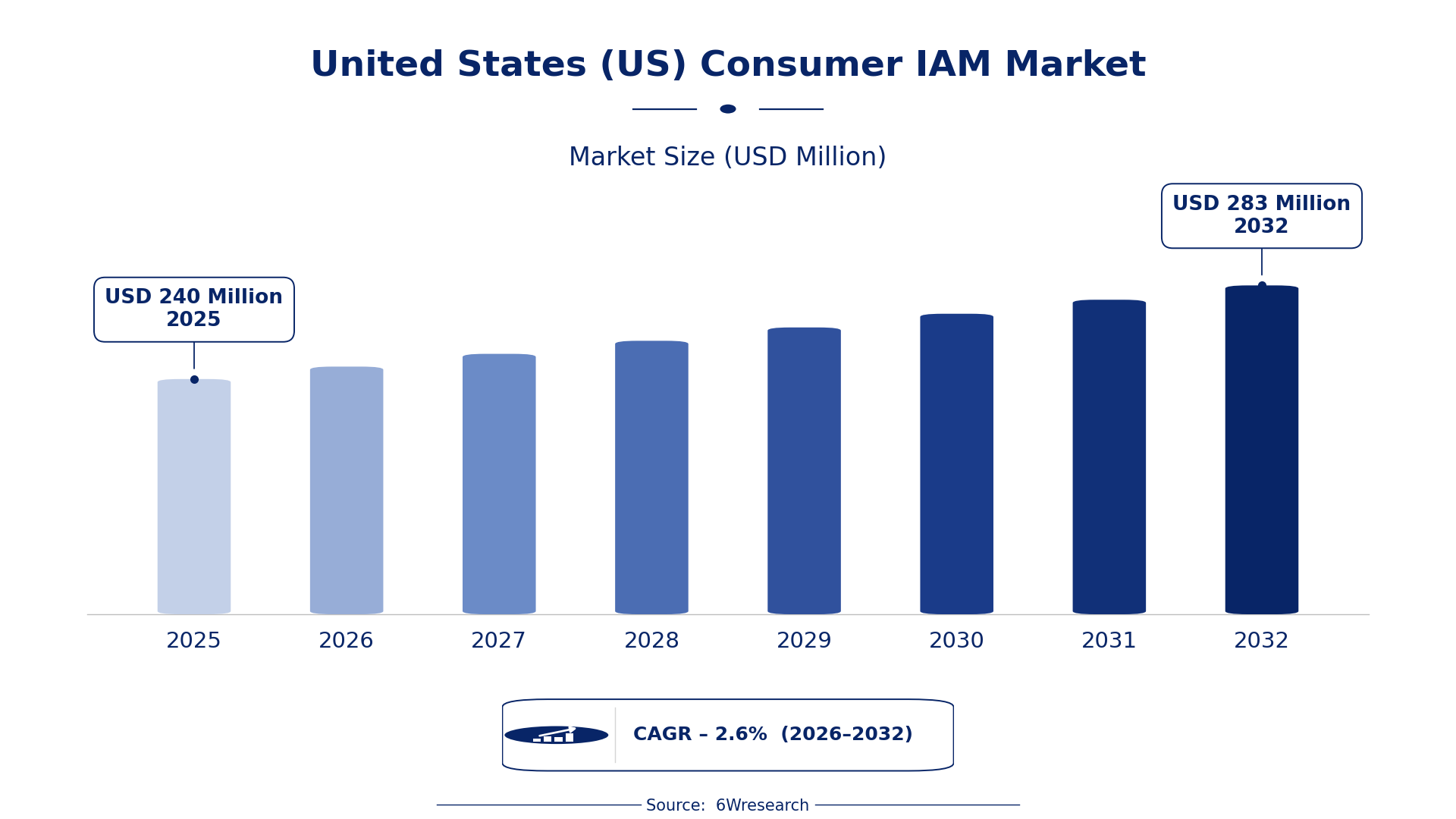
The United States (US) Consumer IAM Market was estimated at USD 240 Million in 2025 and is projected to reach USD 283 Million by 2032, growing at a CAGR of 2.6% from 2026 to 2032.
United States (US) Consumer IAM Market Synopsis
The demand for robust consumer identity and access management (CIAM) solutions is reshaping the United States (US) market. As businesses increasingly adopt digital services, the need for secure and efficient user authentication processes has never been clearer.
Organizations are prioritizing customer data protection, which drives investments in solutions that streamline identity management while ensuring compliance with data privacy regulations. This focus on security and user experience sets the stage for continued market growth.
United States (US) Consumer IAM Market Year-wise Growth Rate and Key Drivers
This graph illustrates the annual growth rates of the United States (US) Consumer IAM Market from 2021 to 2032, highlighting a steady upward trajectory and projected expansion over the forecast period.
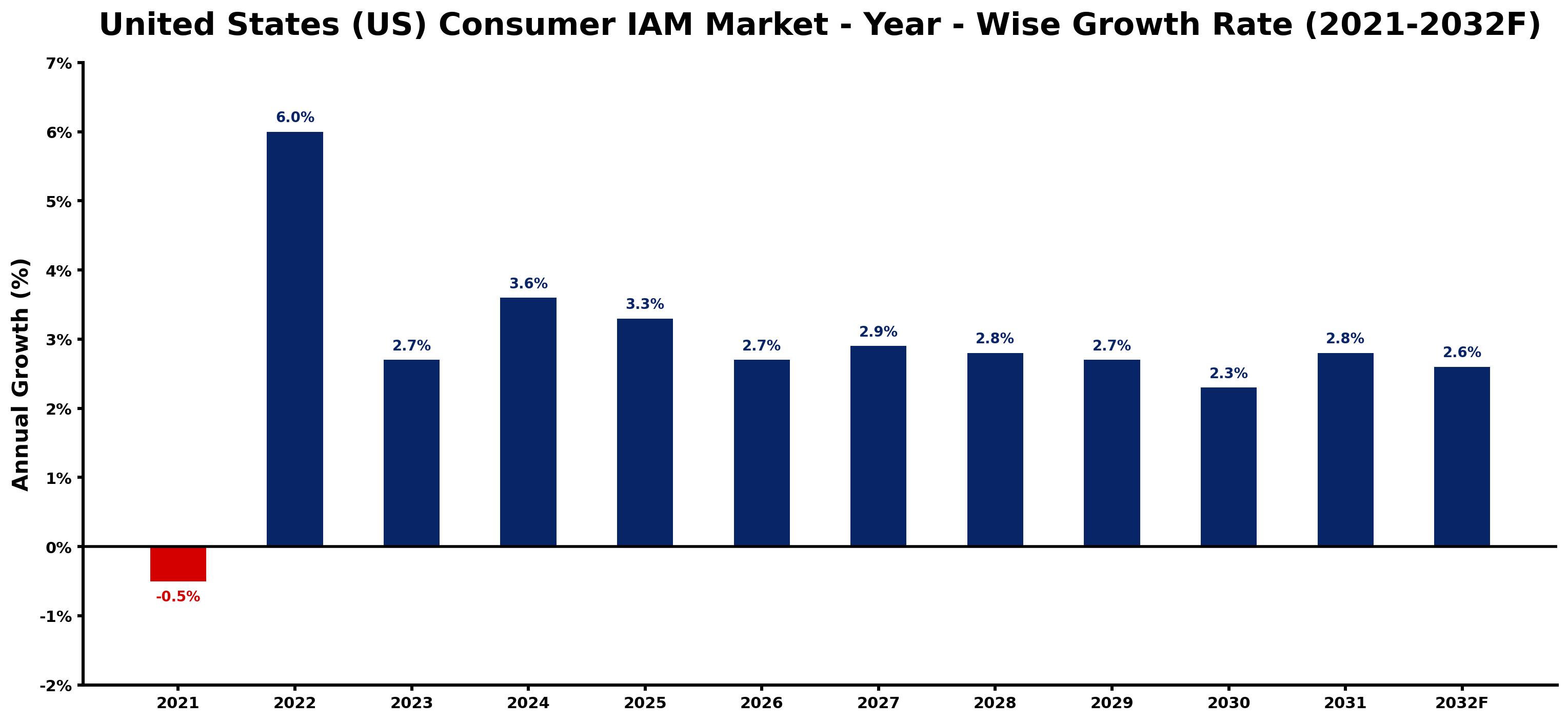
The table below presents the year‑wise growth rates along with the key drivers influencing the market
| Year | Growth Rate | Major Drivers |
| 2021 | -0.5% | Data breaches undermined trust in IAM solutions. |
| 2022 | 6.0% | Increased focus on cybersecurity regulations by NIST. |
| 2023 | 2.7% | Adoption of biometric authentication for mobile banking. |
| 2024 | 3.6% | Enhanced privacy policies driving customer identity protection. |
| 2025 | 3.3% | Rise in e-commerce fueling consumer IAM adoption. |
| 2026 | 2.7% | State-level data breach laws requiring stronger identity measures. |
| 2027 | 2.9% | Growing landscape of remote work enhancing identity validation needs. |
| 2028 | 2.8% | Increased online fraud incidents prompting IAM investment. |
| 2029 | 2.7% | Surge in IoT devices necessitating robust consumer IAM solutions. |
| 2030 | 2.3% | Heightened awareness of personal data protection among consumers. |
| 2031 | 2.8% | Major retailers implementing identity verification for online transactions. |
| 2032 | 2.6% | Emerging technologies empowering seamless identity management experiences. |
Note: Market size estimations and growth projections presented in this report are based on 6Wresearch's proprietary forecasting methodology, utilizing the latest available industry data, government publications, and primary research inputs.
United States (US) Consumer IAM Market Key Takeaways
Below are some of the specific key takeaways from the market, including:
- Increasing adoption of multi-factor authentication (MFA) is enhancing consumer data security.
- Cloud-based IAM solutions are gaining traction, driven by remote work requirements.
- Organizations are focusing on personalized user experiences to attract and retain customers.
- Compliance with GDPR and CCPA regulations is influencing investment strategies in IAM solutions.
- Advanced authentication methods, including biometrics, are expected to see significant growth.
Evaluation of Restraints in United States (US) Consumer IAM Market
The market faces real challenges related to the complexity of managing digital identities. As consumers create multiple accounts across various platforms, identity fragmentation occurs, leading to heightened security risks. Striking a balance between user convenience and robust security protocols is a constant struggle for businesses. on top of that, the escalating threat of data breaches and phishing attacks necessitates ongoing investment in innovative authentication solutions, pushing organizations to stay ahead in this competitive market.
United States (US) Consumer IAM Market Trends
Several trends are currently shaping the US Consumer IAM market. The increasing use of multi-factor authentication (MFA) stands out as a primary method to enhance security. Companies are also aiming to provide users with convenient and personalized experiences that cater to their preferences.
Additionally, a shift towards cloud-based IAM solutions is evident as organizations adapt to remote work environments. With regulatory pressures surrounding data privacy, businesses are increasingly investing in IAM solutions that not only meet compliance requirements but also prioritize consumer trust.
United States (US) Consumer IAM Market Opportunities
Investment opportunities abound in the US Consumer IAM market. The rising reliance on digital transactions, coupled with the need for data security, creates a fertile ground for growth. Innovative authentication technologies, such as biometrics and advanced multi-factor authentication, are areas ripe for development.
on top of that, the continued expansion of the Internet of Things (IoT) is driving demand for comprehensive IAM solutions that can securely manage consumer identities across various devices. This market offers a wealth of potential for investors looking to capitalize on the digital transformation.
Government Initiatives in the United States (US) Consumer IAM Market
Government policies play a crucial role in shaping the Consumer IAM market in the United States. Regulations such as the California Consumer Privacy Act (CCPA) and the Health Insurance Portability and Accountability Act (HIPAA) set stringent requirements for data protection and access security. These mandates promote a stronger focus on consumer privacy and secure access management.
- A recently completed initiative involves the enforcement of the CCPA, which has increased transparency requirements for organizations handling consumer data.
- Ongoing efforts by the Federal Trade Commission (FTC) focus on enhancing data security practices across the marketplace.
- A planned public-private initiative aims to develop advanced identity verification technologies by 2027, fostering innovation in the CIAM sector.
- Current discussions are underway regarding updates to the National Strategy for Trusted Identities in Cyberspace (NSTIC), aimed at improving online identity verification methods.
Future Insights of the United States (US) Consumer IAM Market
Looking ahead to 2026-2032, the United States Consumer IAM market is set for robust expansion. Growing concerns about data privacy and an increasing number of online transactions will compel businesses to enhance their IAM strategies. Expect to see widespread adoption of advanced authentication technologies like biometrics and AI-driven solutions to improve security.
As regulations continue to tighten, organizations will need to invest more in compliance-ready IAM systems that not only safeguard consumer information but also build long-term trust with users. This proactive approach will drive innovation and investment in the sector, leading to a competitive market environment.
United States (US) Consumer IAM Market Latest Developments
The past year has seen notable advancements in the United States Consumer IAM market, reflecting a clear trend towards security enhancement and user experience optimization. Companies are rapidly adopting new technologies to protect consumer identities amidst growing threats.
- A major technology vendor launched an advanced multi-factor authentication solution in Q2 2025, significantly enhancing security for consumer-facing applications.
- An initiative aimed at integrating AI capabilities into existing IAM solutions began in early 2025 and is currently underway, promising to bolster security measures.
- In late 2025, a partnership between two leading security firms was announced to develop innovative biometric authentication tools aimed at improving user experiences.
- A rollout of a comprehensive cloud-based IAM platform is expected to commence in the third quarter of 2026, catering specifically to small and medium-sized enterprises.
United States (US) Consumer IAM Market - Key Attractiveness of the Report
- 10 Years of Market Numbers
- Historical Data Starting from 2022 to 2025
- Base Year: 2025
- Forecast Data until 2032
- Key Performance Indicators Impacting the Market
- Major Upcoming Developments and Projects
Key Highlights of the Report:
- United States (US) Consumer IAM Market Outlook
- Market Size of United States (US) Consumer IAM Market, 2025
- Forecast of United States (US) Consumer IAM Market, 2032
- Historical Data and Forecast of United States (US) Consumer IAM Revenues & Volume for the Period 2022-2032F
- United States (US) Consumer IAM Market Trend Evolution
- United States (US) Consumer IAM Market Drivers and Challenges
- United States (US) Consumer IAM Price Trends
- United States (US) Consumer IAM Porter's Five Forces
- United States (US) Consumer IAM Industry Life Cycle
- Historical Data and Forecast of United States (US) Consumer IAM Market Revenues & Volume By Component for the Period 2022-2032F
- Historical Data and Forecast of United States (US) Consumer IAM Market Revenues & Volume By Solutions for the Period 2022-2032F
- Historical Data and Forecast of United States (US) Consumer IAM Market Revenues & Volume By Services for the Period 2022-2032F
- Historical Data and Forecast of United States (US) Consumer IAM Market Revenues & Volume By Solutions for the Period 2022-2032F
- Historical Data and Forecast of United States (US) Consumer IAM Market Revenues & Volume By Identity Governance for the Period 2022-2032F
- Historical Data and Forecast of United States (US) Consumer IAM Market Revenues & Volume By Identity Verification for the Period 2022-2032F
- Historical Data and Forecast of United States (US) Consumer IAM Market Revenues & Volume By Authentication for the Period 2022-2032F
- Historical Data and Forecast of United States (US) Consumer IAM Market Revenues & Volume By Vertical for the Period 2022-2032F
- Historical Data and Forecast of United States (US) Consumer IAM Market Revenues & Volume By BFSI for the Period 2022-2032F
- Historical Data and Forecast of United States (US) Consumer IAM Market Revenues & Volume By Hospitality for the Period 2022-2032F
- Historical Data and Forecast of United States (US) Consumer IAM Market Revenues & Volume By Healthcare for the Period 2022-2032F
- Historical Data and Forecast of United States (US) Consumer IAM Market Revenues & Volume By Retail and e-commerce for the Period 2022-2032F
- Historical Data and Forecast of United States (US) Consumer IAM Market Revenues & Volume By Public Sector for the Period 2022-2032F
- Historical Data and Forecast of United States (US) Consumer IAM Market Revenues & Volume By Automotive for the Period 2022-2032F
- Historical Data and Forecast of United States (US) Consumer IAM Market Revenues & Volume By Education for the Period 2022-2032F
- Historical Data and Forecast of United States (US) Consumer IAM Market Revenues & Volume By IT for the Period 2022-2032F
- Historical Data and Forecast of United States (US) Consumer IAM Market Revenues & Volume By Deployment Mode for the Period 2022-2032F
- Historical Data and Forecast of United States (US) Consumer IAM Market Revenues & Volume By Cloud for the Period 2022-2032F
- Historical Data and Forecast of United States (US) Consumer IAM Market Revenues & Volume By On-Premises for the Period 2022-2032F
- Historical Data and Forecast of United States (US) Consumer IAM Market Revenues & Volume By Organization Size for the Period 2022-2032F
- Historical Data and Forecast of United States (US) Consumer IAM Market Revenues & Volume By Large Enterprises for the Period 2022-2032F
- Historical Data and Forecast of United States (US) Consumer IAM Market Revenues & Volume By SMEs for the Period 2022-2032F
- United States (US) Consumer IAM Import Export Trade Statistics
- Market Opportunity Assessment By Component
- Market Opportunity Assessment By Solutions
- Market Opportunity Assessment By Vertical
- Market Opportunity Assessment By Deployment Mode
- Market Opportunity Assessment By Organization Size
- United States (US) Consumer IAM Top Companies Market Share
- United States (US) Consumer IAM Competitive Benchmarking By Technical and Operational Parameters
- United States (US) Consumer IAM Company Profiles
- United States (US) Consumer IAM Key Strategic Recommendations






































