United States (US) Container Security Market Size & Growth Rate (2026-2032)
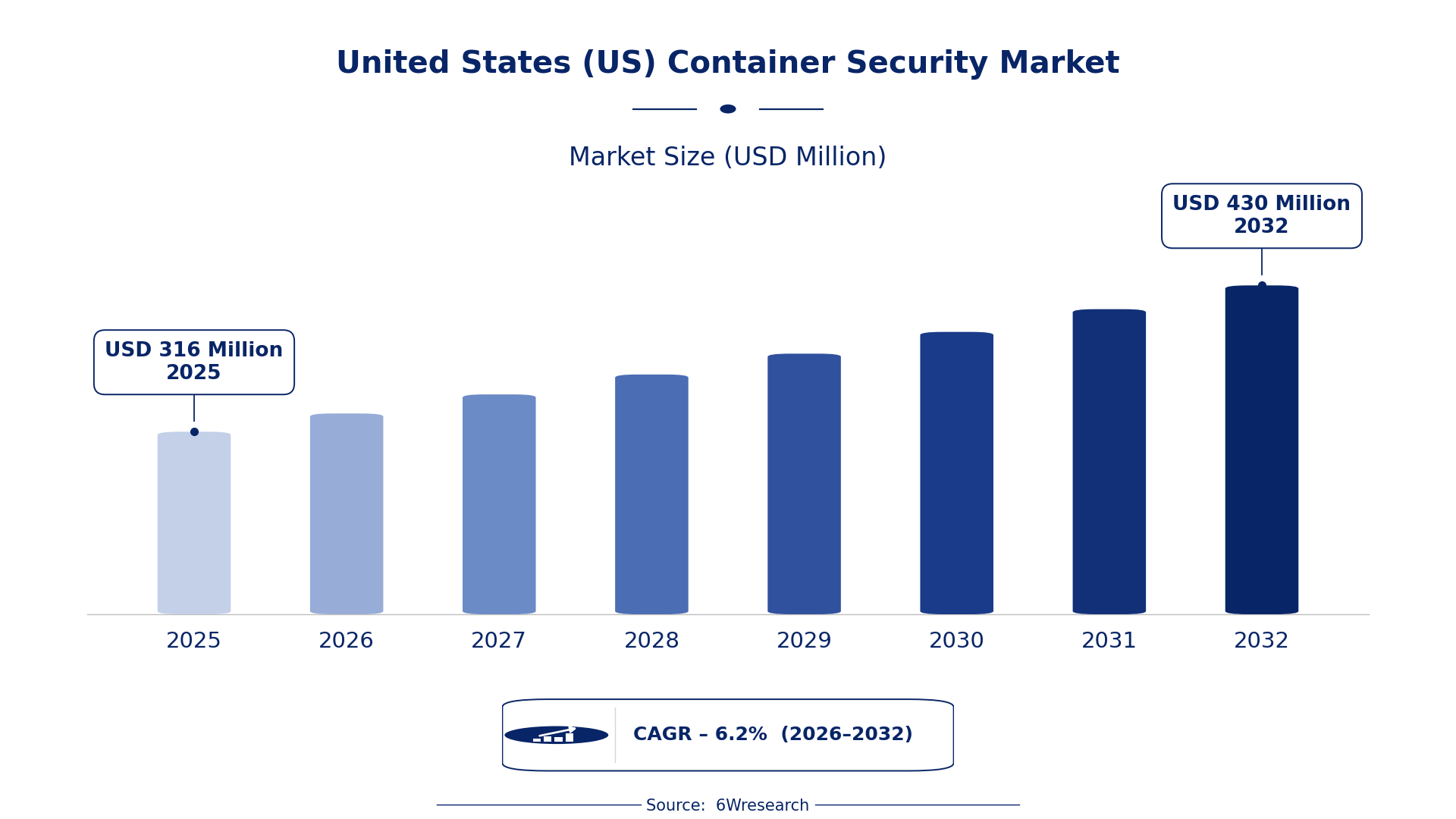
The United States (US) Container Security Market was estimated at USD 316 Million in 2025 and is projected to reach USD 430 Million by 2032, growing at a CAGR of 6.2% from 2026 to 2032.
United States (US) Container Security Market Synopsis
The US Container Security Market is currently witnessing a surge in demand driven by escalating concerns about supply chain vulnerabilities. As global trade intensifies, so do the risks associated with container transportation, prompting a push for enhanced security measures across various sectors.
The market encapsulates a diverse array of solutions, including tracking, monitoring, screening, and scanning technologies. With increasing e-commerce activities and stringent regulatory frameworks, businesses are compelled to invest in advanced security solutions to safeguard their operations and mitigate risks from smuggling and terrorism.
United States (US) Container Security Market Year-wise Growth Rate and Key Drivers
This graph illustrates the annual growth rates of the United States (US) Container Security Market from 2021 to 2032, highlighting a steady upward trajectory and projected expansion over the forecast period.
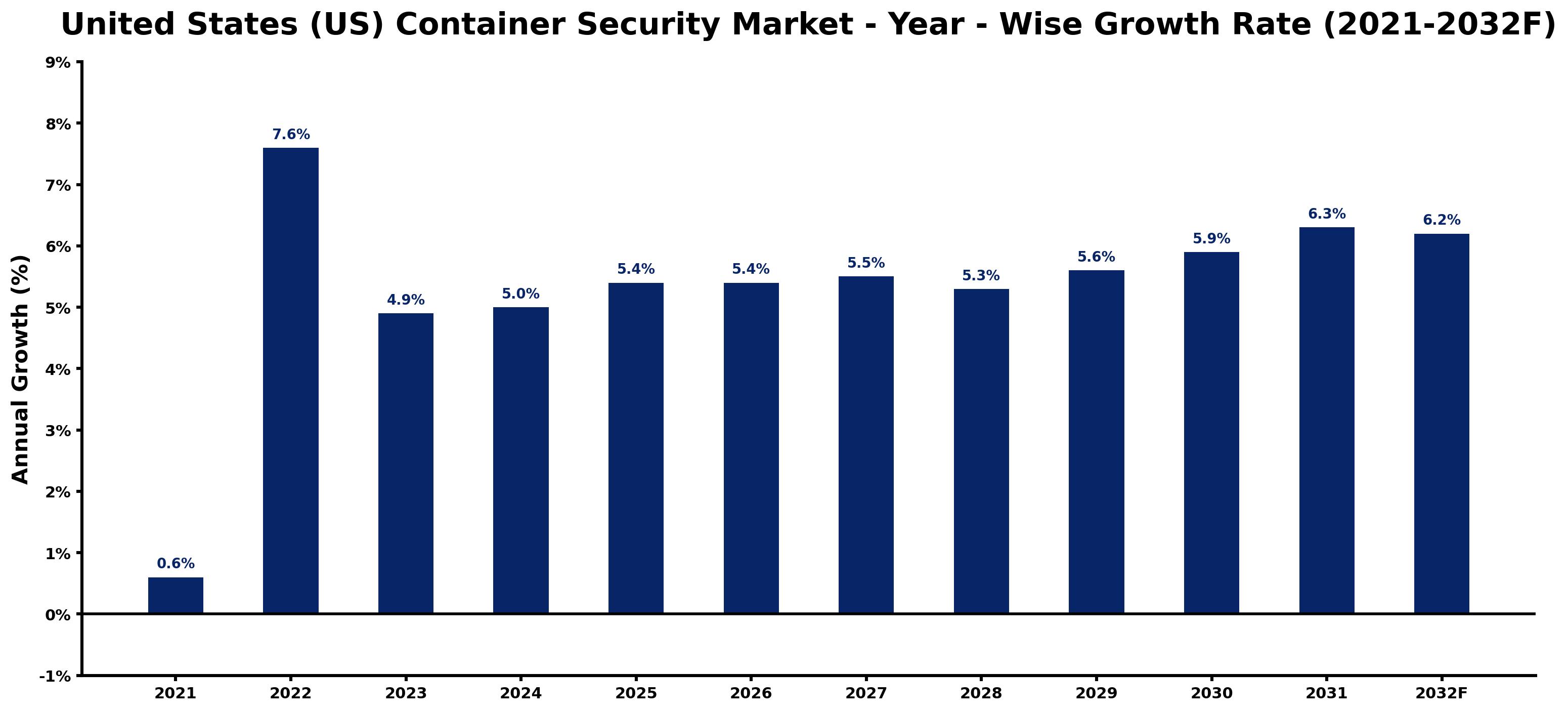
The table below presents the year‑wise growth rates along with the key drivers influencing the market
| Year | Growth Rate | Major Drivers |
| 2021 | 0.6% | Implementation of C-TPAT enhancing trade security standards. |
| 2022 | 7.6% | Increased port technology investments for security enhancements. |
| 2023 | 4.9% | Surge in e-commerce boosting container security needs. |
| 2024 | 5.0% | USCG initiatives for improved maritime security protocols. |
| 2025 | 5.4% | Strengthened cybersecurity measures for cargo tracking systems. |
| 2026 | 5.4% | Growing concerns over supply chain vulnerabilities post-pandemic. |
| 2027 | 5.5% | Adoption of AI for threat detection in containers. |
| 2028 | 5.3% | Enhancements in digital customs processing by CBP. |
| 2029 | 5.6% | Increased collaboration between public and private security sectors. |
| 2030 | 5.9% | Emergence of blockchain for transparent logistics monitoring. |
| 2031 | 6.3% | Larger investments in physical security for terminals. |
| 2032 | 6.2% | Rise in regulatory compliance requirements for container transport. |
Note: Market size estimations and growth projections presented in this report are based on 6Wresearch's proprietary forecasting methodology, utilizing the latest available industry data, government publications, and primary research inputs.
United States (US) Container Security Market Key Takeaways
Below are some of the specific key takeaways from the market, including:
- The market is expanding rapidly due to heightened security concerns and rising global trade activities.
- Key technologies driving the market include IoT, AI, and blockchain for better tracking and monitoring capabilities.
- Regulatory requirements are pushing organizations towards adopting comprehensive container security measures.
- Integration of physical and cybersecurity is becoming essential in developing effective security strategies.
- Investment opportunities are growing in real-time monitoring, data analytics, and innovative software solutions.
Evaluation of Restraints in United States (US) Container Security Market
The US Container Security Market faces considerable restraints stemming from the complexities of modern supply chains. Ensuring real-time visibility and accurate tracking of containers is a monumental challenge due to the vast volume of shipments and the myriad of logistics touchpoints involved. Compounding this issue is the absence of standardized security protocols across different ports and transport modes, which hinders the overall effectiveness of security initiatives. Collaborations among stakeholders and significant investments in advanced technologies are crucial to overcoming these obstacles.
United States (US) Container Security Market Trends
The market is seeing transformative trends as organizations increasingly adopt advanced technologies like blockchain and IoT sensors. These innovations are crucial for enhancing container tracking and monitoring capabilities. Additionally, a pronounced shift towards cloud-based solutions is emerging, allowing for improved scalability and flexibility. The integration of cybersecurity measures into physical security strategies is becoming imperative to address evolving threats and vulnerabilities effectively.
United States (US) Container Security Market Opportunities
There exists a substantial growth opportunity within the market as businesses prioritize securing their supply chains. The demand for advanced tracking and monitoring technologies, particularly those utilizing real-time data analytics, is on the rise. Companies that develop innovative solutions tailored to mitigate risks related to cargo theft and smuggling are likely to experience robust growth. Additionally, the increasing acceptance of IoT and cloud security solutions provides fertile ground for investment and development.
Government Initiatives in the United States (US) Container Security Market
Government policies are playing a critical role in shaping the trajectory of the US Container Security Market. The regulatory environment, focused on enhancing security measures, is pivotal for businesses operating in this space. Ongoing initiatives reflect the government’s commitment to improving supply chain integrity and thwarting potential threats.
- A recently launched initiative by the Department of Homeland Security (DHS) aims to improve screening protocols for containerized cargo entering the US.
- Currently, the Customs-Trade Partnership Against Terrorism (C-TPAT) program encourages businesses to enhance their security processes against terrorism-related threats.
- The US Coast Guard continues to enforce the Maritime Transportation Security Act (MTSA), requiring security measures at maritime facilities.
- A planned public-private partnership initiative expected to roll out by mid-2026 will focus on upgrading port security infrastructure.
Future Insights of the United States (US) Container Security Market
Looking ahead to 2026-2032, the US Container Security Market is set for significant expansion driven by the growing demand for integrated security solutions. Companies will increasingly embrace advanced technologies to enhance container tracking and monitoring, influenced by stricter government regulations aimed at combating illicit activities. The pressing need for effective risk management strategies amidst rising threats will further bolster investment in innovative security measures.
United States (US) Container Security Market Latest Developments
In the past year, the US Container Security Market has seen notable activity focused on advancing security technologies and initiatives. Stakeholders across the industry are aligning their strategies to meet the demands of an increasingly complex security environment.
- A major technology vendor completed the development of an AI-driven container monitoring system in Q1 2025, enhancing detection capabilities.
- In early 2025, a leading logistics provider launched a comprehensive container tracking platform that integrates real-time data analytics for better visibility.
- Currently underway, an initiative to standardize security protocols across major US ports aims to facilitate more consistent security measures and enhance overall effectiveness.
- A new partnership was formed in Q2 2025 between logistics firms to collaborate on developing cloud-based security solutions that streamline container security operations.
United States (US) Container Security Market - Key Attractiveness of the Report
- 10 Years of Market Numbers
- Historical Data Starting from 2022 to 2025
- Base Year: 2025
- Forecast Data until 2032
- Key Performance Indicators Impacting the Market
- Major Upcoming Developments and Projects
Key Highlights of the Report:
- United States (US) Container Security Market Outlook
- Market Size of United States (US) Container Security Market, 2025
- Forecast of United States (US) Container Security Market, 2032
- Historical Data and Forecast of United States (US) Container Security Revenues & Volume for the Period 2022-2032F
- United States (US) Container Security Market Trend Evolution
- United States (US) Container Security Market Drivers and Challenges
- United States (US) Container Security Price Trends
- United States (US) Container Security Porter's Five Forces
- United States (US) Container Security Industry Life Cycle
- Historical Data and Forecast of United States (US) Container Security Market Revenues & Volume By Component for the Period 2022-2032F
- Historical Data and Forecast of United States (US) Container Security Market Revenues & Volume By Container Security Products for the Period 2022-2032F
- Historical Data and Forecast of United States (US) Container Security Market Revenues & Volume By Services (Professional, Managed) for the Period 2022-2032F
- Historical Data and Forecast of United States (US) Container Security Market Revenues & Volume By Deployment Type for the Period 2022-2032F
- Historical Data and Forecast of United States (US) Container Security Market Revenues & Volume By Cloud for the Period 2022-2032F
- Historical Data and Forecast of United States (US) Container Security Market Revenues & Volume By On-premises for the Period 2022-2032F
- Historical Data and Forecast of United States (US) Container Security Market Revenues & Volume By Vertical for the Period 2022-2032F
- Historical Data and Forecast of United States (US) Container Security Market Revenues & Volume By BFSI for the Period 2022-2032F
- Historical Data and Forecast of United States (US) Container Security Market Revenues & Volume By Retail for the Period 2022-2032F
- Historical Data and Forecast of United States (US) Container Security Market Revenues & Volume By Government for the Period 2022-2032F
- Historical Data and Forecast of United States (US) Container Security Market Revenues & Volume By Healthcare for the Period 2022-2032F
- United States (US) Container Security Import Export Trade Statistics
- Market Opportunity Assessment By Component
- Market Opportunity Assessment By Deployment Type
- Market Opportunity Assessment By Vertical
- United States (US) Container Security Top Companies Market Share
- United States (US) Container Security Competitive Benchmarking By Technical and Operational Parameters
- United States (US) Container Security Company Profiles
- United States (US) Container Security Key Strategic Recommendations






































