United States (US) Cutting Equipment Market Size, Share & Growth Rate
The United States (US) Cutting Equipment Market was estimated at USD 218 Million in 2025 and is projected to reach USD 255 Million by 2032, growing at a CAGR of 2.3% from 2026 to 2032. This growth trajectory is driven by the ongoing advancements in cutting technologies, notably in automation and precision. As industries across manufacturing, automotive, and aerospace continue to evolve, the need for efficient and reliable cutting solutions is more critical than ever, further propelling demand within the market.
United States (US) Cutting Equipment Market Year-wise Growth Rate and Key Drivers
This graph highlights how the United States (US) Cutting Equipment Market has steadily grown over the years, supported by major growth factors.
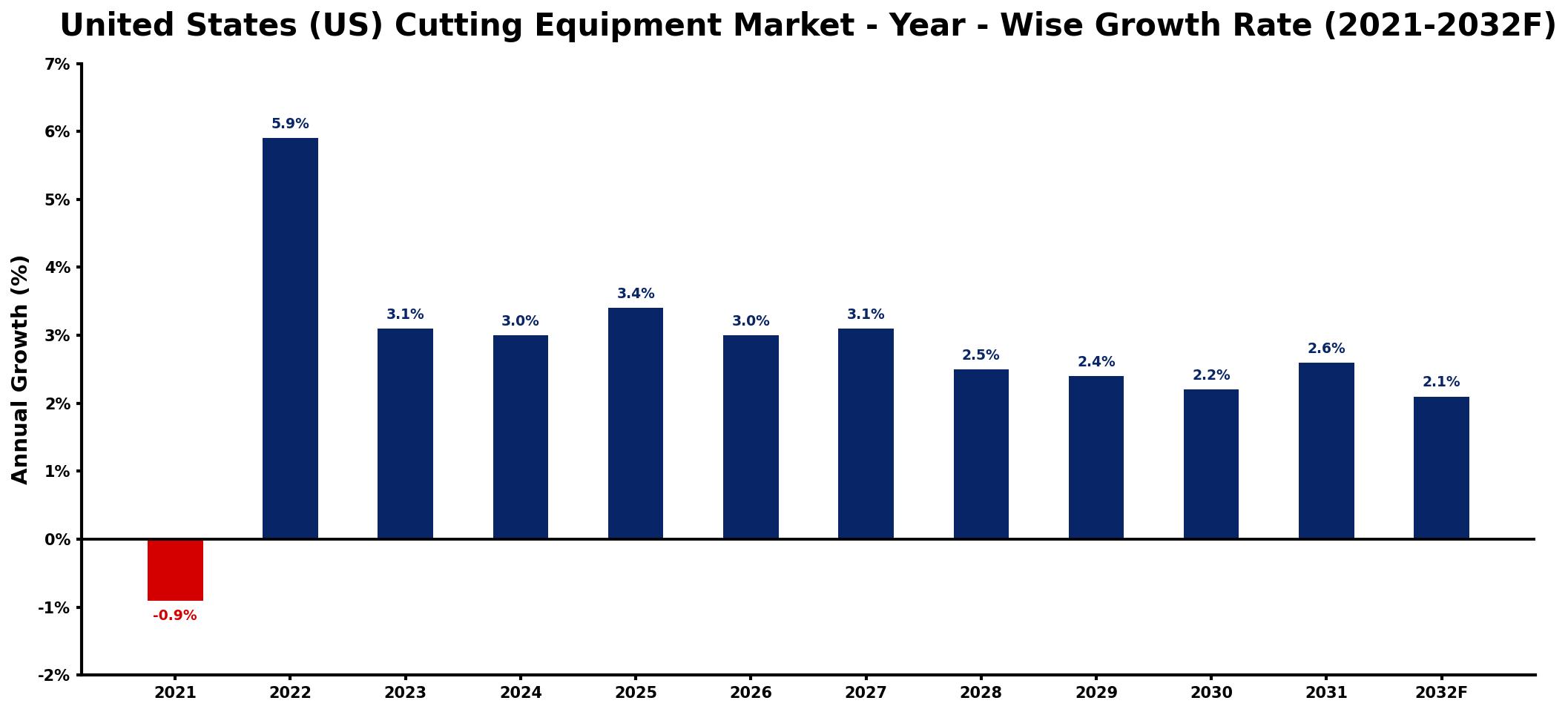
The table below presents the year‑wise growth rates along with the key drivers influencing the market
| Year | Growth Rate | Major Drivers |
| 2021 | -0.9% | decreased manufacturing output levels |
| 2022 | 5.9% | increased construction sector investments |
| 2023 | 3.1% | growing demand from automotive industry |
| 2024 | 3.0% | expansion in renewable energy projects |
| 2025 | 3.4% | boost in aerospace sector production |
| 2026 | 3.0% | rising consumer electronics manufacturing |
| 2027 | 3.1% | enhanced logistics and distribution networks |
| 2028 | 2.5% | greater focus on precision applications |
| 2029 | 2.4% | strengthened infrastructure development initiatives |
| 2030 | 2.2% | emerging technologies driving innovation |
| 2031 | 2.6% | higher adoption of automation trends |
| 2032 | 2.1% | increased sustainability initiatives across sectors |
Note: Market size estimations and growth projections presented in this report are based on 6Wresearch's proprietary forecasting methodology, utilizing the latest available industry data, government publications, and primary research inputs.
United States (US) Cutting Equipment Market Synopsis
The strongest force currently shaping the United States Cutting Equipment Market is the rapid integration of automation and advanced technologies, such as CNC systems. This shift towards intelligent equipment is enhancing operational efficiency and precision, making cutting processes faster and more reliable.
In addition to technological advancements, a growing emphasis on sustainability is pushing manufacturers to adopt eco-friendly cutting solutions. This trend aligns with a broader industry shift towards reducing energy consumption and emissions, positioning the market for innovative and responsible growth.
United States (US) Cutting Equipment Market Key Takeaways
- The market is expanding due to increasing demand across multiple sectors, including automotive and aerospace.
- Automation and precision technologies are driving significant improvements in cutting equipment performance.
- There is a marked trend towards eco-friendly solutions, influencing product development strategies.
- Integrated cutting systems offering multifunctionality are gaining traction among users.
- Investment opportunities are emerging from the demand for advanced and automated cutting technologies.
Evaluation of Restraints in United States (US) Cutting Equipment Market
Despite a positive outlook, the United States Cutting Equipment Market faces constraints primarily related to the rapid pace of technological change. Companies must continuously invest in new machinery and technologies to remain competitive, which can strain financial resources. Additionally, pricing pressures from international competitors offering cost-effective solutions can hinder growth for domestic manufacturers. Compliance with strict regulatory standards also poses challenges, necessitating ongoing investment in safety and environmental protocols.
United States (US) Cutting Equipment Market Trends
The US Cutting Equipment Market is currently witnessing several pivotal trends. A pronounced increase in the adoption of CNC systems and automation technologies is transforming traditional cutting processes. Furthermore, there is a growing preference for portable and lightweight equipment, catering to the need for flexibility and ease of use across various applications. Companies are also focusing on developing integrated solutions that provide multiple functionalities, reflecting the diverse needs of modern manufacturing.
United States (US) Cutting Equipment Market Opportunities
Investment opportunities within the US Cutting Equipment Market are abundant. The shift towards automated and smart cutting technologies presents a prime avenue for investors. Companies developing robotic cutting solutions or software-integrated tools are likely to see increased demand. Additionally, the push for sustainable practices in manufacturing opens doors for eco-friendly cutting equipment. Investors should also consider opportunities in sectors that are expanding due to infrastructure projects and e-commerce growth, which will drive demand for more advanced cutting solutions.
Government Initiatives in the United States (US) Cutting Equipment Market
Government policies significantly influence the US Cutting Equipment Market, particularly in areas related to trade, environmental standards, and workplace safety. Trade agreements and tariffs can impact the dynamics of equipment imports and exports, while stringent environmental regulations encourage the development of greener technologies. Additionally, workplace safety laws enforced by agencies like OSHA mandate adherence to safety protocols, impacting production processes and equipment design.
Future Insights of the United States (US) Cutting Equipment Market
Looking ahead to 2026-2032, the United States Cutting Equipment Market is poised for robust growth. The continued demand for innovative cutting solutions across key industries such as automotive, aerospace, and construction is expected to drive market expansion. As cutting technologies evolve, integrating artificial intelligence and advanced robotics will likely enhance productivity and precision. Additionally, the commitment to sustainable manufacturing practices will further propel the adoption of eco-friendly equipment, positioning the market for dynamic advancements and opportunities.
United States (US) Cutting Equipment Market Latest Developments (2025 - 2026)
Recent developments in the US Cutting Equipment Market indicate a strong movement towards automation and technological integration. Companies are increasingly focusing on innovation to enhance product efficiency, alongside the growing popularity of environmentally friendly solutions. Moreover, partnerships and collaborations aimed at developing cutting-edge technologies are becoming more common, signaling a competitive drive among firms to meet the evolving demands of various industries.
United States (US) Cutting Equipment Market - Key Attractiveness of the Report
- 10 Years of Market Numbers
- Historical Data Starting from 2022 to 2025
- Base Year: 2025
- Forecast Data until 2032
- Key Performance Indicators Impacting the Market
- Major Upcoming Developments and Projects
Key Highlights of the Report:
- United States (US) Cutting Equipment Market Outlook
- Market Size of United States (US) Cutting Equipment Market, 2025
- Forecast of United States (US) Cutting Equipment Market, 2032
- Historical Data and Forecast of United States (US) Cutting Equipment Revenues & Volume for the Period 2022-2032F
- United States (US) Cutting Equipment Market Trend Evolution
- United States (US) Cutting Equipment Market Drivers and Challenges
- United States (US) Cutting Equipment Price Trends
- United States (US) Cutting Equipment Porter's Five Forces
- United States (US) Cutting Equipment Industry Life Cycle
- Historical Data and Forecast of United States (US) Cutting Equipment Market Revenues & Volume By Equipment Type for the Period 2022-2032F
- Historical Data and Forecast of United States (US) Cutting Equipment Market Revenues & Volume By Manual for the Period 2022-2032F
- Historical Data and Forecast of United States (US) Cutting Equipment Market Revenues & Volume By Mechanized for the Period 2022-2032F
- Historical Data and Forecast of United States (US) Cutting Equipment Market Revenues & Volume By Cutting Technology for the Period 2022-2032F
- Historical Data and Forecast of United States (US) Cutting Equipment Market Revenues & Volume By Plasma cutting for the Period 2022-2032F
- Historical Data and Forecast of United States (US) Cutting Equipment Market Revenues & Volume By Oxy-fuel cutting for the Period 2022-2032F
- Historical Data and Forecast of United States (US) Cutting Equipment Market Revenues & Volume By Laser cutting for the Period 2022-2032F
- Historical Data and Forecast of United States (US) Cutting Equipment Market Revenues & Volume By Waterjet cutting for the Period 2022-2032F
- Historical Data and Forecast of United States (US) Cutting Equipment Market Revenues & Volume By Carbon arc cutting for the Period 2022-2032F
- Historical Data and Forecast of United States (US) Cutting Equipment Market Revenues & Volume By End Use Industry for the Period 2022-2032F
- Historical Data and Forecast of United States (US) Cutting Equipment Market Revenues & Volume By Construction for the Period 2022-2032F
- Historical Data and Forecast of United States (US) Cutting Equipment Market Revenues & Volume By Heavy metal fabrication for the Period 2022-2032F
- Historical Data and Forecast of United States (US) Cutting Equipment Market Revenues & Volume By Shipbuilding & offshore for the Period 2022-2032F
- Historical Data and Forecast of United States (US) Cutting Equipment Market Revenues & Volume By Automotive for the Period 2022-2032F
- Historical Data and Forecast of United States (US) Cutting Equipment Market Revenues & Volume By Others for the Period 2022-2032F
- Historical Data and Forecast of United States (US) Cutting Equipment Market Revenues & Volume By Type for the Period 2022-2032F
- Historical Data and Forecast of United States (US) Cutting Equipment Market Revenues & Volume By Equipment for the Period 2022-2032F
- Historical Data and Forecast of United States (US) Cutting Equipment Market Revenues & Volume By Consumables/Accessories for the Period 2022-2032F
- United States (US) Cutting Equipment Import Export Trade Statistics
- Market Opportunity Assessment By Equipment Type
- Market Opportunity Assessment By Cutting Technology
- Market Opportunity Assessment By End Use Industry
- Market Opportunity Assessment By Type
- United States (US) Cutting Equipment Top Companies Market Share
- United States (US) Cutting Equipment Competitive Benchmarking By Technical and Operational Parameters
- United States (US) Cutting Equipment Company Profiles
- United States (US) Cutting Equipment Key Strategic Recommendations






































