United States (US) Digital Market Size & Growth Rate (2026-2032)
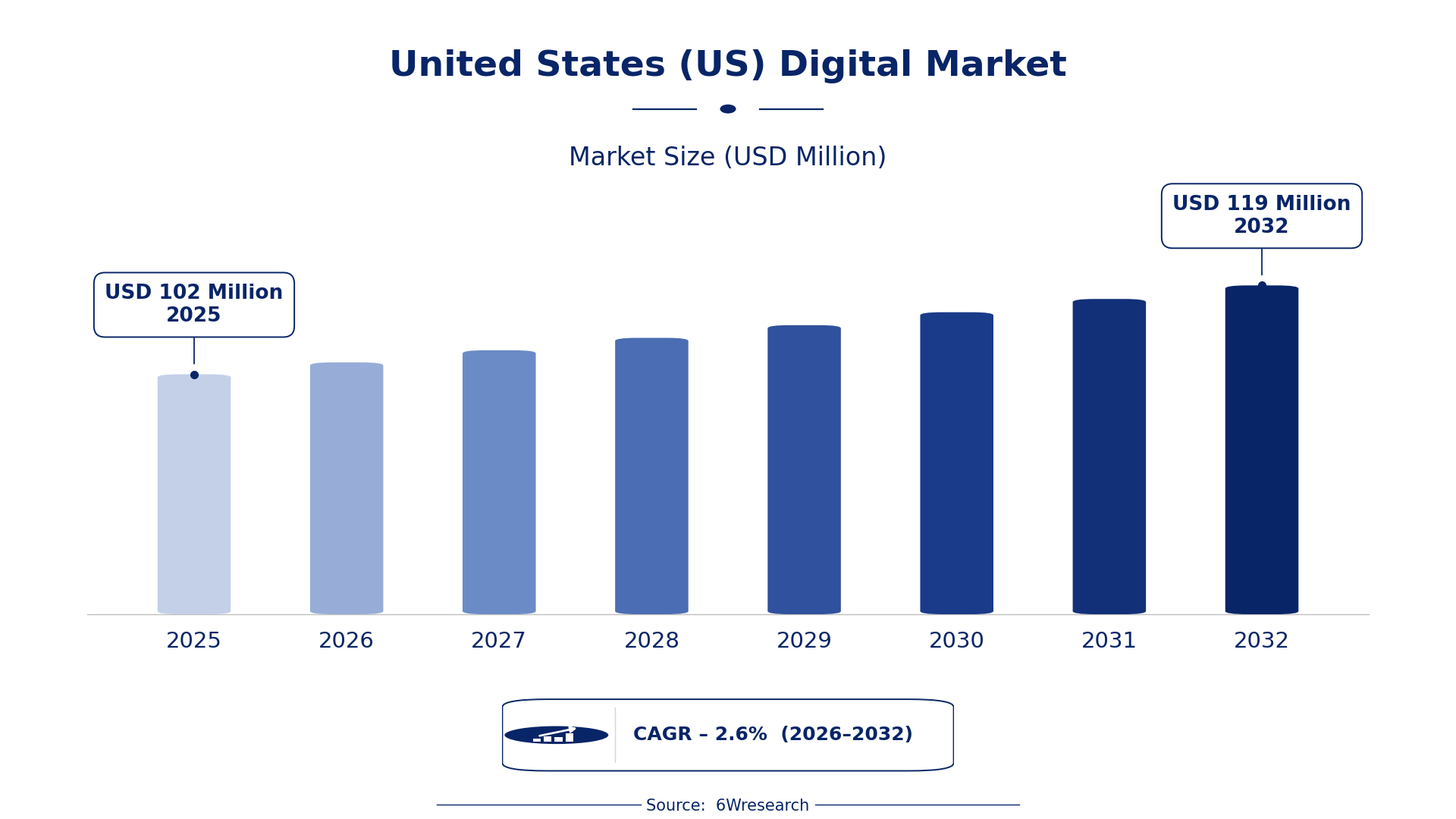
The United States (US) Digital Market was estimated at USD 102 Million in 2025 and is projected to reach USD 119 Million by 2032, growing at a CAGR of 2.6% from 2026 to 2032.
United States (US) Digital Market Synopsis
The driving force behind the United States digital market is the relentless growth of e-commerce, which has reshaped how consumers shop. The convenience and vast selection offered online have led to a significant shift in purchasing behavior, solidifying the market's role as a cornerstone of the broader economy.
As digital advertising strategies become more sophisticated, companies are leveraging data analytics to create personalized marketing experiences. This trend not only enhances consumer engagement but also drives competition among businesses to adopt innovative digital solutions.
United States (US) Digital Market Year-wise Growth Rate and Key Drivers
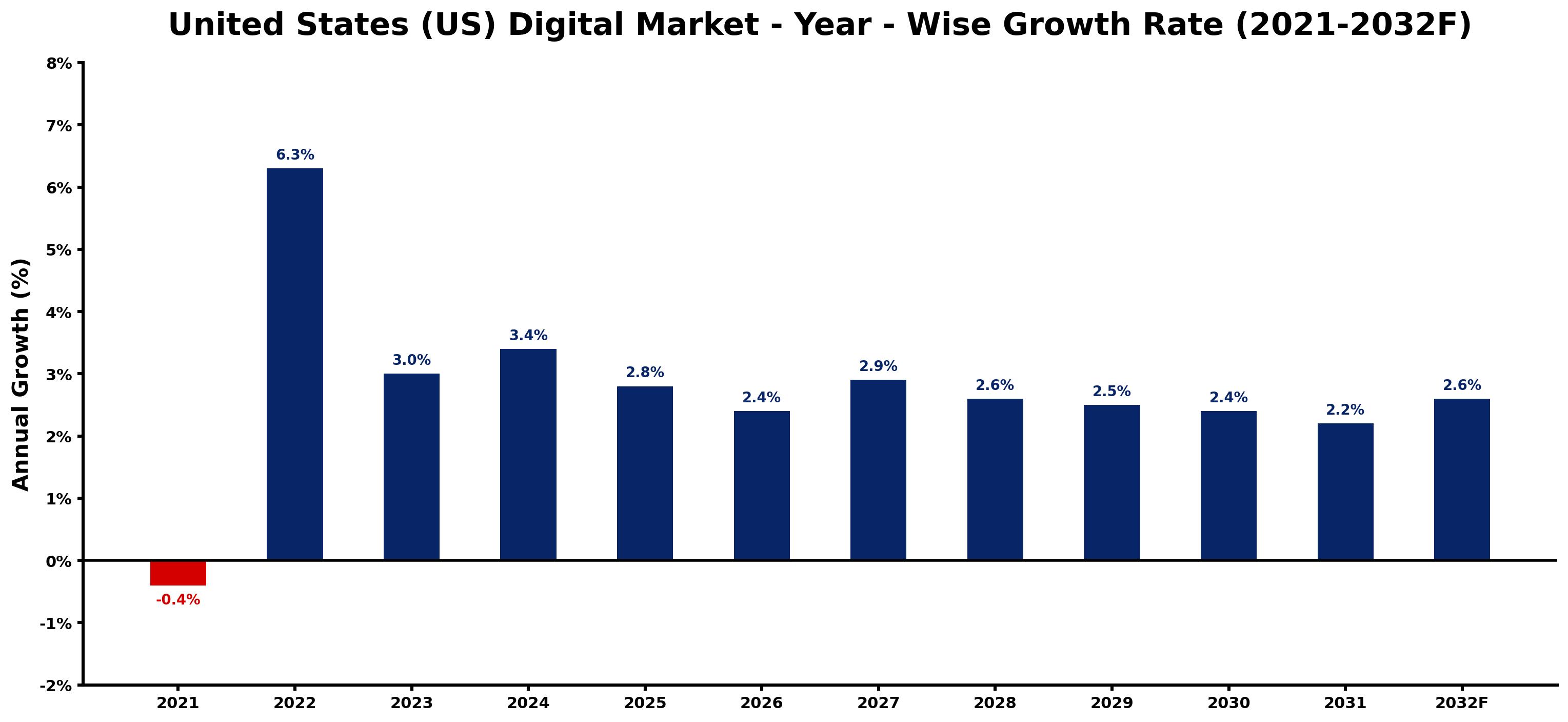
This graph illustrates the annual growth rates of the United States (US) Digital Market from 2021 to 2032, highlighting a steady upward trajectory and projected expansion over the forecast period.
The table below presents the year‑wise growth rates along with the key drivers influencing the market
| Year | Growth Rate | Major Drivers |
| 2021 | -0.4% | Increased data privacy regulations by California Consumer Privacy Act |
| 2022 | 6.3% | Surge in e-commerce driving digital advertising spending. |
| 2023 | 3.0% | Increased reliance on digital payments post-pandemic. |
| 2024 | 3.4% | Rise in telehealth services boosting online health platforms. |
| 2025 | 2.8% | Growing interest in subscription-based content services. |
| 2026 | 2.4% | Emergence of AI tools enhancing digital marketing strategies. |
| 2027 | 2.9% | Expanding online education initiatives fueling digital content platforms. |
| 2028 | 2.6% | Increased cybersecurity regulations driving demand for protection tools. |
| 2029 | 2.5% | Digital transformation initiatives across traditional retail sectors. |
| 2030 | 2.4% | Shift toward digital-first customer engagement strategies. |
| 2031 | 2.2% | Investment in augmented reality for enhanced shopping experiences. |
| 2032 | 2.6% | Development of smart home technologies influencing digital services. |
Note: Market size estimations and growth projections presented in this report are based on 6Wresearch's proprietary forecasting methodology, utilizing the latest available industry data, government publications, and primary research inputs.
United States (US) Digital Market Key Takeaways
Below are some of the specific key takeaways from the market, including:
- The e-commerce sector continues to dominate the digital market, with increasing consumer reliance on online shopping.
- Mobile commerce is gaining traction, reflecting changing consumer preferences toward mobile devices for shopping.
- Data privacy and cybersecurity concerns are prompting stricter regulations and compliance measures for digital businesses.
- Investment opportunities abound in emerging technologies like AI, cloud computing, and digital content creation.
- Government initiatives are shaping the regulatory environment, ensuring competition and consumer protection.
Evaluation of Restraints in United States (US) Digital Market
Intense competition remains a significant restraint in the United States digital market. The dominance of tech giants like Google, Facebook, and Amazon creates barriers for smaller enterprises, making market entry challenging. Compliance with evolving data privacy regulations, such as the CCPA, adds another layer of complexity for businesses. on top of that, the ever-present threat of cybersecurity breaches demands continuous investment in security measures, which can strain resources and limit growth potential.
United States (US) Digital Market Trends
Several trends are currently shaping the United States digital market. First, the rapid shift toward mobile commerce is undeniable, with consumers increasingly opting for smartphones and tablets for their shopping needs. Social media platforms are becoming essential marketing tools, with influencers playing a crucial role in shaping consumer preferences.
Additionally, the rise of digital streaming services is transforming entertainment consumption patterns, leading to declining traditional media viewership. The growing emphasis on data privacy is prompting companies to adopt more transparent practices, driving a significant focus on cybersecurity measures.
United States (US) Digital Market Opportunities
Investment opportunities in the United States digital market are plentiful. The e-commerce sector presents avenues for growth through online retail and innovative payment solutions. The technology space is ripe for expansion, particularly in areas such as artificial intelligence, cybersecurity, and cloud computing.
The surge in digital entertainment and streaming services is creating demand for content development and virtual reality technologies. on top of that, the healthcare sector is undergoing a digital transformation, with telemedicine and remote monitoring solutions gaining traction.
Government Initiatives in the United States (US) Digital Market
Government policies are actively shaping the dynamics of the United States digital market. Regulatory frameworks focus on fostering competition while ensuring consumer protection, making compliance a priority for businesses. The government's commitment to enhancing cybersecurity also influences the strategic direction of digital initiatives.
- A recently completed initiative aimed at improving internet access in rural areas, enhancing digital connectivity for underserved populations.
- A currently ongoing program promoting digital literacy among small businesses to better equip them in the digital marketplace.
- A planned public-private partnership to develop a national digital infrastructure upgrade expected to commence by 2026.
- An initiative to establish clearer data privacy regulations, reflecting growing concerns among consumers and stakeholders.
- A regulatory review process initiated by the FTC to assess antitrust practices among leading tech companies.
Future Insights of the United States (US) Digital Market
Looking ahead to 2026-2032, the United States digital market is set for continued evolution. E-commerce will further expand as more consumers embrace online shopping for its convenience and variety. The integration of emerging technologies such as AI and blockchain will enhance customer experiences and operational efficiencies.
Digital advertising will shift toward increasingly personalized campaigns, driven by advanced data analytics. As businesses invest in digital transformation, sectors like cloud computing and cybersecurity will see significant growth, positioning the market for a promising future.
United States (US) Digital Market Latest Developments
Recent activity in the United States digital market has been characterized by rapid advancements and strategic initiatives. Companies are increasingly focused on enhancing their digital capabilities to meet evolving consumer demands, with significant investments in technology and infrastructure.
- A major technology vendor launched a new digital marketing platform in early 2025, aimed at improving customer engagement through AI-driven insights.
- An ongoing initiative by a leading regional operator to expand broadband services to rural areas has been progressing since late 2025.
- Plans for a new regulatory framework addressing data privacy were announced in mid-2026, focusing on improving user consent processes.
- A digital entertainment company is currently developing an innovative streaming service, expected to roll out in Q4 2026.
- By early 2026, a collaborative project among tech firms is set to begin, targeting advancements in cybersecurity measures.
United States (US) Digital Market - Key Attractiveness of the Report
- 10 Years of Market Numbers
- Historical Data Starting from 2022 to 2025
- Base Year: 2025
- Forecast Data until 2032
- Key Performance Indicators Impacting the Market
- Major Upcoming Developments and Projects
Key Highlights of the Report:
- United States (US) Digital Market Outlook
- Market Size of United States (US) Digital Market, 2025
- Forecast of United States (US) Digital Market, 2032
- Historical Data and Forecast of United States (US) Digital Revenues & Volume for the Period 2022-2032F
- United States (US) Digital Market Trend Evolution
- United States (US) Digital Market Drivers and Challenges
- United States (US) Digital Price Trends
- United States (US) Digital Porter's Five Forces
- United States (US) Digital Industry Life Cycle
- Historical Data and Forecast of United States (US) Digital Market Revenues & Volume By Software for the Period 2022-2032F
- Historical Data and Forecast of United States (US) Digital Market Revenues & Volume By CRM Software for the Period 2022-2032F
- Historical Data and Forecast of United States (US) Digital Market Revenues & Volume By Email Marketing Software for the Period 2022-2032F
- Historical Data and Forecast of United States (US) Digital Market Revenues & Volume By Social Media Advertising for the Period 2022-2032F
- United States (US) Digital Import Export Trade Statistics
- Market Opportunity Assessment By Software
- United States (US) Digital Top Companies Market Share
- United States (US) Digital Competitive Benchmarking By Technical and Operational Parameters
- United States (US) Digital Company Profiles
- United States (US) Digital Key Strategic Recommendations






































