United States (US) Eco Fibers Market Top 5 Importing Countries and Market Competition (HHI) Analysis
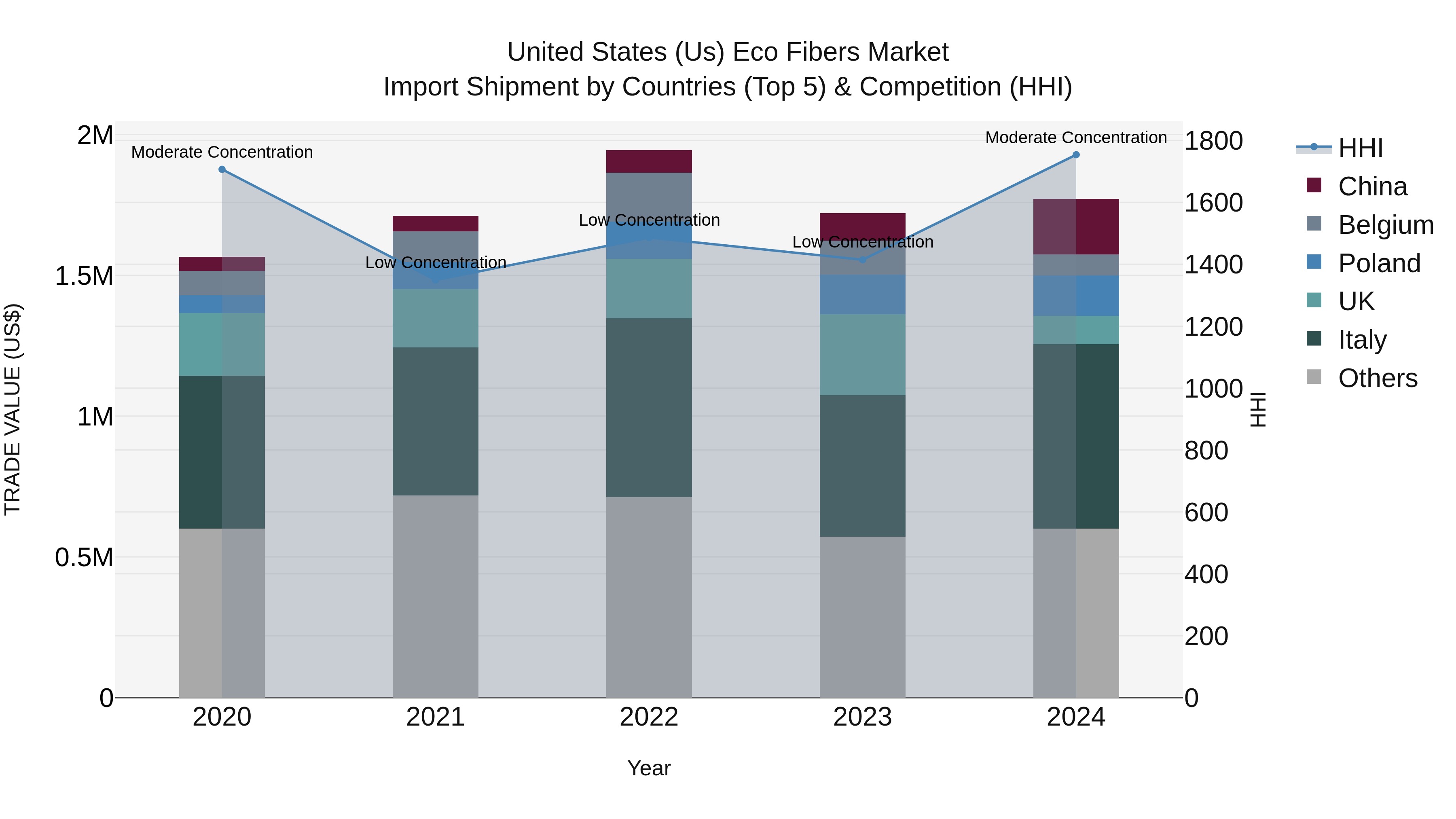
The United States saw an increase in eco fibers import shipments in 2024, with top exporting countries being Italy, China, Poland, Lithuania, and the UK. The market concentration, as measured by the HHI, shifted from low to moderate in 2024, indicating a more competitive landscape. The compound annual growth rate (CAGR) from 2020 to 2024 was 3.13%, showing steady growth in the eco fibers market. Additionally, the growth rate from 2023 to 2024 was 2.89%, suggesting a continued positive momentum in the industry.
United States (US) Eco Fibers Market Overview
The United States Eco Fibers Market is a rapidly growing sector within the textile industry, driven by increasing environmental awareness and sustainable practices. Eco fibers, including organic cotton, bamboo, hemp, and recycled materials, are gaining popularity among consumers seeking eco-friendly and ethically produced clothing and textiles. The market is witnessing a shift towards eco-conscious products as more brands and retailers adopt sustainable sourcing and manufacturing practices to meet consumer demand for environmentally friendly options. Factors such as government initiatives promoting sustainability, rising concerns over climate change, and a growing preference for natural and biodegradable materials are fueling the growth of the US eco fibers market. This trend is expected to continue as consumers become more conscious of their environmental impact and seek sustainable alternatives in the fashion and textile industry.
United States (US) Eco Fibers Market Trends and Opportunities
The US Eco Fibers Market is experiencing significant growth due to increasing consumer awareness and demand for sustainable and environmentally friendly products. Key trends include the rising popularity of organic cotton, recycled polyester, and biodegradable fibers. The shift towards eco-friendly alternatives in the fashion and textile industry is creating opportunities for companies to innovate and develop new sustainable materials. Additionally, government initiatives promoting sustainability and circular economy practices are driving market growth. Companies that prioritize sustainability and transparency in their supply chain are likely to benefit from the growing demand for eco fibers in the US market, presenting opportunities for expansion and differentiation in a competitive landscape focused on environmental stewardship.
United States (US) Eco Fibers Market Challenges
The US Eco Fibers Market faces several challenges, including consumer awareness and education about sustainable textile options, the higher cost of eco-friendly fibers compared to conventional ones, and the limited availability of eco fibers in the market. Additionally, there are challenges related to the inconsistent labeling and certification standards for eco fibers, leading to confusion among consumers. The lack of infrastructure for recycling and reusing eco fibers also presents a hurdle for the market`s growth. To overcome these challenges, industry stakeholders need to collaborate to improve awareness, drive innovation for cost-effective production of eco fibers, establish clear labeling standards, and invest in recycling facilities to create a more sustainable and circular economy for eco-friendly textiles in the US.
United States (US) Eco Fibers Market Drivers
The United States Eco Fibers Market is primarily driven by increasing consumer awareness and demand for sustainable and environmentally friendly products. Consumers are becoming more conscious of the environmental impact of their purchasing decisions, leading to a growing preference for eco-friendly fibers such as organic cotton, bamboo, and recycled polyester. Government initiatives and regulations promoting sustainability and reducing carbon footprint are also significant drivers of the market. Additionally, the fashion and textile industry`s adoption of sustainable practices and the implementation of corporate social responsibility strategies by major companies are further fueling the growth of the US Eco Fibers Market. Overall, the demand for eco fibers is expected to continue rising as sustainability becomes a key consideration for both businesses and consumers.
United States (US) Eco Fibers Market Government Policy
The United States government has implemented various policies to promote sustainability and eco-friendly practices in the Eco Fibers Market. These policies include tax incentives for companies using renewable materials, grants for research and development of sustainable fibers, and regulations promoting transparency in labeling and marketing of eco-friendly products. Additionally, the government has set targets for reducing greenhouse gas emissions and promoting energy efficiency in the textile industry. Overall, these policies aim to encourage the adoption of environmentally sustainable practices in the Eco Fibers Market and support the growth of the green economy in the United States.
United States (US) Eco Fibers Market Future Outlook
The United States Eco Fibers Market is poised for significant growth in the coming years. Increasing environmental awareness and concerns over sustainability are driving the demand for eco-friendly fibers derived from renewable sources such as organic cotton, bamboo, and recycled materials. Consumers are increasingly seeking products that have minimal impact on the environment, leading to a shift towards eco fibers in industries like fashion, textiles, and home furnishings. Additionally, government initiatives promoting sustainable practices and regulations favoring eco-friendly products are expected to further boost the market. With a growing focus on ethical and sustainable consumption, the US Eco Fibers Market is forecasted to experience steady growth and innovation in the foreseeable future.
Key Highlights of the Report:
- United States (US) Eco Fibers Market Outlook
- Market Size of United States (US) Eco Fibers Market, 2024
- Forecast of United States (US) Eco Fibers Market, 2031
- Historical Data and Forecast of United States (US) Eco Fibers Revenues & Volume for the Period 2021 - 2031
- United States (US) Eco Fibers Market Trend Evolution
- United States (US) Eco Fibers Market Drivers and Challenges
- United States (US) Eco Fibers Price Trends
- United States (US) Eco Fibers Porter's Five Forces
- United States (US) Eco Fibers Industry Life Cycle
- Historical Data and Forecast of United States (US) Eco Fibers Market Revenues & Volume By Type for the Period 2021 - 2031
- Historical Data and Forecast of United States (US) Eco Fibers Market Revenues & Volume By Regenerated fibers for the Period 2021 - 2031
- Historical Data and Forecast of United States (US) Eco Fibers Market Revenues & Volume By Recycled fibers for the Period 2021 - 2031
- Historical Data and Forecast of United States (US) Eco Fibers Market Revenues & Volume By Organic fibers for the Period 2021 - 2031
- Historical Data and Forecast of United States (US) Eco Fibers Market Revenues & Volume By Application for the Period 2021 - 2031
- Historical Data and Forecast of United States (US) Eco Fibers Market Revenues & Volume By Textile/Clothing for the Period 2021 - 2031
- Historical Data and Forecast of United States (US) Eco Fibers Market Revenues & Volume By Household Furnishings for the Period 2021 - 2031
- Historical Data and Forecast of United States (US) Eco Fibers Market Revenues & Volume By Industrial for the Period 2021 - 2031
- Historical Data and Forecast of United States (US) Eco Fibers Market Revenues & Volume By Medical for the Period 2021 - 2031
- United States (US) Eco Fibers Import Export Trade Statistics
- Market Opportunity Assessment By Type
- Market Opportunity Assessment By Application
- United States (US) Eco Fibers Top Companies Market Share
- United States (US) Eco Fibers Competitive Benchmarking By Technical and Operational Parameters
- United States (US) Eco Fibers Company Profiles
- United States (US) Eco Fibers Key Strategic Recommendations






































