United States (US) Electric Shavers Market Top 5 Importing Countries and Market Competition (HHI) Analysis
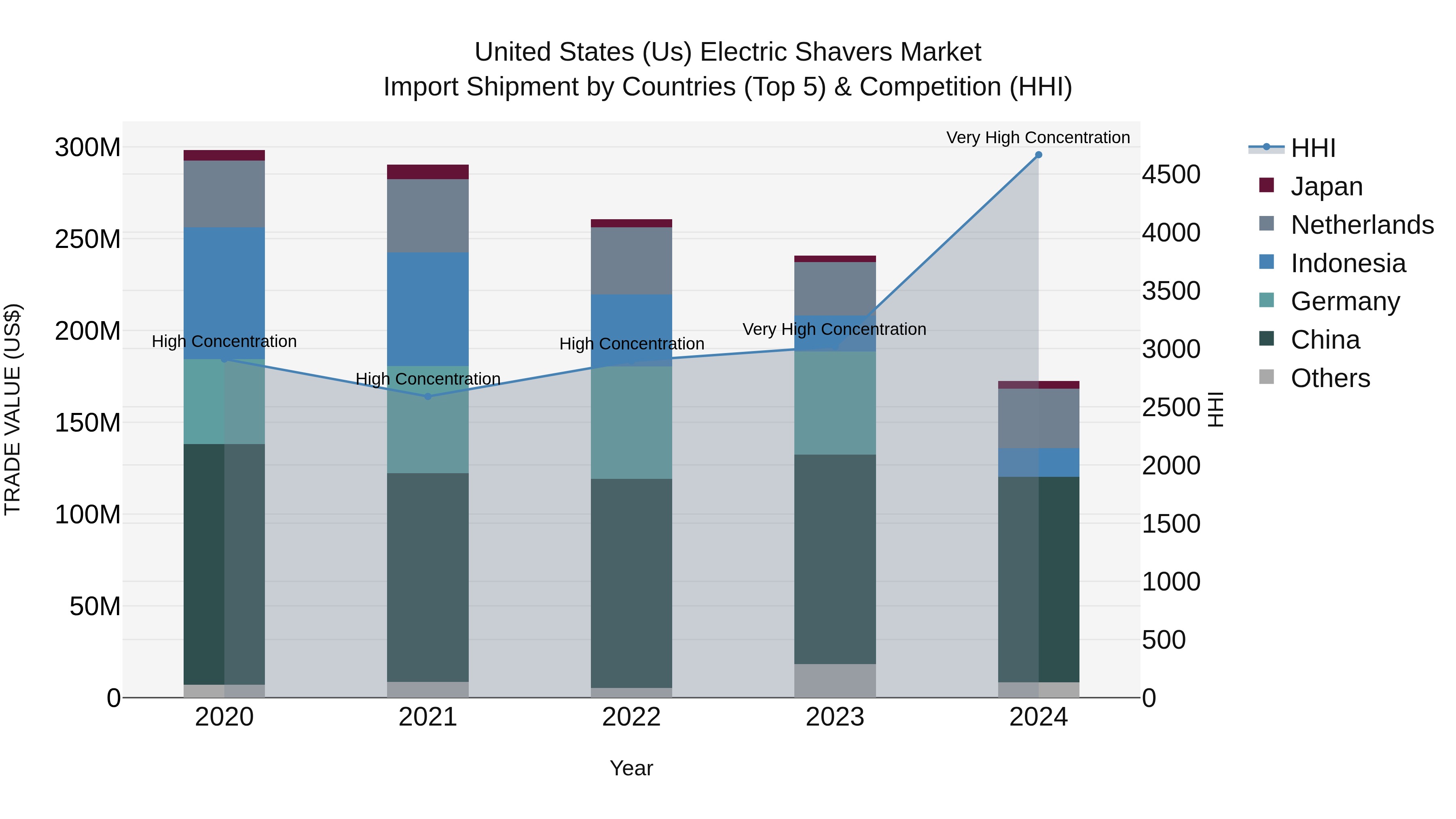
The United States saw a decline in electric shaver imports in 2024, with China, Netherlands, Indonesia, Japan, and Mexico being the top exporting countries. Despite a negative Compound Annual Growth Rate (CAGR) of -12.8% from 2020 to 2024, the Herfindahl-Hirschman Index (HHI) indicated a high concentration of imports. The growth rate plummeted even further in 2024, with a significant decrease of -28.41% compared to the previous year. This trend suggests a challenging market environment for electric shaver imports into the US, potentially influenced by various factors such as changing consumer preferences or supply chain disruptions.
USA Export Potential Assessment For Electric shavers Market (Values in USD Thousand)
United States (US) Electric shavers Market Overview
The United States electric shavers market is a dynamic and competitive industry characterized by a wide range of products catering to various consumer needs. With a growing emphasis on personal grooming and convenience, electric shavers have become increasingly popular among both men and women in the US. Key players in the market include industry giants such as Philips, Braun, and Panasonic, as well as emerging brands offering innovative features and designs. Factors driving market growth include technological advancements, increasing disposable income, and changing lifestyle trends. Product offerings range from basic entry-level models to high-end, feature-rich devices with options such as wet/dry shaving, precision trimming, and ergonomic designs. Market trends also indicate a growing demand for eco-friendly and sustainable electric shavers, reflecting consumer preferences for environmentally conscious products.
United States (US) Electric shavers Market Trends
The US Electric shavers market is experiencing significant growth driven by a rising focus on personal grooming and convenience. Consumers are increasingly looking for advanced features such as precision cutting, longer battery life, and ergonomic designs. Multi-functional electric shavers that cater to different grooming needs are gaining popularity, leading to a shift towards hybrid models that can trim, shave, and style hair. Additionally, there is a growing demand for sustainable and eco-friendly electric shavers, with manufacturers incorporating recyclable materials and energy-efficient technologies. Online sales channels are also playing a crucial role in the market expansion, offering a wide range of options and convenient purchasing experiences for consumers. Overall, the US Electric shavers market is witnessing innovation, product diversification, and a focus on sustainability to meet evolving consumer preferences.
United States (US) Electric shavers Market Challenges
In the US Electric shavers market, one of the primary challenges faced is increasing competition from both traditional razor manufacturers and newer entrants offering innovative grooming solutions. The market is saturated with a wide range of products, leading to intense price competition and pressure on profit margins. Additionally, shifting consumer preferences towards natural and organic grooming products pose a challenge for electric shaver manufacturers to adapt and innovate their offerings. Moreover, the rapid pace of technological advancements requires companies to continuously invest in research and development to stay relevant and meet evolving consumer demands. Lastly, economic uncertainties and fluctuations in disposable income levels can impact consumer spending on non-essential items like electric shavers, further adding to the challenges faced by players in the US Electric shavers market.
United States (US) Electric shavers Market Investment Opportunities
The US Electric shavers market presents several investment opportunities due to the increasing adoption of grooming products, rising disposable income, and technological advancements in the industry. Key areas for investment include innovative product development focusing on features such as precision trimming, skin-friendly materials, and wireless charging capabilities to cater to evolving consumer preferences. Additionally, investing in marketing strategies to target specific consumer segments like millennials and men`s grooming enthusiasts can drive sales growth. Furthermore, exploring the potential for eco-friendly and sustainable electric shavers could also be a lucrative investment avenue considering the growing demand for environmentally conscious products. Overall, the US Electric shavers market offers opportunities for investors to capitalize on the market`s growth potential through product innovation, targeted marketing, and sustainability initiatives.
United States (US) Electric shavers Market Government Policy
The United States government does not have specific policies targeting the electric shavers market. However, general consumer protection laws, trade regulations, and safety standards apply to electric shavers. The US Consumer Product Safety Commission oversees product safety regulations, ensuring that electric shavers meet safety standards. Additionally, the Federal Trade Commission monitors advertising practices to prevent deceptive marketing in the electric shavers market. Import and export regulations also impact the industry, with tariffs and trade agreements affecting the pricing and availability of electric shavers in the US market. Overall, while there are no direct government policies solely focused on electric shavers, various regulations and oversight mechanisms contribute to shaping the market dynamics in the United States.
United States (US) Electric shavers Market Future Outlook
The United States electric shavers market is poised for steady growth in the coming years, driven by factors such as increasing consumer preference for grooming products, technological advancements in electric shaver designs, and rising awareness about personal grooming among both men and women. The market is expected to witness a surge in demand for high-tech features such as precision trimming, wet and dry shaving capabilities, and longer battery life. Additionally, the growing trend of online shopping and e-commerce platforms offering a wide range of electric shavers at competitive prices will further propel market growth. Overall, the US electric shavers market is likely to experience a positive trajectory, with manufacturers focusing on innovation and product differentiation to cater to evolving consumer preferences.
Key Highlights of the Report:
- United States (US) Electric shavers Market Outlook
- Market Size of United States (US) Electric shavers Market, 2021
- Forecast of United States (US) Electric shavers Market, 2027
- Historical Data and Forecast of United States (US) Electric shavers Revenues & Volume for the Period 2018 - 2027
- United States (US) Electric shavers Market Trend Evolution
- United States (US) Electric shavers Market Drivers and Challenges
- United States (US) Electric shavers Price Trends
- United States (US) Electric shavers Porter's Five Forces
- United States (US) Electric shavers Industry Life Cycle
- Historical Data and Forecast of United States (US) Electric shavers Market Revenues & Volume By Product for the Period 2018 - 2027
- Historical Data and Forecast of United States (US) Electric shavers Market Revenues & Volume By Oil Shaver for the Period 2018 - 2027
- Historical Data and Forecast of United States (US) Electric shavers Market Revenues & Volume By Wet/Dry Shaver for the Period 2018 - 2027
- Historical Data and Forecast of United States (US) Electric shavers Market Revenues & Volume By Clippers for the Period 2018 - 2027
- Historical Data and Forecast of United States (US) Electric shavers Market Revenues & Volume By A Rotary Shaver for the Period 2018 - 2027
- Historical Data and Forecast of United States (US) Electric shavers Market Revenues & Volume By Accessories for the Period 2018 - 2027
- Historical Data and Forecast of United States (US) Electric shavers Market Revenues & Volume By End-user for the Period 2018 - 2027
- Historical Data and Forecast of United States (US) Electric shavers Market Revenues & Volume By Male for the Period 2018 - 2027
- Historical Data and Forecast of United States (US) Electric shavers Market Revenues & Volume By Female for the Period 2018 - 2027
- Historical Data and Forecast of United States (US) Electric shavers Market Revenues & Volume By Distribution Channel for the Period 2018 - 2027
- Historical Data and Forecast of United States (US) Electric shavers Market Revenues & Volume By Health & Beauty Stores for the Period 2018 - 2027
- Historical Data and Forecast of United States (US) Electric shavers Market Revenues & Volume By General Merchandising/Mass Stores for the Period 2018 - 2027
- Historical Data and Forecast of United States (US) Electric shavers Market Revenues & Volume By Supermarkets & Hypermarkets for the Period 2018 - 2027
- Historical Data and Forecast of United States (US) Electric shavers Market Revenues & Volume By Others for the Period 2018 - 2027
- Historical Data and Forecast of United States (US) Electric shavers Market Revenues & Volume By Type for the Period 2018 - 2027
- Historical Data and Forecast of United States (US) Electric shavers Market Revenues & Volume By Rechargeable Shaver for the Period 2018 - 2027
- Historical Data and Forecast of United States (US) Electric shavers Market Revenues & Volume By Battery Type Shaver for the Period 2018 - 2027
- United States (US) Electric shavers Import Export Trade Statistics
- Market Opportunity Assessment By Product
- Market Opportunity Assessment By End-user
- Market Opportunity Assessment By Distribution Channel
- Market Opportunity Assessment By Type
- United States (US) Electric shavers Top Companies Market Share
- United States (US) Electric shavers Competitive Benchmarking By Technical and Operational Parameters
- United States (US) Electric shavers Company Profiles
- United States (US) Electric shavers Key Strategic Recommendations






































