United States (US) Facial Recognition Market Size & Growth Rate (2026-2032)
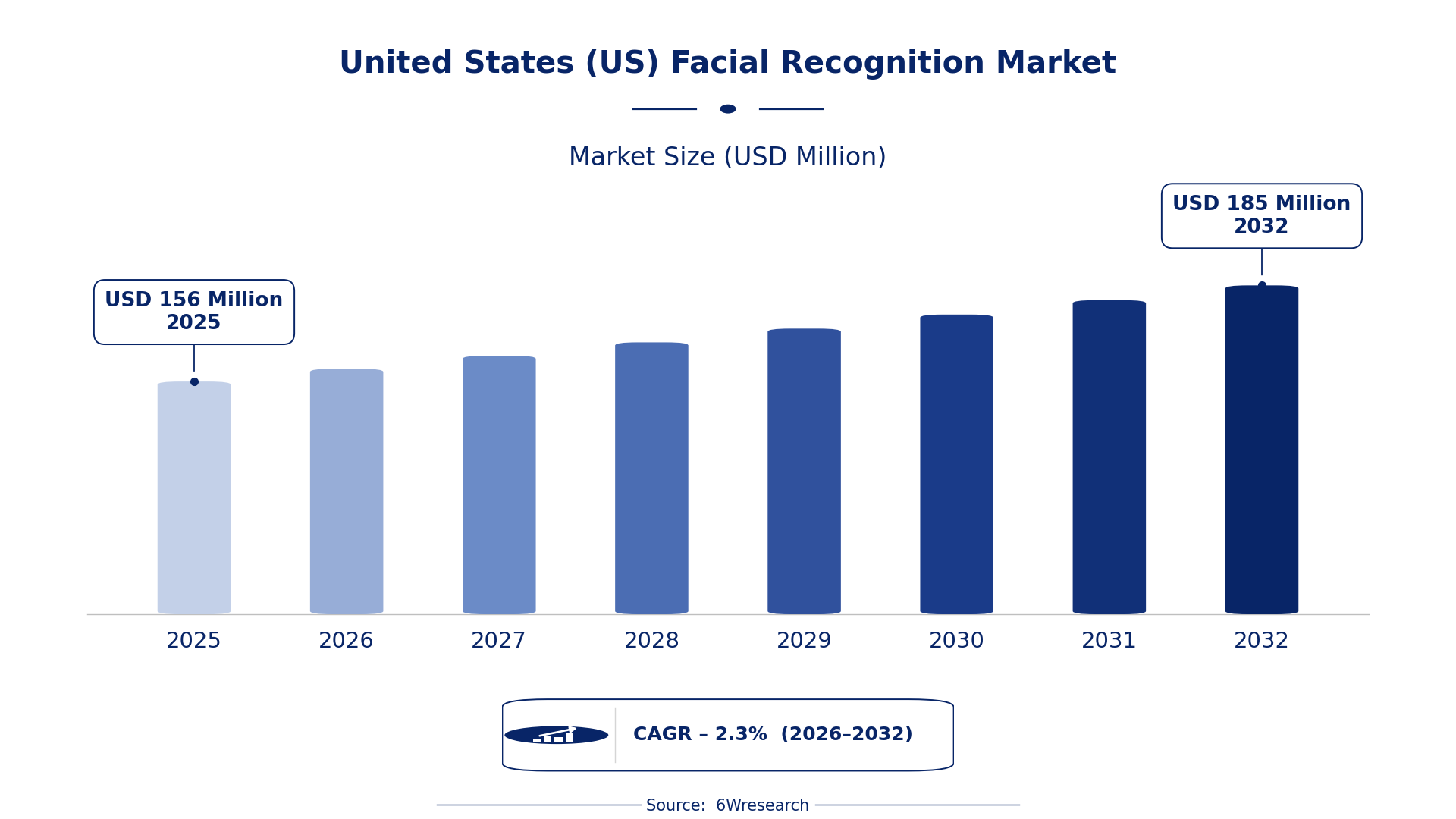
The United States (US) Facial Recognition Market was estimated at USD 156 Million in 2025 and is projected to reach USD 185 Million by 2032, growing at a CAGR of 2.3% from 2026 to 2032.
United States (US) Facial Recognition Market Synopsis
The most significant factor driving the United States Facial Recognition Market is the increasing demand for security solutions across various sectors. As organizations grapple with rising security threats, the need for accurate and reliable identification systems has never been more critical.
In addition, the growing integration of AI and machine learning technologies into facial recognition systems is pushing the boundaries of efficiency and effectiveness. As businesses seek to improve customer experiences and operational efficiency, the adoption of these advanced technologies is accelerating.
United States (US) Facial Recognition Market Year-wise Growth Rate and Key Drivers
This graph illustrates the annual growth rates of the United States (US) Facial Recognition Market from 2021 to 2032, highlighting a steady upward trajectory and projected expansion over the forecast period.
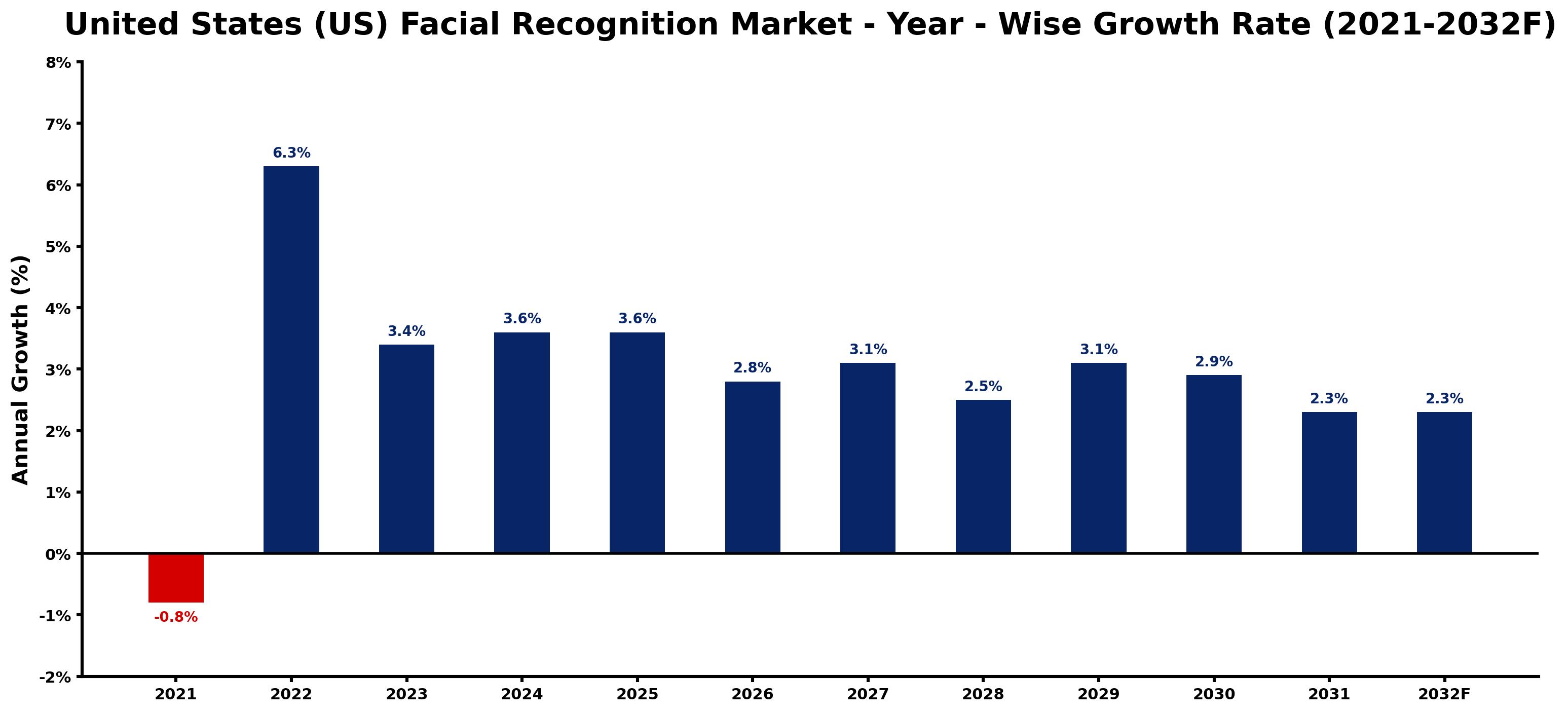
The table below presents the year‑wise growth rates along with the key drivers influencing the market
| Year | Growth Rate | Major Drivers |
| 2021 | -0.8% | Federal Trade Commission privacy concerns deterred adoption. |
| 2022 | 6.3% | Increased demand for security in public spaces. |
| 2023 | 3.4% | Enhanced biometric regulations from the Federal Trade Commission. |
| 2024 | 3.6% | Growth in police adoption following crime prevention initiatives. |
| 2025 | 3.6% | Rise in retail applications for customer engagement analytics. |
| 2026 | 2.8% | Expanding AI investments by major US tech companies. |
| 2027 | 3.1% | New law enforcement standards support facial recognition integration. |
| 2028 | 2.5% | Emerging partnership between tech firms and security agencies. |
| 2029 | 3.1% | Increased use in healthcare for patient identification security. |
| 2030 | 2.9% | Regulatory support for contactless technology in transportation. |
| 2031 | 2.3% | Rising public acceptance of surveillance for safety measures. |
| 2032 | 2.3% | Government grants for advanced security technology implementations. |
Note: Market size estimations and growth projections presented in this report are based on 6Wresearch's proprietary forecasting methodology, utilizing the latest available industry data, government publications, and primary research inputs.
United States (US) Facial Recognition Market Key Takeaways
Below are some of the specific key takeaways from the market, including:
- The market is witnessing a surge in the use of facial recognition for law enforcement and security applications.
- AI and machine learning integration are enhancing the accuracy of facial recognition systems.
- Contactless authentication solutions have gained traction, especially amid health concerns from the COVID-19 pandemic.
- Privacy and data security issues remain prominent challenges that need to be addressed for broader acceptance.
- Investment opportunities are emerging across sectors like healthcare, retail, and automotive as businesses seek to improve security measures.
Evaluation of Restraints in United States (US) Facial Recognition Market
The United States Facial Recognition Market faces several pressing challenges that could impede its growth. Privacy concerns are at the forefront, with many consumers wary of how biometric data is collected and utilized. The potential for biases in facial recognition technology further complicates the situation, leading to public skepticism. on top of that, the absence of comprehensive federal regulations creates uncertainty for businesses trying to navigate this complex landscape.
These restraints necessitate a concerted effort from industry stakeholders to establish ethical guidelines and improve transparency in the usage of facial recognition technology.
United States (US) Facial Recognition Market Trends
The trends shaping the United States Facial Recognition Market reflect an ongoing evolution in technology and application. The integration of AI and machine learning is not just a trend; it's becoming a standard for enhancing accuracy and operational efficiency. on top of that, the push for contactless authentication methods is likely to persist as more businesses adopt these solutions in response to changing consumer expectations.
Additionally, there is a growing trend toward using facial recognition for personalized marketing, enabling retailers to tailor experiences based on customer preferences and behaviors. This trend is expected to drive further adoption across various sectors.
United States (US) Facial Recognition Market Opportunities
Investment opportunities within the United States Facial Recognition Market are abundant, particularly in sectors demanding enhanced security and identification systems. The healthcare industry, for example, is increasingly adopting facial recognition technology to streamline patient verification processes and improve security in facilities.
Retailers are also tapping into the technology for customer insights and personalized shopping experiences. on top of that, the automotive sector is beginning to explore facial recognition for driver monitoring systems, presenting a new frontier for growth and innovation.
Government Initiatives in the United States (US) Facial Recognition Market
The regulatory environment surrounding the United States Facial Recognition Market is evolving, with various government initiatives reflecting public concerns and technological advancements. While there is currently no comprehensive federal regulation, local and state governments are increasingly scrutinizing the use of facial recognition technology.
- A regulatory framework introduced in 2025 aims to establish best practices for the use of facial recognition by law enforcement agencies.
- Several states are currently evaluating legislation to limit the use of facial recognition technology, driven by privacy advocacy and civil rights concerns.
- A national digital infrastructure upgrade program is underway, which includes funding for secure biometric systems in public safety initiatives.
- In 2024, a public-private partnership was launched to promote transparency and accountability in facial recognition usage across various sectors.
- Future plans include the rollout of a standardized framework for data handling and privacy protection for biometric data, expected to be drafted by late 2026.
Future Insights of the United States (US) Facial Recognition Market
Looking ahead to 2026-2032, the United States Facial Recognition Market is set to experience notable advancements driven by technological innovation and rising security concerns. As organizations increasingly prioritize advanced identification systems, the demand for accurate and efficient facial recognition solutions will continue to grow.
The integration of AI and machine learning will further enhance system capabilities, while ongoing discussions around privacy and regulatory measures will shape market dynamics. Businesses that navigate these complexities effectively will likely emerge as leaders in this evolving landscape.
United States (US) Facial Recognition Market Latest Developments
Recent months have seen a flurry of activity in the United States Facial Recognition Market, with advancements in technology and regulatory discussions gaining momentum. Companies are increasingly focused on enhancing the accuracy and efficiency of facial recognition systems, while also addressing privacy concerns that have captured public attention.
- A major technology vendor launched a new AI-driven facial recognition system in Q1 2025, designed to improve accuracy across diverse demographic groups.
- In mid-2025, a pilot program was initiated in several cities to test the efficacy of contactless authentication systems in public transport facilities.
- An initiative that began in early 2025 aims to establish ethical guidelines for the deployment of facial recognition technology in commercial settings.
- By late 2025, a collaborative project involving several states is expected to provide insights into the impact of facial recognition technology on public safety.
- A rollout of updated regulatory guidelines is anticipated in 2026, focusing on data security measures for biometric data collection.
United States (US) Facial Recognition Market - Key Attractiveness of the Report
- 10 Years of Market Numbers
- Historical Data Starting from 2022 to 2025
- Base Year: 2025
- Forecast Data until 2032
- Key Performance Indicators Impacting the Market
- Major Upcoming Developments and Projects
Key Highlights of the Report:
- United States (US) Facial Recognition Market Outlook
- Market Size of United States (US) Facial Recognition Market, 2025
- Forecast of United States (US) Facial Recognition Market, 2032
- Historical Data and Forecast of United States (US) Facial Recognition Revenues & Volume for the Period 2022-2032F
- United States (US) Facial Recognition Market Trend Evolution
- United States (US) Facial Recognition Market Drivers and Challenges
- United States (US) Facial Recognition Price Trends
- United States (US) Facial Recognition Porter's Five Forces
- United States (US) Facial Recognition Industry Life Cycle
- Historical Data and Forecast of United States (US) Facial Recognition Market Revenues & Volume By Component for the Period 2022-2032F
- Historical Data and Forecast of United States (US) Facial Recognition Market Revenues & Volume By Software for the Period 2022-2032F
- Historical Data and Forecast of United States (US) Facial Recognition Market Revenues & Volume By Services for the Period 2022-2032F
- Historical Data and Forecast of United States (US) Facial Recognition Market Revenues & Volume By Application for the Period 2022-2032F
- Historical Data and Forecast of United States (US) Facial Recognition Market Revenues & Volume By Access Control for the Period 2022-2032F
- Historical Data and Forecast of United States (US) Facial Recognition Market Revenues & Volume By Attendance Tracking & Monitoring for the Period 2022-2032F
- Historical Data and Forecast of United States (US) Facial Recognition Market Revenues & Volume By Emotion Recognition for the Period 2022-2032F
- Historical Data and Forecast of United States (US) Facial Recognition Market Revenues & Volume By Security & Surveillance for the Period 2022-2032F
- Historical Data and Forecast of United States (US) Facial Recognition Market Revenues & Volume By Others for the Period 2022-2032F
- Historical Data and Forecast of United States (US) Facial Recognition Market Revenues & Volume By Vertical for the Period 2022-2032F
- Historical Data and Forecast of United States (US) Facial Recognition Market Revenues & Volume By Retail & E-Commerce for the Period 2022-2032F
- Historical Data and Forecast of United States (US) Facial Recognition Market Revenues & Volume By Media & Entertainment for the Period 2022-2032F
- Historical Data and Forecast of United States (US) Facial Recognition Market Revenues & Volume By BFSI for the Period 2022-2032F
- Historical Data and Forecast of United States (US) Facial Recognition Market Revenues & Volume By Automobile & Transportation for the Period 2022-2032F
- Historical Data and Forecast of United States (US) Facial Recognition Market Revenues & Volume By Telecom & IT for the Period 2022-2032F
- Historical Data and Forecast of United States (US) Facial Recognition Market Revenues & Volume By Government for the Period 2022-2032F
- Historical Data and Forecast of United States (US) Facial Recognition Market Revenues & Volume By Healthcare for the Period 2022-2032F
- Historical Data and Forecast of United States (US) Facial Recognition Market Revenues & Volume By Others for the Period 2022-2032F
- Historical Data and Forecast of United States (US) Facial Recognition Market Revenues & Volume By Technology for the Period 2022-2032F
- Historical Data and Forecast of United States (US) Facial Recognition Market Revenues & Volume By 2D for the Period 2022-2032F
- Historical Data and Forecast of United States (US) Facial Recognition Market Revenues & Volume By 3D for the Period 2022-2032F
- Historical Data and Forecast of United States (US) Facial Recognition Market Revenues & Volume By Facial Analytics for the Period 2022-2032F
- United States (US) Facial Recognition Import Export Trade Statistics
- Market Opportunity Assessment By Component
- Market Opportunity Assessment By Application
- Market Opportunity Assessment By Vertical
- Market Opportunity Assessment By Technology
- United States (US) Facial Recognition Top Companies Market Share
- United States (US) Facial Recognition Competitive Benchmarking By Technical and Operational Parameters
- United States (US) Facial Recognition Company Profiles
- United States (US) Facial Recognition Key Strategic Recommendations






































