United States (US) Fans and Blowers Market Top 5 Importing Countries and Market Competition (HHI) Analysis
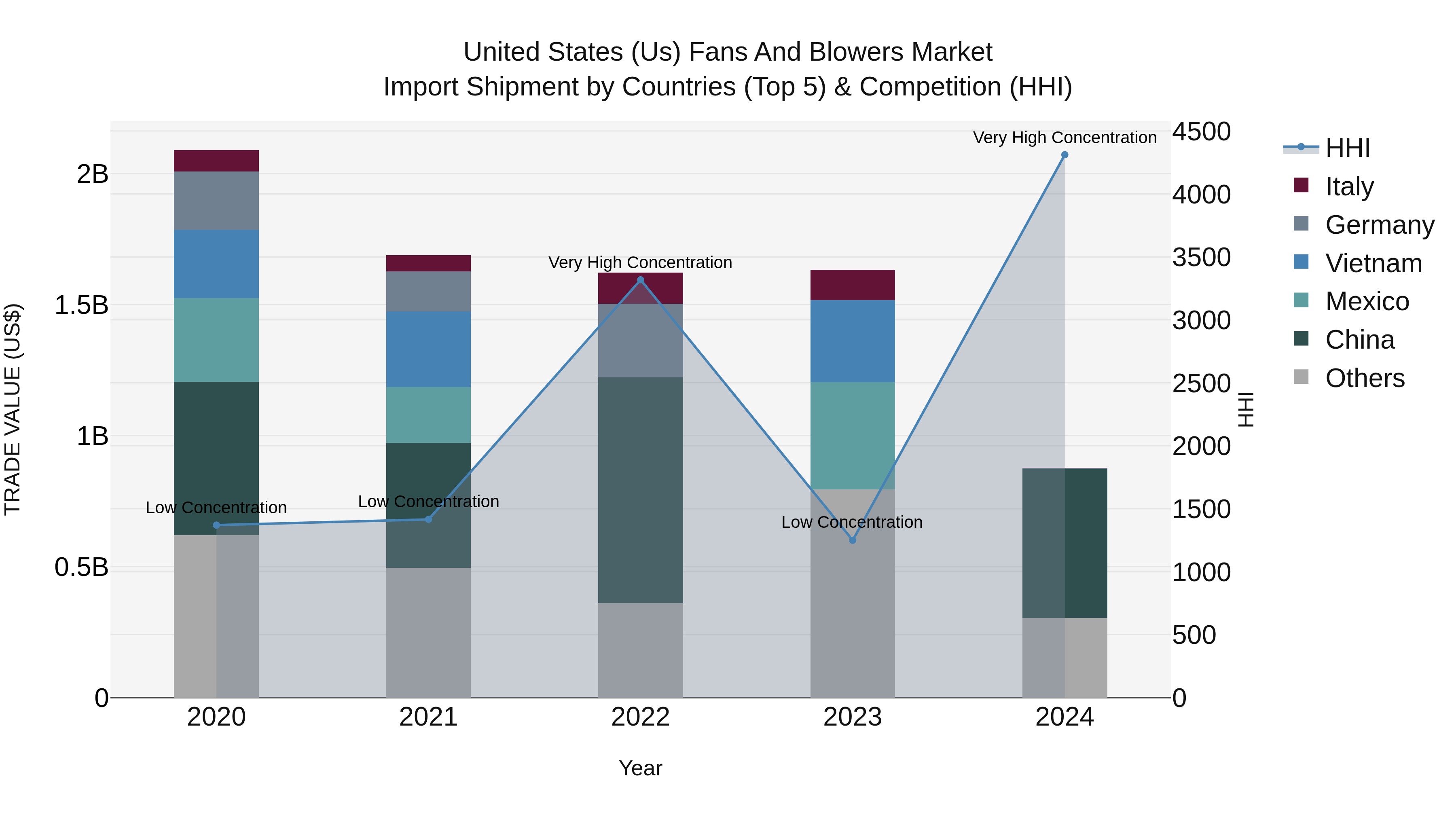
US fans and blowers import shipments in 2024 saw a significant shift in concentration, with top exporting countries being China, UAE, Denmark, Ireland, and Hungary. The HHI index showed a shift from low to very high concentration. The industry experienced a negative CAGR of -19.52% from 2020 to 2024, with a sharp decline in growth rate of -46.29% from 2023 to 2024. This data indicates a challenging market environment for US importers in the fans and blowers sector, highlighting the need for strategic planning and adaptation to changing market dynamics.
USA Export Potential Assessment For Fans And Blowers Market (Values in USD Thousand)
United States (US) Fans And Blowers Market Overview
The United States fans and blowers market is a mature and highly competitive industry driven by factors such as industrial growth, infrastructure development, and technological advancements. The market is segmented into various types of fans and blowers, including axial fans, centrifugal fans, and industrial blowers, catering to diverse applications across industries such as HVAC, automotive, power generation, and manufacturing. Key trends in the market include a shift towards energy-efficient and environmentally friendly products, as well as increasing demand for customized solutions to meet specific industrial requirements. Major players in the US fans and blowers market include companies like Tuthill Corporation, Twin City Fan Companies, and Howden Group, among others. With a strong focus on innovation and product development, the market is expected to witness steady growth in the coming years.
United States (US) Fans And Blowers Market Trends
The United States Fans and Blowers Market is experiencing several key trends. Firstly, there is a growing demand for energy-efficient and environmentally friendly products, leading to an increased focus on developing high-efficiency fans and blowers. Additionally, advancements in technology such as IoT integration and smart controls are being incorporated into fans and blowers, enabling remote monitoring and control for improved efficiency. The market is also witnessing a rise in demand from various industries including HVAC, automotive, and manufacturing as they expand and upgrade their facilities. Furthermore, there is a shift towards customization and tailor-made solutions to meet specific requirements of end-users. Overall, these trends indicate a positive outlook for the US Fans and Blowers Market with a focus on innovation, sustainability, and industry-specific solutions.
United States (US) Fans And Blowers Market Challenges
In the US Fans And Blowers Market, several challenges are prominent. One key challenge is the increasing competition from international manufacturers offering lower-cost products, leading to price pressures on domestic companies. Another challenge is the need for constant innovation to meet evolving customer demands for energy-efficient and environmentally friendly products. Additionally, stringent regulations related to emissions and noise levels pose compliance challenges for manufacturers. The market also faces disruptions due to supply chain issues, such as component shortages and transportation delays. Furthermore, fluctuations in raw material prices and economic uncertainties can impact the overall growth and profitability of companies operating in the US Fans And Blowers Market. Overcoming these challenges requires strategic planning, investment in research and development, and a strong focus on operational efficiency.
United States (US) Fans And Blowers Market Investment Opportunities
The US Fans and Blowers Market presents various investment opportunities for both domestic and international investors. With the growing demand for energy-efficient and technologically advanced products in industries such as HVAC, automotive, and power generation, investing in companies that specialize in the manufacturing and distribution of high-quality fans and blowers could be lucrative. Additionally, the increasing emphasis on sustainability and environmental regulations is driving the adoption of eco-friendly solutions in the market. Investing in companies that offer green and energy-efficient fans and blowers can be a strategic move. Furthermore, the market is witnessing innovations in smart and connected fans and blowers, presenting opportunities for investors looking to capitalize on the trend towards automation and digitization in industrial processes.
United States (US) Fans And Blowers Market Government Policy
The US government has implemented various policies related to the Fans and Blowers Market, including energy efficiency standards set by the Department of Energy (DOE) to promote the use of energy-efficient products. Additionally, the Environmental Protection Agency (EPA) has regulations in place to ensure that fans and blowers meet emission standards and do not harm the environment. Trade policies and tariffs imposed by the US government can also impact the import and export of fans and blowers. The government also supports research and development initiatives in the industry through grants and incentives to encourage innovation and technological advancements in the market. Overall, government policies in the US Fans and Blowers Market aim to promote sustainability, energy efficiency, and compliance with environmental regulations while fostering growth and competitiveness in the industry.
United States (US) Fans And Blowers Market Future Outlook
The United States fans and blowers market is expected to witness steady growth in the coming years due to increasing demand from various industries such as HVAC, automotive, and manufacturing. Factors such as rising investments in infrastructure development, technological advancements leading to energy-efficient products, and stringent regulations regarding air quality control are driving the market growth. Additionally, the growing focus on sustainable practices and increasing awareness about energy conservation are expected to further boost the market. The adoption of smart technologies and IoT integration in fans and blowers is also anticipated to drive market growth. Overall, the US fans and blowers market is projected to expand steadily in the foreseeable future.
Key Highlights of the Report:
- United States (US) Fans And Blowers Market Outlook
- Market Size of United States (US) Fans And Blowers Market, 2021
- Forecast of United States (US) Fans And Blowers Market, 2031
- Historical Data and Forecast of United States (US) Fans And Blowers Revenues & Volume for the Period 2018 - 2031
- United States (US) Fans And Blowers Market Trend Evolution
- United States (US) Fans And Blowers Market Drivers and Challenges
- United States (US) Fans And Blowers Price Trends
- United States (US) Fans And Blowers Porter's Five Forces
- United States (US) Fans And Blowers Industry Life Cycle
- Historical Data and Forecast of United States (US) Fans And Blowers Market Revenues & Volume By Type for the Period 2018 - 2031
- Historical Data and Forecast of United States (US) Fans And Blowers Market Revenues & Volume By Centrifugal Fans and Blowers for the Period 2018 - 2031
- Historical Data and Forecast of United States (US) Fans And Blowers Market Revenues & Volume By Axial Fans and Blowers for the Period 2018 - 2031
- Historical Data and Forecast of United States (US) Fans And Blowers Market Revenues & Volume By Others for the Period 2018 - 2031
- Historical Data and Forecast of United States (US) Fans And Blowers Market Revenues & Volume By Application for the Period 2018 - 2031
- Historical Data and Forecast of United States (US) Fans And Blowers Market Revenues & Volume By Industrial for the Period 2018 - 2031
- Historical Data and Forecast of United States (US) Fans And Blowers Market Revenues & Volume By Commercial for the Period 2018 - 2031
- Historical Data and Forecast of United States (US) Fans And Blowers Market Revenues & Volume By Others for the Period 2018 - 2031
- Historical Data and Forecast of United States (US) Fans And Blowers Market Revenues & Volume By Distribution Channel for the Period 2018 - 2031
- Historical Data and Forecast of United States (US) Fans And Blowers Market Revenues & Volume By Online for the Period 2018 - 2031
- Historical Data and Forecast of United States (US) Fans And Blowers Market Revenues & Volume By Offline for the Period 2018 - 2031
- United States (US) Fans And Blowers Import Export Trade Statistics
- Market Opportunity Assessment By Type
- Market Opportunity Assessment By Application
- Market Opportunity Assessment By Distribution Channel
- United States (US) Fans And Blowers Top Companies Market Share
- United States (US) Fans And Blowers Competitive Benchmarking By Technical and Operational Parameters
- United States (US) Fans And Blowers Company Profiles
- United States (US) Fans And Blowers Key Strategic Recommendations






































