United States (US) Fleet Management Market Size & Growth Rate (2026-2032)
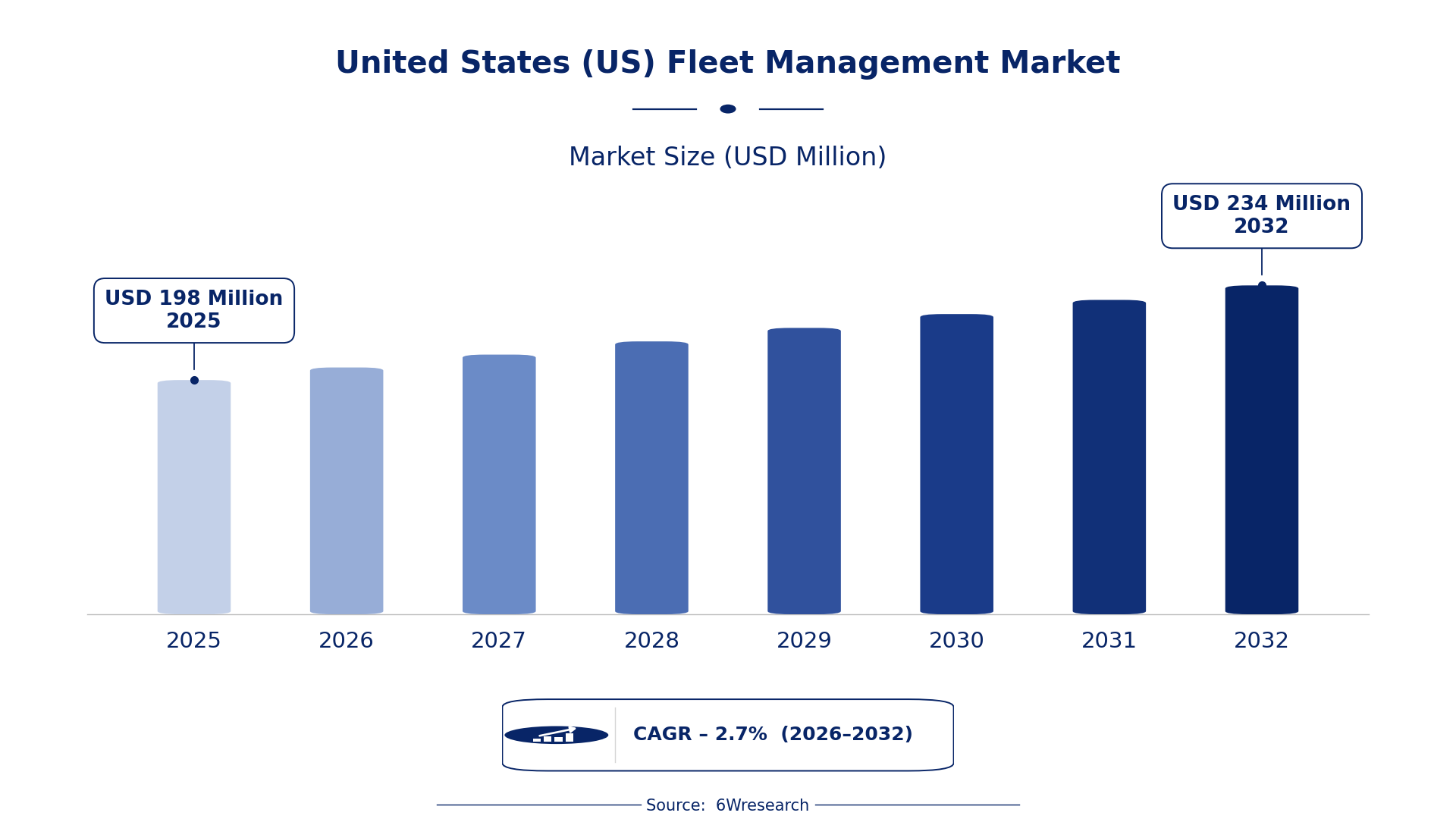
The United States (US) Fleet Management Market was estimated at USD 198 Million in 2025 and is projected to reach USD 234 Million by 2032, growing at a CAGR of 2.7% from 2026 to 2032.
United States (US) Fleet Management Market Synopsis
The demand for fleet management solutions in the United States is driven by a need for enhanced operational efficiency and cost reduction. Businesses are increasingly investing in technologies such as GPS tracking and telematics to ensure real-time monitoring of their vehicle fleets, thus improving performance and safety standards.
As industries adapt to evolving challenges, fleet management has become essential for navigating complexities such as regulatory compliance and rising fuel costs. Companies across various sectors are recognizing that effective fleet management not only optimizes routes but also contributes to sustainability efforts.
United States (US) Fleet Management Market Year-wise Growth Rate and Key Drivers
This graph illustrates the annual growth rates of the United States (US) Fleet Management Market from 2021 to 2032, highlighting a steady upward trajectory and projected expansion over the forecast period.
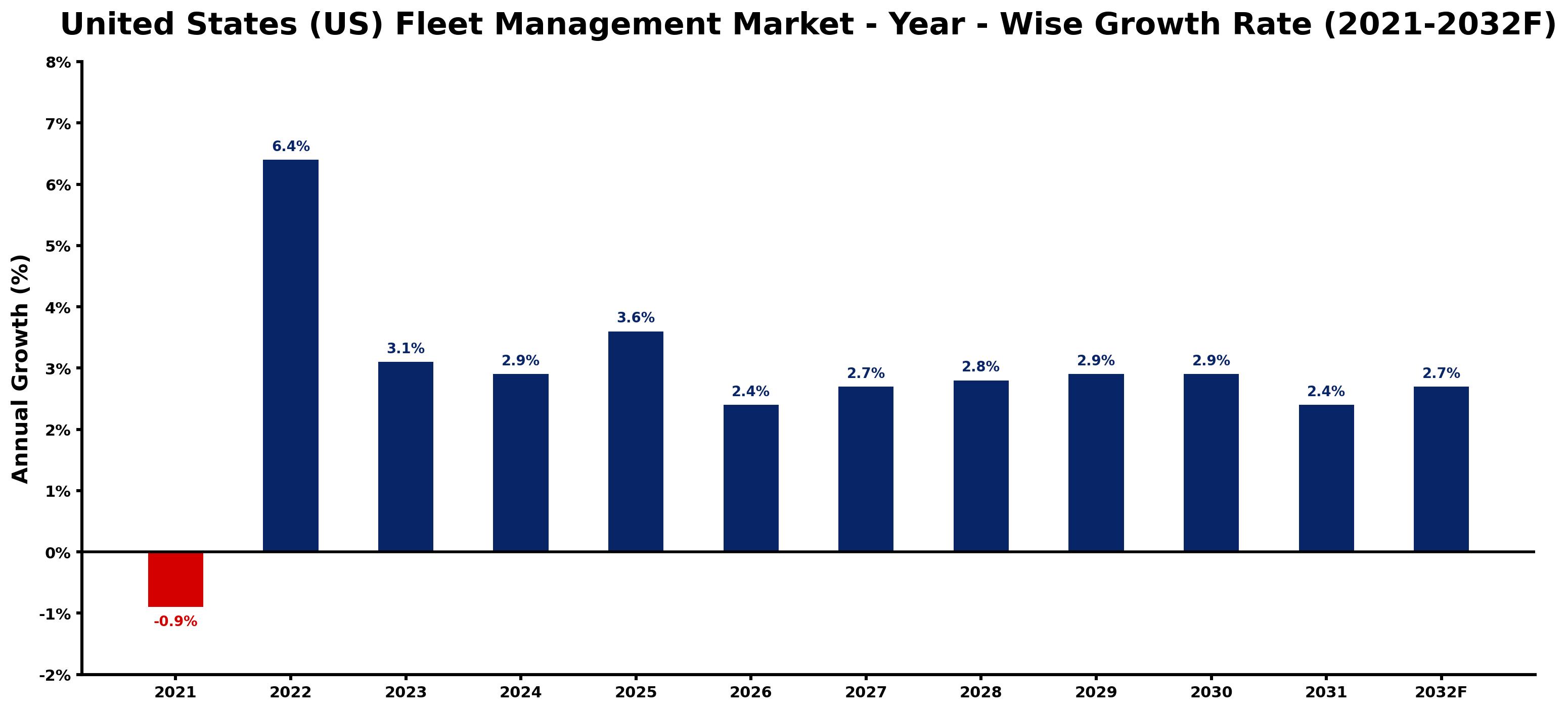
The table below presents the year‑wise growth rates along with the key drivers influencing the market
| Year | Growth Rate | Major Drivers |
| 2021 | -0.9% | Chip shortage impacting fleet management technology upgrades |
| 2022 | 6.4% | Increased adoption of telematics by US fleets |
| 2023 | 3.1% | Rise in sustainability regulations for fleet operations |
| 2024 | 2.9% | Government incentives for electric vehicle fleet upgrades |
| 2025 | 3.6% | Increased demand for real-time fleet tracking solutions |
| 2026 | 2.4% | Growing focus on reducing operational costs through optimization |
| 2027 | 2.7% | Expanding logistics industry requiring advanced fleet solutions |
| 2028 | 2.8% | Enhanced data analytics capabilities driving operational efficiency |
| 2029 | 2.9% | Regulatory pressures for emissions reduction in transport fleets |
| 2030 | 2.9% | Growing popularity of alternative fuel vehicles in fleets |
| 2031 | 2.4% | Continued investment in smart transportation technologies |
| 2032 | 2.7% | Increased focus on driver safety and compliance measures |
Note: Market size estimations and growth projections presented in this report are based on 6Wresearch's proprietary forecasting methodology, utilizing the latest available industry data, government publications, and primary research inputs.
United States (US) Fleet Management Market Key Takeaways
Below are some of the specific key takeaways from the market, including:
- Increased adoption of telematics and GPS technologies is transforming fleet efficiency.
- Electric vehicle integration is becoming a priority for many fleet operators.
- Data analytics and AI are playing a crucial role in decision-making processes.
- Regulatory compliance remains a significant driver of fleet management investments.
- Companies are seeking integrated solutions that cover multiple operational aspects.
Evaluation of Restraints in United States (US) Fleet Management Market
Several factors are restricting growth in the US Fleet Management Market. One major concern is the fluctuating cost of fuel, which directly impacts operational budgets for fleet managers. Regulatory changes, particularly regarding emissions and safety, are forcing companies to adapt quickly, often requiring significant investment in new technologies. on top of that, the rapid pace of technological advancement demands ongoing upgrades, which can strain resources. The shortage of skilled technicians and drivers further complicates operational efficiency, making it challenging for fleet managers to maintain optimal performance levels.
United States (US) Fleet Management Market Trends
Several key trends are shaping the US Fleet Management Market today. The rise of telematics solutions has become a cornerstone for businesses looking to improve fleet efficiency and driver safety. Additionally, the growing emphasis on sustainability has accelerated the demand for electric vehicles within fleets, driven by both cost efficiency and environmental considerations.
There’s also a noticeable shift towards integrated fleet management solutions that encompass a wide array of functionalities, including route optimization, maintenance scheduling, and fuel management. As data analytics and artificial intelligence continue to evolve, companies are increasingly turning to these technologies to make informed decisions and improve operational performance.
United States (US) Fleet Management Market Opportunities
The US Fleet Management Market presents a plethora of investment opportunities as businesses strive for operational excellence. The increasing demand for fleet telematics solutions is noteworthy; these systems enable real-time tracking and optimization of vehicles, a must-have for modern fleet operators. on top of that, there’s a burgeoning need for advanced software platforms that enhance analytics and maintenance scheduling, which can lead to substantial cost reductions.
Investment in electric and autonomous vehicles also stands out as a promising avenue for growth, propelled by environmental initiatives and the push for automation. Companies that provide innovative solutions to meet these evolving needs are likely to find ample opportunities in this expanding market.
Government Initiatives in the United States (US) Fleet Management Market
Government policies significantly influence the US Fleet Management Market, particularly in promoting sustainability and efficiency. Federal regulations like the Corporate Average Fuel Economy (CAFE) standards compel automakers to enhance fuel efficiency, which directly impacts fleet operations. Additionally, various incentives for adopting alternative fuel vehicles are reshaping fleet management strategies across the country.
- A regulatory framework introduced in 2025 mandating stricter vehicle emissions standards is currently under implementation.
- The Environmental Protection Agency (EPA) is offering grants to fleet operators for investing in clean transportation solutions, an ongoing initiative.
- A national program aimed at encouraging the transition to electric vehicles in commercial fleets was launched in late 2024.
- State-level tax incentives for businesses adopting telematics and fleet management technologies are currently available.
- A planned public-private partnership focused on enhancing infrastructure for electric vehicle charging stations is expected to roll out by 2026.
Future Insights of the United States (US) Fleet Management Market
Looking ahead to 2026-2032, the United States Fleet Management Market is set for noteworthy advancements, driven largely by technological innovation. The proliferation of telematics and vehicle connectivity technologies will continue to reshape how fleets operate, focusing on efficiency and compliance. The increasing shift towards electric and autonomous vehicles will also provide fertile ground for new fleet management solutions.
As more businesses recognize the strategic importance of fleet management, investment in cutting-edge technologies will likely grow, ensuring that operations are optimized not just for cost savings but for sustainability as well. The market's future appears bright, with ongoing innovation and adaptation to meet the evolving needs of fleet operators.
United States (US) Fleet Management Market Latest Developments
In the last 12-14 months, the United States Fleet Management Market has witnessed significant activity, reflecting a strong push towards technological integration and sustainability. Companies are launching new products and services that cater to the evolving demands of fleet operators, particularly in areas like telematics and electric vehicle integration.
- A major technology vendor launched an advanced telematics solution in Q2 2025 that enhances real-time vehicle tracking and analytics capabilities.
- An initiative focused on retrofitting existing fleet vehicles with electric components began in early 2025 and is currently ongoing.
- A regional operator is expanding its fleet to include electric vehicles, with a rollout expected to begin in the second half of 2026.
- A new software platform aimed at providing comprehensive maintenance management features was released in early 2025, enhancing fleet operational efficiency.
- Several companies are in discussions for partnerships to improve data sharing between fleets and smart city infrastructures, with developments anticipated in late 2025.
United States (US) Fleet Management Market - Key Attractiveness of the Report
- 10 Years of Market Numbers
- Historical Data Starting from 2022 to 2025
- Base Year: 2025
- Forecast Data until 2032
- Key Performance Indicators Impacting the Market
- Major Upcoming Developments and Projects
Key Highlights of the Report:
- United States (US) Fleet Management Market Outlook
- Market Size of United States (US) Fleet Management Market, 2025
- Forecast of United States (US) Fleet Management Market, 2032
- Historical Data and Forecast of United States (US) Fleet Management Revenues & Volume for the Period 2022-2032F
- United States (US) Fleet Management Market Trend Evolution
- United States (US) Fleet Management Market Drivers and Challenges
- United States (US) Fleet Management Price Trends
- United States (US) Fleet Management Porter's Five Forces
- United States (US) Fleet Management Industry Life Cycle
- Historical Data and Forecast of United States (US) Fleet Management Market Revenues & Volume By Solution for the Period 2022-2032F
- Historical Data and Forecast of United States (US) Fleet Management Market Revenues & Volume By Operations Management for the Period 2022-2032F
- Historical Data and Forecast of United States (US) Fleet Management Market Revenues & Volume By Vehicle Maintenance and Diagnostics for the Period 2022-2032F
- Historical Data and Forecast of United States (US) Fleet Management Market Revenues & Volume By Fleet Analytics and Reporting for the Period 2022-2032F
- Historical Data and Forecast of United States (US) Fleet Management Market Revenues & Volume By Deployment Type for the Period 2022-2032F
- Historical Data and Forecast of United States (US) Fleet Management Market Revenues & Volume By Cloud for the Period 2022-2032F
- Historical Data and Forecast of United States (US) Fleet Management Market Revenues & Volume By On-premises for the Period 2022-2032F
- Historical Data and Forecast of United States (US) Fleet Management Market Revenues & Volume By Fleet Type for the Period 2022-2032F
- Historical Data and Forecast of United States (US) Fleet Management Market Revenues & Volume By Commercial Fleets for the Period 2022-2032F
- Historical Data and Forecast of United States (US) Fleet Management Market Revenues & Volume By Passenger Cars for the Period 2022-2032F
- Historical Data and Forecast of United States (US) Fleet Management Market Revenues & Volume By Service for the Period 2022-2032F
- Historical Data and Forecast of United States (US) Fleet Management Market Revenues & Volume By Professional Services for the Period 2022-2032F
- Historical Data and Forecast of United States (US) Fleet Management Market Revenues & Volume By Managed Services for the Period 2022-2032F
- Historical Data and Forecast of United States (US) Fleet Management Market Revenues & Volume By Vertical for the Period 2022-2032F
- Historical Data and Forecast of United States (US) Fleet Management Market Revenues & Volume By Retail for the Period 2022-2032F
- Historical Data and Forecast of United States (US) Fleet Management Market Revenues & Volume By Healthcare and Pharmaceutical for the Period 2022-2032F
- Historical Data and Forecast of United States (US) Fleet Management Market Revenues & Volume By Construction for the Period 2022-2032F
- Historical Data and Forecast of United States (US) Fleet Management Market Revenues & Volume By Transportation and Logistics for the Period 2022-2032F
- Historical Data and Forecast of United States (US) Fleet Management Market Revenues & Volume By Utilities for the Period 2022-2032F
- Historical Data and Forecast of United States (US) Fleet Management Market Revenues & Volume By Oil, Gas, and Mining for the Period 2022-2032F
- Historical Data and Forecast of United States (US) Fleet Management Market Revenues & Volume By Government for the Period 2022-2032F
- Historical Data and Forecast of United States (US) Fleet Management Market Revenues & Volume By Other Verticals for the Period 2022-2032F
- United States (US) Fleet Management Import Export Trade Statistics
- Market Opportunity Assessment By Solution
- Market Opportunity Assessment By Deployment Type
- Market Opportunity Assessment By Fleet Type
- Market Opportunity Assessment By Service
- Market Opportunity Assessment By Vertical
- United States (US) Fleet Management Top Companies Market Share
- United States (US) Fleet Management Competitive Benchmarking By Technical and Operational Parameters
- United States (US) Fleet Management Company Profiles
- United States (US) Fleet Management Key Strategic Recommendations






































