United States (US) Food Dehydrators Market Size, Share & Growth Rate
The United States (US) Food Dehydrators Market was estimated at USD 174 Million in 2025 and is projected to reach USD 205 Million by 2032, growing at a CAGR of 2.4% from 2026 to 2032. This growth trajectory is fueled by increasing consumer interest in healthy snacking alternatives and a surge in home food preservation methods. As consumers prioritize retaining nutritional value in their food while minimizing waste, the appeal of food dehydrators continues to expand.
United States (US) Food Dehydrators Market Year-wise Growth Rate and Key Drivers
This graph highlights how the United States (US) Food Dehydrators Market has steadily grown over the years, supported by major growth factors.
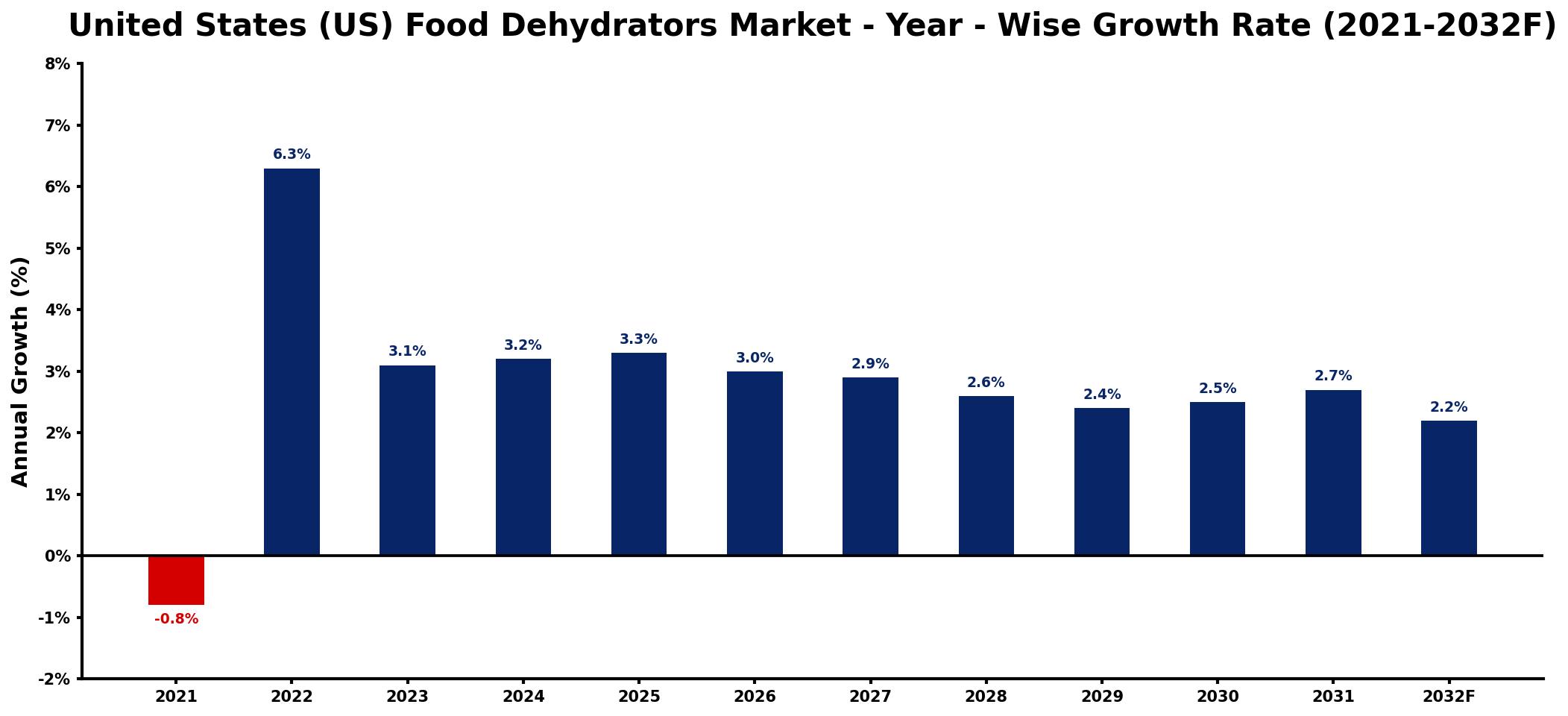
The table below presents the year‑wise growth rates along with the key drivers influencing the market
| Year | Growth Rate | Major Drivers |
| 2021 | -0.8% | shifts in consumer purchasing habits |
| 2022 | 6.3% | growing interest in healthy lifestyle |
| 2023 | 3.1% | increased home cooking popularity |
| 2024 | 3.2% | expansion of online retail channels |
| 2025 | 3.3% | rise in sustainable living practices |
| 2026 | 3.0% | advancements in energy efficient appliances |
| 2027 | 2.9% | rising demand from electronics |
| 2028 | 2.6% | growing demand for DIY solutions |
| 2029 | 2.4% | increased overall sector activity |
| 2030 | 2.5% | increased focus on nutrition education |
| 2031 | 2.7% | growth in eco-friendly packaging |
| 2032 | 2.2% | rising interest in culinary exploration |
Note: Market size estimations and growth projections presented in this report are based on 6Wresearch's proprietary forecasting methodology, utilizing the latest available industry data, government publications, and primary research inputs.
United States (US) Food Dehydrators Market Synopsis
The US Food Dehydrators Market is witnessing a notable shift toward healthier eating habits, as consumers seek ways to prepare their own nutrient-dense snacks at home. Dehydrators provide a practical solution for preserving various foods, appealing to both health enthusiasts and families looking to combat food waste.
Market offerings are diversifying, with innovative features such as smart technology and multi-functionality increasingly appealing to a tech-savvy audience. This evolution signals a robust future for food dehydrators, which are now positioned as essential kitchen appliances for both casual cooks and dedicated food preservers.
United States (US) Food Dehydrators Market Key Takeaways
- The market is thriving due to a heightened demand for home food preservation and healthy snack alternatives.
- Technological advancements are driving innovation, including smart and multifunctional dehydrator designs.
- Consumer awareness around food waste reduction is influencing purchasing decisions.
- Emerging trends point to increased preferences for compact and user-friendly dehydrators suited for urban living.
- Investment opportunities are on the rise, catering to niche markets including outdoor enthusiasts and DIY food preservers.
Evaluation of Restraints in United States (US) Food Dehydrators Market
Despite the positive growth outlook, several constraints are affecting the US Food Dehydrators Market. Increasing competition from alternative food preservation methods, such as freezing and canning, poses a challenge, as these options may be perceived as more convenient or cost-effective. Additionally, a significant portion of the consumer base remains unaware of the benefits of dehydrated foods, which hinders broader adoption. Price sensitivity also plays a role, as high-quality dehydrators can be a considerable investment, potentially limiting access for some consumers. Lastly, sustainability concerns regarding energy consumption and regulatory compliance for food safety further complicate the market landscape.
United States (US) Food Dehydrators Market Trends
The US Food Dehydrators Market is currently shaped by several key trends. The rise in health consciousness among consumers is driving demand for dehydrators, which allow for the preservation of nutrients in food. Additionally, technological advancements are leading to the development of smart dehydrators featuring programmable settings that enhance user experience. Compact designs are gaining traction, appealing to city dwellers with limited kitchen space, while multifunctional units are increasingly popular, merging capabilities like air frying and yogurt making.
United States (US) Food Dehydrators Market Opportunities
Investing in the US Food Dehydrators Market presents several lucrative opportunities. There is a growing inclination towards DIY food preservation, driven by consumers' desire for control over ingredients and processes. Developing energy-efficient technologies can also cater to environmentally conscious buyers. Targeting specialized consumer segments—such as those focused on healthy living, outdoor activities, and culinary enthusiasts—offers potential for tailored marketing strategies and product innovations, paving the way for sustained market growth.
Government Initiatives in the United States (US) Food Dehydrators Market
The US Food Dehydrators Market operates under the scrutiny of various government policies that prioritize food safety and quality. The Food and Drug Administration (FDA) plays a crucial role in regulating food processing methods, including dehydration, ensuring that products adhere to safety standards. Furthermore, the Department of Agriculture (USDA) provides guidelines regarding food preservation methods, which influence the design and functionality of dehydrators. Compliance with energy efficiency standards also remains important, fostering a market environment that aligns with broader sustainability goals.
Future Insights of the United States (US) Food Dehydrators Market
Looking ahead to 2026-2032, the United States Food Dehydrators Market is positioned for continued growth. The increasing focus on health and wellness, paired with a greater emphasis on sustainability and reducing food waste, will drive consumer engagement. Technological innovations and the emergence of multifunctional devices will reshape market dynamics, attracting a broader audience. As consumers become more educated about the benefits of dehydrated foods, the market is set to expand, promising a prosperous landscape for manufacturers and investors alike.
United States (US) Food Dehydrators Market Latest Developments (2025 - 2026)
Recent developments in the US Food Dehydrators Market indicate a strong shift towards integrating smart technology in dehydrators. Manufacturers are investing in research and development to introduce innovative features that allow users to control settings via mobile apps. Additionally, there is a rising trend of product launches focusing on energy efficiency and sustainability, with many companies emphasizing eco-friendly materials and practices in their manufacturing processes.
United States (US) Food Dehydrators Market - Key Attractiveness of the Report
- 10 Years of Market Numbers
- Historical Data Starting from 2022 to 2025
- Base Year: 2025
- Forecast Data until 2032
- Key Performance Indicators Impacting the Market
- Major Upcoming Developments and Projects
Key Highlights of the Report:
- United States (US) Food Dehydrators Market Outlook
- Market Size of United States (US) Food Dehydrators Market, 2025
- Forecast of United States (US) Food Dehydrators Market, 2032
- Historical Data and Forecast of United States (US) Food Dehydrators Revenues & Volume for the Period 2022-2032F
- United States (US) Food Dehydrators Market Trend Evolution
- United States (US) Food Dehydrators Market Drivers and Challenges
- United States (US) Food Dehydrators Price Trends
- United States (US) Food Dehydrators Porter's Five Forces
- United States (US) Food Dehydrators Industry Life Cycle
- Historical Data and Forecast of United States (US) Food Dehydrators Market Revenues & Volume By Technology for the Period 2022-2032F
- Historical Data and Forecast of United States (US) Food Dehydrators Market Revenues & Volume By Vertical Flow for the Period 2022-2032F
- Historical Data and Forecast of United States (US) Food Dehydrators Market Revenues & Volume By Horizontal Flow for the Period 2022-2032F
- Historical Data and Forecast of United States (US) Food Dehydrators Market Revenues & Volume By End-Use for the Period 2022-2032F
- Historical Data and Forecast of United States (US) Food Dehydrators Market Revenues & Volume By Industrial for the Period 2022-2032F
- Historical Data and Forecast of United States (US) Food Dehydrators Market Revenues & Volume By Commercial for the Period 2022-2032F
- Historical Data and Forecast of United States (US) Food Dehydrators Market Revenues & Volume By Residential for the Period 2022-2032F
- Historical Data and Forecast of United States (US) Food Dehydrators Market Revenues & Volume By Others for the Period 2022-2032F
- Historical Data and Forecast of United States (US) Food Dehydrators Market Revenues & Volume By Energy Source for the Period 2022-2032F
- Historical Data and Forecast of United States (US) Food Dehydrators Market Revenues & Volume By Electricity for the Period 2022-2032F
- Historical Data and Forecast of United States (US) Food Dehydrators Market Revenues & Volume By Biofuel for the Period 2022-2032F
- Historical Data and Forecast of United States (US) Food Dehydrators Market Revenues & Volume By Solar for the Period 2022-2032F
- Historical Data and Forecast of United States (US) Food Dehydrators Market Revenues & Volume By Others for the Period 2022-2032F
- United States (US) Food Dehydrators Import Export Trade Statistics
- Market Opportunity Assessment By Technology
- Market Opportunity Assessment By End-Use
- Market Opportunity Assessment By Energy Source
- United States (US) Food Dehydrators Top Companies Market Share
- United States (US) Food Dehydrators Competitive Benchmarking By Technical and Operational Parameters
- United States (US) Food Dehydrators Company Profiles
- United States (US) Food Dehydrators Key Strategic Recommendations






































