United States (US) Generator Market Top 5 Importing Countries and Market Competition (HHI) Analysis
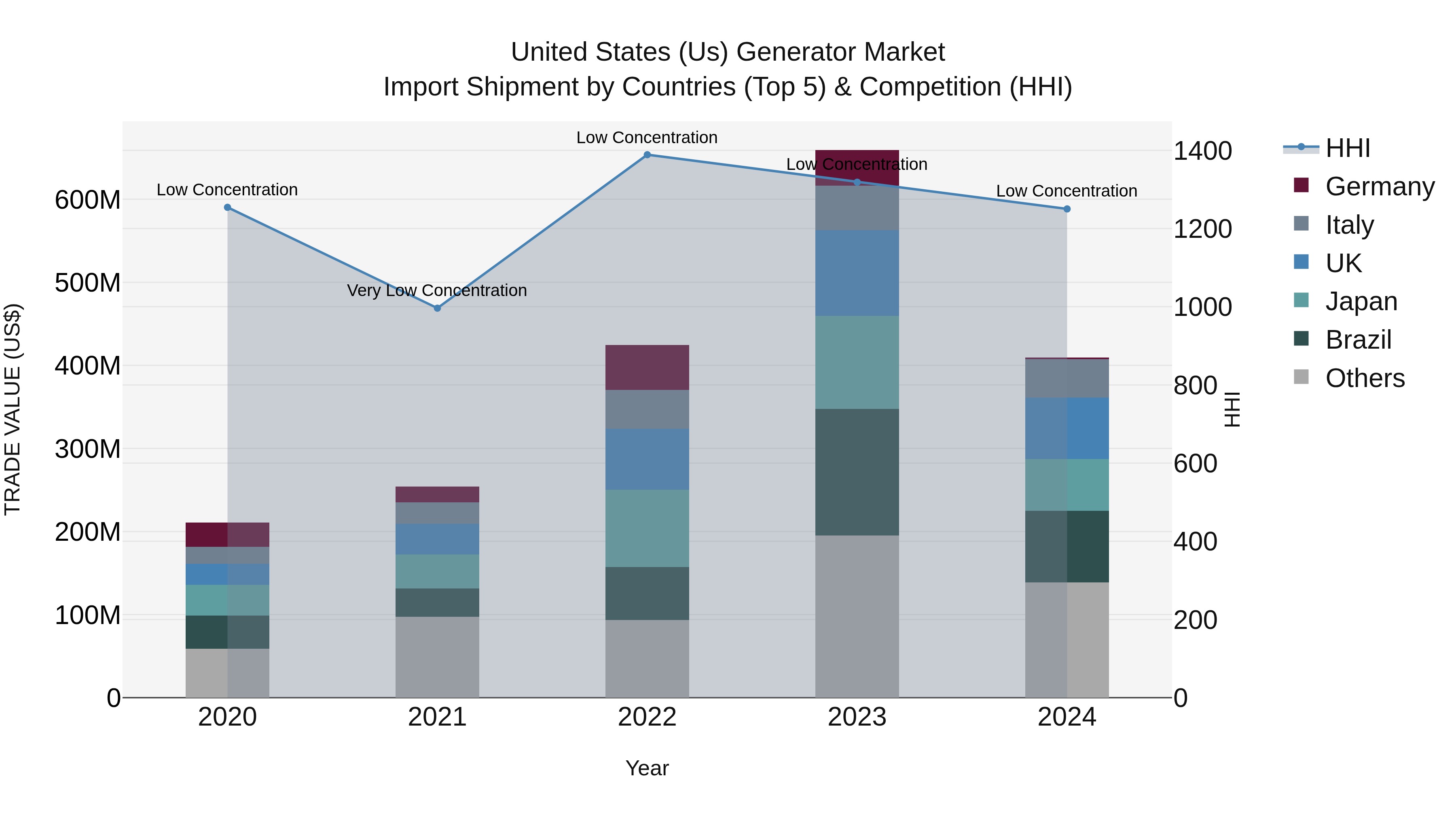
In 2024, the United States continued to see a diverse range of generator imports, with top suppliers including Brazil, UK, Japan, Italy, and Canada. The market exhibited low concentration with a low Herfindahl-Hirschman Index (HHI). The impressive compound annual growth rate (CAGR) of 18.07% from 2020 to 2024 indicates a strong upward trajectory in the generator import market. However, the negative growth rate of -37.85% from 2023 to 2024 suggests a recent slowdown in the industry. US importers should closely monitor these trends to make informed decisions in this competitive market.
USA Export Potential Assessment For Generator Market (Values in USD Thousand)
United States (US) Generator Market Synopsis
The United States generator market is a dynamic and growing industry driven by increasing demand for backup power solutions across various sectors including residential, commercial, industrial, and healthcare. Factors such as extreme weather events, aging power infrastructure, and the need for reliable power supply have propelled the market expansion. The market offers a wide range of generators including portable generators, standby generators, and inverter generators catering to different customer needs. Key players in the US generator market include Generac Power Systems, Cummins Inc., Caterpillar Inc., and Briggs & Stratton Corporation. Technological advancements such as smart generators, remote monitoring capabilities, and increased focus on energy efficiency are shaping the market landscape. Additionally, government initiatives promoting clean energy sources are influencing the adoption of environmentally friendly generators in the US market.
United States (US) Generator Market Trends
In the United States generator market, there is a growing demand for clean energy solutions, leading to an increasing interest in renewable energy generators such as solar and wind-powered systems. The push for sustainability and environmental consciousness is driving consumers and businesses to seek alternatives to traditional fossil fuel generators. Additionally, advancements in technology have led to the development of more efficient and reliable generators, including smart generators that can be remotely monitored and controlled. With a focus on resilience and backup power solutions in the face of natural disasters and grid instabilities, there is also a rise in the adoption of hybrid generators that combine multiple power sources for increased reliability. Overall, the US generator market is witnessing a shift towards more sustainable and technologically advanced solutions to meet the evolving energy needs of consumers and industries.
United States (US) Generator Market Challenges
In the US Generator Market, several challenges are faced, including increasing competition among manufacturers leading to pricing pressures, stringent environmental regulations necessitating cleaner and more efficient generator designs, and a shifting energy landscape with a growing emphasis on renewable sources impacting the demand for traditional generators. Additionally, fluctuations in fuel prices can impact the operational costs of generators, while supply chain disruptions and trade barriers can affect the availability of key components and materials. Moreover, evolving customer preferences towards more advanced features such as remote monitoring and automation are driving the need for continuous innovation in generator technology. Overall, navigating these challenges requires market players to adapt quickly, invest in research and development, and build robust partnerships to stay competitive in the dynamic US Generator Market.
United States (US) Generator Market Investment Opportunities
The US Generator Market presents promising investment opportunities due to increasing demand for reliable backup power solutions across various sectors, including residential, commercial, and industrial. The market is driven by factors such as natural disasters, aging infrastructure, and a growing emphasis on energy security. Investors can capitalize on this growing market by investing in generator manufacturers, distributors, and service providers. Additionally, the shift towards renewable energy sources like solar and wind power presents opportunities for hybrid generator systems. With advancements in technology leading to more efficient and environmentally friendly generators, investing in innovative solutions could also be a lucrative option in this expanding market. Overall, the US Generator Market offers diverse investment avenues for those seeking to benefit from the increasing need for backup power solutions.
Jordan Agar Market Government Policies
The US Generator Market is influenced by several government policies aimed at promoting energy efficiency, resilience, and environmental sustainability. These policies include tax incentives for the installation of renewable energy generators, such as solar and wind power systems, as well as regulations that require the use of backup generators in critical facilities to ensure continuity of operations during power outages. Additionally, the US government has implemented emission standards and fuel efficiency requirements for generators to reduce air pollution and greenhouse gas emissions. The Federal Energy Regulatory Commission (FERC) also plays a role in overseeing the reliability of the electric grid, which indirectly impacts the demand for generators in the US market. Overall, government policies in the US Generator Market focus on fostering a more resilient and sustainable energy infrastructure while reducing environmental impacts.
United States (US) Generator Market Future Outlook
The future outlook for the United States Generator Market appears promising, driven by factors such as increasing frequency of natural disasters, growing demand for uninterrupted power supply in commercial and residential sectors, and the aging power grid infrastructure. The market is expected to witness steady growth due to rising investments in backup power solutions, particularly in regions prone to extreme weather events. Additionally, the adoption of clean energy sources and the integration of smart technologies in generators are likely to fuel market expansion. However, challenges such as stringent emission regulations and the shift towards renewable energy alternatives may impact the growth trajectory. Overall, the US Generator Market is anticipated to experience growth opportunities, supported by technological advancements and evolving consumer needs.
Key Highlights of the Report:
- United States (US) Generator Market Outlook
- Market Size of United States (US) Generator Market, 2021
- Forecast of United States (US) Generator Market, 2031
- Historical Data and Forecast of United States (US) Generator Revenues & Volume for the Period 2018 - 2031
- United States (US) Generator Market Trend Evolution
- United States (US) Generator Market Drivers and Challenges
- United States (US) Generator Price Trends
- United States (US) Generator Porter's Five Forces
- United States (US) Generator Industry Life Cycle
- Historical Data and Forecast of United States (US) Generator Market Revenues & Volume By Application for the Period 2018 - 2031
- Historical Data and Forecast of United States (US) Generator Market Revenues & Volume By Stationary Generators for the Period 2018 - 2031
- Historical Data and Forecast of United States (US) Generator Market Revenues & Volume By Portable Generators for the Period 2018 - 2031
- Historical Data and Forecast of United States (US) Generator Market Revenues & Volume By Fuel for the Period 2018 - 2031
- Historical Data and Forecast of United States (US) Generator Market Revenues & Volume By Diesel Generators for the Period 2018 - 2031
- Historical Data and Forecast of United States (US) Generator Market Revenues & Volume By Gas Generators for the Period 2018 - 2031
- Historical Data and Forecast of United States (US) Generator Market Revenues & Volume By End Use for the Period 2018 - 2031
- Historical Data and Forecast of United States (US) Generator Market Revenues & Volume By Residential Generators for the Period 2018 - 2031
- Historical Data and Forecast of United States (US) Generator Market Revenues & Volume By Commercial Generators for the Period 2018 - 2031
- Historical Data and Forecast of United States (US) Generator Market Revenues & Volume By Industrial Generators for the Period 2018 - 2031
- Historical Data and Forecast of United States (US) Generator Market Revenues & Volume By Others for the Period 2018 - 2031
- Historical Data and Forecast of United States (US) Generator Market Revenues & Volume By Capacity for the Period 2018 - 2031
- Historical Data and Forecast of United States (US) Generator Market Revenues & Volume By 0-100 kVA for the Period 2018 - 2031
- Historical Data and Forecast of United States (US) Generator Market Revenues & Volume By 100-350 kVA for the Period 2018 - 2031
- Historical Data and Forecast of United States (US) Generator Market Revenues & Volume By 350-1000kVA for the Period 2018 - 2031
- Historical Data and Forecast of United States (US) Generator Market Revenues & Volume By Above 1000kVA for the Period 2018 - 2031
- United States (US) Generator Import Export Trade Statistics
- Market Opportunity Assessment By Application
- Market Opportunity Assessment By Fuel
- Market Opportunity Assessment By End Use
- Market Opportunity Assessment By Capacity
- United States (US) Generator Top Companies Market Share
- United States (US) Generator Competitive Benchmarking By Technical and Operational Parameters
- United States (US) Generator Company Profiles
- United States (US) Generator Key Strategic Recommendations






































