United States (US) Geotextile Market Top 5 Importing Countries and Market Competition (HHI) Analysis
The United States geotextile import market saw significant growth in 2024, with a notable increase in concentration levels compared to the previous year. Mexico, China, Germany, Canada, and Luxembourg emerged as the top exporting countries to the USA. The compound annual growth rate (CAGR) from 2020 to 2024 stood at a robust 13.93%, showcasing a thriving market. Moreover, the impressive growth rate of 51.53% from 2023 to 2024 indicates a rapidly expanding demand for geotextiles in the US market, presenting opportunities for both domestic and international players in the industry.
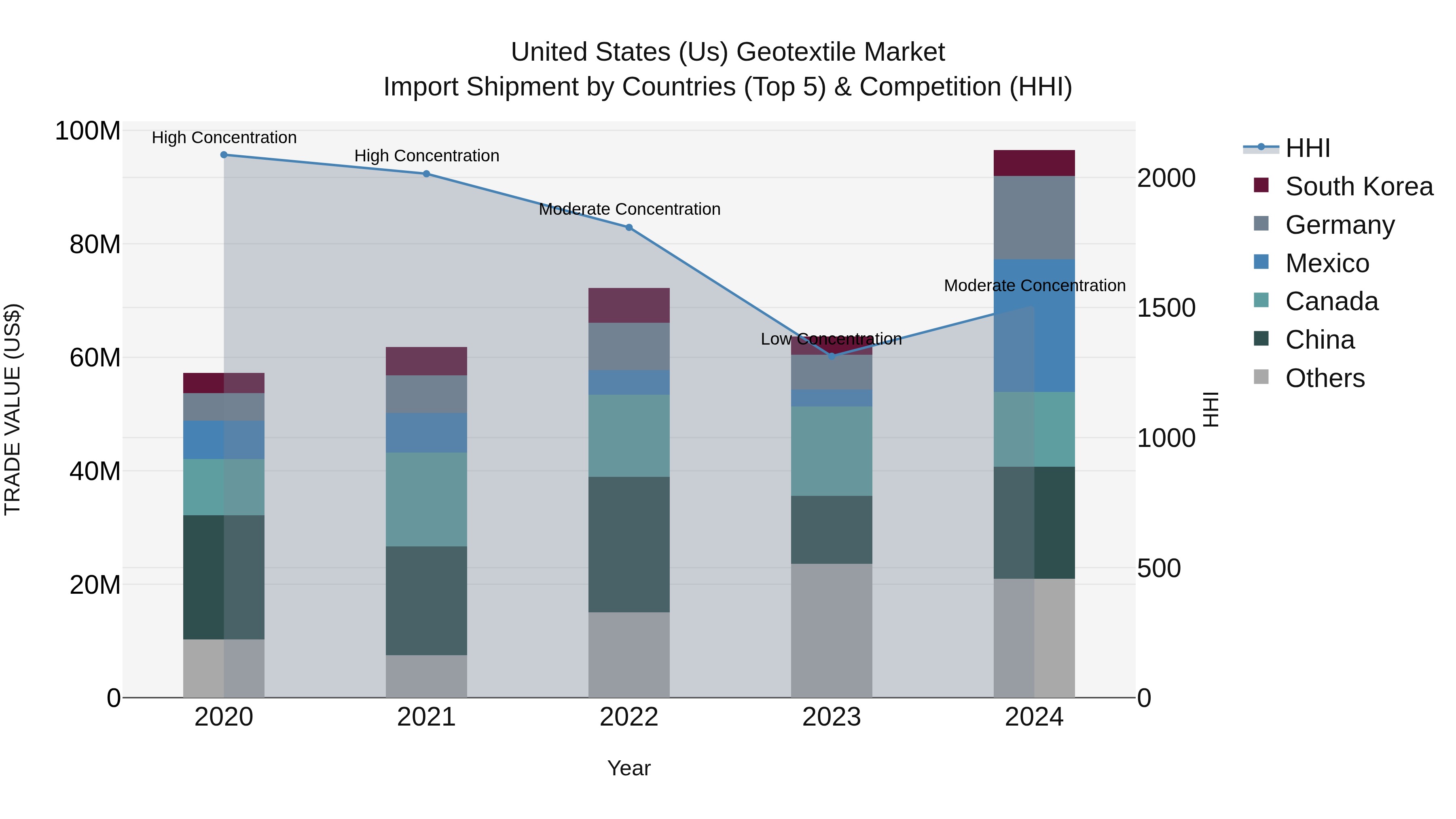
United States (US) Geotextile Market Synopsis
The United States geotextile market is experiencing steady growth driven by infrastructure development, environmental concerns, and increasing demand for sustainable construction materials. Geotextiles are widely used in road construction, erosion control, drainage systems, and other civil engineering applications. The market is characterized by the presence of key players such as TenCate Geosynthetics, GSE Environmental, and Propex Operating Company, among others, offering a variety of geotextile products to cater to diverse project requirements. Government initiatives promoting the use of geotextiles in infrastructure projects, coupled with the growing awareness about the benefits of geotextiles in improving construction durability and sustainability, are expected to further fuel market growth in the US. The market is also witnessing innovations in materials and technologies to enhance product performance and durability in challenging environmental conditions.
United States (US) Geotextile Market Trends
The US geotextile market is experiencing steady growth driven by increasing infrastructure development, particularly in transportation, construction, and environmental sectors. The rising demand for geotextiles can be attributed to their superior properties such as improved soil stabilization, erosion control, and drainage capabilities. With a growing focus on sustainable construction practices and environmental protection, geotextiles are being increasingly used in various applications. Opportunities in the US geotextile market include the development of innovative and high-performance geotextile materials, expansion into new application areas such as agriculture and mining, and the adoption of geosynthetic products in green infrastructure projects. Additionally, the market is witnessing a shift towards the use of recycled materials in geotextile production, aligning with the circular economy principles.
United States (US) Geotextile Market Challenges
In the US Geotextile Market, several challenges are prevalent. One key challenge is the varying regulations and standards across different states, leading to inconsistencies in product requirements and specifications. This can make it challenging for geotextile manufacturers to ensure compliance and meet the diverse needs of different regions. Another challenge is the competition from alternative materials in construction projects, as some developers may opt for traditional methods over geotextiles due to perceived cost or performance concerns. Additionally, the market faces pressure from fluctuations in raw material prices and supply chain disruptions, impacting production costs and overall market stability. To navigate these challenges successfully, companies in the US Geotextile Market must focus on innovation, regulatory compliance, and strategic partnerships to maintain a competitive edge and drive growth.
United States (US) Geotextile Market Investment Opportunities
The United States geotextile market is primarily driven by factors such as increasing infrastructure development projects, growing environmental concerns related to soil erosion and sediment control, and the rising demand for geotextiles in transportation and construction sectors. The use of geotextiles to improve soil stability, prevent erosion, and enhance drainage systems is driving market growth. Additionally, government initiatives promoting sustainable practices and regulations mandating the use of geotextiles in certain applications are further fueling market expansion. The development of advanced geotextile materials with improved durability, strength, and performance characteristics is also contributing to the market`s growth trajectory in the US.
United States (US) Geotextile Market Government Policie
Government policies related to the US geotextile market primarily focus on promoting the use of geotextiles in infrastructure projects to enhance sustainability and reduce environmental impact. The government has implemented regulations and standards, such as the Federal Highway Administration`s Geosynthetic Design and Construction Guidelines, to ensure the quality and performance of geotextile products used in construction projects. Additionally, government agencies provide funding and incentives for the research and development of innovative geotextile technologies that can address specific environmental challenges, like erosion control and soil stabilization. Overall, these policies aim to encourage the adoption of geotextiles in construction projects across various sectors, including transportation, environmental protection, and agriculture, to achieve long-term economic and environmental benefits.
United States (US) Geotextile Market Future Outlook
The United States geotextile market is poised for steady growth in the coming years due to increasing infrastructure development and construction activities. The market is expected to be driven by factors such as the rising demand for geotextiles in road construction, erosion control, environmental protection, and drainage applications. With a focus on sustainable construction practices and the need for efficient solutions to address environmental challenges, geotextiles are gaining importance in the US market. Technological advancements leading to the development of innovative and high-performance geotextile materials are also expected to propel market growth. Overall, the US geotextile market is likely to experience a positive trajectory, offering opportunities for manufacturers, suppliers, and stakeholders in the construction industry.
Key Highlights of the Report:
- United States (US) Geotextile Market Outlook
- Market Size of United States (US) Geotextile Market, 2024
- Forecast of United States (US) Geotextile Market, 2031
- Historical Data and Forecast of United States (US) Geotextile Revenues & Volume for the Period 2021 - 2031
- United States (US) Geotextile Market Trend Evolution
- United States (US) Geotextile Market Drivers and Challenges
- United States (US) Geotextile Price Trends
- United States (US) Geotextile Porter's Five Forces
- United States (US) Geotextile Industry Life Cycle
- Historical Data and Forecast of United States (US) Geotextile Market Revenues & Volume By Material Type for the Period 2021 - 2031
- Historical Data and Forecast of United States (US) Geotextile Market Revenues & Volume By Synthetic for the Period 2021 - 2031
- Historical Data and Forecast of United States (US) Geotextile Market Revenues & Volume By Natural for the Period 2021 - 2031
- Historical Data and Forecast of United States (US) Geotextile Market Revenues & Volume By Product Type for the Period 2021 - 2031
- Historical Data and Forecast of United States (US) Geotextile Market Revenues & Volume By Nonwoven for the Period 2021 - 2031
- Historical Data and Forecast of United States (US) Geotextile Market Revenues & Volume By Woven for the Period 2021 - 2031
- Historical Data and Forecast of United States (US) Geotextile Market Revenues & Volume By Knitted for the Period 2021 - 2031
- Historical Data and Forecast of United States (US) Geotextile Market Revenues & Volume By Application for the Period 2021 - 2031
- Historical Data and Forecast of United States (US) Geotextile Market Revenues & Volume By Road Construction for the Period 2021 - 2031
- Historical Data and Forecast of United States (US) Geotextile Market Revenues & Volume By Pavement Repair for the Period 2021 - 2031
- Historical Data and Forecast of United States (US) Geotextile Market Revenues & Volume By Erosion for the Period 2021 - 2031
- Historical Data and Forecast of United States (US) Geotextile Market Revenues & Volume By Drainage for the Period 2021 - 2031
- Historical Data and Forecast of United States (US) Geotextile Market Revenues & Volume By Railway Work for the Period 2021 - 2031
- Historical Data and Forecast of United States (US) Geotextile Market Revenues & Volume By Agriculture for the Period 2021 - 2031
- United States (US) Geotextile Import Export Trade Statistics
- Market Opportunity Assessment By Material Type
- Market Opportunity Assessment By Product Type
- Market Opportunity Assessment By Application
- United States (US) Geotextile Top Companies Market Share
- United States (US) Geotextile Competitive Benchmarking By Technical and Operational Parameters
- United States (US) Geotextile Company Profiles
- United States (US) Geotextile Key Strategic Recommendations






































