United States Glass Market Growth Rate Analysis (2025 - 2031)
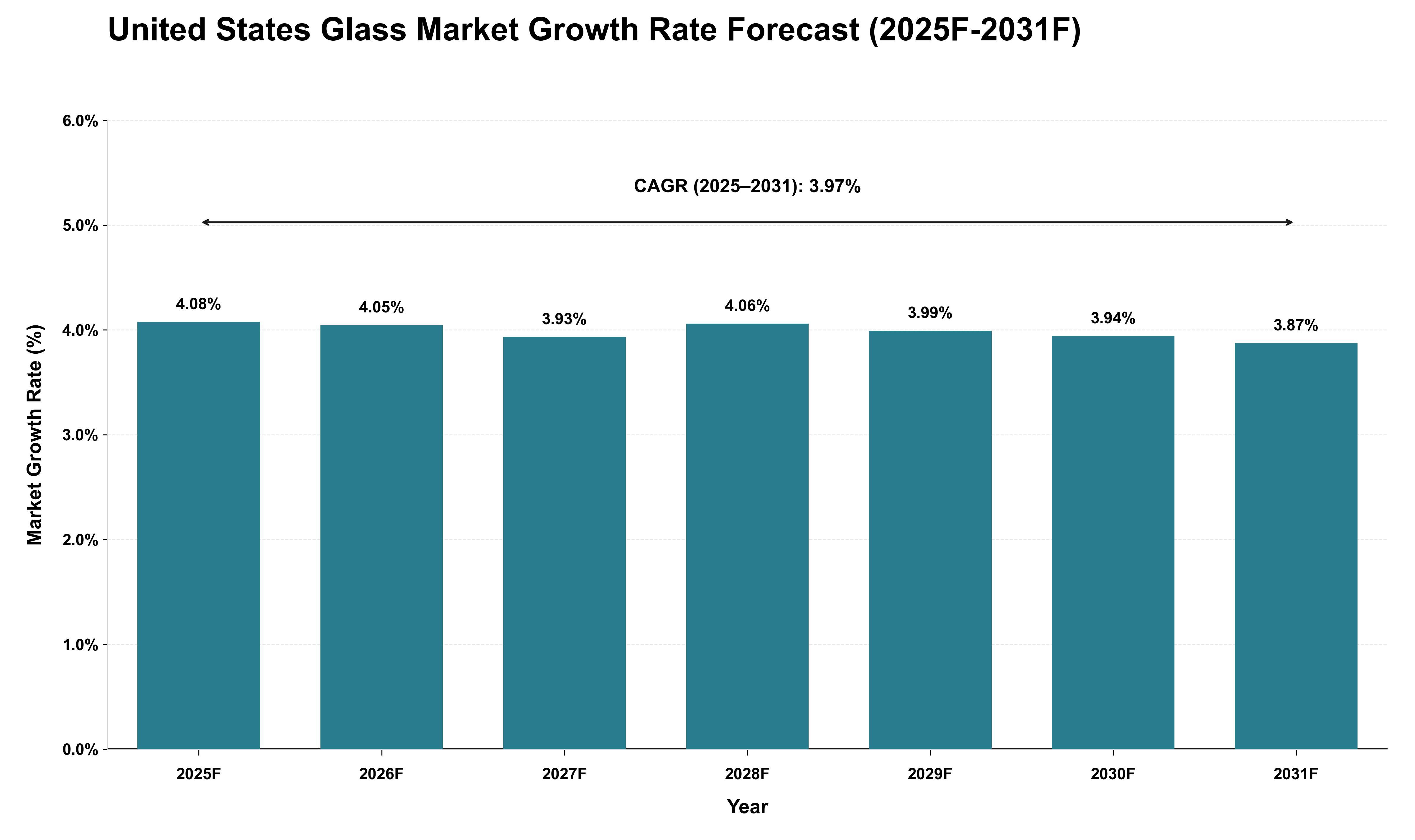
The United States glass market is projected to experience a compound annual growth rate of 3.97% from 2025 to 2031, reflecting a steady demand driven by technological advancements and product substitution dynamics. As industries increasingly adopt energy-efficient and sustainable glass solutions, the market will likely witness a shift towards innovative applications, particularly in construction and automotive sectors. The anticipated annual growth rates, peaking at 4.08% in 2025 and gradually tapering to 3.87% by 2031, suggest that while demand remains robust, it will be influenced by cyclical economic factors such as fluctuations in construction activity and consumer spending patterns. Additionally, import dependencies on raw materials may introduce volatility in pricing structures, further impacting growth trajectories. Overall, the interplay of these macroeconomic elements will shape the competitive landscape of the glass market during this forecast period.
Key Highlights of the Report:
- United States (US) Glass Market Outlook
- Market Size of United States (US) Glass Market, 2025
- Forecast of United States (US) Glass Market, 2032
- Historical Data and Forecast of United States (US) Glass Revenues & Volume for the Period 2022 - 2032F
- United States (US) Glass Market Trend Evolution
- United States (US) Glass Market Drivers and Challenges
- United States (US) Glass Price Trends
- United States (US) Glass Porter's Five Forces
- United States (US) Glass Industry Life Cycle
- Historical Data and Forecast of United States (US) Glass Market Revenues & Volume By Product Types for the Period 2022 - 2032F
- Historical Data and Forecast of United States (US) Glass Market Revenues & Volume By Basic for the Period 2022 - 2032F
- Historical Data and Forecast of United States (US) Glass Market Revenues & Volume By Tempered for the Period 2022 - 2032F
- Historical Data and Forecast of United States (US) Glass Market Revenues & Volume By Laminated for the Period 2022 - 2032F
- Historical Data and Forecast of United States (US) Glass Market Revenues & Volume By Insulated for the Period 2022 - 2032F
- Historical Data and Forecast of United States (US) Glass Market Revenues & Volume By Others for the Period 2022 - 2032F
- Historical Data and Forecast of United States (US) Glass Market Revenues & Volume By Applications for the Period 2022 - 2032F
- Historical Data and Forecast of United States (US) Glass Market Revenues & Volume By Architectural for the Period 2022 - 2032F
- Historical Data and Forecast of United States (US) Glass Market Revenues & Volume By Automotive & transportation for the Period 2022 - 2032F
- Historical Data and Forecast of United States (US) Glass Market Revenues & Volume By Others for the Period 2022 - 2032F
- Historical Data and Forecast of United States (US) Glass Market Revenues & Volume By Technology Types for the Period 2022 - 2032F
- Historical Data and Forecast of United States (US) Glass Market Revenues & Volume By Float for the Period 2022 - 2032F
- Historical Data and Forecast of United States (US) Glass Market Revenues & Volume By Rolled for the Period 2022 - 2032F
- Historical Data and Forecast of United States (US) Glass Market Revenues & Volume By Sheet for the Period 2022 - 2032F
- United States (US) Glass Import Export Trade Statistics
- Market Opportunity Assessment By Product Types
- Market Opportunity Assessment By Applications
- Market Opportunity Assessment By Technology Types
- United States (US) Glass Top Companies Market Share
- United States (US) Glass Competitive Benchmarking By Technical and Operational Parameters
- United States (US) Glass Company Profiles
- United States (US) Glass Key Strategic Recommendations






































