United States (US) Hyperscale Data Center Market Size & Growth Rate (2026-2032)
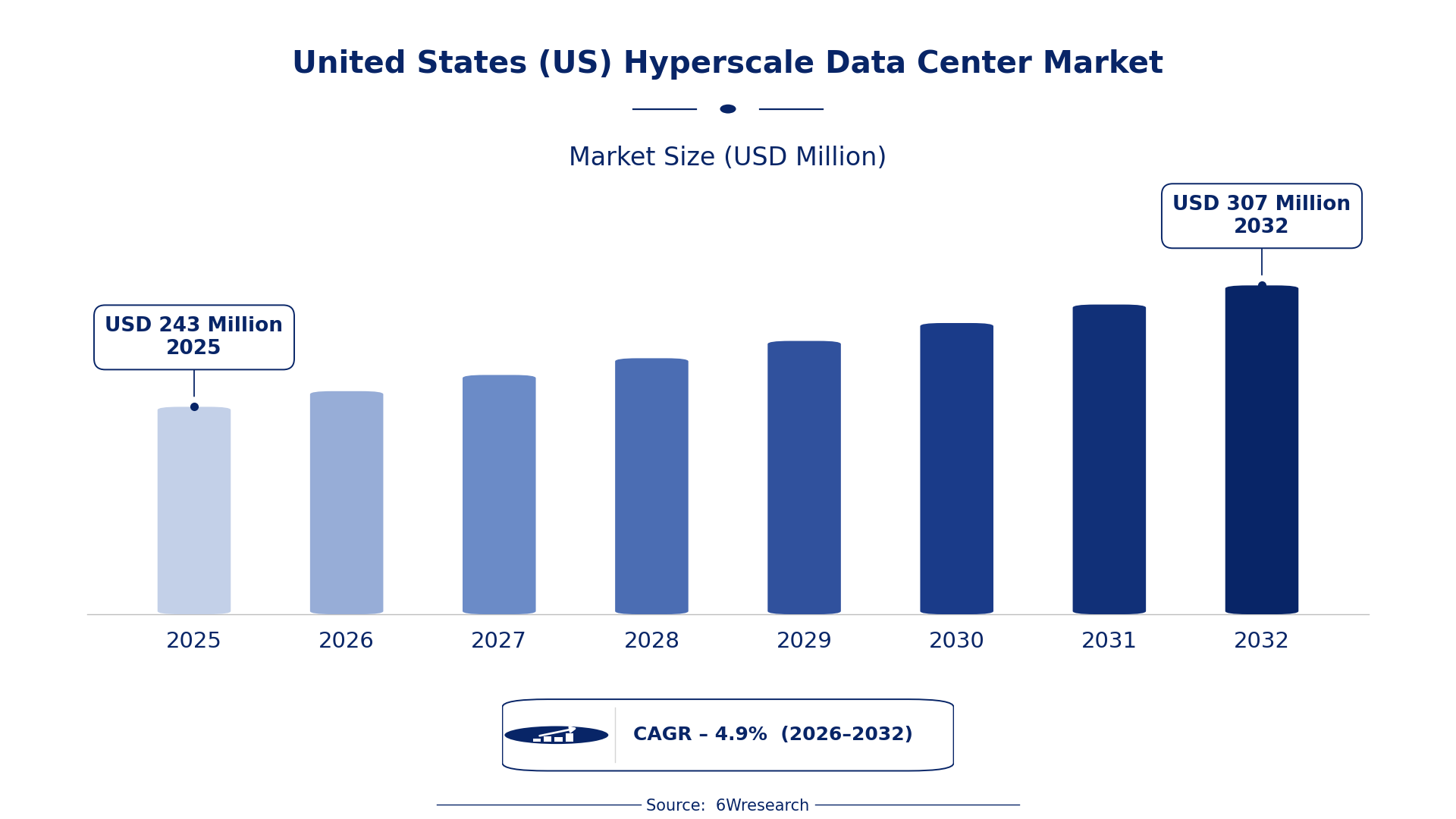
The United States (US) Hyperscale Data Center Market was estimated at USD 243 Million in 2025 and is projected to reach USD 307 Million by 2032, growing at a CAGR of 4.9% from 2026 to 2032.
United States (US) Hyperscale Data Center Market Synopsis
In recent years, the US hyperscale data center market has surged, propelled by the growing demand for cloud services, big data analytics, and the increasing reliance on IoT technologies. This momentum is expected to continue, but the market is also preparing for a shift toward more energy-efficient and secure infrastructures.
As businesses embrace digital transformation, the need for scalability and high-performance computing will drive further investment in hyperscale facilities. However, challenges such as land and power costs, alongside cybersecurity threats, will necessitate strategic planning for future developments.
United States (US) Hyperscale Data Center Market Year-wise Growth Rate and Key Drivers
This graph illustrates the annual growth rates of the United States (US) Hyperscale Data Center Market from 2021 to 2032, highlighting a steady upward trajectory and projected expansion over the forecast period.
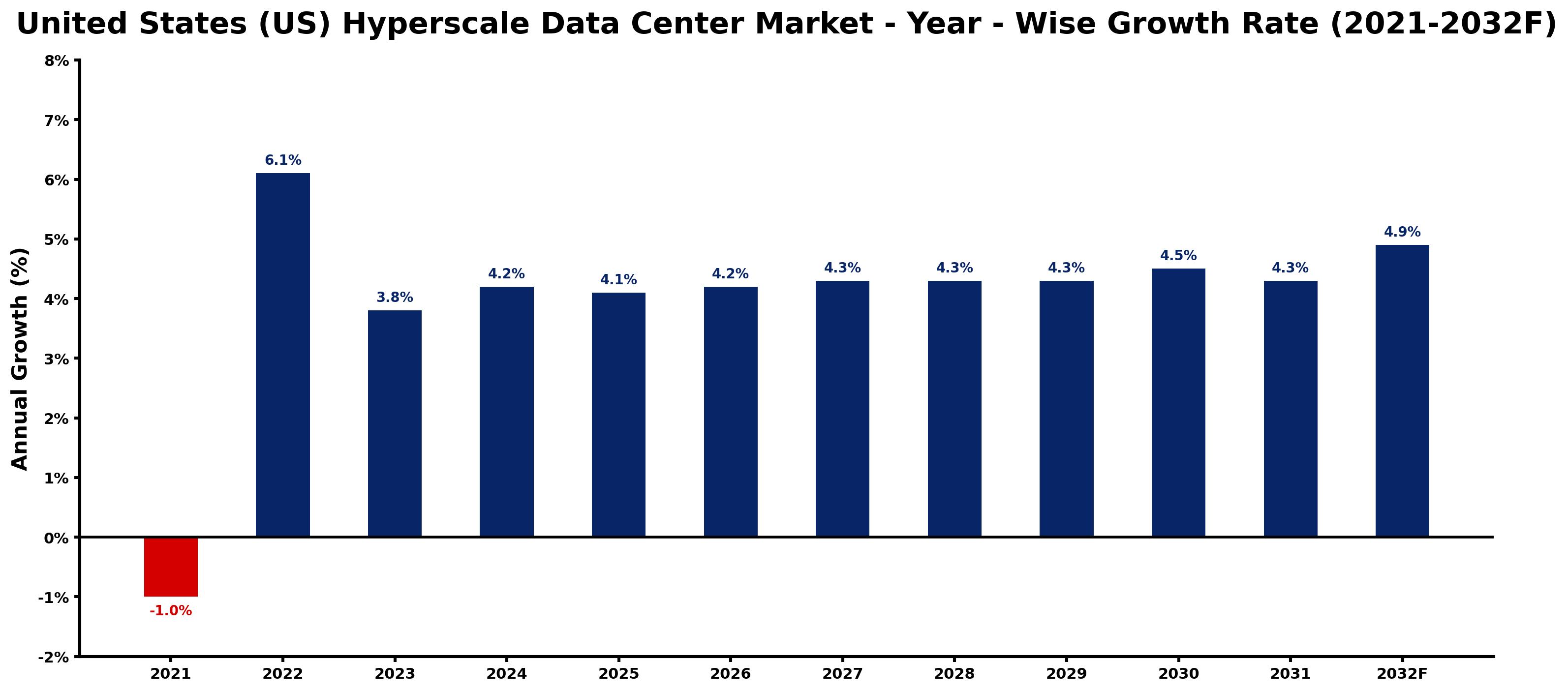
The table below presents the year‑wise growth rates along with the key drivers influencing the market
| Year | Growth Rate | Major Drivers |
| 2021 | -1.0% | Increased energy costs from Federal Energy Regulatory Commission changes. |
| 2022 | 6.1% | Federal tax incentives for renewable energy in data centers. |
| 2023 | 3.8% | Regulatory support for green technology adoption in IT. |
| 2024 | 4.2% | State-level initiatives encouraging sustainable data practices. |
| 2025 | 4.1% | Increased enterprise migration to cloud-based solutions. |
| 2026 | 4.2% | Emerging AI applications driving higher processing demand. |
| 2027 | 4.3% | Evolving cybersecurity regulations boosting data protection investments. |
| 2028 | 4.3% | Local government partnerships fostering tech ecosystem growth. |
| 2029 | 4.3% | Telecom advancements supporting edge computing deployment. |
| 2030 | 4.5% | Enhanced broadband access facilitating data center expansion. |
| 2031 | 4.3% | Increased energy efficiency mandates for technology infrastructure. |
| 2032 | 4.9% | Growing hybrid cloud adoption among enterprises. |
Note: Market size estimations and growth projections presented in this report are based on 6Wresearch's proprietary forecasting methodology, utilizing the latest available industry data, government publications, and primary research inputs.
United States (US) Hyperscale Data Center Market Key Takeaways
Below are some of the specific key takeaways from the market, including:
- Demand for cloud services and big data analytics is a primary growth driver.
- Energy-efficient designs and modular data centers are increasingly favored for new developments.
- Cybersecurity measures are becoming critical as data breaches rise.
- The market is adapting to the shift towards edge computing to meet low-latency demands.
- Investment opportunities abound in advanced technologies and infrastructure expansions.
Evaluation of Restraints in United States (US) Hyperscale Data Center Market
The US hyperscale data center market faces notable restraints that could hinder its growth. One major concern is the high cost of land and energy in key metropolitan areas, which can escalate operational expenses for providers. Additionally, the rapid increase in data volumes and the constant need for technological upgrades challenge efficiency and scalability. Cybersecurity threats also loom large, as the risk of data breaches requires continuous investment in protective measures. Lastly, a shortage of skilled professionals in data center operations further complicates the industry's ability to meet surging demand.
United States (US) Hyperscale Data Center Market Trends
The current trends within the US hyperscale data center market highlight a push towards sustainability and efficiency. Companies are increasingly adopting energy-efficient practices to mitigate operational costs and environmental impact. Modular designs are gaining traction, offering flexibility as business needs evolve. There's also a rising emphasis on edge computing, driven by the necessity for rapid data processing and localization. Alongside these trends, cybersecurity remains a paramount focus, as organizations work to safeguard sensitive information from emerging threats.
United States (US) Hyperscale Data Center Market Opportunities
The market is rife with investment opportunities, particularly in the development of new hyperscale facilities and the modernization of existing infrastructures. As demand for cloud services and IoT adoption accelerates, there is a pressing need for reliable data storage and processing capabilities. Investing in advanced technologies such as AI and edge computing is crucial for enhancing the operational efficiency of data centers. These factors create a fertile ground for investors looking to capitalize on the growing digital economy.
Government Initiatives in the United States (US) Hyperscale Data Center Market
Government policies are significantly shaping the US hyperscale data center market, focusing on data privacy, security, and sustainability. Regulatory frameworks are evolving to support the industry's growth while ensuring compliance with environmental standards. The government's involvement is critical for fostering innovation and maintaining competitive market dynamics.
- A recently completed initiative saw the introduction of guidelines by the Federal Trade Commission (FTC) to enhance data protection measures across the sector.
- Currently ongoing are efforts by the Department of Energy (DOE) to promote energy efficiency in data centers, providing best practice frameworks for operators.
- Planned initiatives include a public-private partnership aimed at expanding digital infrastructure access in underserved regions, projected to launch in 2026.
- Tax incentives are being introduced to encourage the establishment of new data centers in specific regions, stimulating local economies.
- Regulatory bodies are working on frameworks to ensure transparency in data center operations, slated for rollout by late 2025.
Future Insights of the United States (US) Hyperscale Data Center Market
Looking ahead to 2026-2032, the US hyperscale data center market is expected to maintain a trajectory of strong growth driven by the relentless demand for cloud computing, AI, and big data capabilities. As organizations continue to invest in digital transformation, hyperscale facilities will play a crucial role in supporting operational efficiencies. The anticipated expansion of edge computing will also influence infrastructure development, as businesses seek to reduce latency and improve service delivery. With continued investments in technology and infrastructure, the market's future appears bright.
United States (US) Hyperscale Data Center Market Latest Developments
In the past year, the US hyperscale data center market has witnessed several noteworthy developments reflecting the industry's response to growing demands. Operators are increasingly focusing on energy efficiency and cybersecurity to stay competitive in a rapidly evolving environment.
- A major technology vendor announced the launch of a cutting-edge modular data center prototype in Q1 2023, designed for enhanced scalability and energy efficiency.
- An initiative that began in early 2023 is currently underway, focusing on upgrading existing data center infrastructures to improve operational efficiencies.
- A leading regional operator is expected to break ground on a new hyperscale facility by mid-2024, designed to support rising cloud service demands.
- A partnership formed in late 2022 between several industry players is now implementing advanced cybersecurity protocols across multiple data centers.
- Looking ahead, a rollout of next-generation cooling technologies is planned for 2025, aimed at reducing energy consumption in data center operations.
United States (US) Hyperscale Data Center Market - Key Attractiveness of the Report
- 10 Years of Market Numbers
- Historical Data Starting from 2022 to 2025
- Base Year: 2025
- Forecast Data until 2032
- Key Performance Indicators Impacting the Market
- Major Upcoming Developments and Projects
Key Highlights of the Report:
- United States (US) Hyperscale Data Center Market Outlook
- Market Size of United States (US) Hyperscale Data Center Market, 2025
- Forecast of United States (US) Hyperscale Data Center Market, 2032
- Historical Data and Forecast of United States (US) Hyperscale Data Center Revenues & Volume for the Period 2022-2032F
- United States (US) Hyperscale Data Center Market Trend Evolution
- United States (US) Hyperscale Data Center Market Drivers and Challenges
- United States (US) Hyperscale Data Center Price Trends
- United States (US) Hyperscale Data Center Porter's Five Forces
- United States (US) Hyperscale Data Center Industry Life Cycle
- Historical Data and Forecast of United States (US) Hyperscale Data Center Market Revenues & Volume By Solution for the Period 2022-2032F
- Historical Data and Forecast of United States (US) Hyperscale Data Center Market Revenues & Volume By Server for the Period 2022-2032F
- Historical Data and Forecast of United States (US) Hyperscale Data Center Market Revenues & Volume By Storage for the Period 2022-2032F
- Historical Data and Forecast of United States (US) Hyperscale Data Center Market Revenues & Volume By Networking for the Period 2022-2032F
- Historical Data and Forecast of United States (US) Hyperscale Data Center Market Revenues & Volume By Software for the Period 2022-2032F
- Historical Data and Forecast of United States (US) Hyperscale Data Center Market Revenues & Volume By Service for the Period 2022-2032F
- Historical Data and Forecast of United States (US) Hyperscale Data Center Market Revenues & Volume By Consulting for the Period 2022-2032F
- Historical Data and Forecast of United States (US) Hyperscale Data Center Market Revenues & Volume By Installation and deployment for the Period 2022-2032F
- Historical Data and Forecast of United States (US) Hyperscale Data Center Market Revenues & Volume By Maintenance and support for the Period 2022-2032F
- Historical Data and Forecast of United States (US) Hyperscale Data Center Market Revenues & Volume By End-User for the Period 2022-2032F
- Historical Data and Forecast of United States (US) Hyperscale Data Center Market Revenues & Volume By Cloud providers for the Period 2022-2032F
- Historical Data and Forecast of United States (US) Hyperscale Data Center Market Revenues & Volume By Colocation providers for the Period 2022-2032F
- Historical Data and Forecast of United States (US) Hyperscale Data Center Market Revenues & Volume By Enterprises for the Period 2022-2032F
- Historical Data and Forecast of United States (US) Hyperscale Data Center Market Revenues & Volume By Data Center Size for the Period 2022-2032F
- Historical Data and Forecast of United States (US) Hyperscale Data Center Market Revenues & Volume By Small and medium-sized data centers for the Period 2022-2032F
- Historical Data and Forecast of United States (US) Hyperscale Data Center Market Revenues & Volume By Large data centers for the Period 2022-2032F
- Historical Data and Forecast of United States (US) Hyperscale Data Center Market Revenues & Volume By Industry for the Period 2022-2032F
- Historical Data and Forecast of United States (US) Hyperscale Data Center Market Revenues & Volume By Banking, Financial Services, and Insurance (BFSI) for the Period 2022-2032F
- Historical Data and Forecast of United States (US) Hyperscale Data Center Market Revenues & Volume By IT and telecom for the Period 2022-2032F
- Historical Data and Forecast of United States (US) Hyperscale Data Center Market Revenues & Volume By Research and academics for the Period 2022-2032F
- Historical Data and Forecast of United States (US) Hyperscale Data Center Market Revenues & Volume By Government and defense for the Period 2022-2032F
- Historical Data and Forecast of United States (US) Hyperscale Data Center Market Revenues & Volume By Retail for the Period 2022-2032F
- Historical Data and Forecast of United States (US) Hyperscale Data Center Market Revenues & Volume By Manufacturing for the Period 2022-2032F
- Historical Data and Forecast of United States (US) Hyperscale Data Center Market Revenues & Volume By Healthcare for the Period 2022-2032F
- Historical Data and Forecast of United States (US) Hyperscale Data Center Market Revenues & Volume By Media and entertainment for the Period 2022-2032F
- United States (US) Hyperscale Data Center Import Export Trade Statistics
- Market Opportunity Assessment By Solution
- Market Opportunity Assessment By Service
- Market Opportunity Assessment By End-User
- Market Opportunity Assessment By Data Center Size
- Market Opportunity Assessment By Industry
- United States (US) Hyperscale Data Center Top Companies Market Share
- United States (US) Hyperscale Data Center Competitive Benchmarking By Technical and Operational Parameters
- United States (US) Hyperscale Data Center Company Profiles
- United States (US) Hyperscale Data Center Key Strategic Recommendations






































